by COWBERRY

10 minute read
Pink salt (sendha namak): names, benefits and how to use it

Pink salt is sendha namak — the pink rock salt of Indian vrat kitchens, one of the two rock salts the Dietary Guidelines for Indians name, and the one the guidelines place among the purest forms of salts. This hub gathers the salt's names, nutrition, benefits, side effects, storage and buying guide, each part linking to its own page.
What is pink salt?
Pink salt is the pink rock salt Indian kitchens know as sendha namak — one of the two rock salts the Dietary Guidelines for Indians name, with black salt (kala namak) as the other, and the one the same guidelines place among the purest forms of salts. The two rock salts are told apart by colour, texture and smell, and they lead different kitchen lives: the pink jar seasons vrat food, while the dark one is kept for chaats and fruit. The guidelines also set rock salt apart from the common refined and non-refined salts, listing it for specific recipes or occasions. Like every salt, pink salt traces back to sea salt — ICMR-NIN notes that technically all salt comes from sea salt — and the pink salt sold as himalayan salt carries the origin in the name. What it is made of, step by step, is on how rock salt is formed.
Pink salt names: sendha namak, rock salt, Himalayan salt
Three names travel on the same salt. Pink salt names the colour; rock salt is the English name of the family; sendha namak is the Hindi name the guidelines print as the pair — pink salt (sendha namak). A fourth, Himalayan salt, names the origin, and kala namak is not another name for this salt but the second, different rock salt. The name record is thin: the one food-names record for this salt in USDA FoodData Central carries only the English "Salt, table", while the Hindi name the guidelines print is sendha namak. The table below holds the two English names public sources print. The guidelines' own pairing settles it — pink salt is sendha namak, the purest-form line sits with the pink one, and any pack that states the origin plainly is telling the same story. The wider name story — language by language — is on rock salt in hindi.
| Language | Name (romanised) |
|---|---|
| English | Salt, table, Rock salt, Pink salt |
| Hindi | — |
| Marathi | — |
| Gujarati | — |
| Punjabi | — |
| Bengali | — |
| Odia | — |
| Assamese | — |
| Kannada | — |
| Telugu | — |
| Tamil | — |
| Malayalam | — |
| Urdu | — |
| Sanskrit | — |
| Botanical name | — |
Source: USDA FoodData Central record 173468 (English and scientific name only; no Indian-language names in source). — means no name recorded in the source.
English ‘Rock salt’: Wikipedia: Himalayan salt. English ‘Pink salt’: Wikipedia: Himalayan salt.
Pink salt nutrition per 100 g
The food-composition records keep one figure for pink salt: 38800 mg of sodium per 100 g, because no pink-salt entry exists in IFCT 2017 or USDA FoodData Central, so the figure is USDA's table-salt value standing in. Every other line stays blank because neither IFCT 2017 nor USDA FoodData Central prints a value, and the blank itself is information. One scale note: 100 g of salt is a big pile — the day's cap is 5 g, so the figure is best read through the teaspoon.
| Nutrient | Per 100 g | Source of the figure |
|---|---|---|
| Sodium | 38800 mg | USDA table-salt value, used as a stand-in |
| Calories | None | Blank in IFCT 2017 and USDA FoodData Central |
| Protein, fat, carbs, fibre | None | Blank in IFCT 2017 and USDA FoodData Central |
| Minerals (calcium, iron, magnesium, potassium, zinc) | None | Blank in IFCT 2017 and USDA FoodData Central |
| Glycemic index | Does not apply | GI covers carbohydrate foods |
A blank line means no figure exists to quote, not that the salt holds none of that nutrient. In the kitchen the number that matters is the teaspoon: 1940 mg of sodium in one level teaspoon of 5 g, against the day's cap of one teaspoon. The per-teaspoon walk-through and the 2020 Australian mineral scan live on rock salt nutritional value per 100g.
Pink salt benefits
The benefits record is short, and the hub says it in one paragraph, with the three claims the sources support. One body role: sodium works with potassium to keep the body's water and fluid balance and electrolyte equilibrium, with the electrophysiological functions of every cell in the same job (ICMR-NIN) — the single health role the guidelines give any salt, pink or white. One kitchen role: rock salt is kept for specific recipes or occasions; in Indian homes the occasion is the vrat — kuttu roti, sabudana khichdi, the fast-day curry. One colour story: salt often carries trace minerals such as magnesium, calcium and iron (ICMR-NIN), but the 2020 scan of 31 pink salts bought in Australia, covering 25 nutrients and non-nutritive minerals, put the meaningful line at over 30 g a day, about six teaspoons — far past the day's cap. The claims with no source behind them are named plainly on rock salt benefits, and the same story in Hindi is on rock salt khane ke fayde.
Pink salt side effects: who should limit it
Side effects run through sodium, and the guidelines are clear on them: high salt intake is tied in the guidelines to high blood pressure, plus related vascular and heart diseases; high intake may also raise the risk of stomach cancer, and excessive salt can disturb the stomach mucosa and raise the risk of gastritis and atrophy; and higher sodium means greater calcium excretion, which may reduce bone density. Pink salt is not exempt from any of this — the sodium across the varieties is almost similar (ICMR-NIN). One quality note: a sample in the 2020 Australian scan carried lead above the national limit of 2 mg per kg. On iodine, the records are simply silent: neither IFCT 2017 nor USDA FoodData Central prints an iodine figure for rock salt, and the WHO's iodization guideline covers food-grade table salt, which is why the guidelines say use iodized salt. The cap that contains all of this is 5 g of added salt a day — one level teaspoon — whichever variety sits in the jar, and a 2017 survey of 1395 people measured the day's salt at 8.59 g and 9.46 g in its two regions — already above it. Anyone taking medicines for blood pressure, heart or kidney conditions should ask their doctor. The full list with sources is on the rock salt benefits page.
Pink salt vs black salt, table salt and sendha namak
Three versus questions, three answers in a line. Pink salt vs sendha namak: no contest at all — sendha namak is the Hindi name of the same pink salt, and the guidelines print the pair themselves. Pink salt vs black salt: two different rock salts, told apart by colour, texture and smell; black salt is preserved with assorted spices, charcoal, seeds and tree bark, and it is the dark salt kept for chaats and fruit. Pink salt vs table salt: same sodium, almost similar (ICMR-NIN), different jobs — the pink jar for vrat days, the iodized everyday jar for the rest, the everyday form finely ground with an anti-caking agent. Common salt is sold refined and unrefined, at 99 and 96 percent purity respectively (ICMR-NIN), while the pink salt is the occasion salt. The full side-by-sides: is rock salt and sendha namak the same, rock salt against black salt and rock salt against normal salt.
How to cook with pink salt
Pink salt's home ground is the vrat kitchen: it goes into the kuttu roti dough, the sabudana khichdi and the fast-day curry, and it finishes chaas and raita the way any salt would, while the everyday table salt waits out the fast. The crystals tend to come coarse, so crush them just before use — a mortar or a quick grind — since vrat doughs and khichdis take the fine powder more evenly. Two habits keep it simple: salt the cooking lightly and taste before adding more at the table, and count namkeen and papads in the day's total, because the cap stays one teaspoon whether the day is a vrat day or not. On ordinary days the same salt works in dal and chaas; only the jar changes, not the cap. The vrat rules around the pink jar live on why sendha namak is used in fast.
Pink salt recipes
Two vrat staples carry the pink salt best: Kuttu roti, the buckwheat flatbread that is the fast-day constant, and Kuttu khichdi, the one-pot fast-day meal. Both season with sendha namak the vrat way — lightly, within the day's teaspoon — and both take the salt naturally, in the dough and in the pot. More ways to cook with the vrat grain are gathered on buckwheat recipes.
How to store and buy pink salt
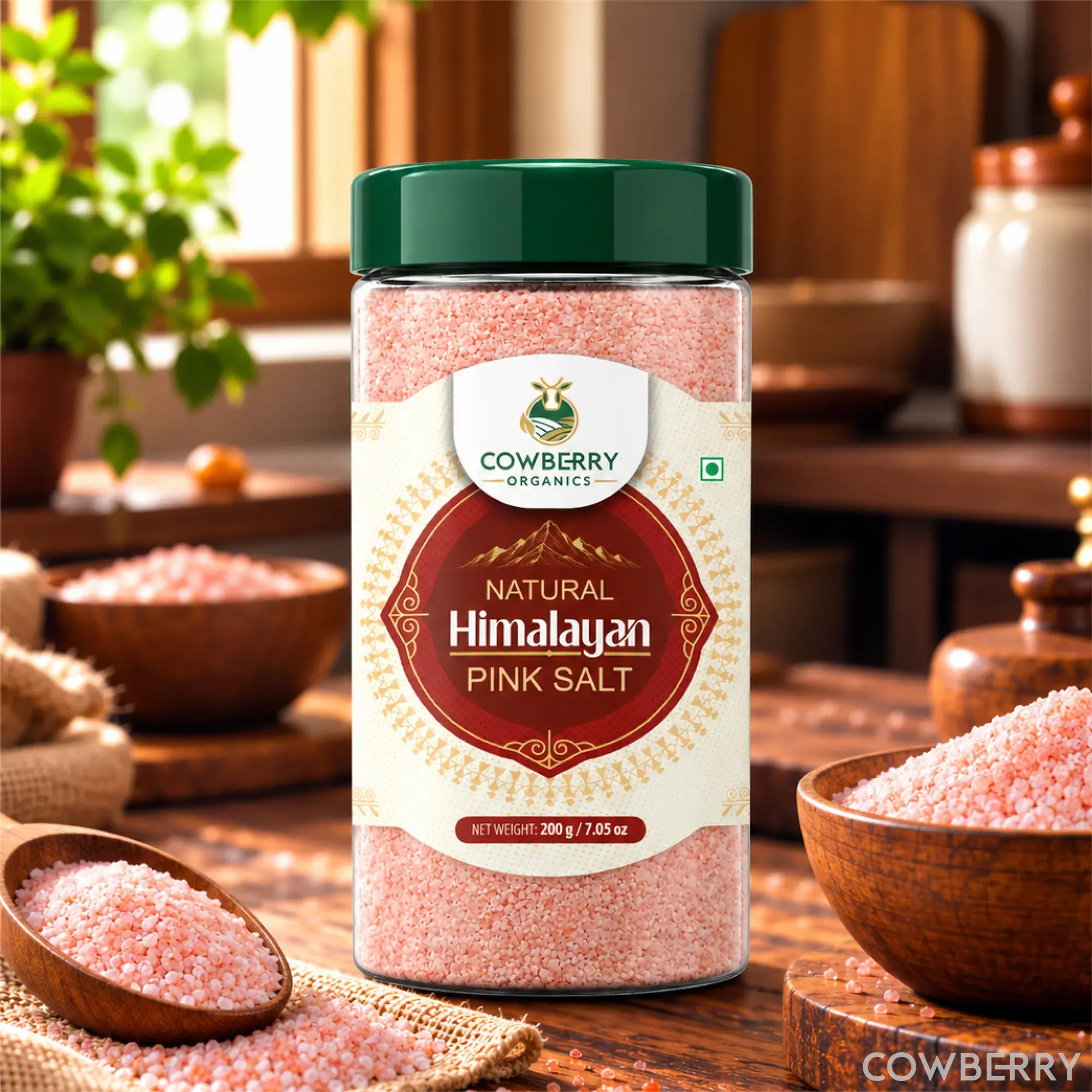
Storage is simple: keep the jar dry and shut — a dry spoon, an airtight lid, and a place away from steam. Salt keeps, but it drinks moisture, and once it clumps the jar shakes and measures poorly, so the lid and the dry spoon do the real work. The guidelines' one storage note is about the other rock salt: black salt grows darker on storage (ICMR-NIN). Buying is simple too, with two checks. The pack should state the origin plainly — the Himalayas for this salt — and it should be sold as natural salt. COWBERRY's natural himalayan pink salt is the pink rock salt sold under the origin name. A last buying point: the pink jar is not a medicine and not a low-sodium swap — the label should say salt, and the cap stays one teaspoon. Beyond that, choose by use: the pink jar for vrat cooking, the iodized everyday jar for the rest, and both within the same 5 g cap.
FAQs
What is sendha namak?
Sendha namak is the Hindi name of pink rock salt, the salt the Dietary Guidelines for Indians pair as pink salt (sendha namak) and place among the purest forms of salts. It is the salt Indian homes reach for on vrat days, while black salt (kala namak) is the other rock salt, told apart by colour, texture and smell.
What is rock salt?
Rock salt is the English name for a family of two salts: pink salt (sendha namak) and black salt (kala namak), told apart by colour, texture and smell (ICMR-NIN). The pink one is the salt of vrat cooking; the dark one is the salt kept for chaats and fruit, preserved with spices, charcoal, seeds and tree bark.
Why rock salt is pink in colour?
None of the sources in the references explains the chemistry of the pink colour, so none is given. The record does pin one colour fact: the 2020 Australian scan coded colour intensity and found darker-coloured pink salt generally higher in minerals, with wide variation sample to sample — though the amounts stay below any meaningful daily contribution at the day's salt cap.
Can we eat sendha namak daily?
Yes — sendha namak can season any day's food, so long as the whole day's added salt stays at one level teaspoon, the 5 g cap (ICMR-NIN). It is not a lower-sodium salt — ICMR-NIN puts the sodium across varieties at almost similar — so eating it every day changes nothing about the cap; the iodized everyday jar keeps its job too.
Does rock salt contain iodine?
Rock salt carries no iodine figure in IFCT 2017 or USDA FoodData Central, and the WHO's iodization guideline points iodine's home elsewhere: it covers fortifying food-grade table salt, and the guidelines keep saying use iodized salt. So the pink jar adds no iodine to a vrat day — the iodized everyday salt is where the iodine comes from.
Is rock salt and sendha namak same?
Yes: one salt, two languages. Sendha namak is Hindi for the pink rock salt — the pair the guidelines print themselves — with black salt (kala namak) as the second, different rock salt. The sodium number behind the two names is one: 38800 mg per 100 g, with the 5 g a day cap applying whichever name you use.
References
- Indian Food Composition Tables (IFCT) 2017, ICMR-National Institute of Nutrition
- Dietary Guidelines for Indians, ICMR-National Institute of Nutrition
- USDA FoodData Central
- Fayet-Moore F, Wibisono C, Carr P et al. An Analysis of the Mineral Composition of Pink Salt Available in Australia. Foods, 2020
- Johnson C, Mohan S, Rogers K et al. Mean Dietary Salt Intake in Urban and Rural Areas in India: A Population Survey of 1395 Persons. J Am Heart Assoc, 2017
- WHO guideline: fortification of food-grade salt with iodine for the prevention and control of iodine deficiency disorders (2014)
Shop this article
Keep reading
Coriander water benefits: what dhania water actually does
Peanuts in Hindi (moongfali): groundnut names in Indian languages
Coriander vs cilantro: are they the same herb?