by COWBERRY

6 minute read
How rock salt is formed: from sea water to sendha namak

How rock salt is formed: sea water evaporates and leaves salt behind — ICMR-NIN notes that technically all salt, table salt included, comes from sea salt. The pink rock salt sold in India as sendha namak comes from the Himalayas, and the journey from shop to vrat kitchen is below. Where the public record is thin, the page says so, told against the pink salt hub's other pages.
How rock salt is formed: the short answer
How rock salt is formed, in one paragraph: sea water evaporates and the salt dissolved in it is left behind as solid salt — technically all salt comes from sea salt, table salt included, as ICMR-NIN's guidelines put it plainly. The pink rock salt sold in Indian shops, sendha namak, carries its origin on the label: the Himalayas. The 2020 Australian study of 31 pink salts coded the origin of every sample and found the Himalayan-origin ones were generally the higher-mineral group. The sources cover formation, origin, the two types and what happens in the kitchen; they do not cover the mining process in detail, so this page does not invent one.
Rock salt made from: sea water, then the Himalayas
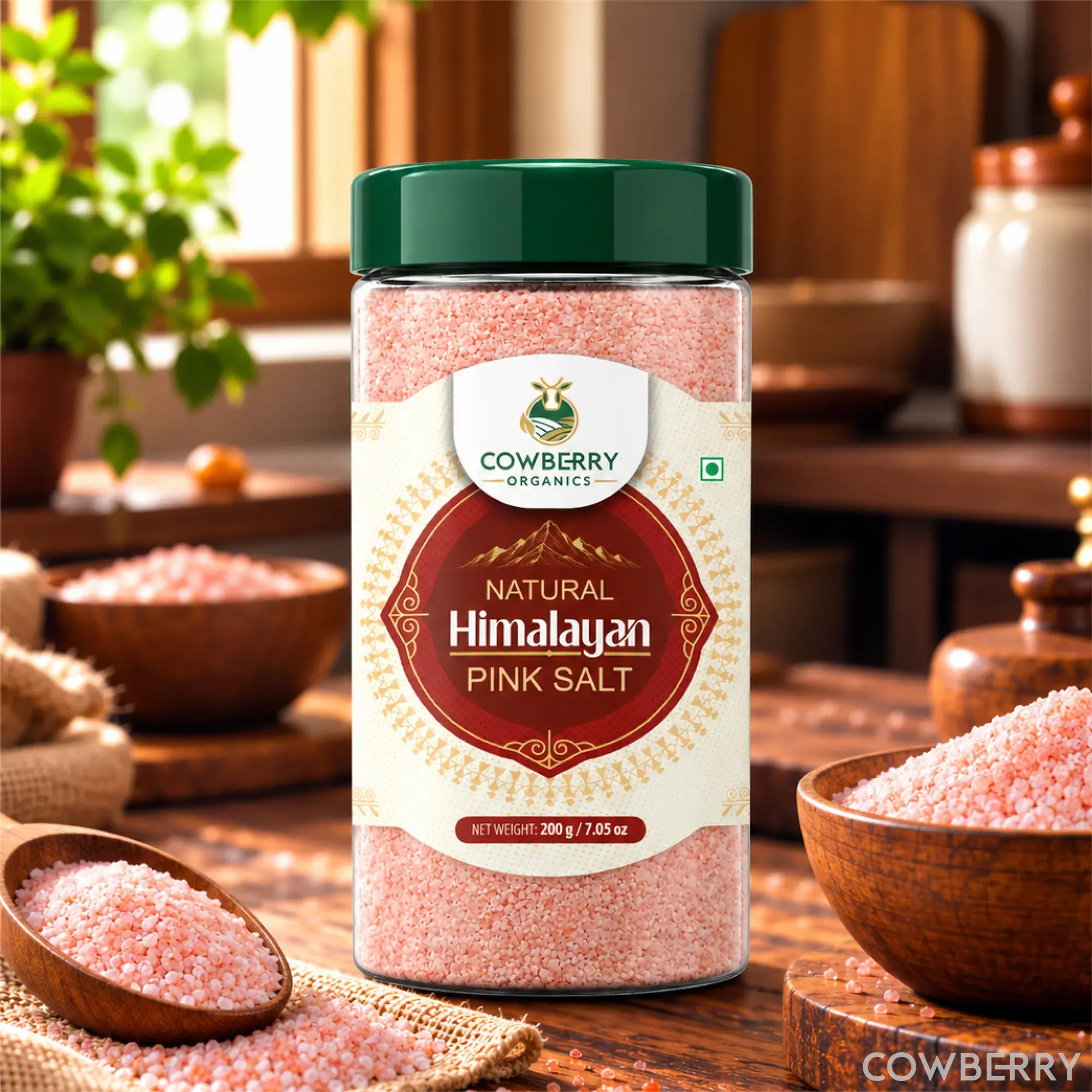
Rock salt is made from sea water in the simplest sense: water goes, salt stays. That is the line ICMR-NIN gives for every salt, table salt included. The salt is then sold in pieces rather than as the fine everyday salt — the Australian study notes the flake-form samples were generally among the higher-mineral ones — and the origin on the pack is the second fact: pink salt from the Himalayas. In that study, the samples that originated from the Himalayas were generally the higher-mineral group, and the same origin names COWBERRY's natural himalayan pink salt. One caution the study carries: mineral levels across the 31 samples varied widely, so pink salt is a family of salts, not one fixed recipe.
Rock salt extraction process: what the record shows
On the extraction side, the public record is thin, and this page says so rather than inventing steps. What the record does show: ICMR-NIN describes salt as available in two forms, refined and unrefined, consumed at 99 percent and 96 percent purity respectively. The 2020 Australian study describes its own method in full: 31 pink salts bought from Australian retail, each coded for origin, form and colour, then analysed for minerals — and that analysis is where the wide variation, the one sample above the Australian lead limit, and the over-30-g-a-day line for meaningful minerals all come from. For sendha namak in India specifically, no public record details an extraction process; the honest answer to how it is extracted is that the record does not say.
The two types of rock salt
The name covers two salts, and the guidelines pin them down: pink salt (sendha namak) and black salt (kala namak). The guidelines tell the two apart by colour, texture and smell; black salt is preserved with spices, charcoal, seeds and tree bark, and pink salt counts among the purest salt forms. One storage note from the same passage: black salt grows darker on storage. The two compared in full are on rock salt vs black salt.
Why sendha namak cannot be made at home (and what to do instead)
No home kitchen step makes rock salt — the salt forms in nature, and the kitchen's job starts at the shop. The steps a home cook actually follows: buy the pink salt, with the origin stated on the pack, like COWBERRY's natural Himalayan pink salt; crush the crystals as needed, a mortar or a quick spin in the grinder turning them into the powder vrat dishes want; measure with the day's cap in mind, 5 g or one level teaspoon (ICMR-NIN); and season the fast-day cooking — kuttu roti, sabudana khichdi, vrat curry — the way any salt would be used. That is the whole making of sendha namak at home: buying, crushing, measuring, cooking.
How to keep sendha namak at home
Salt keeps simply, and the rules are the same for pink and black: a dry spoon, an airtight jar, and a shelf away from steam. Salt does not spoil the way food does, but it drinks moisture, and a clumped jar is harder to shake and measure. The one sourced storage fact: black salt grows darker on storage (ICMR-NIN), so a darkening kala namak jar is the salt doing what the guidelines say, not a sign of a bad jar. The quantities that matter for rock salt in the kitchen:
| Measure | Quantity | Where it comes from |
|---|---|---|
| Day's cap for added salt | 5 g, one level teaspoon | ICMR-NIN |
| Sodium in one teaspoon | 1940 mg | Derived from the USDA table-salt value (38800 mg per 100 g) |
| Pink salt a day before minerals matter | More than 30 g, about six teaspoons | 2020 Australian study |
| Measured intake in two surveyed Indian regions | 8.59 g a day (Delhi and Haryana), 9.46 g a day (Andhra Pradesh) | 2017 survey |
Common mistakes with rock salt
Three mistakes to skip. First, expecting the minerals in a pinch: the Australian study puts the meaningful-mineral level at over 30 g of pink salt a day — about six teaspoons, well past the cap. Second, keeping the jar open or dipping a wet spoon: moisture clumps the salt and makes measuring uneven. Third, seeing sendha namak as the whole salt story: the sodium in the varieties is almost similar (ICMR-NIN), so the day's cap still applies, and the guidelines' advice to use iodized salt still stands. The pink salt hub has the salt's other pages.
FAQs
How rock salt is formed?
Sea water evaporates and leaves its salt behind; ICMR-NIN traces every salt, table salt included, back to sea salt. The pink rock salt sold in India, sendha namak, then carries the Himalayas as its origin on the pack.
What is sendha namak made of?
Salt — the same sodium chloride every salt is made of, with almost similar sodium across varieties (ICMR-NIN). No public food-composition record breaks sendha namak down further, so the sodium figure is the only composition number printed for it.
How sendha namak is made?
In nature, from sea water: evaporation leaves the salt behind (ICMR-NIN), and the pink salt's origin is the Himalayas, as coded in the 2020 Australian study and printed on packs. At home it is not made at all — only bought, crushed, measured and cooked with.
How to make sendha namak at home?
You cannot: no home process turns anything into rock salt, and the sources give no method. Buy the pink salt and crush its crystals in a mortar or grinder as a dish needs them — that is the home part.
How himalayan salt is made?
Himalayan salt is pink rock salt named for its origin, and it is made the way all salt is: sea water evaporates and leaves salt behind (ICMR-NIN). In the 2020 Australian study, the samples of Himalayan origin generally measured higher in minerals.
How rock salt is mined?
No public record prints a mining process for rock salt. What it does print: the salt's origin (the Himalayas, on the pack and in the Australian study), its two types, and its sodium.
References
- Dietary Guidelines for Indians, ICMR-National Institute of Nutrition
- Fayet-Moore F, Wibisono C, Carr P et al. An Analysis of the Mineral Composition of Pink Salt Available in Australia. Foods, 2020
- Johnson C, Mohan S, Rogers K et al. Mean Dietary Salt Intake in Urban and Rural Areas in India: A Population Survey of 1395 Persons. J Am Heart Assoc, 2017
- USDA FoodData Central
Shop this article
Keep reading
Coriander water benefits: what dhania water actually does
Peanuts in Hindi (moongfali): groundnut names in Indian languages
Coriander vs cilantro: are they the same herb?