by COWBERRY

6 minute read
Kabuli chana vs chickpeas: is it the same as chole or chana?

Chickpeas vs chana is a naming question, not a difference of species: kabuli chana is the white chickpea, chana is the word India uses for chickpeas, and chole is the dish made from them. Both whole types belong to Cicer arietinum. This page untangles the words and then compares kabuli chana with its dark twin kala chana, number by number, with the grain's own guide at the kabuli chana hub.
Verdict in three lines
Kabuli chana and chickpeas are the same food. Kabuli chana is the white, larger type of chickpea; the USDA's record for it reads chickpeas, garbanzo beans, bengal gram.
Chana is the Indian umbrella word for chickpeas, and IFCT 2017 prints it as the Hindi name of the dark desi type, Bengal gram, sold as kala chana.
Chole is the dish. The curry, and loosely the cooked white chana in it, but never a different pulse.
The word-by-word explanation follows, then the numbers for kabuli chana against kala chana; the kabuli chana guide covers the white type on its own.
Kabuli chana vs chickpeas, garbanzo, chole and chana: what each word means
- Chickpeas: the English name. The USDA FoodData Central record used for kabuli chana lists chickpeas, garbanzo beans, bengal gram as one food, mature seeds, raw, so the three English names are one seed in the food tables.
- Garbanzo beans: another English name, printed in the same USDA line.
- Chana: the Hindi word for chickpeas. IFCT 2017 gives chana as the Hindi name of Bengal gram, whole, the desi type, and its regional name lists belong to Bengal gram only; for the white type, the Wikipedia article on chickpeas records kabuli chana in Hindi.
- Kala chana: the dark desi type, smaller seeded, IFCT 2017's Bengal gram, whole; its own guide is the kala chana hub.
- Chole: the curry made from cooked kabuli chana, and in conversation the cooked chana themselves; the dish is the Punjabi chole recipe.
The names on record for both types are on our page on chickpeas in Hindi and Indian languages, and the dark-type angle of this same question is covered on our kala chana vs kabuli chana page.
Kabuli chana vs kala chana: side by side per 100 g
The table sets kabuli chana beside Bengal gram, whole (kala chana) and Bengal gram, dal (chana dal), the three faces of chana in the food tables, per 100 g raw. Kabuli chana is the most calorie-dense of the three at 378 kcal and carries the most carbohydrate, 63 g; kala chana carries the most fibre at 25.22 g and more iron, 6.78 mg against 4.31 mg, with fewer calories at 287 kcal; chana dal, the split gram, tops protein at 21.55 g.
The glycemic index does not separate the two whole types: the nine entries in the University of Sydney database are for plain boiled whole chickpeas, the database does not say whether each test used kabuli or desi grain, and none was tested in India, so both whole types share the mean of 23, with entries spread from 5 to 36. Boiled chana dal has one India-tested entry at 11. One shared number worth knowing: both whole types sit firmly in the low-GI band, which the University of Sydney classes as 55 or under.
| Nutrient | Kabuli chana | Kala chana | Chana dal |
|---|---|---|---|
| Energy (kcal) | 378 | 287 | 329 |
| Protein (g) | 20 | 19 | 22 |
| Fat (g) | 6 | 5.1 | 5.3 |
| Carbohydrates (g) | 63 | 40 | 47 |
| Dietary fibre (g) | 12 | 25 | 15 |
| Iron (mg) | 4.3 | 6.8 | 6.1 |
| Calcium (mg) | 57 | 150 | 46 |
| Magnesium (mg) | 79 | 160 | 118 |
| Potassium (mg) | 718 | 935 | 957 |
| Sodium (mg) | 24 | 27 | 21 |
| Zinc (mg) | 2.8 | 3.4 | 3.6 |
| Folate (mcg) | 557 | 233 | 182 |
| Vitamin C (mg) | 4 | — | — |
| Glycemic index (GI) | 23 | 23 | 11 |
Per 100 g raw, edible portion. Composition: USDA FoodData Central (SR Legacy), FDC ID 173756, NDB 16056; IFCT 2017 (ICMR-NIN). GI: University of Sydney GI database. — means not reported. These are average values for the food; the label on a pack gives the values for that product.
Taste and cooking: white chana vs black chana
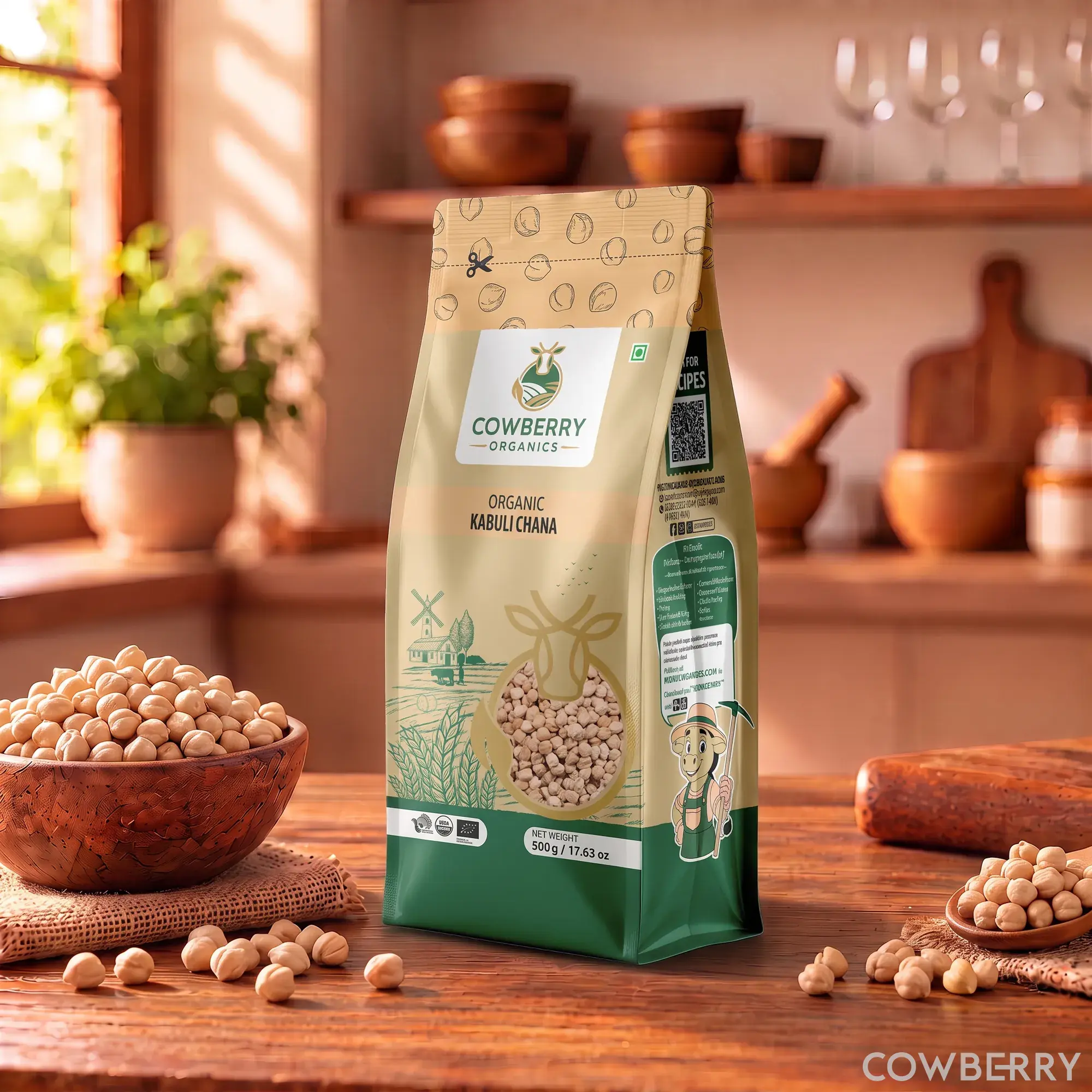
The product page for COWBERRY's kabuli chana describes bold chickpeas of large size and creamy white appearance; the white type cooks soft and creamy and is the one used for chole and hummus. The dark type is smaller, usually stays firmer, and turns up whole in chaat. Both are soaked before cooking, and both take a pressure cooker well.
In the kitchen the split is simple: Punjabi chole, hummus, salads and falafel from the white type; chana chaat and kala chana curries from the dark one. Swapping one for the other usually works; the dish changes colour and bite.
Cost, storage and where each fits
Kabuli chana usually costs a little more per kilo than kala chana, though cost rarely decides between them. Storage carries one printed difference: a 2009 study comparing chickpea genotypes found the desi types it tested were more resistant to the pulse beetle than kabuli. Whichever you buy, keep it sealed and dry.
What decides is the dish. White chana fits chole, hummus, salads, falafel and anything where a soft, creamy grain and a light colour matter. Kala chana fits chaat, sundal, thin kala chana curries and anything that wants a firmer bite and a darker gravy. The split dal is a third option, the one that cooks fastest and thickens dals; its own guide is chana dal.
Which for whom
- Chole or hummus night: kabuli chana, soaked and pressure cooked.
- Counting calories or fibre: kala chana's 287 kcal and 25.22 g of fibre per 100 g beat kabuli's 378 kcal and 12.2 g on both counts, so a calorie-conscious plate leans dark.
- More protein per spoon: chana dal at 21.55 g per 100 g.
- A quick weeknight: the split dal cooks fastest.
FAQs
Is kabuli chana and chickpeas same?
Yes. Kabuli chana is the white, larger type of chickpea, Cicer arietinum, and the USDA FoodData Central record for it reads chickpeas, garbanzo beans, bengal gram. The word chickpeas takes in the white kabuli type and the dark desi type, so every kabuli chana is a chickpea, while not every chickpea is a kabuli one.
Is kabuli chana and chole same?
In the kitchen, nearly: chole is the curry made from kabuli chana, and the word is often used for the cooked white chana themselves. Strictly, chole is the dish and kabuli chana the pulse that goes into it. The Punjabi chole recipe soaks the white chana overnight and pressure cooks them before the masala.
Difference between chickpeas and kabuli chana?
Only the type. Chickpeas is the English umbrella for Cicer arietinum, and kabuli chana is one type of it: the white, larger one, against the dark, smaller desi type sold as kala chana. Per 100 g raw, kabuli has 378 kcal and 12.2 g of fibre, kala chana 287 kcal and 25.22 g.
Which chickpeas are best black or white?
Neither wins outright; pick by dish. White kabuli chana cooks soft and creamy for chole, hummus and salads; black kala chana holds its shape for chaat and brings more fibre, 25.22 g per 100 g against 12.2 g, and more iron, 6.78 mg against 4.31 mg. The black type also carries fewer calories, 287 against 378 kcal per 100 g.
What is kabuli chana?
Kabuli chana is the white chickpea: the larger, cream-coloured type of Cicer arietinum, sold whole and cooked as chole, salads, hummus and falafel. Our kabuli chana nutrition page gives its numbers per 100 g dry, soaked and boiled.
Difference between kala chana and kabuli chana?
Colour, size and numbers. The dark desi type is the smaller one; the kabuli type is larger and creamy white. Per 100 g raw, kala chana has 287 kcal, 25.22 g of fibre and 6.78 mg of iron, kabuli chana 378 kcal, 12.2 g of fibre and 4.31 mg of iron. Both share the mean GI of 23 from the same nine boiled-chickpea entries.
References
- USDA FoodData Central
- Indian Food Composition Tables (IFCT) 2017, ICMR-National Institute of Nutrition
- University of Sydney glycemic index database (GI search)
- University of Sydney: about the glycemic index
- Erler F, Ceylan F, Erdemir T, Toker C. Preliminary results on evaluation of chickpea, Cicer arietinum, genotypes for resistance to the pulse beetle, Callosobruchus maculatus. J Insect Sci, 2009
Shop this article
Keep reading
Green gram plant: crop, varieties and how it grows in India
Rajma vs lobia: difference, nutrition and which to choose
Rajma plant: how rajma is grown in India (it is not a tree)