by COWBERRY

10 minute read
Kala chana (black chickpeas, brown chana): nutrition and cooking

Brown chana, the shop name for kala chana and black chickpeas, is the small, dark desi chickpea that IFCT 2017 files as Bengal gram, whole: 287 kcal, 18.77 g protein and 25.22 g fibre per 100 g, with a glycemic index of 23. This page gathers names, nutrition, benefits, cooking and every other kala chana page on the site.
What is kala chana?
Kala chana is the small, dark, wrinkled chickpea of the desi type, the same species as the big cream kabuli chana, though a different type; the shops also sell it as brown chana, and black chickpeas is the straight translation of the Hindi name. IFCT 2017 files it as Bengal gram, whole, with the botanical name Cicer arietinum, food code B002. The 2012 chickpea review adds the geography: chickpea is grown and consumed worldwide, especially in Afro-Asian countries.
Many Indian kitchens know it as the curry chana and the soaked morning handful, and what sits behind every name is one seed, sold dry and whole; soaked and boiled, it turns into the dark, nutty beans that carry curries, chaats and salads. In the kitchen the two types behave differently: the dark one usually wears a thicker skin and a nuttier taste, holding a firmer bite through cooking, and its per-100 g numbers run lighter in energy and heavier in fibre, as the nutrition section below shows. In a recipe, kabuli chana and chana dal are the nearest swaps, each bringing its own texture and its own cooking time; the kala chana vs kabuli chana page splits the two chickpeas number by number.
Kala chana names in Indian languages
Every name below comes from the IFCT 2017 local-names list for the same food code; English is Bengal gram, whole, and the botanical name is Cicer arietinum. The thirteen Indian-language names, from Hindi Chana to Sanskrit Chanak, sit in the table below; the Marathi spelling Harbhara, common on packs, is a variant of the name IFCT 2017 records, Harbara. The same seed answers to all of them, so a recipe that says chana, boot or kadala asks for nothing different. The full names story, including what harbara dal is and where each name is used, is on the harbhara in english page.
| Language | Name (romanised) |
|---|---|
| English | Bengal gram, whole |
| Hindi | Chana |
| Marathi | Harbara, Harbhara |
| Gujarati | Chana |
| Punjabi | Shole |
| Bengali | Chola |
| Odia | Buta |
| Assamese | Boot |
| Kannada | Kadale |
| Telugu | Sanagalu |
| Tamil | Kondaikadalai |
| Malayalam | Kadala |
| Urdu | Chana |
| Sanskrit | Chanak |
| Botanical name | Cicer arietinum |
Source: IFCT 2017 (ICMR-NIN) local-names list. — means no name recorded in the source.
Marathi ‘Harbhara’: spelling variant of the IFCT 2017 name ‘Harbara’.
Kala chana nutrition per 100 g
Per 100 g of raw kala chana: 287 kcal, 18.77 g protein, 5.11 g fat, 39.56 g carbohydrate and 25.22 g fibre, with 6.78 mg iron, 150 mg calcium, 160 mg magnesium, 935 mg potassium and 233 mcg folate (IFCT 2017). Beside it, the white kabuli type from USDA FoodData Central shows the contrast: 378 kcal and 20.5 g of protein, more of both, and 12.2 g of fibre against the dark type's 25.22 g. Chana dal, the split and skinned form of the same seed, keeps its own numbers on its own page in this same series.
On the glycemic index, plain boiled whole chickpeas average 23 across nine published tests, results spread from 5 to 36, low on the scale that runs up to 55. The database does not split the two types, so both share that figure. What a katori and a serving give, and how all the numbers move after soaking and boiling, is on the brown chana protein page.
| Nutrient | Kala chana (raw, whole) | Kabuli chana (raw) |
|---|---|---|
| Energy (kcal) | 287 | 378 |
| Protein (g) | 19 | 20 |
| Fat (g) | 5.1 | 6 |
| Carbohydrates (g) | 40 | 63 |
| Dietary fibre (g) | 25 | 12 |
| Iron (mg) | 6.8 | 4.3 |
| Calcium (mg) | 150 | 57 |
| Magnesium (mg) | 160 | 79 |
| Potassium (mg) | 935 | 718 |
| Sodium (mg) | 27 | 24 |
| Zinc (mg) | 3.4 | 2.8 |
| Folate (mcg) | 233 | 557 |
| Vitamin C (mg) | — | 4 |
| Glycemic index (GI) | 23 | 23 |
Per 100 g raw, edible portion. Composition: IFCT 2017 (ICMR-NIN); USDA FoodData Central (SR Legacy), FDC ID 173756, NDB 16056. GI: University of Sydney GI database. — means not reported. These are average values for the food; the label on a pack gives the values for that product.
Kala chana benefits
The numbers carry the benefits. Protein: 18.77 g per 100 g, with a 2012 review rating chickpea protein quality above other pulses and noting significant amounts of every essential amino acid bar the sulphur-containing pair, which cereals in the daily diet can supply — ICMR-NIN's 3:1 cereal-pulse rule in practice. Fibre: 25.22 g per 100 g is the number behind chana's reputation for fullness (ICMR-NIN guidelines). Iron: 6.78 mg per 100 g takes up better beside vitamin C foods, guava and orange among them, while tea is best kept an hour away from the meal. Folate at 233 mcg per 100 g plus the B-vitamin set rounds out the list: the 2012 review counts chickpea among good sources of riboflavin, niacin, thiamin and folate.
Each benefit above sits on its source on the dedicated page, along with the side effects, the daily portion and how to eat it: the kala chana benefits page.
Side effects: gas, and who should limit kala chana
The known side effect is gas and intestinal discomfort. Raffinose, stachyose and verbascose, the sugars chana carries, reach the colon undigested and ferment there; a 2019 review adds that whether this is the main reason for the gas has recently been questioned, and that most people who do get gas settle down within a few weeks of steady eating. The same review finds no evidence of harmful lectins in properly cooked pulses, and soaking and cooking remove the lectin and trypsin-inhibitor activity.
On uric acid the news is mild: a 2019 Nutrients review files cooked garbanzo beans in the very low purine band, and a 12-year study of 47,150 men recorded no link between plant foods with a relatively higher purine content and gout; anyone with gout or advanced kidney disease should still take care with high-purine plant foods and talk to their doctor or dietitian. The full side-effects story is on the kala chana benefits page, and the same story in simple Hinglish is on kala chana khane ke fayde, with the same numbers, hedges and doctor line.
Soaking and cooking kala chana
Whole kala chana always starts with a soak: 6 to 8 hours in cold water, shorter in summer, or a hot quick soak of at least 3 hours when time is short, then 6 to 7 whistles in the cooker with roughly three times the water, until a chana squashes between finger and thumb. The soak water is drained before cooking, and the dry beans are washed well, but not repeatedly, beforehand (ICMR-NIN guidelines). Every timing, and the reason each one matters, is on the black chana soaked overnight page.
Cook in just enough water, with none poured away, to keep the folate, and do not overcook, which lowers protein quality (ICMR-NIN guidelines). Soaking before cooking is the step worth keeping: it cuts the cooking time, and the guidelines count it among the household methods that improve the digestibility of legumes. One cup of dry chana, 200 g, roughly doubles to two cups once soaked, which is four servings; the same arithmetic says 100 g of boiled chana starts from about 50 g of dry grain and carries roughly 144 kcal, with 9.4 g of protein and 12.6 g of fibre. The nine ways to eat the cooked grain, from boiled with lemon to roasted, are on the black chickpeas how to eat page.
Kala chana recipes: curry, khichdi, chaat, tikki and laddu
The site's five kala chana recipes run from dinner to dessert. kala chana curry is the everyday one: overnight-soaked chana simmered in a thin onion-tomato gravy, four servings in about an hour. black chana khichdi cooks whole chana and rice in one pot under a ghee, cumin and hing tempering, about 300 kcal a bowl. chana chaat recipe tosses the boiled chana cold with onion, tomato, lemon, roasted cumin and amchur: four tangy bowls, about 35 minutes after the soak. kala chana tikki recipe mashes the boiled chana into eight patties held with rice flour, pan-fried or air-fried. And black chana laddu skips the soak and the pot entirely: roasted chana ground and bound with jaggery and ghee, 12 laddus in about 25 minutes that keep about two weeks in an airtight tin. One pot of boiled chana covers the curry, the chaat and the tikkis, since all three start from the same soaked-and-boiled grain.
Around India the same boiled chana carry other names and shapes: sundal down south, tossed with mustard seeds, curry leaves and coconut. Besan, the flour milled from this same gram, and roasted chana sattu are covered by FSSAI's besan and sattu standards, and besan has its own guide on this site.
Kala chana for weight loss, diabetes, pregnancy and babies
Four condition pages take one question each. kala chana for weight loss works out the portions, the swap and what the pooled pulse-diet trials found; the katori at 86 kcal and 7.6 g of fibre is the anchor. is kala chana good for diabetes runs the GI of 23 through katori and serving, landing at glycemic loads of about 2.7 and 4.5, with the meal rules. kala chana in pregnancy covers iron and folate in pregnancy, with ICMR-NIN's own pregnancy menu amounts. kala chana for babies fixes the first amounts and the safe textures, from six months on, well cooked and mashed. A fifth question — where chana sits in gout — is answered in the side-effects section above, with the very low purine band from the 2019 Nutrients review and the doctor line.
How to store kala chana, and how to buy it
Dried kala chana keeps in an airtight container in a cool, dry place, and the main enemy has a name: the pulse beetle. A 2009 study found that pulse beetles can take up to 30 percent of stored chickpeas within two months, with the desi types testing as the more resistant ones; at home, airtight storage is the practical answer, and a pack with clean, whole grains, free of insect damage, is the thing to check for. The dry grain keeps for many months in a sealed jar away from heat and moisture, so a kilo bought today can wait for the next big pot.
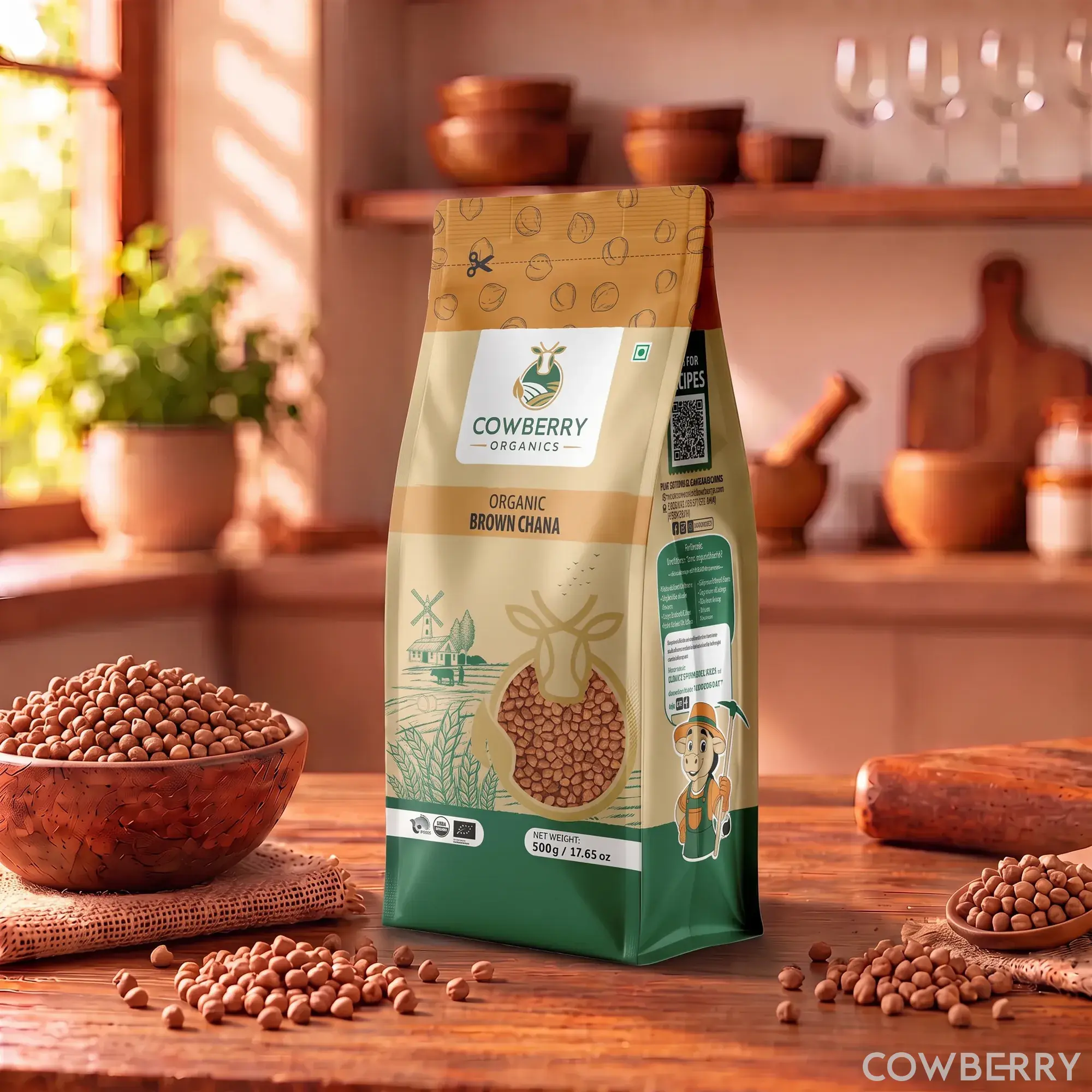
On buying, the site's pick is COWBERRY's Organic Brown Chana: desi kala chana from Central and Northern India grown with cow-based organic farming, harvested at full maturity, cleaned, graded and left unpolished, which keeps the dense texture and nutty flavour. The product card below carries the certifications, the pack sizes and the link.
FAQs
What is kala chana?
Kala chana is the small, dark desi chickpea, IFCT 2017's Bengal gram, whole (Cicer arietinum), the seed behind brown chana and black chickpeas. It is the type Indian kitchens boil whole, while the larger cream kabuli chana is its cousin; the two split number by number on the kala chana vs kabuli chana page.
What is black chickpeas?
The same seed as kala chana and brown chana: black chickpeas is the English reading of the Hindi name. Nothing separates the three labels in the kitchen; 287 kcal, 18.77 g protein and 25.22 g fibre per 100 g (IFCT 2017) describe all of them.
Does kala chana have protein?
Yes: 18.77 g per 100 g (IFCT 2017), and a katori of cooked dal about 5.6 g. It is the protein a 2012 review rates above other pulses; the sulphur-containing pair is the one gap, and cereals at the same meal can supply it. the per-serving arithmetic is on the brown chana protein page.
Why black chana cause gas?
Black chana carry raffinose, stachyose and verbascose, sugars that reach the colon and ferment there; a 2019 review flags that this mechanism has recently been questioned and that most people who do get gas settle down within a few weeks of eating pulses regularly. Soaking and cooking handle lectin and trypsin-inhibitor activity, not the gas.
Is kala chana good for weight loss?
As a swap, yes: the katori costs about 86 kcal and carries fibre that raises a meal's satiety value. The pooled pulse-diet trials and the portion plan sit on the kala chana for weight loss page.
Difference between kala chana and brown chana?
There is none: kala chana and brown chana are two shop names for the same seed, Bengal gram, whole. If a pack says one and a recipe the other, no substitution is needed; the one difference in the shops is the name on the label.
References
- Indian Food Composition Tables (IFCT) 2017, ICMR-National Institute of Nutrition
- Dietary Guidelines for Indians, ICMR-National Institute of Nutrition
- University of Sydney glycemic index database (GI search)
- University of Sydney: about the glycemic index
- USDA FoodData Central
- Jukanti AK, Gaur PM, Gowda CL et al. Nutritional quality and health benefits of chickpea (Cicer arietinum L.): a review. Br J Nutr, 2012
- Thompson HJ. Improving human dietary choices through understanding of the tolerance and toxicity of pulse crop constituents. Curr Opin Food Sci, 2019
- Erler F, Ceylan F, Erdemir T, Toker C. Preliminary results on evaluation of chickpea, Cicer arietinum, genotypes for resistance to the pulse beetle, Callosobruchus maculatus. J Insect Sci, 2009
- FSSAI: Food Products Standards and Food Additives Regulations compendium (Version XXII, 02.03.2022): 2.4.4 Besan and 2.4.33 Roasted Bengal Gram Flour (Chana Sattu)
- Jakse B, Jakse B, Pajek M, Pajek J. Uric acid and plant-based nutrition. Nutrients, 2019
- Choi HK, Atkinson K, Karlson EW, Willett W, Curhan G. Purine-rich foods, dairy and protein intake, and the risk of gout in men. N Engl J Med, 2004
Shop this article
Keep reading
Green gram plant: crop, varieties and how it grows in India
Rajma vs lobia: difference, nutrition and which to choose
Rajma plant: how rajma is grown in India (it is not a tree)