by COWBERRY

8 minute read
Asafoetida benefits and side effects: traditional uses of hing

Asafoetida benefits sit on two shelves: what a 2011 review records as traditional use, and what laboratory studies have shown, none of it yet shown in people. Hing is eaten by the pinch, about 3.3 kcal a gram, so this page gives the honest list with each setting named, then the side effects, the daily amount and how to eat it; the hing powder hub covers names and buying.
Asafoetida benefits: what the record actually shows
One review anchors every claim on this page. Iranshahy and Iranshahi, writing in the Journal of Ethnopharmacology in 2011, describe asafoetida as an oleo-gum-resin obtained from the roots of Ferula assa-foetida, used in different countries as a culinary spice and in traditional medicine. The traditional uses they record are asthma, gastrointestinal disorders and intestinal parasites, and the activities the resin is known to possess, antifungal, anti-diabetic, anti-inflammatory, anti-mutagenic and antiviral, are listed as properties of the resin, not as results in people.
Krishnaswamy, writing on traditional Indian spices in 2008, sets the wider scene: India is recognised all over the world for its spices, and current biomedical work aims to give the traditional uses a science base. Opara and Chohan add the honest limit in 2014: spices are normally eaten in small quantities and in combination with other foods, so their true health benefit is hard to establish. Each benefit below therefore names its setting, and none of them is a result measured in people.
Asafoetida benefits in traditional use
Traditional use for gastrointestinal disorders
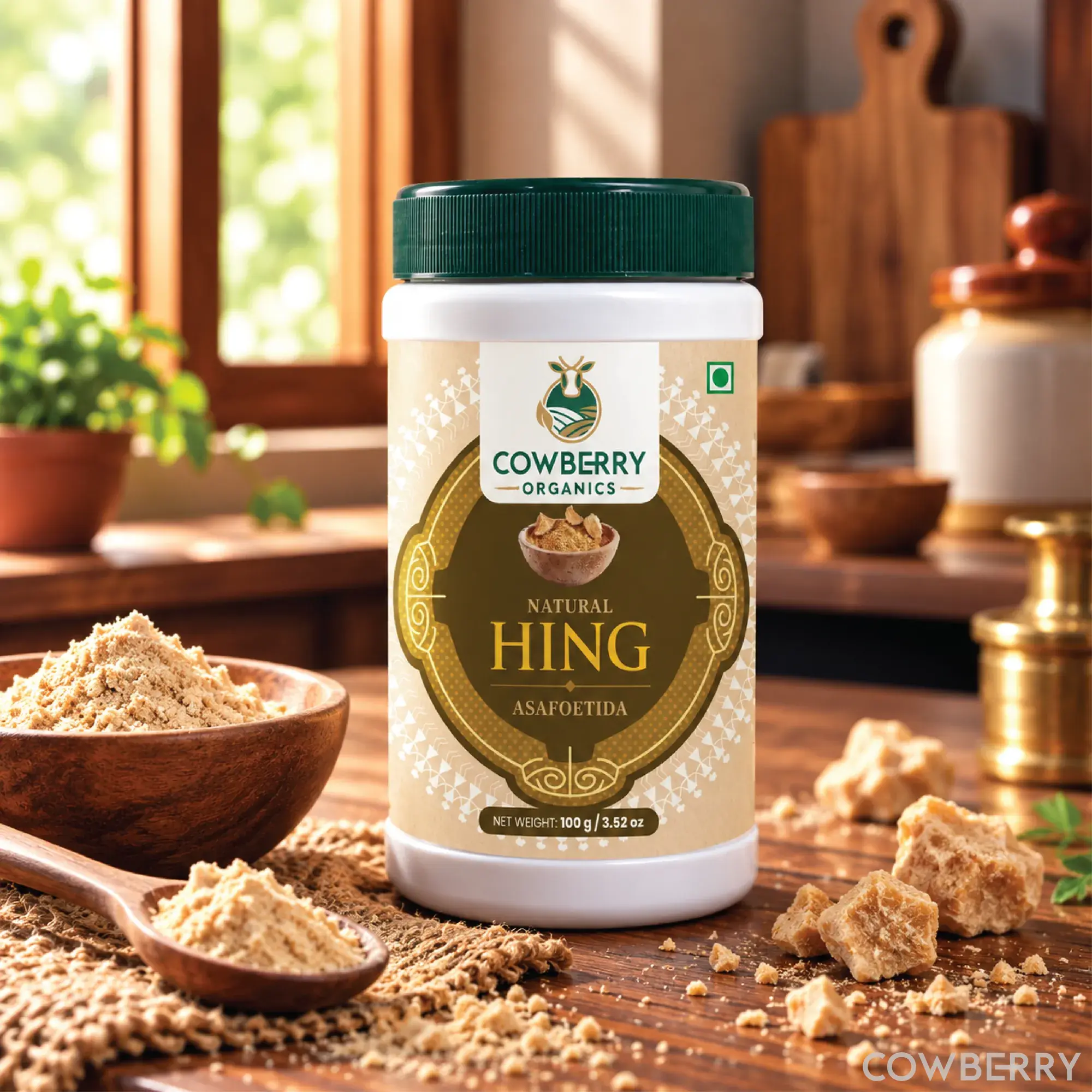
The 2011 review lists gastrointestinal disorders among the conditions for which asafoetida has traditional uses. That is a record of practice, not a clinical result: no study in these texts measured hing against bloating or gas in people. What is documented in people is the everyday use, a pinch of hing tempered in oil or ghee for dal, sambar, curries and vegetables, which is how COWBERRY's product page describes its cooking.
Traditional use for asthma
Asthma also appears in the review's list of traditional uses. Again the setting is tradition: no trial in these texts measured hing against asthma in people. Anyone with asthma should keep their usual care and think of hing only as a seasoning; talk to your doctor or dietitian before using any spice or supplement in place of the care your doctor has prescribed.
Traditional use against intestinal parasites
Intestinal parasites round out the traditional list. The review records the use; it does not print a dose, a preparation or a result, so none is given here. The pinch in the tadka is a seasoning, nothing more in any of these texts.
What laboratory studies found: preclinical, not clinical
Antifungal and antiviral activity
The 2011 review names antifungal and antiviral activity among what the resin is known to possess, and points to promising antiviral sesquiterpene coumarins in recent studies. These are laboratory findings, not results in people.
Anti-inflammatory, anti-diabetic and anti-mutagenic activity
The same review lists anti-inflammatory, anti-diabetic and anti-mutagenic activities alongside. None of them carries a human result in these texts, so this page makes no claim about hing and inflammation or blood sugar in a person's body.
Why the kitchen pinch is not the lab dose
Opara and Chohan explain the gap in their 2014 review: the way these foods are consumed, in small quantities and with other foods, plus digestion and interactions between foods, makes their true benefit from a health perspective unclear. Hing is an extreme case of that pattern, used a pinch at a time in a tadka rather than by the gram.
The chemistry behind the aroma
The 2011 review also summarises what has been isolated from the plant: sugars, sesquiterpene coumarins and polysulfides. The resin's smell is the other famous fact: strong and pungent when raw, which earned hing the nickname devil's dung, as COWBERRY's product page tells it, and smooth like fried onions once cooked in oil or ghee.
The flavour change is the one asafoetida benefit any Indian kitchen can verify without a study. The pinch goes into the hot fat of a tadka, and the dish gets depth rather than the resin's raw smell. How the resin becomes powder is on how asafoetida is made.
Asafoetida side effects: who should be careful
No side-effect list for hing is printed in any of these texts, and none is invented here. What is documented is how the spice is used and what else can sit in a jar.
- Amount. The cooking guidance is very small amounts, a pinch into the hot fat; nothing in these texts supports eating hing by the spoonful.
- Compounded packs. Compounded hing is hing with other materials mixed in, declared on the label in descending order, so the additions, not the resin, are what need reading; the comparison is on hing vs compounded hing.
- Allergies. Hing itself is naturally gluten-free, as COWBERRY's product page states, but the Dietary Guidelines name wheat proteins among the ingredients that commonly cause allergy, so on a compounded pack the ingredient list decides. FSSAI's household checks for foreign resin, non-edible gum or resin and soapstone are on the asafoetida adulteration test page.
- Raw hing. The cooking guidance is a pinch tempered in hot oil or ghee, and nothing in these texts describes eating it raw at the table; the method is on asafoetida how to use.
If you have asthma or a long-standing digestive condition and are thinking of using hing as anything more than a seasoning, talk to your doctor or dietitian first.
How much hing per day
No daily amount of hing is printed in these texts, and the guidance is qualitative: very small amounts, a pinch per dish. The nearest printed number is for spices as a group: the Dietary Guidelines' suggested balanced diets for elderly people allow 10 g of spices a day (Tables 16.1 and 16.2), and ask for well cooked, soft food preparations with less salt and moderate amounts of spices. A 1 g pinch of hing is one tenth of that 10 g, which shows how little of a spice allowance hing needs.
What a pinch carries, 3.3 kcal, 0.06 g of protein and 0.16 mg of iron, is set out with its arithmetic on the asafoetida nutritional value per 100g page. Anyone on a prescribed diet should keep following it; hing changes nothing in that arithmetic.
How to eat hing: dal, sambar, pickles and beyond
Hing works in one place: the tadka. A pinch goes into hot oil or ghee before the seeds, and that tempering is poured over dal, sambar, curries and vegetables, the dishes COWBERRY's product page names for its powder; pickles also take hing, for flavour. Beyond those, any dish with a tadka takes a pinch: rasam, kadhi, upma, poha and stuffed vegetables all work the same way.
Two rules complete the method. Keep the amount very small and taste before adding a second pinch, and store the jar airtight in a cool, dry place so the aroma holds. The step-by-step method is on asafoetida how to use, the names it goes by across India are on the hing in english page, and the whole cluster meets on the hing powder hub.
FAQs
Is hing good for health?
As a seasoning used a pinch per dish, yes, and none of these texts prints a harm from it. As a nutrient or a medicine, no: a pinch brings about 3.3 kcal and 0.16 mg of iron, the traditional uses for asthma and gastrointestinal disorders are tradition, and the antifungal and antiviral activity is laboratory work. Hing earns its place on flavour, not on a health claim.
Does asafoetida cause acidity?
None of these texts reports acidity from asafoetida. The 2011 review records traditional use for gastrointestinal disorders, and the kitchen dose stays tiny, a pinch tempered in hot oil or ghee per dish. The record is silent on acidity, so this page makes no claim in either direction beyond the traditional-use note.
Is asafoetida good for diabetes?
Not on the evidence. The 2011 review lists anti-diabetic activity among the resin's laboratory findings, but nothing in these texts measured hing in people with diabetes, and no glycemic index is printed for the spice in these tables. A pinch carries 0.72 g of carbohydrate. If you have diabetes, settle what you eat with your doctor or dietitian.
Is asafoetida bad for health?
Nothing in these texts reports harm from hing eaten the normal way, a pinch tempered in oil or ghee, and no side-effect list is printed for the spice. The care points are elsewhere: a compounded pack's added materials, declared on the label, and the wheat proteins the Dietary Guidelines name among common causes of allergy, for anyone who must avoid them.
Can asafoetida cause gas?
Gas from hing appears in none of these texts. The 2011 review records a traditional use for gastrointestinal disorders, and the amount eaten is tiny, a pinch at a time in a tadka. Those are separate facts: the tradition is not proof that gas cannot happen.
References
- Indian Food Composition Tables (IFCT) 2017, ICMR-National Institute of Nutrition
- Dietary Guidelines for Indians, ICMR-National Institute of Nutrition
- Iranshahy M, Iranshahi M. Traditional uses, phytochemistry and pharmacology of asafoetida (Ferula assa-foetida oleo-gum-resin)-a review. J Ethnopharmacol, 2011
- Opara EI, Chohan M. Culinary herbs and spices: their bioactive properties, the contribution of polyphenols and the challenges in deducing their true health benefits. Int J Mol Sci, 2014
- Krishnaswamy K. Traditional Indian spices and their health significance. Asia Pac J Clin Nutr, 2008
- FSSAI Eat Right India: DART (Detect Adulteration with Rapid Test), salt, spices and condiments tests
Shop this article
Keep reading
Coriander water benefits: what dhania water actually does
Peanuts in Hindi (moongfali): groundnut names in Indian languages
Coriander vs cilantro: are they the same herb?