by COWBERRY

6 minute read
Asafoetida nutritional value per 100g: calories, protein and more

Asafoetida nutritional value per 100g, from IFCT 2017: 332 kcal, 6.34 g protein, 1.26 g fat, 71.95 g carbohydrate and 5.13 g fibre, with 15.68 mg of iron and 266 mg of calcium. Because hing is eaten by the pinch, the table below comes with the per-pinch arithmetic that actually reaches a plate. The hing powder hub covers the spice itself.
Asafoetida nutritional value per 100g: the full table
The table gives asafoetida nutritional value per 100 g of the dried resin as sold, the entry that IFCT 2017, the Indian food composition tables of ICMR-National Institute of Nutrition, lists under food code G019: 332 kcal of energy, 6.34 g of protein, 1.26 g of fat, 71.95 g of carbohydrate and 5.13 g of dietary fibre. Beside it sit cumin seeds and mustard seeds (black), the other two tempering spices from the same tables, so the hing entry can be read in context.
Two things to remember while reading. First, the entry describes the raw spice in the jar: no dish uses 100 g of hing, and the next section does the per-pinch arithmetic. Second, hing is a dried resin, not a seed spice, and its entry is dominated by that carbohydrate figure of 71.95 g per 100 g, while the entries beside it sit far lower.
| Nutrient | Asafoetida (hing) | Cumin seeds | Mustard seeds (black) |
|---|---|---|---|
| Energy (kcal) | 332 | 305 | 510 |
| Protein (g) | 6.3 | 14 | 20 |
| Fat (g) | 1.3 | 17 | 40 |
| Carbohydrates (g) | 72 | 23 | 17 |
| Dietary fibre (g) | 5.1 | 30 | 14 |
| Iron (mg) | 16 | 21 | 13 |
| Calcium (mg) | 266 | 878 | 402 |
| Magnesium (mg) | 96 | 442 | 266 |
| Potassium (mg) | 245 | 1886 | 694 |
| Sodium (mg) | 16 | 125 | 4 |
| Zinc (mg) | 1 | 4.3 | 4 |
| Folate (mcg) | 26 | 28 | 95 |
Per 100 g raw, edible portion. Composition: IFCT 2017 (ICMR-NIN). — means not reported. These are average values for the food; the label on a pack gives the values for that product.
Hing nutrition facts 100g, and what one pinch adds
No recipe cooks 100 g of hing, so asafoetida calories matter per pinch. A pinch is about 1 g, and the arithmetic stays small: one gram works out to about 3.3 kcal, 0.06 g of protein, 0.72 g of carbohydrate, 0.01 g of fat and 0.05 g of fibre. The same gram holds 0.16 mg of iron and 2.7 mg of calcium, amounts a dal or sabzi supplies many times over.
| Measure | Energy | Protein | Carbs | Fat | Fibre | Iron | Calcium |
|---|---|---|---|---|---|---|---|
| 1 pinch (about 1 g) | 3.3 kcal | 0.06 g | 0.72 g | 0.01 g | 0.05 g | 0.16 mg | 2.7 mg |
| Per 100 g | 332 kcal | 6.34 g | 71.95 g | 1.26 g | 5.13 g | 15.68 mg | 266 mg |
That is the honest reading of the row: hing adds flavour at almost no energy, not nutrition worth counting. The portion and the method are on asafoetida how to use.
Asafoetida nutrition against cumin seeds and mustard seeds
The entry reads better next to the two spices hing is tempered with. Protein is the contrast: hing holds 6.34 g per 100 g, while IFCT 2017 lists 13.91 g for cumin seeds and 19.51 g for mustard seeds (black). Fat tells the same story the other way round, 1.26 g in hing against 16.64 g in cumin seeds and 40.19 g in mustard seeds. Fibre is 5.13 g, below cumin seeds at 30.35 g and mustard seeds at 14.10 g.
Carbohydrate is where hing leads: 71.95 g per 100 g, over three times the 22.62 g in cumin seeds and over four times the 16.80 g in mustard seeds. Hing is a resin, not a seed. On energy, hing sits at 332 kcal per 100 g, above cumin seeds at 305 kcal and well below mustard seeds at 510 kcal, though a real dish uses far smaller amounts of all three than 100 g.
Glycemic index and vitamin C: the values IFCT 2017 does not print
Two cells in the IFCT 2017 entry are empty, and the honest thing is to say so. IFCT 2017 reports no glycemic index for asafoetida, and none is quoted here; the pinch above carries 0.72 g of carbohydrate, so hing is not where a meal's glycemic response comes from. The dal, rice or roti it seasons carries the carbohydrate, and those foods have their own published values.
Vitamin C is the other gap: IFCT 2017 prints no vitamin C value for hing. Neither gap matters much in practice, because hing is a tempering spice used in very small amounts. A 2014 review of culinary herbs and spices describes exactly that as the normal way these foods are eaten: in small quantities, and in combination with other foods.
Iron, calcium and the other minerals in hing
The mineral column per 100 g: iron 15.68 mg, calcium 266 mg, magnesium 96.40 mg, potassium 245 mg, sodium 16.04 mg, zinc 0.98 mg and folate 26.28 mcg. Beside the two tempering spices, hing's iron sits below cumin seeds at 20.58 mg and above mustard seeds at 13.49 mg, while its calcium of 266 mg trails both of them, at 878 mg and 402 mg.
Read per pinch, the same column turns modest. The 1 g that seasons a dal brings 0.16 mg of iron and 2.7 mg of calcium, beside 0.96 mg of magnesium, 2.45 mg of potassium and 0.26 mcg of folate. Those are real but tiny contributions; the iron and calcium in a meal come from the dal, grains and vegetables, not from the seasoning. Sodium is 16.04 mg per 100 g, so the salt in a hing-tempered dish is almost entirely the cook's own.
Hing nutritional value in the kitchen: where the numbers end up
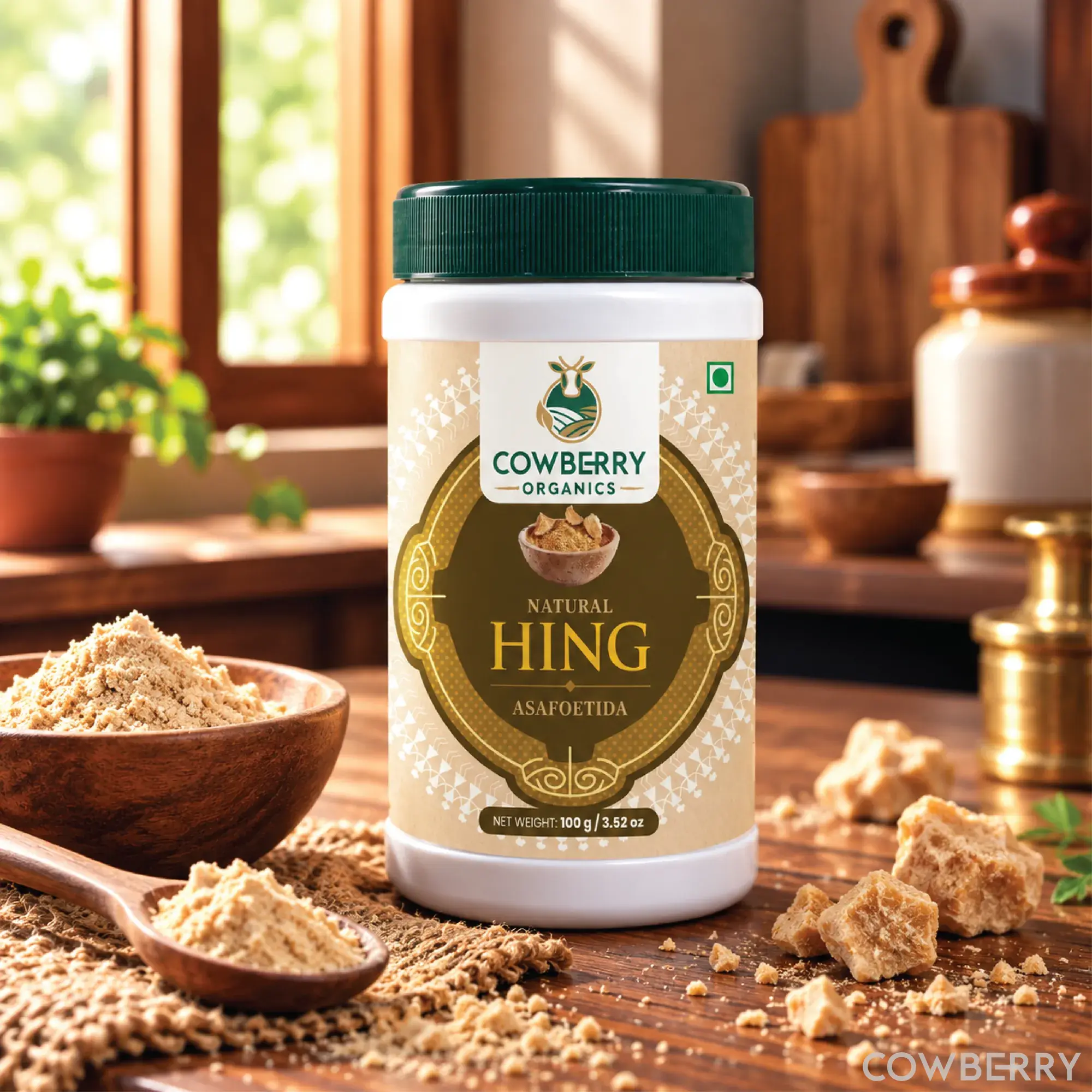
The numbers above describe the powder in the jar; in the pan they dissolve into a pinch added to the hot fat when the tempering begins, whether the pot holds dal, sambar, a curry, vegetables or a pickle. Cooking in oil or ghee turns the raw, pungent smell into the smooth, fried-onion-like flavour, as COWBERRY's product page puts it, and the amount stays very small.
Kept in a closed jar somewhere cool and dry, the powder holds its strong aroma and flavour. What each nutrient does, and what traditional use of hing does and does not show, is on asafoetida benefits, and the names, buying notes and every other page meet on the hing powder hub.
FAQs
Is asafoetida good for health?
As a seasoning, yes; as a nutrient source, not really. A 1 g pinch adds about 3.3 kcal and 0.16 mg of iron, so hing's per-100 g numbers barely register in a dish. A 2011 review records traditional uses for asthma and gastrointestinal disorders and laboratory findings of antifungal and antiviral activity, none of them shown in people. Count hing as a seasoning, not a nutrition source.
Does asafoetida have gluten?
Hing itself is a plant resin, not a cereal grain, and COWBERRY's product page describes its hing powder as naturally gluten-free. The question matters on compounded packs, where other materials are mixed in: the Dietary Guidelines put proteins in wheat on their list of common allergy-causing ingredients, so read the ingredient list on any compounded pack before you use it.
Is asafoetida good for diabetes?
IFCT 2017 prints no glycemic index for asafoetida, and a pinch carries 0.72 g of carbohydrate, so hing itself barely touches a meal's carbohydrate. A 2011 review in the Journal of Ethnopharmacology records anti-diabetic activity for the resin, but as a laboratory finding, not a result in people with diabetes. If you have diabetes, talk to your doctor or dietitian about your diet.
Is asafoetida good for weight loss?
None of the sources in the references links asafoetida with weight loss, so the honest answer is that it is neither a help nor a hindrance: a pinch brings about 3.3 kcal and 0.72 g of carbohydrate. What hing does add is flavour, which lets a dal or sabzi taste deeper without extra oil. Weight loss comes from the whole plate, not from one spice.
Why asafoetida is used in cooking?
For flavour, at a price of about 3.3 kcal a pinch. Hing is added to the hot fat as the tempering begins, for dal, sambar, curries and vegetables, where the heat turns its raw, strong smell into the smooth, fried-onion-like flavour COWBERRY's product page describes, and into pickles to enhance flavour. The amount stays very small, one pinch per dish.
References
- Indian Food Composition Tables (IFCT) 2017, ICMR-National Institute of Nutrition
- Dietary Guidelines for Indians, ICMR-National Institute of Nutrition
- Iranshahy M, Iranshahi M. Traditional uses, phytochemistry and pharmacology of asafoetida (Ferula assa-foetida oleo-gum-resin)-a review. J Ethnopharmacol, 2011
- Opara EI, Chohan M. Culinary herbs and spices: their bioactive properties, the contribution of polyphenols and the challenges in deducing their true health benefits. Int J Mol Sci, 2014
Shop this article
Keep reading
Coriander water benefits: what dhania water actually does
Peanuts in Hindi (moongfali): groundnut names in Indian languages
Coriander vs cilantro: are they the same herb?