by COWBERRY

7 minute read
How asafoetida is made: from ferula plant resin to hing

How asafoetida is made: the spice starts as the dried oleo-gum-resin of the roots of Ferula assa-foetida, a plant of the arid lands of Iran, Uzbekistan and Afghanistan, and reaches Indian kitchens as ground powder; COWBERRY's is processed in Madhya Pradesh with no fillers added. The hing powder hub covers the spice itself; this page follows the chain from plant to pack.
Short answer: from Ferula plant to powder
Three stages, nothing hidden. First, the plant: Ferula assa-foetida, which grows in arid Iran, Uzbekistan and Afghanistan. Second, the material: the Journal of Ethnopharmacology's 2011 review describes asafoetida as the oleo-gum-resin the plant's roots yield. Third, the processing: the resin is ground, and COWBERRY's powder is processed in Madhya Pradesh without artificial fillers, without synthetic additives, without preservatives and without artificial colour.
The same review summarises the plant's chemistry, with sugars, sesquiterpene coumarins and polysulfides among the compounds isolated from it, and records that the spice is used for cooking as well as in traditional medicine. It does not narrate the farm work of tapping the roots, and neither does any other source cited, so this page gives the steps that are documented and names what is not.
The asafoetida plant: Ferula assa-foetida
IFCT 2017, the Indian food composition tables, lists the food under code G019 with the botanical name Ferula assa-foetida, and the 2011 review writes of the material as obtained from the roots of the Ferula plant. The plant is a member of the Ferula genus, and its resin is the spice. Where the plant grows is printed in COWBERRY's own product notes: arid Iran, Uzbekistan and Afghanistan.
The resin the plant yields has a strong, pungent aroma, which is why the spice earned the nickname devil's dung in English, as COWBERRY's product page tells it. Raw, the smell is not pleasant; cooked in oil or ghee it settles into a smooth flavour that the same page compares to fried onions. The name in every Indian language is listed on the hing in english page.
What is asafoetida made of: the oleo-gum-resin of the roots
The exact words of the 2011 review: asafoetida is an oleo-gum-resin obtained from the roots of different Ferula assa-foetida. Oleo-gum-resin is the plant's own oily, gum-like exudate, the dried form of what the roots produce, so hing is a resin spice, not a seed spice. The Dietary Guidelines for Indians include asafoetida in their own list of Indian spices, alongside cumin seeds, fenugreek seeds, mustard seeds, chillies and ginger.
IFCT 2017 measured the dried resin itself: 332 kcal, 6.34 g protein, 71.95 g carbohydrate, 1.26 g fat and 5.13 g fibre per 100 g. Those numbers describe the asafoetida itself; the full entry is on the asafoetida nutritional value per 100g page.
How hing is prepared: from solid resin to powder
Hing is sold and used as a powder, and the powder begins as the solid resin. FSSAI's household test instructions take the solid form as the starting point: for the water test they ask you to powder a gram of asafoetida first, which shows the spice is also handled in solid form. Commercial processing does the same at scale, and the step that matters for quality is what goes into the mill.
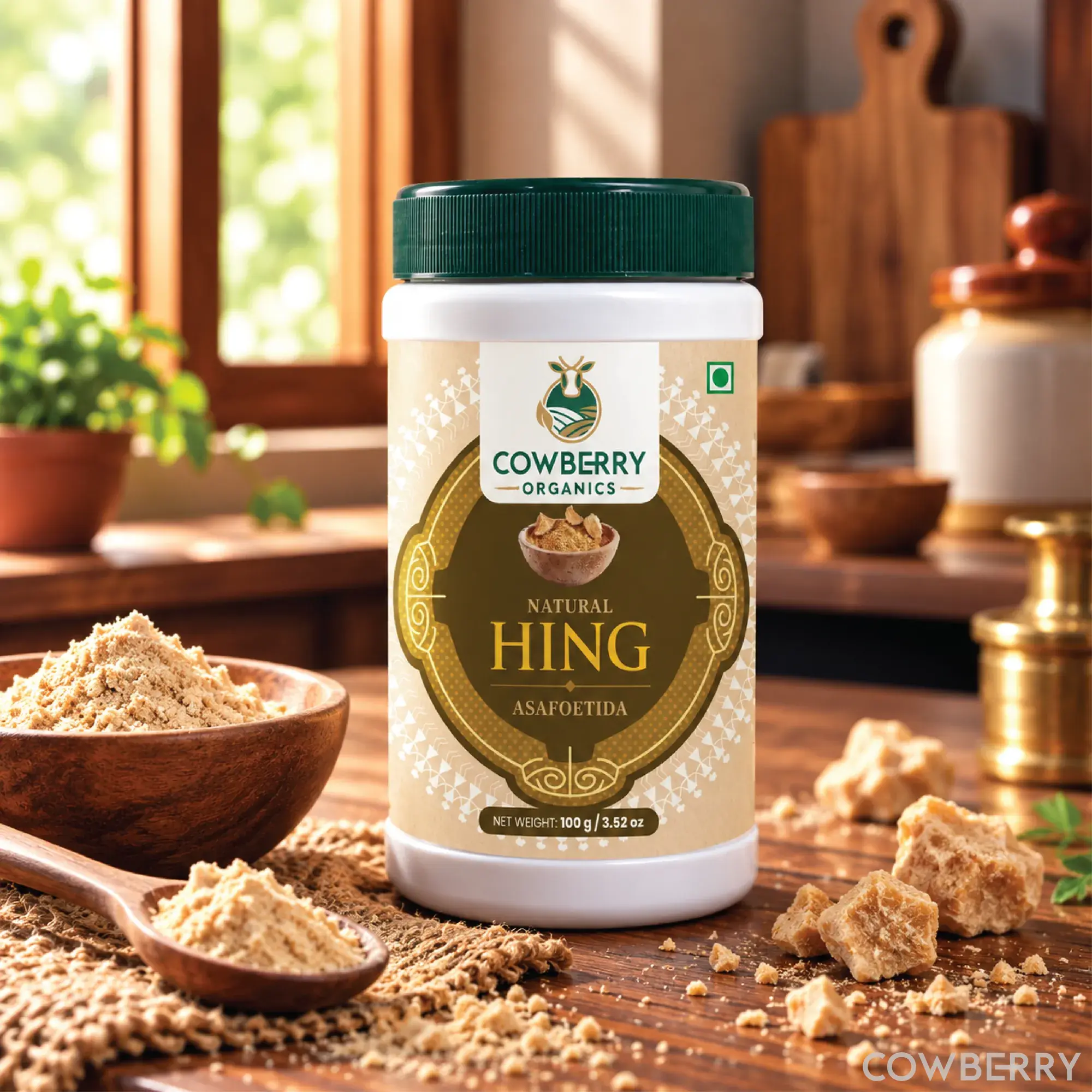
COWBERRY's natural hing powder is sourced and processed in Madhya Pradesh; the pack claims no artificial fillers, no synthetic additives, no preservatives and no artificial colour, so what is sold is milled hing resin with nothing artificial added, in 100 g packs. Once home, keep it airtight in a cool, dry place, which is the storage the product page recommends for holding its strong aroma and flavour.
What pure resin behaves like: FSSAI's kitchen checks
You can recognise the real material by how it behaves, and FSSAI's household test list reads exactly that behaviour. Set fire to a small quantity of hing on a stainless steel spoon: the pure resin takes flame the way camphor does, bright, and adulterated hing will not produce that flame. Mix a gram of the powdered spice with a teaspoon of water in a glass and shake: pure asafoetida gives a milky white solution, nothing settled out, while sediment points to non-edible gum or resin mixed in.
Both checks describe the resin's nature rather than a recipe: it burns bright and mixes milky in water. The full step-by-step methods, and what they cannot detect, are on the asafoetida adulteration test page.
How asafoetida is made in India
The growing regions printed for the plant all lie outside India: the arid lands of Iran, Uzbekistan and Afghanistan. The Indian step in the chain is processing. COWBERRY's hing is sourced and processed in Madhya Pradesh, which means the resin is bought in and worked there, in this case without fillers, synthetic additives, preservatives or artificial colour.
That split, a plant grown in Iran, Uzbekistan and Afghanistan and COWBERRY's powder processed in India, is as far as the product page and the 2011 review take the story. They print no Indian farm growing the plant and no tapping season or yield figure, so this page gives none. What a buyer can verify at home is the material itself, with the FSSAI checks above, and what a buyer should read is the label, covered under the asafoetida adulteration test guide.
The chain at a glance
Each stage, with what is documented about it.
| Stage | What happens |
|---|---|
| Plant | Ferula assa-foetida grows in the arid regions of Iran, Uzbekistan and Afghanistan |
| Resin | The oleo-gum-resin obtained from the roots, dried; strong, pungent aroma |
| Processing | COWBERRY's hing: sourced and processed in Madhya Pradesh; no artificial fillers, no synthetic additives, no preservatives and no artificial colour |
| Powder | Sold in 100 g packs; store in an airtight container in a cool, dry place |
IFCT 2017's numbers for the pure resin are 332 kcal, 6.34 g protein, 71.95 g carbohydrate, 1.26 g fat and 5.13 g fibre per 100 g. The hing powder guide has the rest of the spice's story, from its names to its everyday uses.
FAQs
How asafoetida is made?
From the dried oleo-gum-resin of the roots of Ferula assa-foetida, ground to powder. The plant grows in the arid regions of Iran, Uzbekistan and Afghanistan; the resin obtained from its roots is the spice, and the powder COWBERRY sells is processed in Madhya Pradesh, without artificial fillers, synthetic additives, preservatives and artificial colour.
Does asafoetida grow in India?
COWBERRY's product page places the plant in the arid regions of Iran, Uzbekistan and Afghanistan and prints no growing region inside India. What it does describe is the Indian processing step: COWBERRY's hing powder is sourced and processed in Madhya Pradesh. So the powder is finished in India while the plant, on the evidence cited, is not farmed there.
How asafoetida is grown?
The sources cited describe where the plant grows, not the farming: Ferula assa-foetida comes from the arid regions of Iran, Uzbekistan and Afghanistan, and the part that becomes the spice is the oleo-gum-resin obtained from its roots, as the Journal of Ethnopharmacology's 2011 review puts it. Neither the review nor COWBERRY's product page prints a planting season or harvest detail, so none is given.
What is asafoetida?
Asafoetida is hing: the dried oleo-gum-resin of the roots of Ferula assa-foetida, ground and sold, used by the pinch in Indian cooking. IFCT 2017 lists it under code G019 with 332 kcal, 6.34 g protein and 71.95 g carbohydrate per 100 g. Its traditional and modern uses are covered on the asafoetida benefits page.
Difference between asafoetida and compounded asafoetida?
Asafoetida is the resin alone; compounded asafoetida is the compound version: hing with other materials mixed in, which the label has to declare. Under FSSAI claim rules the word pure is reserved for the single-ingredient food, so a compounded pack cannot claim pure hing. The two forms are compared on the hing vs compounded hing page.
Can asafoetida cause gas?
None of the sources cited reports hing causing gas. The 2011 review records asafoetida's traditional use for gastrointestinal complaints, and the spice is eaten in very small amounts, a pinch at a time in a tadka. Its traditional uses and their limits are on the asafoetida benefits page.
Which hing is best?
The pack whose label shows asafoetida alone, nothing ground with it. FSSAI's household checks read the material itself: pure hing takes flame like camphor, and a gram powdered and shaken with a teaspoon of water goes milky white with nothing settled out. Both tests, with what they cannot catch, are on the asafoetida adulteration test page.
References
- Indian Food Composition Tables (IFCT) 2017, ICMR-National Institute of Nutrition
- Dietary Guidelines for Indians, ICMR-National Institute of Nutrition
- FSSAI Food Safety and Standards (Advertising and Claims) Regulations 2018, compendium (PDF)
- Iranshahy M, Iranshahi M. Traditional uses, phytochemistry and pharmacology of asafoetida (Ferula assa-foetida oleo-gum-resin)-a review. J Ethnopharmacol, 2011
- FSSAI Eat Right India: DART (Detect Adulteration with Rapid Test), salt, spices and condiments tests
Shop this article
Keep reading
Coriander water benefits: what dhania water actually does
Peanuts in Hindi (moongfali): groundnut names in Indian languages
Coriander vs cilantro: are they the same herb?