by COWBERRY

7 minute read
Hing vs compounded hing: what the label must declare

Hing vs compounded hing, in one line: hing is the oleo-gum-resin of Ferula assa-foetida alone, and compounded hing is the same hing with other materials mixed in, and the label declares what else is in the jar. Under FSSAI claim rules, only the single-ingredient pack may call itself pure. What each is, what the tables print, and how to choose are below; the hing powder hub has the wider guide.
Hing vs compounded hing: the verdict
Three lines settle it.
- Hing is the resin alone. The Journal of Ethnopharmacology's 2011 review defines asafoetida as the oleo-gum-resin obtained from the roots of the Ferula plant, a single material.
- Compounded hing is the compound form. It is hing with other materials mixed in, and under FSSAI's Advertising and Claims Regulations the word pure is reserved for single-ingredient food, so a compounded pack may not call itself pure hing.
- The label is the deciding text. Ingredients appear in descending order of quantity, so the pack itself tells you what is in the jar; FSSAI's household checks read the same question in the kitchen.
What hing is
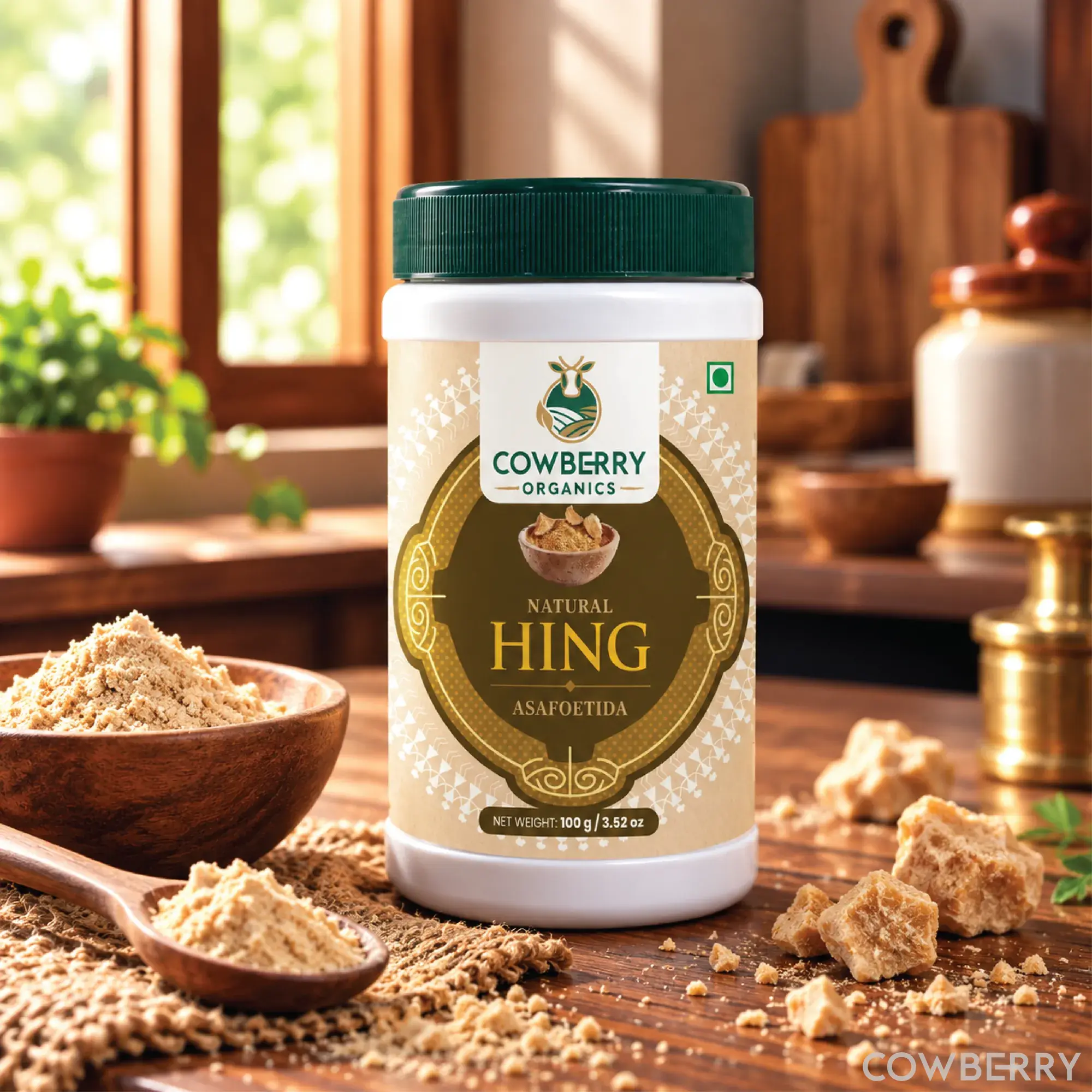
Hing, asafoetida in English, is the oleo-gum-resin from the roots of the Ferula assa-foetida plant, dried. The plant grows across arid Iran, Uzbekistan and Afghanistan, and COWBERRY's natural hing is sourced and processed in Madhya Pradesh; the pack carries no artificial fillers or synthetic additives, no preservatives, no artificial colour, in 100 g packs.
That makes natural hing the reference point of this comparison: one ingredient, the resin, ground and packed. Whatever a compounded pack is, it is measured against this.
What compounded hing is
Compounded hing is a legal category: a compound food, hing prepared with other ingredients, not the resin sold on its own. FSSAI's claim rules draw the line on the word pure. That word fits only a food with a single ingredient, nothing added; compound foods should not generally be called pure, and the most they may say is that they are made with pure ingredients. So a compounded pack cannot put pure on its label or in its name.
What is mixed in is declared, not guessed. The Dietary Guidelines for Indians require the list of ingredients on the pack, in descending order of the quantity used, with the allergen declaration alongside. FSSAI's household test list names the additions its hing checks look for: soapstone or other earthy matter, non-edible gum or resin, and foreign resin. Those are the materials to read for on the label of any hing pack that is not the resin alone.
Nutrition: the tables print the resin, not the mix
IFCT 2017, the Indian food composition tables, lists one entry for this food: asafoetida (hing) itself, the resin. Its entry carries 332 kcal per 100 g, with 6.34 g of protein, 71.95 g of carbohydrate, 1.26 g of fat and 5.13 g of fibre, and iron at 15.68 mg with calcium at 266 mg, in the table below.
IFCT 2017 has no entry for compounded hing, so none is quoted here. The only place its numbers exist is the label, which declares the ingredients in descending order, so a compounded pack's nutrition is whatever its own list of ingredients says, not the resin's entry above.
| Nutrient | Asafoetida (hing) |
|---|---|
| Energy (kcal) | 332 |
| Protein (g) | 6.3 |
| Fat (g) | 1.3 |
| Carbohydrates (g) | 72 |
| Dietary fibre (g) | 5.1 |
| Iron (mg) | 16 |
| Calcium (mg) | 266 |
| Magnesium (mg) | 96 |
| Potassium (mg) | 245 |
| Sodium (mg) | 16 |
| Zinc (mg) | 1 |
| Folate (mcg) | 26 |
Per 100 g raw, edible portion. Composition: IFCT 2017 (ICMR-NIN). — means not reported. These are average values for the food; the label on a pack gives the values for that product.
Taste and cooking: the same pinch, the same rules
The sources cited print the resin's kitchen behaviour, and compounded hing starts from the same material. Raw, hing smells strong and pungent, which earned it the nickname devil's dung; cooked in oil or ghee its taste reads like fried onions, as COWBERRY's product page puts it. The amount stays very small, a pinch into the hot fat at the start of the tadka, for dals, sambar, curries, vegetable dishes and pickles, where hing is commonly used to enhance flavour.
What the compound form adds to that is strength and taste that depend on the mix, and none of them prints a tasting note for compounded hing, so none is given. The honest guide is the same one as before: read the ingredient list, and expect the hing taste to depend on whatever else the pack declares.
Cost and where each fits
No price is printed for either form, per gram or per pack, so none is given here; what FSSAI's claim rules do print is the legal position, which is where the value question lands. The word pure is only legal on the single-ingredient pack, the resin with nothing added, while a compounded pack must declare its additions in descending order. That means the two forms answer two different shopping questions:
- You want the resin and nothing else: natural hing, an ingredient list of one, and the pure claim it is entitled to.
- You are weighing a compounded pack: read the ingredients and the allergen declaration first, then decide whether the mix is what you want to pay for.
Which to choose
Choose by the label, and check what you bought with FSSAI's household tests, set out step by step on the asafoetida adulteration test page. A natural hing pack lists asafoetida alone; COWBERRY's is the natural form, hing sourced and processed in Madhya Pradesh, packed with nothing artificial added: no fillers, no synthetic additives, no preservatives, no colouring.
One more distinction for the same shelf: hing of this kind is described as natural rather than organic. And the full picture of the spice, its names, nutrition and everyday uses, is the hing powder hub.
FAQs
Difference between hing and compounded hing?
Hing is the oleo-gum-resin of Ferula assa-foetida alone, a single ingredient. Compounded hing is the compound form: the same hing with other materials mixed in, and the pack must declare them in descending order of quantity. FSSAI's claim rules give the word pure only to single-ingredient food, so a compounded pack cannot use pure on its label, though it may be described as made with pure ingredients.
Which hing is best?
The single-ingredient one. Buy the pack whose list of ingredients is asafoetida and nothing else, so the whole jar is the resin you paid for. A compounded pack declares its mix in descending order and may not use the word pure. The household checks then read the material: pure hing burns like camphor, and a gram shaken with water goes milky white with no sediment.
What is asafoetida?
Asafoetida is the oleo-gum-resin obtained from the roots of Ferula assa-foetida; milled and sold, it is the hing powder Indian cooking uses by the pinch. The Indian food composition tables, IFCT 2017, print 332 kcal per 100 g for the resin. What it does in the kitchen is on asafoetida how to use.
Is asafoetida good for health?
The honest answer is limited. The 2011 review records traditional uses for asthma, gastrointestinal disorders and intestinal parasites, and its laboratory findings of antifungal, anti-inflammatory and antiviral activity are preclinical, not results from people. A 2014 review notes that spices are eaten in small quantities, which makes their true health benefit hard to establish. The details are on asafoetida benefits.
Does asafoetida have gluten?
The resin itself is not a cereal, and COWBERRY's product page describes its hing powder as naturally gluten-free. On a compounded pack the question belongs to the label: the Dietary Guidelines include proteins in wheat among common allergy-causing ingredients, so the ingredient list, not the name, tells you whether the mix inside is one you can eat.
References
- Indian Food Composition Tables (IFCT) 2017, ICMR-National Institute of Nutrition
- Iranshahy M, Iranshahi M. Traditional uses, phytochemistry and pharmacology of asafoetida (Ferula assa-foetida oleo-gum-resin)-a review. J Ethnopharmacol, 2011
- FSSAI Food Safety and Standards (Advertising and Claims) Regulations 2018, compendium (PDF)
- FSSAI Eat Right India: DART (Detect Adulteration with Rapid Test), salt, spices and condiments tests
- Dietary Guidelines for Indians, ICMR-National Institute of Nutrition
- Opara EI, Chohan M. Culinary herbs and spices: their bioactive properties, the contribution of polyphenols and the challenges in deducing their true health benefits. Int J Mol Sci, 2014
Shop this article
Keep reading
Coriander water benefits: what dhania water actually does
Peanuts in Hindi (moongfali): groundnut names in Indian languages
Coriander vs cilantro: are they the same herb?