by COWBERRY

10 minute read
Hing powder (asafoetida): names, nutrition, benefits and uses

Hing powder is asafoetida, the dried resin of the Ferula assa-foetida plant, a spice Indian kitchens use by the pinch. IFCT 2017 prints 332 kcal, 6.34 g of protein and 15.68 mg of iron per 100 g, but the real serving is a 1 g pinch of about 3.3 kcal. This hub covers the names, the nutrition, the traditional uses, the tests and the cooking method.
What is hing powder?
Hing powder is asafoetida ground fine, and asafoetida is the dried oleo-gum-resin that the roots of Ferula assa-foetida give up. Iranshahy and Iranshahi, in a 2011 Journal of Ethnopharmacology paper, place the resin in kitchens as a spice and in traditional medicine, a double life this guide keeps apart throughout: the pinch in the tempering is one story, the traditional uses no study has yet tested in people are the other. That resin is what gets dried and ground, and it carries both the kitchen story and the medicinal one.
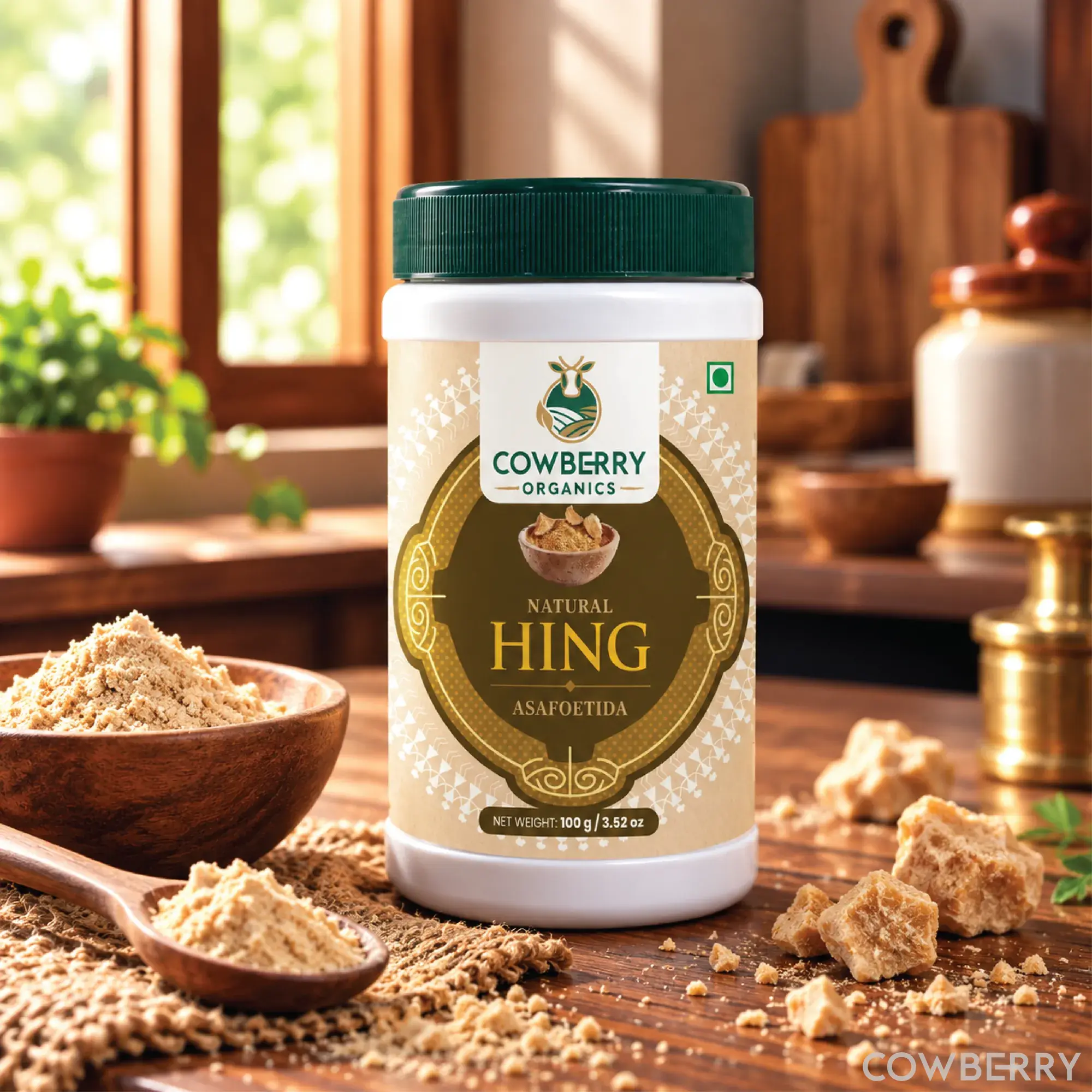
One jar holds two smells. Unheated, the resin is strong and pungent, sharp enough to carry the nickname devil's dung, which COWBERRY's product page recounts; fried briefly in oil or ghee, it mellows into something close to fried onions. That turnaround is why hing belongs in hot fat, not sprinkled on a finished plate, and asafoetida is only the English label: the words every Indian language uses are on the hing in english page.
Hing names in Indian languages
The Indian food composition tables, IFCT 2017, file the spice as asafoetida (hing), and their language column lists thirteen words for it. Seven languages share one spelling: Hindi, Marathi, Gujarati, Punjabi, Bengali, Assamese and Urdu each print hing. After that the words change: hingu in Odia and Kannada, inguva in Telugu, perugayam in Tamil, perungayam in Malayalam, and badhika in Sanskrit. The table below reproduces the column untouched.
The pattern is geographic: hing carries across the north, the west and most of the east, hingu appears in Odia and Kannada, inguva in Telugu, and Tamil and Malayalam keep their own words. All thirteen trace to a single food code, and the complete trail sits on the hing in english page.
| Language | Name (romanised) |
|---|---|
| English | Asafoetida |
| Hindi | Hing |
| Marathi | Hing |
| Gujarati | Hing |
| Punjabi | Hing |
| Bengali | Hing |
| Odia | Hingu |
| Assamese | Hing |
| Kannada | Hingu |
| Telugu | Inguva |
| Tamil | Perugayam |
| Malayalam | Perungayam |
| Urdu | Hing |
| Sanskrit | Badhika |
| Botanical name | Ferula assa-foetida |
Source: IFCT 2017 (ICMR-NIN) local-names list. — means no name recorded in the source.
Hing powder nutrition per 100 g
For 100 g of dried resin, IFCT 2017 lists 332 kcal, 6.34 g of protein, 1.26 g of fat, 71.95 g of carbohydrate and 5.13 g of fibre; the minerals follow at 15.68 mg of iron, 266 mg of calcium, 96.40 mg of magnesium, 245 mg of potassium, 16.04 mg of sodium, 0.98 mg of zinc and 26.28 mcg of folate. Since no dish ever sees a hundred grams, the useful unit is the pinch.
Scaled down: a single gram, roughly one pinch, works out to about 3.3 kcal, 0.06 g of protein, 0.72 g of carbohydrate, 0.16 mg of iron and 2.7 mg of calcium. That is the arithmetic a plate actually meets; the dal, grain and vegetables supply the meal's energy and minerals, while the seasoning contributes taste for a few kilocalories. At 16.04 mg of sodium per 100 g, the cook's own hand sets nearly all the salt in a hing-tempered dish. The complete row, the cumin and mustard seed comparisons, and the arithmetic behind every figure are on the asafoetida nutrition page.
| Nutrient | Asafoetida (hing) |
|---|---|
| Energy (kcal) | 332 |
| Protein (g) | 6.3 |
| Fat (g) | 1.3 |
| Carbohydrates (g) | 72 |
| Dietary fibre (g) | 5.1 |
| Iron (mg) | 16 |
| Calcium (mg) | 266 |
| Magnesium (mg) | 96 |
| Potassium (mg) | 245 |
| Sodium (mg) | 16 |
| Zinc (mg) | 1 |
| Folate (mcg) | 26 |
Per 100 g raw, edible portion. Composition: IFCT 2017 (ICMR-NIN). — means not reported. These are average values for the food; the label on a pack gives the values for that product.
Hing benefits and side effects
One paper stands behind every claim made about hing's uses. Iranshahy and Iranshahi's 2011 review in the Journal of Ethnopharmacology records what tradition asks of the resin, asthma, gastrointestinal disorders and intestinal parasites, and what the laboratory has found in it: antifungal and antiviral activity, plus anti-diabetic, anti-inflammatory and anti-mutagenic findings. Those findings are laboratory work, and none of the traditional uses has a measured human result to its name.
Two older papers set the honest frame. An essay on Indian spices from 2008 observes that the world knows India by its spices, and that biomedical research is only now giving the traditional uses a scientific footing. A 2014 piece by Opara and Chohan adds the practical reason the evidence stays thin: people eat these spices in tiny amounts, mixed into other foods, so any true health benefit is hard to pin down. Hing, used a pinch at a time, sits at the far end of that pattern. Hing earns its shelf space on flavour, which is exactly what the kitchen half of this guide is about.
On side effects the record is equally plain: none of these texts prints a list of them for hing, so this guide does not invent one. The cautions that do exist are practical: keep the amount very small, a pinch per dish; read the additions on any compounded pack, which the label declares; and give wheat proteins due care, since the Dietary Guidelines count them among the common allergy-causing ingredients. Anyone whose asthma or long-standing digestive condition tempts them to make hing more than a seasoning should talk to their doctor or dietitian first. The detailed reading is on asafoetida benefits, and the Hinglish telling on asafoetida khane ke fayde.
How to use hing powder
Hing has exactly one cooking route. A pinch meets the hot fat, oil or ghee, at the tempering's start, before the seeds go in, and the finished tempering is poured over the food. One small addition like that flavours a dal, a sambar, a curry or a vegetable dish, the same uses COWBERRY's pack names, and pickle oil takes it too, for the same reason.
Two habits keep it right. Amount first: very small, and the second pinch waits until the dish is tasted. Then heat: hing is cooked, never raw, because the fried-onion smoothness only appears in the hot fat. At about 3.3 kcal a pinch, there is no volume to argue for. The step-by-step method, solid hing included, is on asafoetida how to use.
A pinch across the day
Once you know the move, it shows up at every meal. Morning upma and poha start with hing in the oil, before the semolina or rice flakes join; afternoon dal and sambar take the pinch at the tempering that finishes them; evening curries and vegetable dishes follow the same order, and pickle jars carry it in their seasoning oil. The spice never changes; only the dish does.
That spread explains the economics of the jar: a single pack of powder seasons a kitchen for a very long time at one pinch per dish, provided the lid stays airtight so the aroma survives the months. The pinch rule scales: one pinch seasons a home dish, and the jar keeps working as long as the aroma holds. For the complete method, see asafoetida how to use.
How hing powder is made
The jar starts life as resin, not seed. The dried oleo-gum-resin is milled to a powder, and the solid form is common enough that FSSAI's home-test instructions begin by powdering a gram of it. Since the resin is the whole spice, the per-100 g figures above describe the asafoetida itself rather than a mixture. COWBERRY's natural hing is handled in Madhya Pradesh, where it is sourced and processed, and the pack adds nothing artificial: no artificial colour, no preservatives, no synthetic additives, no fillers, in 100 g packs.
The whole journey from plant to powder is on how asafoetida is made.
Natural hing vs compounded hing, and the home tests
Shelves offer two styles of jar. The natural form is the resin alone, a single material; the compounded form mixes in other materials, declared on the label in descending order, so the label of a compounded pack is really a reading list of additions. The two sit side by side on hing vs compounded hing.
For what may hide in a jar, FSSAI's Detect Adulteration with Rapid Test page runs four kitchen checks. The burn test: the pure spice burns like camphor. The water test: a milky white solution with nothing settled means pure, and sediment means non-edible gum or resin. The settling test hunts soapstone and other earthy matter, which drop to the bottom as sand does. A fourth entry covers starch, and all four checks run in the kitchen with a flame and water. The step-by-step versions are on how to check hing purity.
Glycemic index and vitamin C: what is not printed
Two gaps in the printed figures deserve plain statement. IFCT 2017 gives asafoetida no glycemic index and no vitamin C value, and this guide quotes neither. In practice neither absence matters: the pinch holds 0.72 g of carbohydrate, and a meal's glycemic response belongs to its dal, rice or roti. The 2014 review makes the matching point about the whole spice shelf: such foods arrive at the table in tiny amounts, joined to other foods, which is why how much they add to health stays unclear. These tables print no GI and no vitamin C figure for hing, so this guide gives neither.
Buying and storing hing powder
Buying is simpler than the shelf looks: pick the natural form, the resin alone, and give any compounded pack a label-reading pass. COWBERRY's natural hing comes from Madhya Pradesh, where it is sourced and processed, packed to the nothing-artificial standard described above, in 100 g packs, and the product is described as natural, not organic.
At home the jar asks for one thing: an airtight lid in a cool, dry place, which is what preserves the strong aroma and flavour. The Dietary Guidelines note that the pack shows its manufacture date and use-by or expiry date, plus storage instructions, so follow the maker's line. A dry spoon, lid straight back on: that is the whole routine, because moisture is what the powder must stay clear of. Kept sealed and dry, the powder seasons dish after dish at a pinch per use, and the cooking method it belongs to is covered above, under how to use hing powder.
FAQs
What is asafoetida?
Asafoetida is the dried resin of Ferula assa-foetida's roots, long in use as a kitchen spice and in traditional medicine across different countries; Iranshahy and Iranshahi describe it that way in their 2011 Journal of Ethnopharmacology review. Unheated it smells strong and pungent; fried in oil or ghee it becomes mild, close to fried onions. Indian kitchens call the same resin hing.
Is hing asafoetida?
Yes: hing is simply the Hindi name for asafoetida, the spice IFCT 2017 files as asafoetida (hing). The same resin is called hingu in Odia and Kannada, inguva in Telugu, and perugayam and perungayam in Tamil and Malayalam. Thirteen Indian languages have their own printed name for it.
What does hing taste like?
Cooked, it tastes like fried onions: that is the flavour COWBERRY's product page names for hing once it meets hot oil or ghee. Raw it is the opposite, strong and pungent, the reason it is cooked, not eaten raw, and the reason for its nickname, devil's dung. A single pinch flavours a whole dal or sabzi.
Does asafoetida have gluten?
Not the resin itself: hing comes from a plant, not a grain, and COWBERRY's page calls its powder naturally gluten-free. Compounded packs change the question, because their additions matter: the Dietary Guidelines count wheat proteins among the common allergy-causing ingredients, so read the label first.
Why asafoetida is called devil's dung?
Because of its raw smell. Uncooked, hing carries a strong, pungent aroma, and that is the source of the nickname, as COWBERRY's product page recounts; once a pinch fries in hot oil or ghee, the same spice smells smooth, like fried onions. The name belongs to the raw resin, not to the cooked dish.
References
- Indian Food Composition Tables (IFCT) 2017, ICMR-National Institute of Nutrition
- Dietary Guidelines for Indians, ICMR-National Institute of Nutrition
- Iranshahy M, Iranshahi M. Traditional uses, phytochemistry and pharmacology of asafoetida (Ferula assa-foetida oleo-gum-resin)-a review. J Ethnopharmacol, 2011
- Opara EI, Chohan M. Culinary herbs and spices: their bioactive properties, the contribution of polyphenols and the challenges in deducing their true health benefits. Int J Mol Sci, 2014
- Krishnaswamy K. Traditional Indian spices and their health significance. Asia Pac J Clin Nutr, 2008
- FSSAI Eat Right India: DART (Detect Adulteration with Rapid Test), salt, spices and condiments tests
Shop this article
Keep reading
Coriander water benefits: what dhania water actually does
Peanuts in Hindi (moongfali): groundnut names in Indian languages
Coriander vs cilantro: are they the same herb?