by COWBERRY

6 minute read
Hing in english: asafoetida names in hindi, tamil, telugu and more

Hing in English is asafoetida, the dried oleo-gum-resin of Ferula assa-foetida, and hing in Hindi is hing itself, the word the spice carries across north and west India. Tamil calls it perugayam, Telugu inguva, Kannada hingu, Odia hingu and Sanskrit badhika. Every name is below with its source; the spice itself is covered on the hing powder hub.
Hing in English, Hindi and every Indian language: quick answer
One line per language: Hindi hing, Marathi hing, Gujarati hing, Punjabi hing, Bengali hing, Assamese hing, Urdu hing, Odia hingu, Kannada hingu, Telugu inguva, Tamil perugayam, Malayalam perungayam and Sanskrit badhika. In English the spice is asafoetida, and the botanical name is Ferula assa-foetida.
Every row of the table traces to IFCT 2017, the Indian food composition tables, which print the local-names list for food code G019. The same table is the source for the thirteen language names, and every name here is written in Latin letters, spelt as IFCT prints it. The resin behind the names, its nutrition and its traditional uses are on the asafoetida benefits page.
| Language | Name (romanised) |
|---|---|
| English | Asafoetida |
| Hindi | Hing |
| Marathi | Hing |
| Gujarati | Hing |
| Punjabi | Hing |
| Bengali | Hing |
| Odia | Hingu |
| Assamese | Hing |
| Kannada | Hingu |
| Telugu | Inguva |
| Tamil | Perugayam |
| Malayalam | Perungayam |
| Urdu | Hing |
| Sanskrit | Badhika |
| Botanical name | Ferula assa-foetida |
Source: IFCT 2017 (ICMR-NIN) local-names list. — means no name recorded in the source.
Asafoetida in English: the botanical name and the devil's dung nickname
Asafoetida in English is the standard name, and IFCT 2017 pairs it with the botanical name Ferula assa-foetida under food code G019. A 2011 review in the Journal of Ethnopharmacology defines the material the name covers: an oleo-gum-resin obtained from the roots of different Ferula assa-foetida.
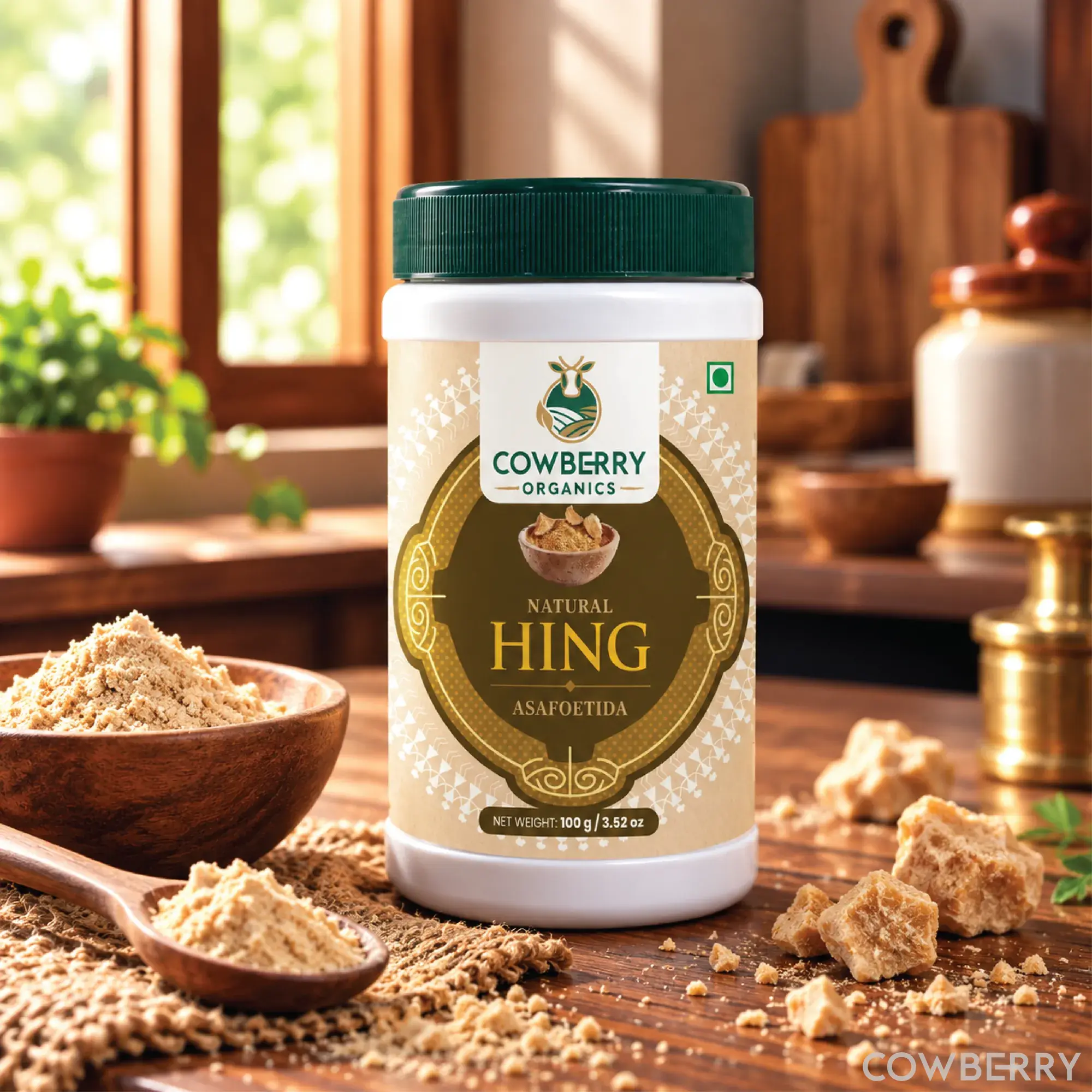
The spice's other English nickname is less polite. COWBERRY's product page tells the story that hing's strong and pungent aroma earned it the nickname devil's dung, and the same page notes what cooking does to that smell: in hot oil or ghee it becomes the smooth flavour of fried onions. So the name is about the raw resin's smell, not the taste of a cooked dish.
Hing names by region
North India: hing in Hindi, Punjabi and Urdu
IFCT prints the same word for all three: hing. That makes asafoetida in Hindi simply hing, and the word works unchanged in Punjabi and Urdu too, which is why the jar in a Delhi, Lucknow or Amritsar kitchen says hing.
West India: hing in Marathi and Gujarati
Marathi and Gujarati also print hing, the same four letters. A Maharashtrian amti and a Gujarati dal share the name as well as the pinch.
East India: hing in Bengali, Assamese and Odia
Bengali and Assamese keep hing; Odia lengthens it to hingu. So a Bengal kitchen and a Bhubaneswar kitchen reach for jars with two different spellings of the same resin.
South India: hingu in Kannada, inguva in Telugu, perugayam in Tamil and Malayalam
Kannada prints hingu and Telugu prints inguva, close cousins of the northern word. Tamil prints perugayam and Malayalam prints perungayam, one letter apart. COWBERRY's product listing also carries kayam and perungayam among its search terms for the same powder. Sanskrit, the classical name, is badhika.
Often confused with: compounded hing, and the resin vs the seed spices
Two confusions come up in shops and searches.
- Hing vs compounded hing: not two names for one thing, but two products. Hing itself is the resin, while compounded hing is the compound form, hing with other materials mixed in, and the label has to declare them. The difference, including what the word pure may say on a pack, is on hing vs compounded hing.
- A resin, not a seed: hing sits on the same shelf as cumin, mustard and fenugreek, but it is not one of them. The Dietary Guidelines for Indians count asafoetida among the spices in their food lists, next to cumin, fenugreek and mustard seeds, chillies and ginger. It comes from a root, not a seed.
Where the Ferula plant grows
The plant behind every name above grows outside India. COWBERRY's product notes place Ferula in arid Iran, Uzbekistan and Afghanistan, and the same notes say the powder itself is sourced and processed in Madhya Pradesh. None of these texts prints an Indian growing region, so none is claimed.
What Indian tables do print is the resin's make-up: IFCT 2017 lists 332 kcal per 100 g, with iron at 15.68 mg and calcium at 266 mg. The full row is under asafoetida nutritional value per 100g, how the resin becomes the powder on the shelf is told on how asafoetida is made, and the names, nutrition and uses all come together on the hing powder hub.
FAQs
Why asafoetida is called devil's dung?
Because of its smell. COWBERRY's product page tells it plainly: hing's strong and pungent aroma earned it the nickname devil's dung. The name describes the raw resin, which is why the same page adds that cooking in oil or ghee turns the smell into a smooth flavour reminiscent of fried onions. The cooked dish owes nothing to the nickname.
What is asafoetida in hindi?
Hing. IFCT 2017 prints hing as the Hindi name for asafoetida under food code G019, and the same word serves for Marathi, Gujarati, Punjabi, Bengali, Assamese and Urdu. So the common jar across north and west India is hing, whether the label is written in Hindi or in English letters.
Is hing asafoetida?
Yes, one and the same. Hing is the Hindi name, asafoetida the English one, and IFCT 2017 lists both against the botanical name Ferula assa-foetida under food code G019. The dried oleo-gum-resin of the plant's roots is the spice under either name, whether a shop sells it as hing powder or asafoetida powder.
What is asafoetida?
Asafoetida is the dried oleo-gum-resin obtained from the roots of Ferula assa-foetida, in the words of a 2011 review in the Journal of Ethnopharmacology, sold ground as hing powder and used in very small amounts in Indian cooking. IFCT 2017 lists it at 332 kcal per 100 g. Its cooking uses are on asafoetida how to use.
Difference between asafoetida and compounded asafoetida?
Asafoetida is the resin on its own, one ingredient; compounded asafoetida is the compound form, hing with other materials mixed in, and the label has to declare them in descending order of quantity. Under FSSAI claim rules, pure is for single-ingredient food only, so a compounded pack cannot call its contents pure hing. The full comparison is on hing vs compounded hing.
Is asafoetida good for health?
The honest answer is a limited one. A 2011 review records the traditional uses: asthma, gastrointestinal disorders and intestinal parasites, with antifungal, anti-inflammatory and antiviral activity shown in the laboratory, though those findings are preclinical. A 2014 review adds that the small quantities spices are eaten in make their true health benefit hard to establish, as the review puts it. The details are on asafoetida benefits.
References
- Indian Food Composition Tables (IFCT) 2017, ICMR-National Institute of Nutrition
- Dietary Guidelines for Indians, ICMR-National Institute of Nutrition
- FSSAI Food Safety and Standards (Advertising and Claims) Regulations 2018, compendium (PDF)
- Iranshahy M, Iranshahi M. Traditional uses, phytochemistry and pharmacology of asafoetida (Ferula assa-foetida oleo-gum-resin)-a review. J Ethnopharmacol, 2011
- Opara EI, Chohan M. Culinary herbs and spices: their bioactive properties, the contribution of polyphenols and the challenges in deducing their true health benefits. Int J Mol Sci, 2014
Shop this article
Keep reading
Coriander water benefits: what dhania water actually does
Peanuts in Hindi (moongfali): groundnut names in Indian languages
Coriander vs cilantro: are they the same herb?