by COWBERRY

8 minute read
Asafoetida adulteration test: how to check hing purity at home

Asafoetida adulteration test: FSSAI's household list has a burn test where pure asafoetida burns like camphor, a water test that flags non-edible gum or resin, and a settling test for soapstone and earthy matter, plus a short starch entry. Each is below step by step, with what it cannot catch and what to read on the label; the hing powder hub covers the spice itself.
Why hing adulteration happens
Spices are among the foods that get mixed with other things. The Dietary Guidelines for Indians name spices among the frequently adulterated food items, and their list of what is added includes extraneous matter such as husk, sand and sawdust in spices; at times, the same guidelines note, spoilt or poor-quality food is made to look fresh by adding harmful colours or other chemicals. Hing, a spice sold by the gram, is part of that picture, and FSSAI writes household checks for it.
FSSAI's DART manual (Detect Adulteration with Rapid Test) states its purpose plainly: adulteration deceives the consumer and can put health at risk, and the manual lists the common methodologies for the adulterants generally found in India, with a scope meant for households so that buyers can check for themselves. For hing it names foreign resin, non-edible gum or resin and soapstone or other earthy matter, and a short fourth entry adds the sample to water to look for starch. The three full checks are below.
Asafoetida adulteration test at home: the burn test
The first check is FSSAI's test for foreign resin in hing, and it reads the flame. Pure asafoetida is itself a resin, and it burns the way camphor does; a pack stretched with other resin burns differently.
The burn test, step by step
- Take a small quantity of asafoetida, a pinch to a quarter teaspoon, on a stainless steel spoon.
- Hold the spoon over the flame and burn the hing.
What you see
- Burns like camphor: a bright flame, the way camphor burns, reads as pure asafoetida in FSSAI's list.
- No bright camphor-like flame: FSSAI reads that as adulterated asafoetida, the signature of foreign resin mixed in.
Burn only a small quantity and keep the spoon over the sink or a steel plate; the sample on the spoon is not food afterwards, so throw it away rather than returning it to the jar. The test targets one thing, foreign resin, and says nothing about anything else.
The water test for non-edible gum or resin
FSSAI's second check for hing is a shake in a glass. Pure asafoetida mixes with water into a milky white solution that settles nothing out; non-edible gum or resin, the second addition the list names, shows up as sediment.
The water test, step by step
- Powder a gram of asafoetida and take it in a glass container.
- Add one teaspoon of water.
- Mix thoroughly by shaking.
What you see
- Milky white solution with no sediments: FSSAI reads that as pure asafoetida.
- Sediment at the bottom: the list's reading is non-edible gum or resin in the sample.
The word to watch is sediments, not colour: the milky white look itself is expected of pure hing. A gram is a small amount, and the sample goes down the sink after the check.
The soapstone and earthy matter test
The third check looks for soapstone and other earthy matter, which settle to the bottom of the water the way sand does.
The settling test, step by step
- Shake a little portion of the sample with water.
- Allow it to settle.
What you see
- Nothing at the bottom: pure asafoetida will not leave any soapstone or other earthy matter at the bottom.
- Soapstone or earthy matter settled at the bottom: that is the list's reading of adulterated hing.
All three checks together cover three of the additions FSSAI names for hing: foreign resin, non-edible gum or resin, and soapstone or other earthy matter. A jar that passes all three has passed what a household can check, and nothing more than that.
What the home tests cannot tell you, and the FSSAI standard
The three tests are kitchen-side awareness, not a full analysis. FSSAI itself describes the manual's scope as household, aimed at building consumer awareness about food safety, so the tests tell you whether the named additions are present in the sample you took, and they are silent on everything else. Confirming the complete make-up of a pack beyond those additions is laboratory work, and FSSAI's page closes with its contact email, labs@fssai.gov.in.
The claim rules also fix what the word pure may say. In FSSAI's Advertising and Claims Regulations, pure fits only a single-ingredient food: nothing added to it, free from avoidable contamination, and any unavoidable contaminants below the prescribed limits. Compound foods are generally not to be called pure; the most they may claim is to be made with pure ingredients, when each ingredient meets that test. The word cannot sit in a brand or fancy name to hint at a purity the food does not have. For hing, that is exactly the line between the resin sold alone and a compounded pack: only the single-ingredient jar may claim pure.
What to read on the label
A label cannot prove purity; what it does is name who is answerable for the jar and what they declare. The Dietary Guidelines for Indians list what a pack shows: the name of the food, the list of ingredients, net weight, brand name, the manufacturer's name and address, date of manufacture, use-by or expiry dates, storage instructions and the allergen declaration. The ingredients appear in descending order, the one used in the highest quantity first. On a hing jar, read these:
- The ingredient list: a single-ingredient hing pack lists asafoetida and nothing else. Any other material, resin, gum, starch or salt, is declared there, in descending order.
- The FSSAI logo with licence number: the guidelines explain that the logo carrying a licence number shows the maker is licensed by the regulator.
- AGMARK: the same guidelines give AGMARK on agricultural products such as spices as a mark of quality.
- Dates and storage: date of manufacture, use-by date and storage instructions; hing wants a sealed jar in a cool, dry place.
- Claims on the front: the guidelines advise cross-checking the claims with the ingredients and nutrition information on the label. Under FSSAI claim rules, pure on a hing pack may only mean the single-ingredient resin, as above.
Buying natural hing: what a clean pack looks like
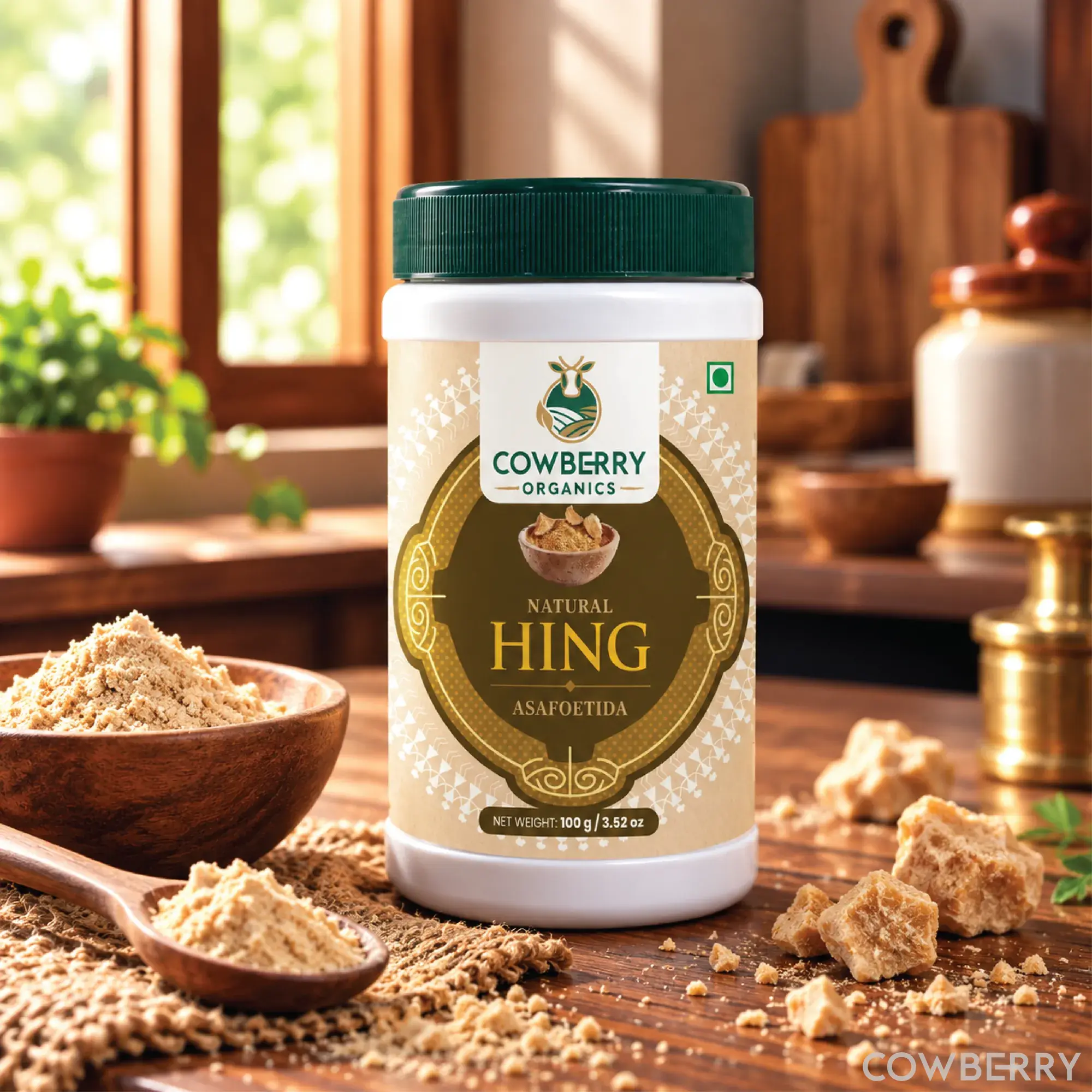
A pack that needs none of the three tests to reassure you is one whose ingredient list is asafoetida alone. COWBERRY's natural hing is sourced and processed in Madhya Pradesh, with a pack that claims no synthetic additives, no artificial fillers, no preservatives and no artificial colour, in 100 g packs; this kind of hing is described as natural, not organic. Run the FSSAI checks on any new jar once, keep the lid tight, and re-read the label of each pack you buy.
How the natural form differs from the compounded packs on the same shelf is set out on hing vs compounded hing, and the full guide to the spice, its names and its uses, is the hing powder hub.
FAQs
How to identify pure asafoetida?
Run FSSAI's household checks for hing. Burn a small quantity in a stainless steel spoon: pure asafoetida burns like camphor. Powder a gram, shake it with a teaspoon of water: pure hing gives a milky white solution with no sediments. Shake a little more with water and let it settle: pure hing leaves no soapstone or earthy matter at the bottom. Any fail means that addition is present.
Difference between asafoetida and compounded asafoetida?
Asafoetida is the resin on its own, while compounded asafoetida is the compound form: hing with other materials mixed in, declared on the label in descending order of quantity. Under FSSAI claim rules the word pure is for single-ingredient food only, so a compounded pack may at most say it is made with pure ingredients, never pure hing. The two are compared on hing vs compounded hing.
Which hing is best?
The jar whose list of ingredients is asafoetida alone, so the whole pack is the spice you paid for. Anything else mixed in must be declared on the label, in descending order, and rules out the word pure. Past the label, FSSAI's household checks, the camphor burn, the milky water shake and the settling test, read the material itself.
What is asafoetida?
Hing, the asafoetida of English, is the dried oleo-gum-resin that Ferula assa-foetida roots produce, ground and sold as a powder, for cooking in very small amounts. The Indian food composition tables, IFCT 2017, list it under food code G019. For its kitchen work, see asafoetida how to use, and how the resin is produced is on how asafoetida is made.
Does asafoetida have gluten?
Hing itself is a plant resin, not a cereal grain, and the COWBERRY product page calls its hing powder naturally gluten-free. Every pack carries an allergen declaration; the Dietary Guidelines name proteins in wheat among common allergy-causing ingredients, so on a compounded pack the label, not the name, tells you what is in the jar. Read it before you buy.
References
- FSSAI Eat Right India: DART (Detect Adulteration with Rapid Test), salt, spices and condiments tests
- Dietary Guidelines for Indians, ICMR-National Institute of Nutrition
- FSSAI Food Safety and Standards (Advertising and Claims) Regulations 2018, compendium (PDF)
- Iranshahy M, Iranshahi M. Traditional uses, phytochemistry and pharmacology of asafoetida (Ferula assa-foetida oleo-gum-resin)-a review. J Ethnopharmacol, 2011
Shop this article
Keep reading
Coriander water benefits: what dhania water actually does
Peanuts in Hindi (moongfali): groundnut names in Indian languages
Coriander vs cilantro: are they the same herb?