by COWBERRY

10 minute read
Amchur powder (dry mango powder): names, nutrition, benefits and uses

Amchur powder is dried, ground raw green mango: a pale, tart powder that sours chaat, chole and chutneys without a drop of liquid. This hub collects what is printed about it — what it is, its names, its per-100g numbers, the research, the side effects, storage and buying — and links every amchur page on this site. Start at the names table, or jump to the section you need.
What is amchur powder
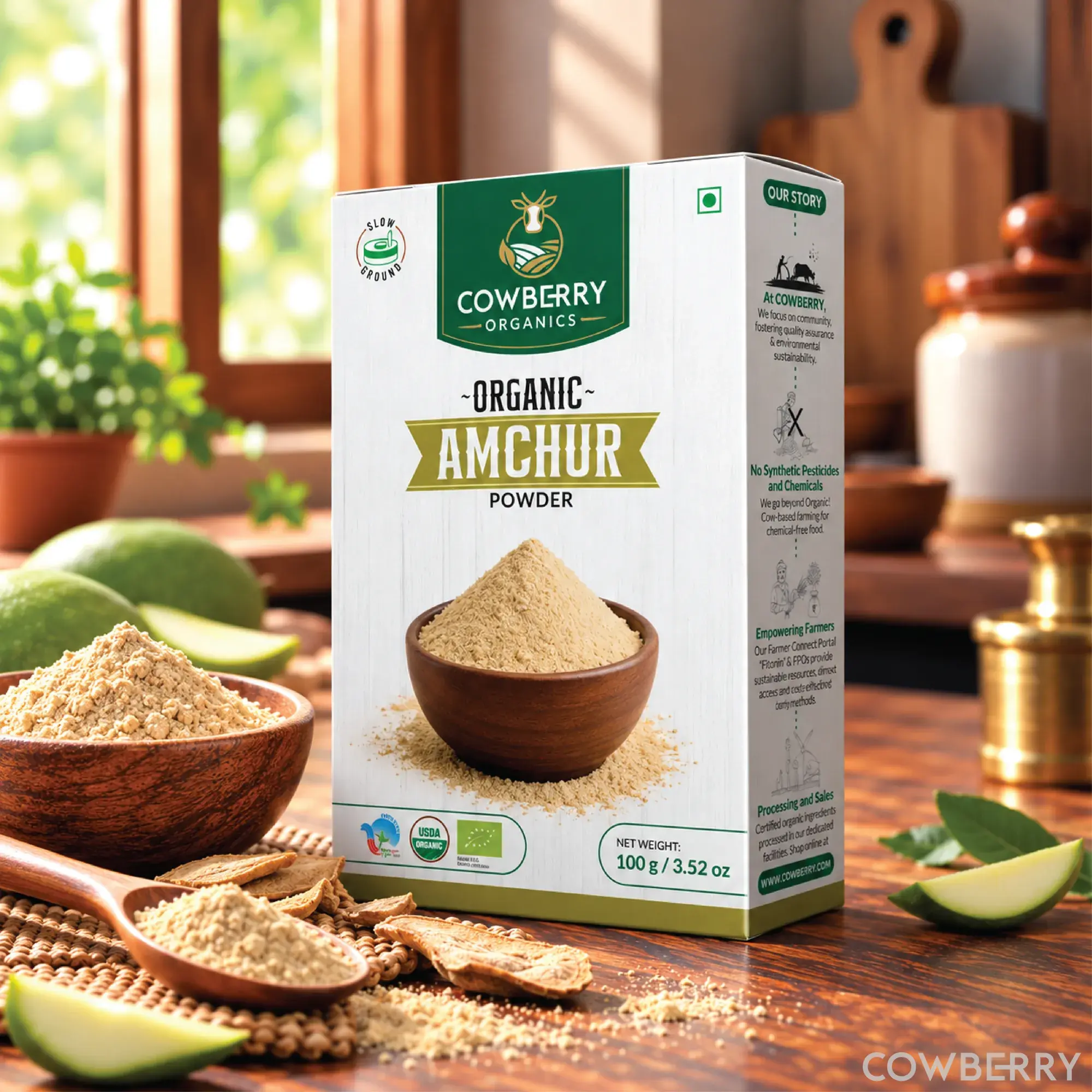
Amchur powder is made of one thing: raw green mango. The fruit is picked unripe and green, then peeled, sliced, sun-dried and ground into a fine, pale powder with a tart, fruity tang; the label on COWBERRY's amchur pack names the mangoes as grown in Uttar Pradesh and Madhya Pradesh. Nothing else is added: no colours, no preservatives, no flavour enhancers. In the jar the powder looks like pale, fine dust, and it smells and tastes of green mango made sharp, a tartness that lands on the tongue the moment it lands on the food. Because it is already ground, it needs no soaking or cooking: a pinch from the jar is ready to use. The powder's whole job is to sour food without wetting it, which is why it belongs to dry things — chaat, spice blends, salads, roasted snacks — while wet sours such as tamarind do a different job in stews and chutneys. The making, stage by stage, is on the how to make amchur powder at home page.
Amchur names in Indian languages
The table below prints every name on record for the powder. Hindi leads with amchur, and the spelling aamchur appears just as often on packs; English calls it mango powder, or dry mango powder in full. Those three names are the entire record: no Tamil, Telugu, Bengali or Marathi name is printed in any source, so none is guessed. Shops may also spell it amchoor, a spelling the Wikipedia article on the powder uses in its title; whichever spelling a pack carries, the powder inside is the same. The language-by-language walk, with how each name behaves in a shop or a recipe, is on the amchur in english page.
| Language | Name (romanised) |
|---|---|
| English | Mango powder |
| Hindi | Amchur, Aamchur |
| Marathi | — |
| Gujarati | — |
| Punjabi | — |
| Bengali | — |
| Odia | — |
| Assamese | — |
| Kannada | — |
| Telugu | — |
| Tamil | — |
| Malayalam | — |
| Urdu | — |
| Sanskrit | — |
| Botanical name | — |
Source: no source found. — means no name recorded in the source.
English ‘Mango powder’: Wikipedia: Amchoor. Hindi ‘Amchur’: Wikipedia: Amchoor. Hindi ‘Aamchur’: Wikipedia: Amchoor.
Amchur nutrition per 100 g: the pack label reading
IFCT 2017 prints no per-100 g entry for amchur, so this page does not invent one. The table below therefore shows the one honest comparison that is printed, tamarind pulp's full printed entry, and leaves amchur's column out. For the powder's own numbers this page reads the pack label: 378.9 kcal, 86.1 g of carbohydrate, 8.7 g of dietary fibre and 3.9 g of protein per 100 g, and a level teaspoon (3 g) turns those into about 11.4 kcal, 2.6 g of carbohydrate, 0.3 g of fibre and 0.1 g of protein, the amount a dish actually meets. No glycemic index value is printed for the powder, and none is claimed here. The amchur nutritional value per 100g page carries the full read-down, minerals and per-teaspoon figures included.
| Nutrient | Tamarind pulp |
|---|---|
| Energy (kcal) | 289 |
| Protein (g) | 2.9 |
| Fat (g) | 0.1 |
| Carbohydrates (g) | 67 |
| Dietary fibre (g) | 5.3 |
| Iron (mg) | 9.2 |
| Calcium (mg) | 149 |
| Magnesium (mg) | 83 |
| Potassium (mg) | 836 |
| Sodium (mg) | 25 |
| Zinc (mg) | 0.6 |
| Folate (mcg) | 9.8 |
| Vitamin C (mg) | 3.6 |
Per 100 g raw, edible portion. Composition: IFCT 2017 (ICMR-NIN). — means not reported. These are average values for the food; the label on a pack gives the values for that product.
Dry mango powder benefits: what the research shows
The research on amchur is thin and mostly laboratory work, and the honest summary is short. In a 2011 digestion-model study, the powder was combined with carrot, onion or garlic, and the mix lifted the iron that a digestion model releases from food grains — yet only for a few of the grains tested; zinc in the same model moved the same way, in a few instances, when onion or garlic joined the powder. A 2014 Food Chemistry analysis reported copper at 77.68 micrograms per gram in mango powder, alongside very low levels of arsenic, cadmium and lead. A 2014 review supplies the frame: spices are eaten in small quantities alongside other foods, so their true health benefit stays unclear, and the research on the powder includes no human trial. None of these papers is a human trial: each finding lives in a laboratory model or a composition table, and this hub states them as exactly that. The dry mango powder benefits page walks through all ten benefits, each with its source, and the same material in Hindi sits on amchur ke fayde aur nuksan.
Amchur side effects: who should go easy
No documented side effects of amchur at cooking amounts turn up in the published research, so this section is mostly precaution. The powder is sour by nature, and anyone whose stomach objects to sour foods does best with smaller pinches; where acidity or reflux is already part of the picture, a doctor or dietitian should help decide how much sour the plate carries. No study in the published research tests amchur against any stomach complaint, and this page does not claim it calms or worsens one. One practical caution has a printed source: the Dietary Guidelines for Indians flag powdered spices as the ones more likely to be adulterated, so a certified pack and a shut, dry jar are the two easy defences. Expectations matter more than warnings here: amchur is a seasoning, and the amounts a kitchen uses are pinches, not portions.
How to cook with amchur
Amchur lands at the end of a dish more than the start. Over chaat, sliced fruit, roasted snacks and salads it goes on as a final shake; into dals, curries and soups it goes near the end of cooking, where the tang stays bright; into marinades and dry spice blends it goes at any point. Chole and bhindi are classic homes for a finishing pinch, and one shake turns a fruit salad into a street-style plate. It also travels well: into picnic salads, tiffin boxes and dry snack mixes, places a wet sour cannot go. Three recipes show the range: the chaat masala recipe builds the blend on the powder, the jeera aloo recipe ends with the powder shaken over the potatoes, and imli chutney pairs the same chaat with its tamarind side. When a dish must stay dry, the powder is the sour that fits, where tamarind's paste would loosen everything; the amchur vs tamarind page sets out the full choice dish by dish.
How to store amchur powder
Amchur keeps for months with two rules: keep it dry and keep it shut. An airtight jar in a cool, dark cupboard, away from the stove's steam and the sun, holds the powder's tang, and a dry spoon every time keeps moisture out. Moisture is the only real enemy: a powder that has clumped into lumps or smells flat has taken some in and is past its best, and a jar left open over a steaming pot is exactly how that happens. A teaspoon that goes into a hot pan and back into the jar is the other habit to avoid, for the same reason. A small pack used within a season of regular cooking is usually finished before it can fade, and a fresh jar beats a faded one. If the jar is empty and dinner is mid-way, the amchur substitute page lists what to use instead.
Which amchur powder to buy
Buy from a certified pack rather than a loose scoop; the certification matters because powdered spices are the easy ones to adulterate, as the dietary guidelines above note. Why COWBERRY's Organic Amchur Powder: raw green mangoes from Uttar Pradesh and Madhya Pradesh, sun-dried, finely ground, no artificial colours or preservatives, and the pack is India Organic, USDA & EU certified. Whichever brand the shelf offers, an ingredient list that says raw mango and nothing else is the label to look for. An airtight, resealable jar does the first month of the storage job by itself; after that the rules of the section above take over. Size the pack to the kitchen's pace, so the powder is finished well before it can fade.
The amchur reading list: names, nutrition, benefits, Hindi
Amchur answers to more than one name on Indian shelves, and the amchur in english page lists them language by language: mango powder on English shelves, amchur and aamchur on Hindi packs. When a recipe or a shop sign uses a different word for the same powder, that page is the translator.
The amchur nutritional value per 100g page does the honest arithmetic: since IFCT 2017 prints no amchur entry, it reads the pack label per 100 g, then divides by the level teaspoon, and sets the figures beside tamarind pulp's printed entry. It also faces the GI question squarely by admitting no GI value is printed.
The dry mango powder benefits page walks through ten benefits, each tied to its source, from the kitchen ones that hold up today to the laboratory ones that are still early. Its side-effects and how-much-per-day sections stay inside what the published papers print.
The same material in Hindi, amchur ke fayde aur nuksan, keeps every number and hedge from the English benefits page and says them in everyday Hindi-English. Readers who prefer Hindi get the identical claims, none added, none dropped.
The amchur reading list: vs, howto, substitutes and the recipe
The amchur vs tamarind page puts the two sours side by side on taste, texture and printed nutrition, and ends with a way to choose: dry finishes want amchur, long simmers want tamarind. Open it when a recipe names one sour and the shelf holds only the other.
How to make amchur powder at home covers the four-stage method, peel, slice, sun-dry and grind, with the mistakes that spoil a batch and how to spot them early. For readers with raw green mangoes and a few sunny days, it is the complete walkthrough.
The amchur substitute guide lists what to reach for when the jar is empty, dish by dish, and explains how each stand-in changes the result. It is the rescue page for a recipe that runs out mid-way.
The chaat masala recipe shows the blend that amchur anchors, with the shares of cumin, coriander and black pepper around it. It is the fastest way to watch the powder do its signature job.
FAQs
What is amchur powder?
Amchur powder is dried, ground raw green mango: unripe green mangoes are peeled, sliced, sun-dried and ground into a pale powder that sours food without adding liquid. It is the dry souring agent behind chaat, chole, chutneys and chaat masala, and the plain powder contains nothing else.
How to store amchur powder?
In an airtight jar in a cool, dry place, away from the stove's steam and direct sun. Kept dry and shut, the powder holds its tang for months; moisture is the only enemy, and a powder that has clumped or smells flat has met it. Always use a dry spoon.
Does amchur powder expire?
Not on a printed date. The powder fades slowly: kept dry in a shut jar it lasts for months, and the tell-tale of age is a clumped texture or a flat, dull smell. Once moisture is in, the tang is on its way out.
Why is amchur powder used?
For dry sourness. One shake lifts chaat, fruit salads, roasted snacks and spice blends, and the powder anchors chaat masala; added near the end of cooking, it keeps a bright tang that a long simmer would dull.
Difference between amchur powder and chaat masala?
Amchur is a single ingredient, dried raw mango; chaat masala is a blend in which amchur is one part, mixed with cumin, coriander, black pepper, dried ginger and black salt. One adds pure sourness, the other adds a whole spiced profile at once.
Is amchur powder good for health?
As a seasoning, yes; as a remedy, the papers do not go that far. The published research stops at laboratory models and includes no human trial, so the honest answer leans on the kitchen rather than the clinic.
References
- Indian Food Composition Tables (IFCT) 2017, ICMR-National Institute of Nutrition
- Dietary Guidelines for Indians, ICMR-National Institute of Nutrition
- Gautam S, Platel K, Srinivasan K. Promoting influence of combinations of amchur, beta-carotene-rich vegetables and Allium spices on the bioaccessibility of zinc and iron from food grains. Int J Food Sci Nutr, 2011
- Khan N, Choi JY, Nho EY et al. Determination of minor and trace elements in aromatic spices by micro-wave assisted digestion and inductively coupled plasma-mass spectrometry. Food Chem, 2014
- Opara EI, Chohan M. Culinary herbs and spices: their bioactive properties, the contribution of polyphenols and the challenges in deducing their true health benefits. Int J Mol Sci, 2014
Shop this article
Keep reading
Coriander water benefits: what dhania water actually does
Peanuts in Hindi (moongfali): groundnut names in Indian languages
Coriander vs cilantro: are they the same herb?