by COWBERRY

8 minute read
Amchur substitute: what to use instead of dry mango powder in cooking

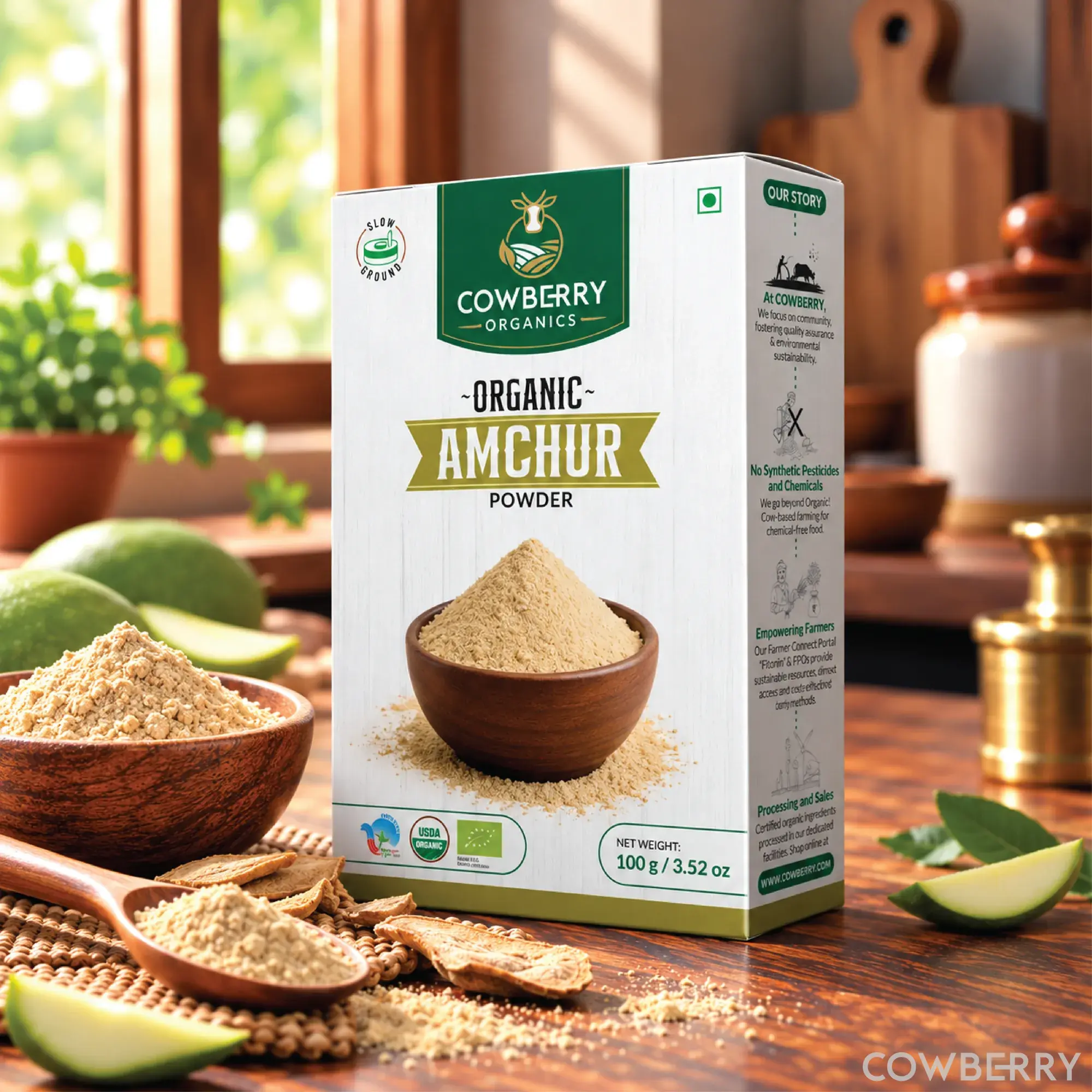
An amchur substitute stands in for dry mango powder, the tangy powder made by sun-drying raw green mangoes and grinding them fine. The swaps that come closest are lemon juice and tamarind in wet dishes, and chaat masala where a dry sprinkle is wanted. This guide takes each one in turn, with how much to use and where it fits.
What is an amchur substitute? The quick answer
Amchur is one thing: dried, ground raw green mango, sold as a pale powder and used for its tangy, fruity sourness. A substitute has to bring sourness, and ideally fruit, to the same dish. Two families of swaps do the job. Wet swaps, lemon juice and tamarind, suit anything cooked with liquid. Dry swaps are thinner on the ground: chaat masala carries amchur inside its own blend, so a sprinkle of it lands the same tang plus its other spices.
Pick by the dish, not by the spoon measure. For a curry or a dal, reach for lemon juice or tamarind; for chaat, dry chutney powder or a spice blend, reach for chaat masala. What amchur is and how to store it are covered on the amchur powder hub page.
Lemon juice: the wet swap that is always at hand
Lemon juice is the easiest amchur substitute because every Indian kitchen has it, and it brings a clean, fresh sourness of its own. It fits anywhere the recipe has liquid to carry it: curries, dals, soups and salads, and it can be squeezed over a finished plate the way amchur is sprinkled on chaat. What it gives up is the fruit: lemon is sour without the soft mango note, and being a liquid it loosens anything dry.
How to swap: for a dish that asks for half a teaspoon of amchur, squeeze in about the same amount of lemon juice, taste, then add more in small squeezes. Add it near the end of cooking and again at the table if needed, since the fresh sourness softens with heat. One habit keeps the swap under control: taste after each small addition, because lemon reads sharp quickly and it is easy to overshoot a powder's gentler tang.
Where lemon carries a whole dish, the lemon rice recipe shows the method, and the same squeeze trick transfers straight to dals and soups.
Tamarind: the other big sour of Indian cooking
Tamarind is another classic Indian souring agent, one many Indian cooks already keep next to the amchur jar. IFCT 2017 records it as tamarind pulp, imli in Hindi, and its taste is deeper and darker than amchur's; it is the sour of sambar and rasam, and of tangy chutneys. Because it comes as a pulp rather than a powder, it needs a small step before it can stand in for amchur: soak a lump in warm water, squeeze out the pulp and use the strained liquid.
How to swap: start with less tamarind than the amchur the recipe asks for, since its sour sits heavier in a dish, then taste and add. Tamarind suits long-cooked curries, dals and chutneys with body; it is wasted in dry snacks. The full comparison is on the amchur vs tamarind page, and the tamarind hub covers the pod itself, its names and its nutrition.
Chaat masala is not a substitute, it is amchur plus more
Chaat masala deserves its own heading because it works, but for a different reason than the other swaps: it is not a stand-in for amchur, it is a blend with amchur as its sour base, along with cumin, coriander and black pepper. A pinch of chaat masala therefore lands the amchur tang plus the blend's other spices, which is exactly right on chaat, fruit and roasted snacks, and too much going on for a plain curry.
If a recipe asks for amchur and you have chaat masala, use it only where the extra spices are welcome. Sprinkle a little, taste, and remember you are adding a mix, not one powder. To see the blend's share of amchur and the rest of its ingredients, the chaat masala recipe sets out the ratios.
Substitute amchur powder in cooking: curries, soups and chole
Amchur powder is used in curries, soups, marinades, spice blends, chutneys and salads, and it is the finishing touch on chole. For each of those, the substitute that fits best is the one that matches the dish's liquid.
- Curries and soups: lemon juice or tamarind, stirred in near the end. Tamarind for a deep, rounded sour; lemon for a bright one.
- Chole: tamarind or lemon juice in the final simmer, in the amount you would have used of amchur, tasted before serving.
- Marinades: lemon juice does double duty here, souring the marinade and helping soften what sits in it, the way amchur is used in marinades; use it in place of the powder.
- Spice blends: this is the one place a wet swap fails, because liquid spoils a dry blend. Use chaat masala, or leave the sour out and add lemon at the table.
Dry mango powder substitute for chaat, chutneys and salads
Chaat and salads want their sour dry, so a squeeze of lemon changes the dish more than the powder did; here the choices are chaat masala and, where a sprinkle over fruit or salad is all that is asked, a light squeeze of lemon at the table.
- Chaat: chaat masala is the natural replacement, because amchur already sits inside it; sprinkle and taste.
- Chutneys: tamarind is the classic chutney sour, so a wet chutney swaps straight over; for a dry chutney powder, chaat masala stands in.
- Salads: lemon juice works well, and unlike amchur it doubles as the dressing's acid, so the same squeeze can replace both the powder and part of the dressing.
A dry mango powder substitute is never exact, whichever way you go: amchur's tang is fruity and mild, where lemon is sharp and tamarind is dark. Taste as you go, and add the swap in small steps.
How much to swap, what cannot be matched, and storage
How much. Work by taste, not by formula. With lemon juice, start at the same amount as the amchur and add in squeezes; with tamarind, start below it and climb, because its sour is stronger in the mouth. With chaat masala, a light sprinkle first. Every one of these ratios is kitchen practice, not a fixed conversion, so let the dish's own balance decide, and write down what worked in the margin of the recipe for next time.
What cannot be matched. Amchur brings sourness as a dry powder, and no swap does that; lemon and tamarind both arrive wet. It also carries a fruit note of its own, from the mango it is made from. Where those two qualities are the point of the dish, the honest advice is to keep amchur in the house rather than swap around it.
Is there a health angle to the swap? Not one this page can promise. IFCT 2017 prints no composition entry for amchur, so no nutrient numbers are listed, and a 2014 review notes that spices are eaten in such small amounts, alongside other foods, that their true health benefit is hard to establish. Researchers have studied amchur's effect on minerals in grains: a 2011 laboratory study found that amchur at 0.75 g per 10 g of grain, combined with carrot, onion or garlic, raised the bioaccessibility of iron and zinc from the grains in a digestion model, though only in a few of the grains tested. That is a laboratory finding about absorption in a test tube, not a reason to choose one sour over another.
Storage. Amchur keeps for months in an airtight jar in a cool, dry place, away from the stove. A powder that has hardened into lumps or lost its smell is past its best; buy a small pack and use it up. The same dry, dark shelf keeps whole lemon for a few days only, tamarind for far longer and chaat masala like amchur, in a closed jar.
FAQs
What is a substitute for dry mango powder?
Lemon juice and tamarind are the two practical answers. For curries, dals and soups, squeeze lemon or stir in soaked, strained tamarind pulp and taste as you go; for chaat and snacks, sprinkle chaat masala, which already contains amchur. No swap reproduces the powder's dry, fruity tang exactly.
What is amchur powder?
Amchur powder is dry mango powder: raw green mangoes that are sun-dried and ground fine. It is sold as a pale, tangy powder and used to sour curries, chutneys, chaat, salads and spice blends without adding liquid. That sour, fruity character is what any amchur substitute has to imitate.
Why is amchur powder used?
For sourness that stays dry. As a powder it sharpens chaat, salads, curries, chutneys and spice blends without loosening them, which is why it sits in chaat masala and gets sprinkled over fruit and fried snacks. A substitute is chosen to copy that one job, wet or dry.
Does dry mango powder expire?
It fades rather than spoils on a set date. Kept in an airtight jar in a cool, dry place it holds its tang for months; a powder that has clumped or smells flat has passed its best and should be replaced. Moisture and heat are what age it fastest.
Is amchur powder good for health?
There is little to build a claim on. IFCT 2017 prints no composition table for amchur, and a 2014 review cautions that spices are eaten in such small culinary amounts that their real health benefit is hard to establish. Enjoy it for the sourness, as part of a balanced diet.
References
- Gautam S, Platel K, Srinivasan K. Promoting influence of combinations of amchur, beta-carotene-rich vegetables and Allium spices on the bioaccessibility of zinc and iron from food grains. Int J Food Sci Nutr, 2011
- Opara EI, Chohan M. Culinary herbs and spices: their bioactive properties, the contribution of polyphenols and the challenges in deducing their true health benefits. Int J Mol Sci, 2014
- Indian Food Composition Tables (IFCT) 2017, ICMR-National Institute of Nutrition
Shop this article
Keep reading
Coriander water benefits: what dhania water actually does

Peanuts in Hindi (moongfali): groundnut names in Indian languages
Coriander vs cilantro: are they the same herb?