by COWBERRY

8 minute read
10 benefits of dry mango powder (amchur) and its side effects

Dry mango powder benefits are honest and mostly culinary: a level teaspoon (3 g) of amchur powder adds roughly 11.4 kcal and a bright, fruity sour, and one digestion-model study shows a mineral effect worth knowing. Ten benefits follow, each with its source, then the side effects, the daily amount and how to eat it. The amchur powder hub covers names, storage and buying.
Amchur powder benefits in the kitchen
1. A bright, fruity sour at about 11.4 kcal a teaspoon
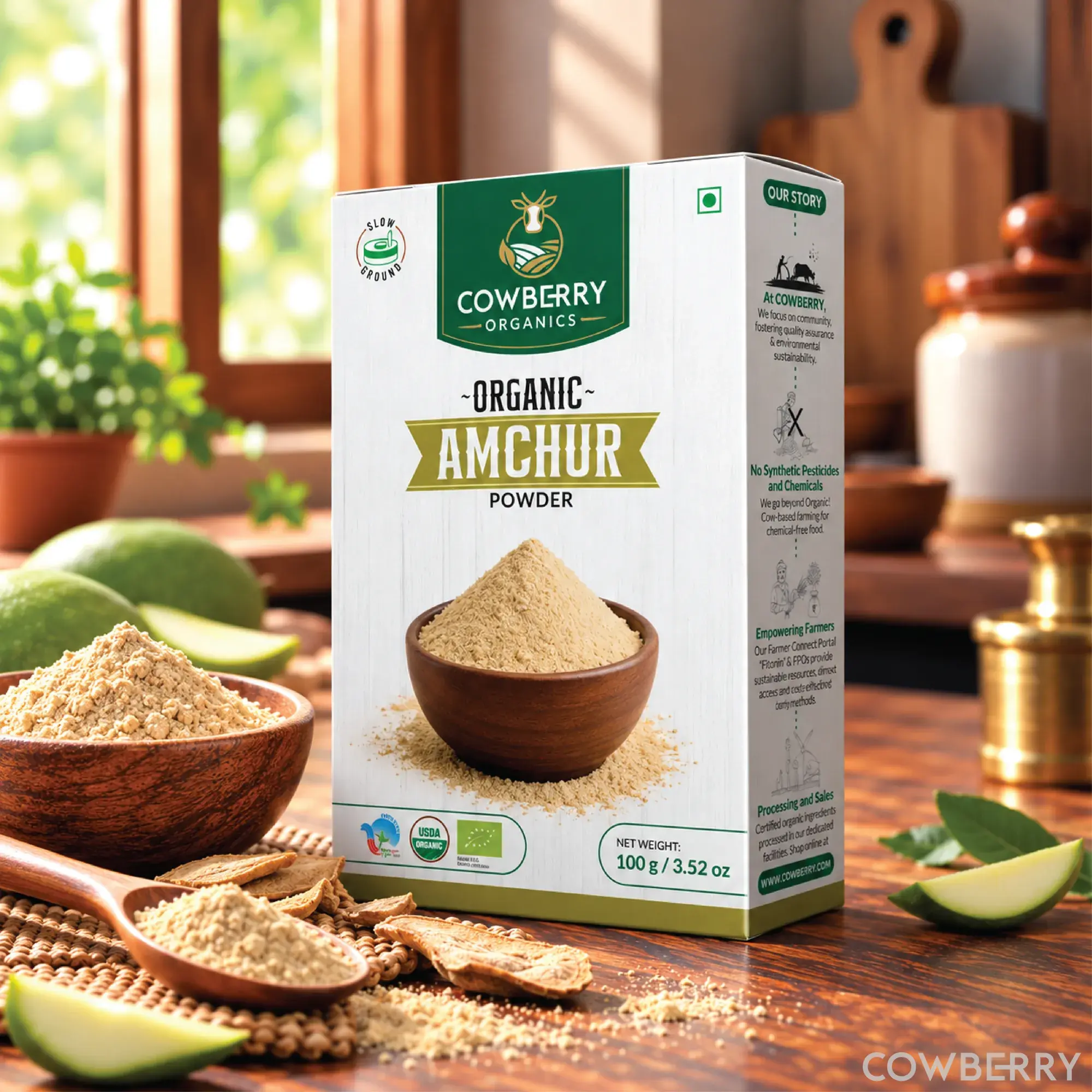
The first benefit is the simplest: amchur gives plain food a bright, fruity sourness at almost no energy cost. The label on COWBERRY's amchur pack prints 378.9 kcal per 100 g, so a level teaspoon (3 g) of amchur powder works out to about 11.4 kcal. That is the powder's real job: it sharpens dal, chole, chaat and salads without adding liquid, fat or much energy.
2. Sourness without the salt
Amchur sours a dish while adding almost no sodium of its own. The pack label prints 69 mg of sodium per 100 g, which in a level teaspoon (3 g) comes to about 2.1 mg. The tang lands on the plate and the salt stays the cook's decision.
3. The dry sour that keeps dishes dry
Amchur is a sour that arrives as a dry powder, so it can sharpen what must stay dry: chaat, salads, roasted snacks and spice blends. Chaat masala uses it this way: cumin, coriander and black pepper fill out the blend, and the chaat masala recipe shows how they combine. The same pinch finishes chole or fruit without loosening the dish.
4. Potassium and calcium on the label
Potassium and calcium sit on the same label: 2124.6 mg and 182.3 mg per 100 g. Read by the spoon, those become about 63.7 mg of potassium and 5.5 mg of calcium in a level teaspoon (3 g), a small top-up that rides along with the seasoning rather than a meal's worth. The day's minerals still come from the dal, grains and vegetables on the plate; the full read-down is on the amchur nutritional value per 100g page.
Dry mango powder benefits in the research
Three published papers carry what research says about amchur, and none of them is a human trial: one digestion-model study on minerals in grains, one laboratory analysis of trace elements, and one review that sets the honest frame.
5. Iron in the powder, and the digestion-model finding
The same label prints 36.7 mg of iron per 100 g, about 1.1 mg in a level teaspoon. One laboratory study went further: in a 2011 digestion-model experiment, researchers combined amchur with carrot, onion or garlic and found that the combination raised the bioaccessibility of iron from food grains, but only in a few of the grains tested. Bioaccessibility is what a digestion model releases from the food; the study did not measure iron in people's blood.
6. Zinc bioaccessibility with onion or garlic
The same 2011 study combined amchur with garlic or onion and recorded a positive influence on zinc bioaccessibility from food grains, in a few instances. The setting, again, was a digestion model, and the finding says nothing about zinc status in people. It is a laboratory thread worth knowing about, not a reason to spoon extra amchur onto a plate.
7. Copper measured in the spice, with toxic elements very low
A 2014 analysis in Food Chemistry (Khan and colleagues) measured minor and trace elements in aromatic spices and found copper high in mango powder, at 77.68 micrograms per gram. In the same spices, the toxic trace elements arsenic, cadmium and lead were very low. That is a composition measurement, not a health finding, but it is a measurement made on mango powder itself, not a label figure.
8. Vitamin C in the powder
The pack label prints 18.8 mg of vitamin C per 100 g, which shrinks to about 0.6 mg in a level teaspoon. That is a trace: worth knowing for the tally, not worth counting on, and the day's vitamin C still comes from fresh fruit and vegetables rather than a pinch of amchur.
Amchur benefits and the honest bottom line
9. Fibre and protein, small but real
The pack label prints 8.7 g of dietary fibre, 3.9 g of protein and 2.1 g of fat per 100 g. A level teaspoon carries about 0.3 g of fibre and 0.1 g of protein, so amchur adds a little of each to every plate it touches while the meal's dal, vegetables and grain carry the rest.
10. What spice research honestly shows
A 2014 review in the International Journal of Molecular Sciences (Opara and Chohan) explains why spice research rarely reaches the plate: herbs and spices are eaten in small quantities and in combination with other foods, so it is unclear what their true benefit is from a health perspective. IFCT 2017 prints no composition entry for amchur, which is why the numbers above come from the pack label. That is the frame for every benefit on this page: the kitchen ones stand, the laboratory ones are early, and the research behind both includes no human trial.
Amchur side effects: who should be careful
None of the three papers in the references reports side effects of amchur, and their work is laboratory work, so the honest side-effects section is short, and most of it is about expectations and precautions rather than the powder itself.
- Acidity. None of the three papers in the references tests whether amchur causes acidity, so there is no evidence either way. The powder is sour by nature and used in pinches, and people who find sour foods upset their stomach keep the amount small. Amchur is not a known acidity remedy, and nothing here recommends it as one.
- Adulteration. The Dietary Guidelines for Indians note that powdered spices are the ones more likely to be adulterated. Buying from a source you trust is the sensible precaution.
- Medicines and conditions. If you take medicines regularly or live with a condition where sour foods matter, the amchur in your meals belongs to that conversation, not outside it.
If you use amchur often and acidity, reflux or another health condition is already in the picture, talk to your doctor or dietitian about how much of a sour spice your meals should carry.
How much amchur per day
No source prints a daily amount for amchur, so this page does not invent one. The printed guidance is for spices as a group: in the Dietary Guidelines for Indians, the suggested balanced diet for an elderly man and the one for an elderly woman each print 10 g of spices a day. Those are diets for elderly people and a figure for all spices together; a level teaspoon (3 g) of amchur is under a third of it.
The 2011 digestion-model study used 0.75 g of amchur per 10 g of grain, alongside 2.5 g of beta-carotene-rich vegetables or 1.5 g of Allium spices; those are study amounts chosen for the experiment, not a daily recommendation. The same page in Hindi, amchur ke fayde aur nuksan, carries the same numbers.
How to eat amchur
Amchur works straight from the jar, which is the point of the powder. Shake it over chaat, sliced fruit and roasted snacks; stir it into curries, dals and soups near the end of cooking, where the tang stays bright; rub it into marinades; and mix it into dry spice blends. Three recipes show it at work: the chaat masala recipe builds the blend on it, jeera aloo finishes with a sprinkle of it, and imli chutney makes the tamarind chutney that sits beside the same chaat.
For a homemade jar, the method is short: peel, slice, sun-dry and grind. The how to make amchur powder at home page sets out each stage, with the mistakes that spoil a batch, and the amchur powder hub holds storage, names and buying.
FAQs
Is amchur powder good for health?
It is good food and an honest seasoning, but the evidence stops at the laboratory. The pack label prints 36.7 mg of iron and 18.8 mg of vitamin C per 100 g, and a 2011 digestion-model study found that amchur combined with carrot, onion or garlic raised iron bioaccessibility from grains, in a few of the grains tested. A 2014 review notes that small culinary amounts make true benefit hard to establish.
Does amchur powder cause acidity?
There is no evidence that amchur causes acidity, and none that it calms it; none of the three papers in the references tests it. The powder is sour by nature and used in pinches, and anyone who finds sour foods upsetting can simply use less. If acidity keeps troubling you, talk to your doctor or dietitian.
How to eat amchur powder?
Sprinkle it over chaat, sliced fruit and roasted snacks, stir it into curries, dals and soups near the end of cooking, or rub it into marinades; it also forms the sour base of chaat masala. A level teaspoon (3 g) adds about 11.4 kcal. No soaking or grinding is needed; use it straight from the jar.
Does amchur have salt?
Amchur is dried, ground raw mango with no additives; the pack label prints 69 mg of sodium per 100 g, which works out to about 2.1 mg in a level teaspoon. The salt on a chaat plate is the cook's decision, not the powder's.
Can amchur be eaten in fast?
What amchur adds to a fast is barely countable: a level teaspoon (3 g) carries about 11.4 kcal and 2.6 g of carbohydrate. Whether your family's fast allows it is a matter of custom and faith, and this page does not rule on it.
What does dry mango powder taste like?
Tangy and fruity: COWBERRY's amchur is described as a natural tangy, fruity sourness. It is a dry powder, so it can be shaken straight over chaat, fruit and salads; the amchur vs tamarind page compares it with tamarind.
References
- Indian Food Composition Tables (IFCT) 2017, ICMR-National Institute of Nutrition
- Dietary Guidelines for Indians, ICMR-National Institute of Nutrition
- Gautam S, Platel K, Srinivasan K. Promoting influence of combinations of amchur, beta-carotene-rich vegetables and Allium spices on the bioaccessibility of zinc and iron from food grains. Int J Food Sci Nutr, 2011
- Khan N, Choi JY, Nho EY et al. Determination of minor and trace elements in aromatic spices by micro-wave assisted digestion and inductively coupled plasma-mass spectrometry. Food Chem, 2014
- Opara EI, Chohan M. Culinary herbs and spices: their bioactive properties, the contribution of polyphenols and the challenges in deducing their true health benefits. Int J Mol Sci, 2014
Shop this article
Keep reading
Coriander water benefits: what dhania water actually does
Peanuts in Hindi (moongfali): groundnut names in Indian languages
Coriander vs cilantro: are they the same herb?