by COWBERRY

6 minute read
Amchur vs tamarind: taste, nutrition and which souring agent to use

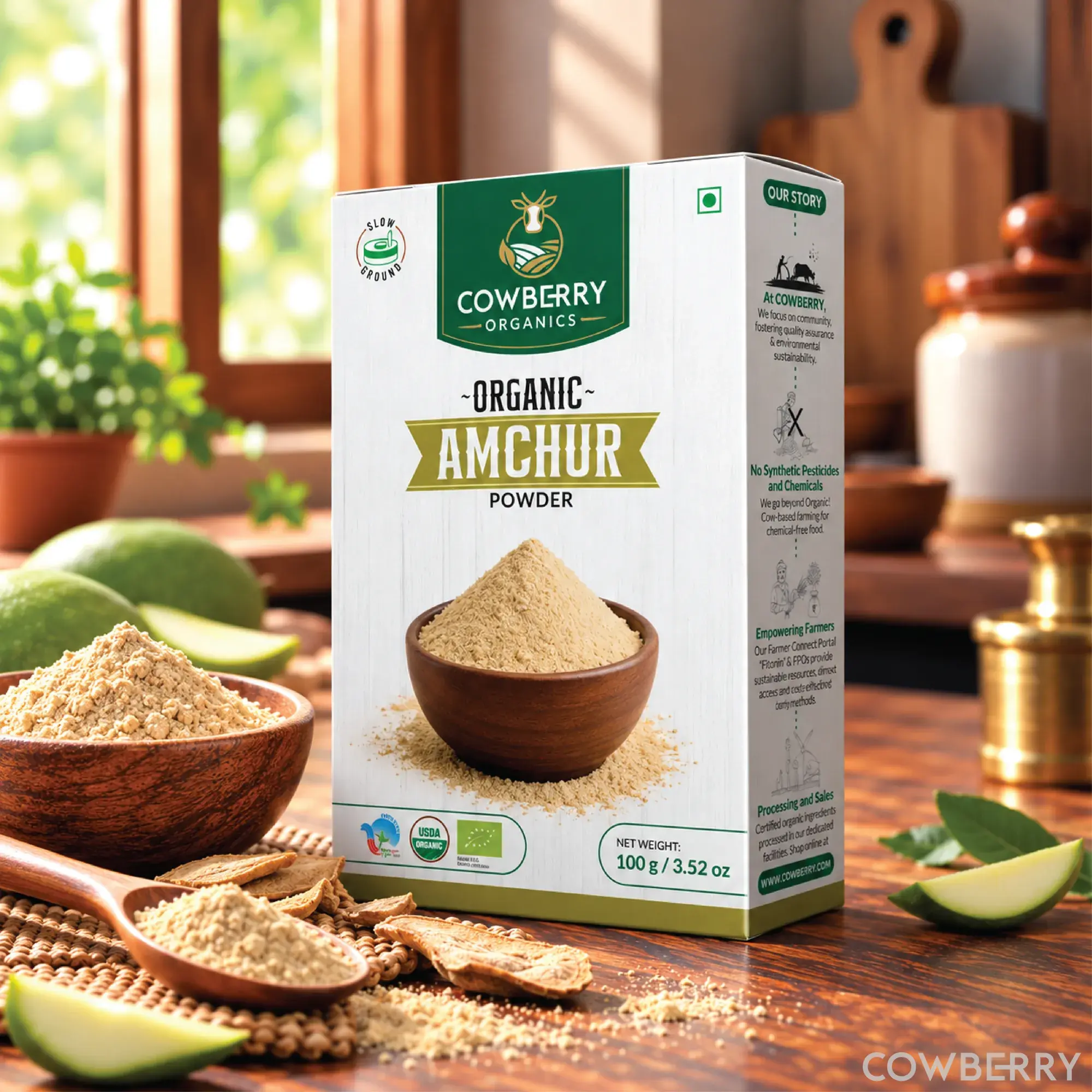
Amchur vs tamarind in one line: amchur is a dry powder of sun-dried raw mango that you shake straight into a dish, while tamarind is a pod's pulp that you soak and strain first. Both are Indian souring agents, and neither covers every dish the other does. The amchur powder hub covers the powder in full; this page compares the two.
Verdict in three lines
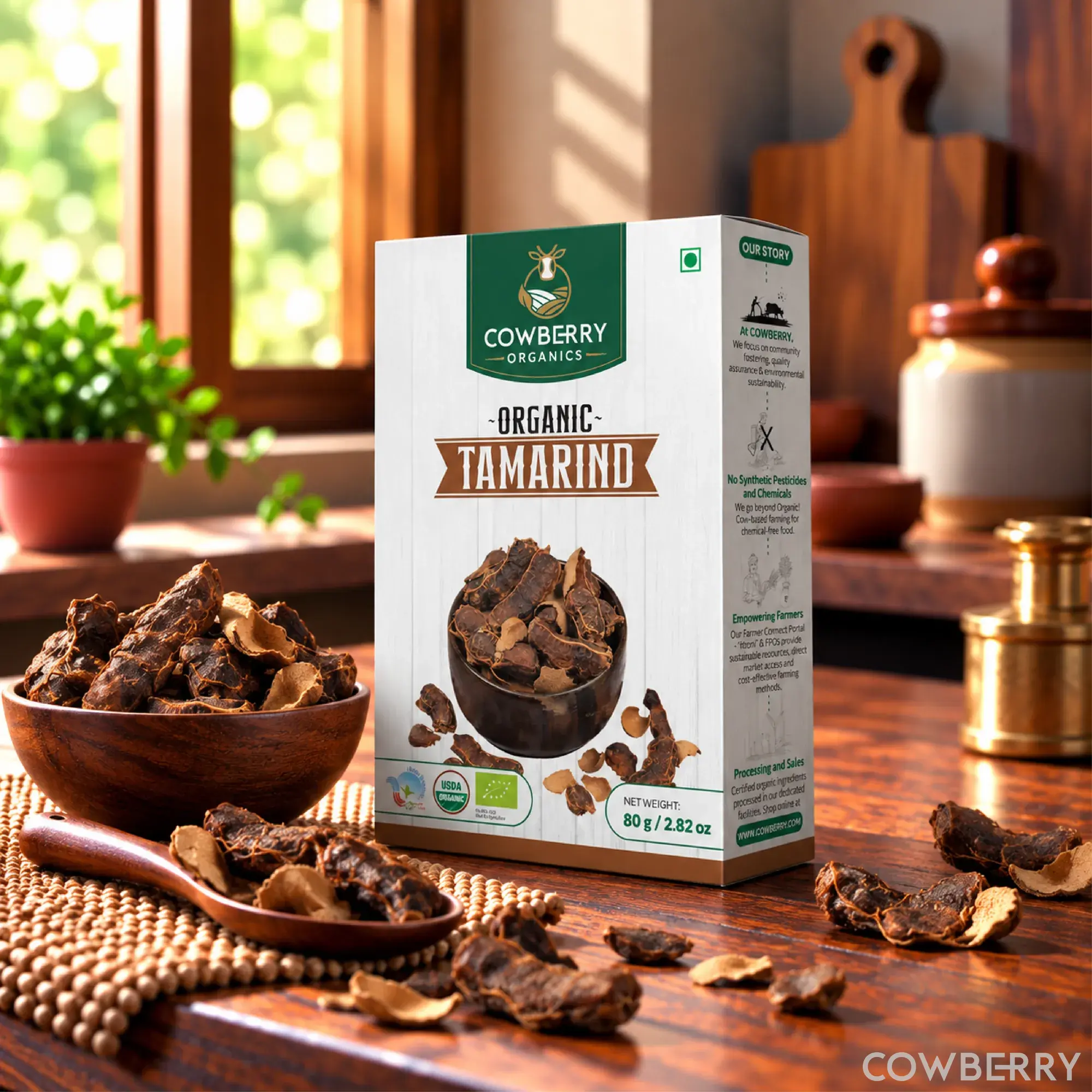
Line one. Amchur is ready-made sour: a pale, finely ground powder of sun-dried raw green mango, shaken straight from the jar. Tamarind is a raw material: the pod's pulp, which needs soaking, squeezing and straining before it sours anything.
Line two. Form decides the dish. Amchur suits what must stay dry — chaat, salads, chole and spice blends — while tamarind suits what simmers — sambar, rasam, dals and curries.
Line three. On nutrition the comparison is one-sided: tamarind has a full IFCT 2017 composition table, and amchur has no printed composition table at all, so only tamarind's numbers appear below, with one measured copper figure for amchur. The tamarind hub covers its side in full.
Amchur vs imli: the same powder and pulp, side by side
Amchur and imli — tamarind's Hindi name — sit at opposite ends of the same shelf. The table lays out what each is in its own column, before the sections below compare them in detail.
| Amchur | Tamarind | |
|---|---|---|
| What it is | Dry mango powder: raw green mangoes, sun-dried and finely ground | Tamarind pulp: the sour pulp of the tamarind pod (IFCT 2017 records it as Tamarind, pulp) |
| Other names | Amchur, aamchur; mango powder | Imli in Hindi, chinch in Marathi, puli in Tamil |
| Getting it ready | Ready to use: shake it in | Soak in warm water, squeeze out the pulp, strain |
| Where it fits | Chaat, chole, chutneys, salads, spice blends | Sambar, rasam, chutneys, curries, dals |
Nutrition: tamarind has measured values, amchur does not
The table below is tamarind's composition per 100 g from IFCT 2017. Amchur's column is absent for a simple reason: IFCT 2017, the only composition table the comparison draws on, prints no amchur entry, so invented numbers would be dishonest. The comparison that can be made: per 100 g, tamarind pulp carries 289 kcal, 5.31 g of fibre and 9.16 mg of iron.
For amchur, one measured figure does exist: a 2014 Food Chemistry analysis of aromatic spices found copper high in mango powder at 77.68 micrograms per gram, while the toxic trace elements — arsenic, cadmium and lead — were very low across the spices analysed. One mineral measurement is not a composition table, and it should not be read as one.
Neither food has a printed glycemic index value, so none is given. The wider caveat covers both: a 2014 review cautions that, because spices are used in tiny culinary doses among many other foods, working out their real health benefit is difficult. Choose between amchur and tamarind for taste and the dish, not for a nutrient edge.
| Nutrient | Tamarind pulp |
|---|---|
| Energy (kcal) | 289 |
| Protein (g) | 2.9 |
| Fat (g) | 0.1 |
| Carbohydrates (g) | 67 |
| Dietary fibre (g) | 5.3 |
| Iron (mg) | 9.2 |
| Calcium (mg) | 149 |
| Magnesium (mg) | 83 |
| Potassium (mg) | 836 |
| Sodium (mg) | 25 |
| Zinc (mg) | 0.6 |
| Folate (mcg) | 9.8 |
| Vitamin C (mg) | 3.6 |
Per 100 g raw, edible portion. Composition: IFCT 2017 (ICMR-NIN). — means not reported. These are average values for the food; the label on a pack gives the values for that product.
Taste and cooking: a powder you sprinkle, a pulp you soak
Amchur arrives as a pale, finely ground powder with a tangy, fruity sourness, and it is used as a finishing touch: stirred into curries, soups, chutneys and salads, rubbed into marinades and shaken over chaat and chole. Because it is dry, it sours without loosening, which is why it forms the base of chaat masala under cumin, coriander and black pepper — the chaat masala recipe shows the blend.
Tamarind needs a small step first: soak the pulp, squeeze and strain — the method on the page about how to use tamarind — and its sour is deeper and darker than amchur's bright tang, standing up to the long simmer of sambar, rasam, dals and curries. In practice tamarind usually simmers with the dish while amchur goes in near the end; that pairing is kitchen habit, not a rule, so follow your recipe.
Cost and where each fits
Both sit on the same spice shelf in small packs, and neither is a considered purchase; what differs is how far a pack goes. Amchur is shaken by the pinch, so a small jar seasons many dishes, while tamarind's pulp is soaked into a working liquid that stretches across every simmered dish it touches. In practice cost rarely decides the choice; the dish does.
Where each fits, in one sentence each: amchur is the dry sour of chaat, chole, salads and spice blends, and tamarind is the simmered sour of sambar, rasam, dals and curries, with chutneys open to both.
Which for whom
- Pick amchur when the dish must stay dry: chaat, fruit, salads, dry chutney powders and any spice blend, chaat masala included.
- Pick tamarind for a long-cooked, deep sour: sambar, rasam, dals and curries that simmer, and chutneys with body.
- Pick amchur when there is no time to soak, since it works straight from the jar.
- Pick tamarind when the recipe is built around its particular sour, as sambar and rasam are.
If the shelf holds one and the recipe names the other, the amchur substitute guide walks through the swaps, and everything about the powder itself is on the amchur powder hub.
FAQs
Is amchur and amla powder same?
No. Amchur is made from raw green mangoes that are sun-dried and ground; amla powder comes from a different fruit entirely, so no claim about one carries over to the other. The two are simply not the same thing.
Difference between amchur powder and chaat masala?
Amchur is one sour powder, the ground dried raw mango. Chaat masala is a blend built on it, with cumin, coriander and black pepper alongside, so a shake of chaat masala lands amchur's tang plus the blend's other spices rather than sourness alone.
What is dry mango powder?
Dry mango powder is amchur under its English name: raw green mango, peeled, sliced, sun-dried and ground into a pale, tangy powder. It is a classic Indian souring agent, with tamarind as its wetter, deeper counterpart.
Is amchur powder good for health?
There is little to build a claim on: amchur has no printed composition table in IFCT 2017, and a 2014 review cautions that spices in tiny culinary doses make their true health benefit hard to pin down. A 2011 laboratory study found amchur, combined with carrot, onion or garlic, raised iron and zinc bioaccessibility from grains in a digestion model, in a few of the grains tested. Use it for its sourness, within a balanced diet.
Difference between amchur and anardana?
Anardana is a different souring ingredient, one this page does not compare; the same applies to kokum. What is certain is amchur's side: it is dry mango powder, the sun-dried, ground raw green mango.
What does dry mango powder taste like?
Tangy and fruity-sour, mild enough to sprinkle by the pinch; next to tamarind it reads bright and light, where tamarind's sour is deeper and darker. That is why amchur finishes dry snacks and tamarind simmers into sambar and rasam.
References
- Indian Food Composition Tables (IFCT) 2017, ICMR-National Institute of Nutrition
- Gautam S, Platel K, Srinivasan K. Promoting influence of combinations of amchur, beta-carotene-rich vegetables and Allium spices on the bioaccessibility of zinc and iron from food grains. Int J Food Sci Nutr, 2011
- Khan N, Choi JY, Nho EY et al. Determination of minor and trace elements in aromatic spices by micro-wave assisted digestion and inductively coupled plasma-mass spectrometry. Food Chem, 2014
- Opara EI, Chohan M. Culinary herbs and spices: their bioactive properties, the contribution of polyphenols and the challenges in deducing their true health benefits. Int J Mol Sci, 2014
Shop this article
Keep reading
Coriander water benefits: what dhania water actually does
Peanuts in Hindi (moongfali): groundnut names in Indian languages
Coriander vs cilantro: are they the same herb?