by COWBERRY

5 minute read
Amchur nutritional value per 100g: calories, vitamins and minerals

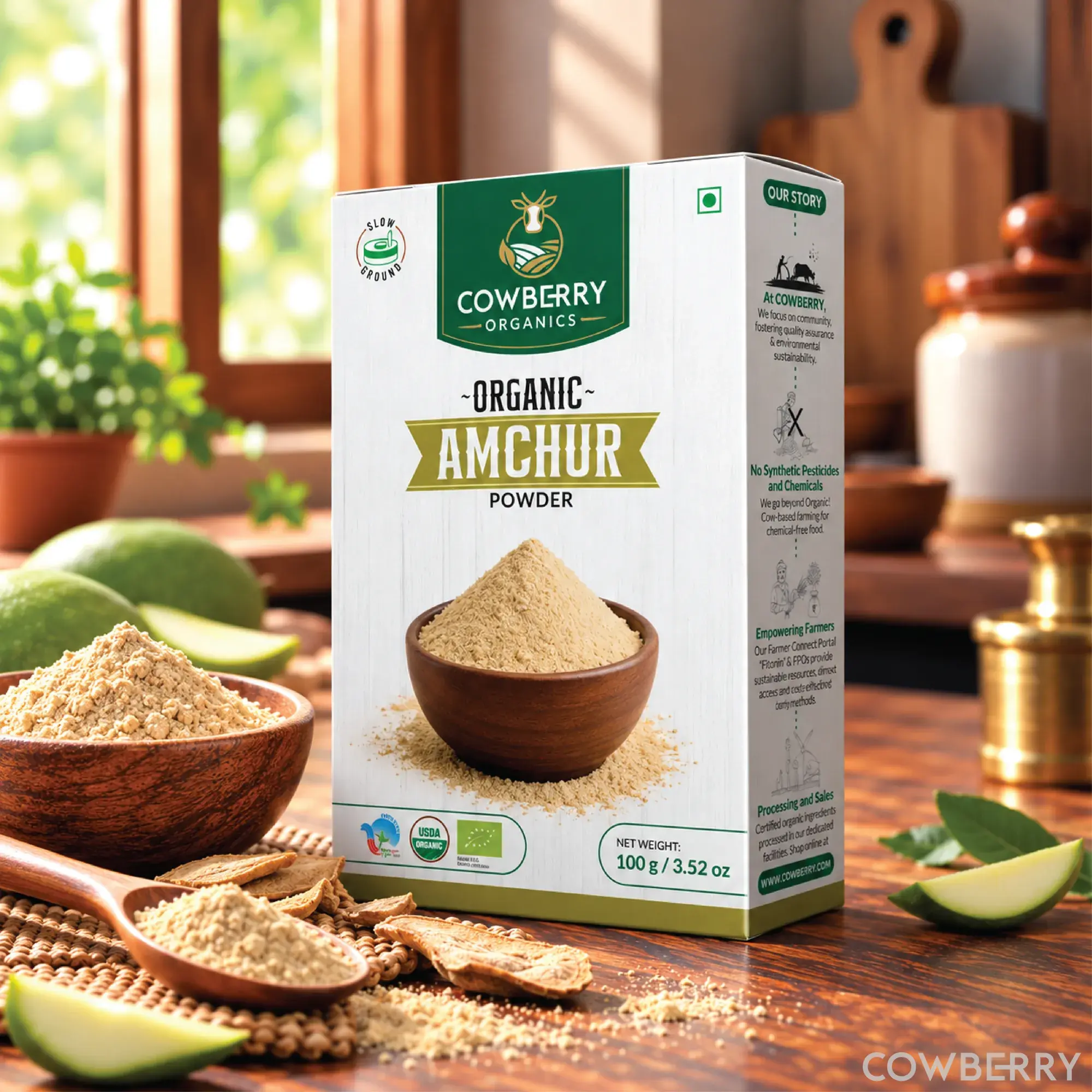
Amchur nutritional value per 100g comes from one source: the pack label, because IFCT 2017 prints no amchur entry. The label prints 378.9 kcal, 86.1 g of carbohydrate and 18.8 mg of vitamin C per 100 g, and a level teaspoon (3 g) shrinks each figure to a pinch. Here is the read-down plus the printed peer comparison, tamarind pulp; the amchur powder hub carries names, storage and buying.
Amchur nutritional value per 100g: the honest table story
The table below shows the one printed comparison this page can make honestly: tamarind pulp per 100 g, from IFCT 2017. Amchur's own column is absent because IFCT 2017 prints no entry for amchur, so the table carries tamarind pulp alone, labelled as such. For the powder's own numbers this page uses the pack label, and every figure from it is named as a label figure in the sections below. Inventing an IFCT-style entry for amchur would be dishonest, so the powder's numbers stay on the label and the table stays truthful.
| Nutrient | Tamarind pulp |
|---|---|
| Energy (kcal) | 289 |
| Protein (g) | 2.9 |
| Fat (g) | 0.1 |
| Carbohydrates (g) | 67 |
| Dietary fibre (g) | 5.3 |
| Iron (mg) | 9.2 |
| Calcium (mg) | 149 |
| Magnesium (mg) | 83 |
| Potassium (mg) | 836 |
| Sodium (mg) | 25 |
| Zinc (mg) | 0.6 |
| Folate (mcg) | 9.8 |
| Vitamin C (mg) | 3.6 |
Per 100 g raw, edible portion. Composition: IFCT 2017 (ICMR-NIN). — means not reported. These are average values for the food; the label on a pack gives the values for that product.
Calories in amchur: per 100 g and per teaspoon
The label on COWBERRY's amchur pack prints 378.9 kcal per 100 g, 86.1 g of carbohydrate, and 39.3 g of sugars, of which 37.1 g are added sugars. A level teaspoon (3 g) holds about 11.4 kcal and 2.6 g of carbohydrate, and that teaspoon is the amount one dish typically gets, since amchur is used in pinches. Next to tamarind pulp's 289 kcal per 100 g (IFCT 2017), the label figure reads higher on paper, but the spoon decides what lands on the plate: the per-teaspoon figure is the one a kitchen actually works with.
Protein and fibre: amchur against tamarind pulp
Per 100 g, the pack label prints 3.9 g of protein and 8.7 g of dietary fibre for amchur, while IFCT 2017 prints 2.92 g of protein and 5.31 g of fibre for tamarind pulp. Read as ratios, the label's protein figure is about 34 percent more than tamarind pulp's, and its fibre figure about 64 percent more. A level teaspoon shrinks them to 0.1 g of protein and 0.3 g of fibre, and the label also prints 2.1 g of fat per 100 g against tamarind pulp's 0.15 g. These are the numbers as printed, a label figure set beside a table figure, not a claim about what either does in the body.
Glycemic index: none is printed
Amchur has no printed glycemic index value, and neither does tamarind pulp, so this page gives no GI figure. IFCT 2017 and the GI database print no value for either souring agent, and no honest page invents one. What a teaspoon adds to a meal, 2.6 g of carbohydrate, is small enough that the GI question matters less than the dish it seasons.
Micronutrients: label minerals and the measured copper
Per 100 g, the pack label prints 2124.6 mg of potassium, 182.3 mg of calcium, 36.7 mg of iron and 18.8 mg of vitamin C. A level teaspoon (3 g) shrinks them to about 63.7 mg of potassium, 5.5 mg of calcium, 1.1 mg of iron and 0.6 mg of vitamin C; the label also prints 69 mg of sodium per 100 g, about 2.1 mg in a teaspoon. One mineral has been measured in amchur itself by an outside laboratory: a 2014 Food Chemistry analysis put copper in mango powder at 77.68 micrograms per gram, and recorded arsenic, cadmium and lead — the toxic trace elements — very low in the same spices. The mineral story of a meal still belongs to its dal, grains and vegetables; amchur's is a pinch-sized extra.
What these numbers mean in a real kitchen
In a kitchen, amchur is a pinch: the per-100 g figures shrink with every spoonful, and the level teaspoon (3 g) is the working unit, worth 11.4 kcal, 2.6 g of carbohydrate, 0.3 g of fibre, 0.1 g of protein and 63.7 mg of potassium. A 2014 review puts the honest frame around even that: spices are eaten in small quantities and with other foods, so their true health benefit stays unclear. The numbers above matter for a tally, not for a promise. Where the figures meet the taste, the chaat masala recipe shows the blend built on the powder; the research reading is on the dry mango powder benefits page, and the amchur vs tamarind page compares the two sours dish by dish. Names, storage and buying sit on the amchur powder hub.
FAQs
Does amchur have vitamin C?
Yes, a trace. The label on COWBERRY's amchur pack prints 18.8 mg of vitamin C per 100 g, which comes to 0.6 mg in a level teaspoon (3 g). IFCT 2017 prints no composition entry for amchur, so the label figure is the only printed vitamin C number for the powder, and the day's vitamin C still arrives from fresh produce.
Is amchur powder good for health?
As a seasoning, yes; as a remedy, there is no human evidence. IFCT 2017 carries no composition entry for amchur, so the numbers come from the pack label: 378.9 kcal, 8.7 g of fibre and 3.9 g of protein per 100 g. A 2014 review cautions that such small amounts make true benefit hard to pin down.
What is dry mango powder?
The English name for amchur: dried, ground raw green mango, sold as a pale powder that sours dishes without wetting them. For nutrition, the pack label is the only printed source, 378.9 kcal and 86.1 g of carbohydrate per 100 g, because IFCT 2017 prints no entry for it.
Why is amchur powder used?
For sourness that stays dry: a pinch sharpens chaat, salads, curries and chutneys, and the powder holds chaat masala together as the blend's sour base. At 11.4 kcal a level teaspoon, the sour costs the plate almost nothing.
Does dry mango powder expire?
Amchur loses its edge slowly, not on a printed date: in a shut, dry jar away from heat and steam it keeps for months, and a powder that has caked into hard lumps or smells flat has met moisture and is past its best. The label figures above assume a jar kept shut and dry.
References
- Indian Food Composition Tables (IFCT) 2017, ICMR-National Institute of Nutrition
- Khan N, Choi JY, Nho EY et al. Determination of minor and trace elements in aromatic spices by micro-wave assisted digestion and inductively coupled plasma-mass spectrometry. Food Chem, 2014
- Opara EI, Chohan M. Culinary herbs and spices: their bioactive properties, the contribution of polyphenols and the challenges in deducing their true health benefits. Int J Mol Sci, 2014
Shop this article
Keep reading
Coriander water benefits: what dhania water actually does
Peanuts in Hindi (moongfali): groundnut names in Indian languages
Coriander vs cilantro: are they the same herb?