by COWBERRY

9 minute read
Moong dal types: yellow, green, chilka, dhuli and which is best

Moong dal types come down to four forms of one bean: yellow dhuli, green chilka, whole sabut moong and sprouts. The split green gram behind them is the same pulse, Vigna radiata, processed to different levels of skin and size, and each form cooks and behaves differently. This guide runs through all four, with the moong dal hub for names and benefits.
The four moong dal types at a glance
FAO defines pulses as the edible seeds of leguminous plants, and counts beans — the Phaseolus and Vigna families — among the most well-known and commonly consumed types. Moong is a Vigna bean, and every moong type below is that one bean at a different stage of processing. All four begin as the same harvested bean; the only difference between them is how much of it reaches your pot, and each step of processing buys back cooking time.
| Form | What it is | Soak | Cooking | Used for |
|---|---|---|---|---|
| Yellow moong dal (dhuli) | Split with the green skin removed | None needed; optional 30 minutes | About 20 minutes | Everyday dal, khichdi, halwa, chilla batter (3 hours) |
| Green moong chilka | Split with the green skin kept on | 30 minutes | A little longer than dhuli | Dal with bite, chilla batter (3 hours) |
| Sabut moong | The whole bean, skin and all | 8 to 12 hours | Pressure cooked until soft | Thick dal, curry, khichdi, sprouting |
| Moong sprouts | Whole beans sprouted after an overnight soak | Overnight, before sprouting | Cooked; see the note on sprouts below | Chaat, stir-fries, salads |
The soak times above are the standard kitchen figures for each form; the step-by-step method, including the quick hot-water soak, is on the how to soak moong page.
Yellow moong dal (dhuli): the everyday dal
This is the moong dal Indian kitchens usually mean by the name: the green gram bean split in two and freed of its green skin, leaving flat yellow halves. Because there is no skin to soften, dhuli is the quickest of the four — about 20 minutes of boiling or pressure cooking, with no soak needed and an optional 30-minute soak when you want it even softer. The same skinned dal, ground after soaking, is the base of chilla batter and moong dal halwa.
IFCT 2017 records this form under the English name "Green gram, dal", with the local names below. What is moong dal dhuli, then? Simply the skinned, split green gram.
| Language | Name (romanised) |
|---|---|
| English | Green gram, dal |
| Hindi | Mug dal |
| Marathi | Mug dal |
| Gujarati | Mug ni daad |
| Punjabi | Mungi-di-dal |
| Bengali | Mung dal |
| Odia | Muga Dali |
| Assamese | Dhua mogu dail |
| Kannada | Hesara bele |
| Telugu | Pesara pappu |
| Tamil | Payatham paruppu |
| Malayalam | Cheru payar parippu |
| Urdu | Moong dal |
| Sanskrit | — |
| Botanical name | Vigna radiata |
Source: IFCT 2017 (ICMR-NIN) local-names list. — means no name recorded in the source.
Green moong chilka: the split with its skin
Chilka moong is the same split bean with the green skin left on, so the pieces are green outside and yellow inside. The skin is exactly what changes the cooking: chilka soaks for 30 minutes, simmers a little longer than dhuli and holds its shape where dhuli falls apart, which makes it the choice for a dal with some bite. Chilla batter from chilka moong needs a full soak, about 3 hours, because the skin must soften before grinding.
IFCT 2017 prints a composition entry for the skinned dal and a separate one for the whole bean, but none for the skin-on split, so read chilka moong as sitting between the two — more of the skin's fibre than dhuli, less than sabut moong. A skin-on split such as organic green moong split is the form to buy when you want that in-between texture.
Sabut moong and sprouts: the whole bean
Sabut moong is the green gram bean whole, olive-green and firm, the form that keeps the whole seed, skin included. It needs the longest cooking of the family: an 8 to 12 hour soak and pressure cooking until the beans crush easily, after which it makes a thick dal, a curry or a hearty khichdi. Sprouting starts from whole beans, not split dal: soak them overnight and keep them damp, and the Dietary Guidelines say the grains should sprout in 1 to 3 days. The US FDA warns that mung bean sprouts served raw or lightly cooked may carry bacteria, and that children, pregnant women, older adults and people with weakened immunity should avoid raw or lightly cooked sprouts of any kind.
What the processing does is well documented. The Dietary Guidelines for Indians list soaking and sprouting among the processes that improve the digestibility and bioavailability of nutrients from legumes, and a 2018 review in Food Science and Nutrition explains the mechanism: germination activates the seed's own enzymes, which break down the antinutritional factors that hold nutrients back. On the cooking side, research on pulse constituents notes that when the recommendations for soaking and cooking pulses are followed, the biological activity of lectins can be completely eliminated.
Nutrition by type: what changes between the forms
The table below is the IFCT 2017 row for raw green gram dal per 100 g: 326 kcal, 23.88 g of protein and 9.37 g of fibre. Since all four forms are one bean, the differences between them are differences of processing, and they run through the skin. Dhuli, skinned, carries the least fibre of the family; chilka keeps some skin; and the whole bean keeps all of it — about 80 percent more than the skinned dal's fibre, as the side-by-side table on the green gram and weight loss page shows. Sprouting changes composition again, and the Guidelines count it among the processes that improve digestibility.
The point for the cook is simple: the more skin a form keeps, the more fibre it brings and the longer it takes to soften. None of the forms is a different food, and no form is a shortcut that another cannot replace with a small change in soaking and cooking time.
| Nutrient | Green gram dal (moong dal) |
|---|---|
| Energy (kcal) | 326 |
| Protein (g) | 24 |
| Fat (g) | 1.4 |
| Carbohydrates (g) | 53 |
| Dietary fibre (g) | 9.4 |
| Iron (mg) | 3.9 |
| Calcium (mg) | 43 |
| Magnesium (mg) | 155 |
| Potassium (mg) | 1268 |
| Sodium (mg) | 10 |
| Zinc (mg) | 2.5 |
| Folate (mcg) | 92 |
| Glycemic index (GI) | 38 |
Per 100 g raw, edible portion. Composition: IFCT 2017 (ICMR-NIN). GI: University of Sydney GI database. — means not reported. These are average values for the food; the label on a pack gives the values for that product.
Which moong for which dish
Choose by texture and time, not by any ranking of goodness.
- Yellow dhuli — everyday dal, moong dal khichdi, moong dal halwa and chilla batter, wherever the softest, fastest result is wanted.
- Green chilka — dal with bite, a chunkier tadka dal, and moong dal chilla when the batter gets its full 3-hour soak.
- Sabut moong — thick dal, curry, sprouting, and any dish where whole beans are the point.
- Sprouts — chaat and stir-fries, the crunch form of the same bean.
Two forms cover everyday cooking: yellow dhuli for the daily dal and one skin-on form, chilka or sabut, for texture. The full spread of dishes, from khichdi to laddu, is collected in the moong dal recipes roundup, and nutrition and side effects live on the moong dal hub.
How moong dal is made and how to keep it
The chain behind the shop names is short. The harvested green gram bean is cleaned and split, which gives chilka moong with its green skin; polishing the split removes the skin and gives yellow dhuli. Nothing is added or removed beyond the skin. The bean itself is then finished in your kitchen: the Dietary Guidelines for Indians say boiling or pressure cooking is the best way to improve the nutritional quality of pulses, since the antinutritional factors are destroyed in cooking.
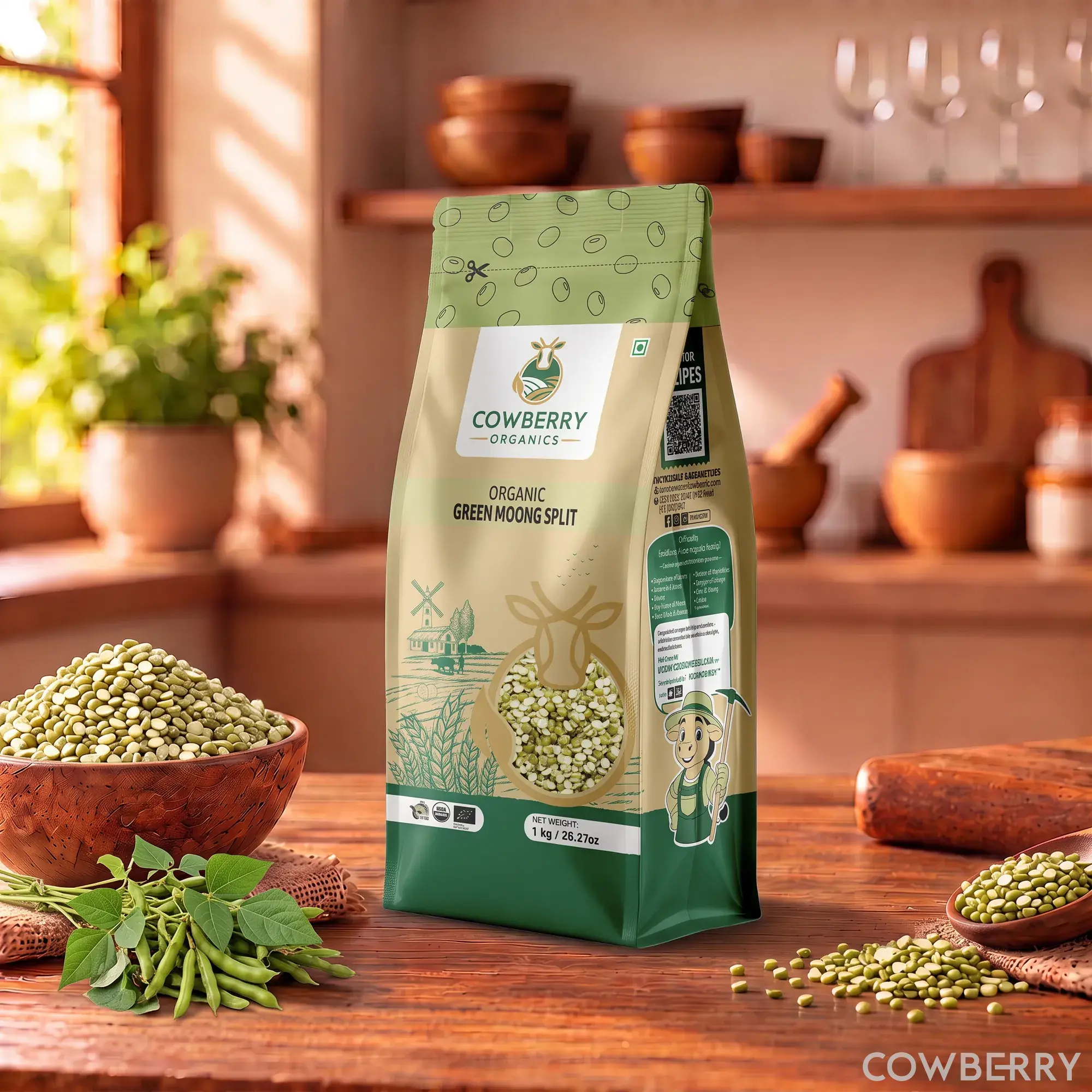
Storage is the same for every form. The Guidelines advise drying food grains adequately and storing them in airtight containers to protect them from moisture, and washing the dal well but not repeatedly before cooking. Dry moong keeps for many months in those conditions; buy the form you cook most and use it, rather than keeping several packs half-open. COWBERRY's split green gram comes from Rajasthan and Central India, grown with cow-based organic farming and packed with the green skin on.
FAQs
What is moong dhuli dal?
Moong dhuli dal is yellow moong dal: the green gram bean split and freed of its green skin. It is the everyday Indian dal — it cooks in about 20 minutes with no soak needed and goes into khichdi, halwa and chilla batter. IFCT 2017 records it under the name "Green gram, dal".
Is moong dal a lentil?
No. Moong is the bean Vigna radiata, one of the Vigna and Phaseolus beans that FAO counts among the best-known pulses; the lentil is a separate pulse crop. Indian English calls every split pulse a dal, which is where the mix-up starts, but the plants are different.
Difference between moong dal and moong dal chilka?
The skin. Yellow moong dal (dhuli) is the split bean with the green skin removed, and moong chilka is the same split with the skin kept on. Chilka therefore soaks for 30 minutes, cooks slightly firmer and holds its shape where dhuli falls apart. IFCT 2017 prints a composition entry only for the skinned dal.
Which moong dal is best green or yellow?
Neither is outright better; it depends on the dish. Yellow dhuli cooks fastest and gives the softest result, so it suits everyday dal, khichdi and halwa. Green chilka keeps its skin, so it suits dal with bite and chilla batter. Pick by texture and the time you have.
How much protein in 100 gm moong dal?
The IFCT 2017 table gives raw green gram dal 23.88 g of protein for every 100 g. The skin-on split and the whole bean are the same pulse processed differently, so their protein sits close to this figure; the whole bean's exact numbers are in the table on the weight-loss page.
What is split green gram dal?
Split green gram is the green gram bean split into two halves. With the green skin kept it is sold as moong chilka; with the skin removed it becomes yellow moong dal, or dhuli. Both are the same pulse, Vigna radiata, which IFCT 2017 records as "Green gram, dal".
How moong dal is made?
The harvested green gram bean is cleaned and split, which gives chilka moong with its green skin; splitting and skinning the halves gives yellow dhuli. Nothing else is added or removed. Boiling or pressure cooking then finishes the dal in your kitchen, which the Dietary Guidelines call the best way to improve the nutritional quality of pulses.
References
- Indian Food Composition Tables (IFCT) 2017, ICMR-National Institute of Nutrition
- Dietary Guidelines for Indians, ICMR-National Institute of Nutrition
- FAO: World Pulses Day (pulses and their role in diets)
- Thompson HJ. Improving human dietary choices through understanding of the tolerance and toxicity of pulse crop constituents. Curr Opin Food Sci, 2019
- Nkhata SG, Ayua E, Kamau EH, et al. Fermentation and germination improve nutritional value of cereals and legumes through activation of endogenous enzymes. Food Sci Nutr, 2018
- US FDA: Selecting and Serving Produce Safely
Shop this article
Keep reading
Green gram plant: crop, varieties and how it grows in India
Rajma vs lobia: difference, nutrition and which to choose
Rajma plant: how rajma is grown in India (it is not a tree)