by COWBERRY

5 minute read
How to soak moong: dal and sabut moong soaking time

How to soak moong depends on which form you bought: yellow split dal needs none, green split chilka takes 30 minutes, and whole sabut moong wants 8 to 12 hours. Below are the step-by-step method, the full time table and what soaking actually does, with the moong dal hub for everything else about the dal.
Short answer
Yellow moong dal (dhuli) needs no soaking and cooks in about 20 minutes; an optional 30 minutes makes it softer. Green split moong (chilka) takes 30 minutes, or 3 hours when it is going into chilla batter. Whole green moong (sabut moong) takes 8 to 12 hours, usually overnight, or about 2 hours in hot water for the quick method. The same soaked dal feeds a moong dal recipe of any kind — the soak depends on the form, and only chilla batter asks for a longer one.
Step by step: how to soak moong
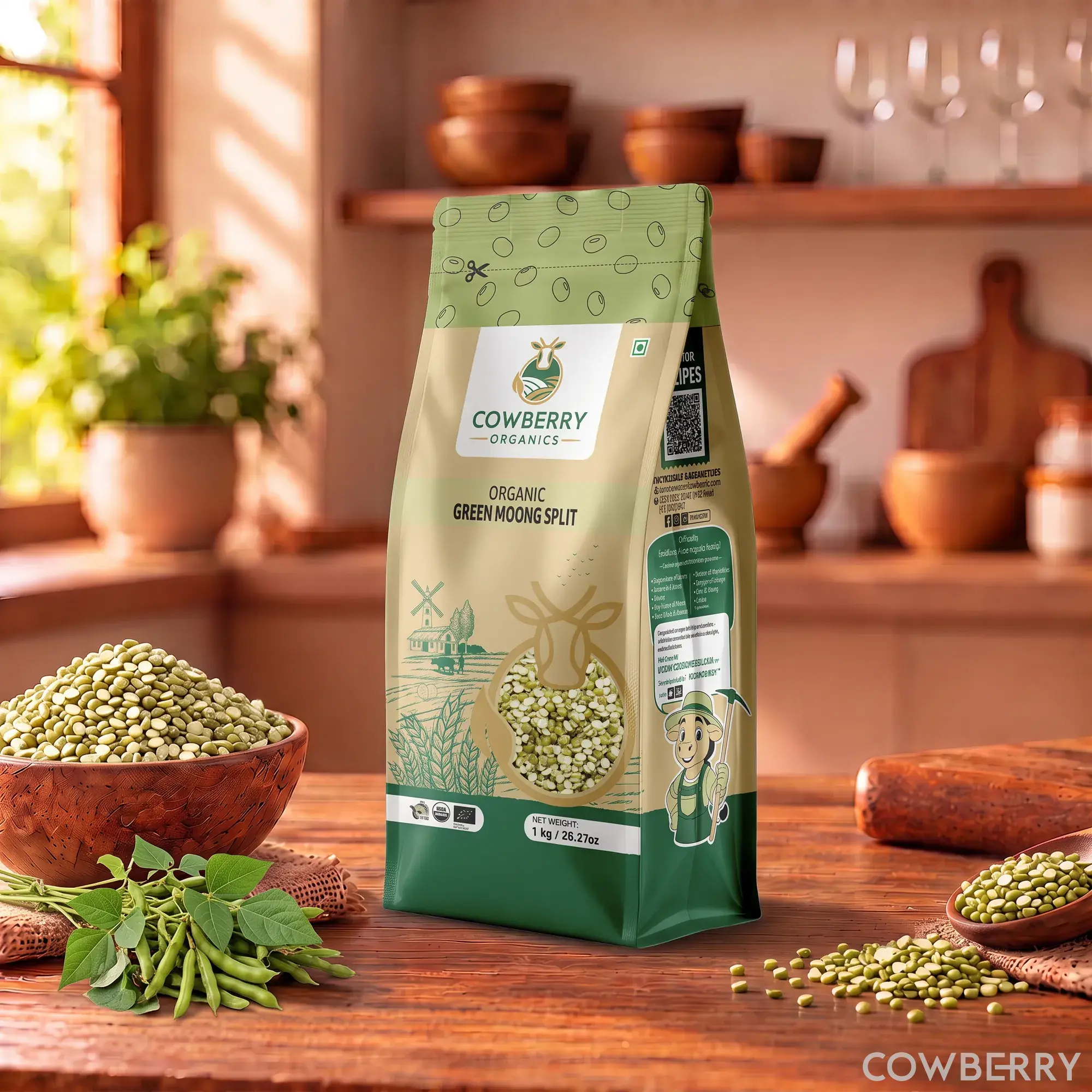
- Pick the form. Yellow dhuli, green chilka or whole sabut moong — the soak below is decided by this alone. For green split, a skin-on pack such as organic green moong split follows the 30-minute line.
- Rinse once. Wash the dal or beans well but not repeatedly, as the Dietary Guidelines for Indians advise; repeated washing is not needed.
- Cover with water. Use three times the dal's volume of clean water, so everything stays submerged as it swells.
- Wait the right time. See the table below; the soak counts from when the water goes on.
- Drain and discard the water. The soaking water is not used for cooking; tip it away and rinse the dal once before the pot.
Soak times by type
The figures below are the kitchen-standard soak times for each form.
| Form | Purpose | Soak time |
|---|---|---|
| Yellow moong dal (dhuli) | Cooking | None needed; optional 30 minutes |
| Yellow moong dal (dhuli) | Chilla batter | 3 hours |
| Green moong chilka | Cooking | 30 minutes |
| Green moong chilka | Chilla batter | 3 hours |
| Sabut moong | Cooking | 8 to 12 hours (overnight) |
| Sabut moong | Quick soak | About 2 hours in hot water |
| Sabut moong | Sprouting | The overnight soak, then kept damp for one to three days |
The quick soak works for whole beans: cover them with just-boiled water, keep the bowl covered and drain after about 2 hours, then cook. It is a shortcut for the evening you forgot the overnight soak, not a replacement for it every day.
What soaking does (and does not do)
The Dietary Guidelines for Indians put soaking on the list of processes that raise the digestibility and bioavailability of what legumes hold, and the research on pulse constituents is specific about safety: when soaking and cooking recommendations are followed, the biological activity of lectins can be completely eliminated. When the soak is the first step of sprouting, a 2018 review describes the next stage: the seed's own enzymes switch on, which breaks down the antinutritional factors inside it. What soaking does not do is cook — every soaked moong still needs its full cooking time, and the soaking water is discarded rather than used.
Common mistakes (and the fix)
- Soaking yellow dal overnight. Dhuli has no skin to soften, so a night in water is not needed and can leave the dal mushy; 30 minutes optional, 3 hours only for batter.
- Not enough water. Beans roughly double in size as they soak; less than three times their volume leaves the top layer dry.
- Keeping the soak water. The water holds what the bean released; drain it and rinse once before cooking.
- Leaving soaked dal out too long. Drained or not, soaked dal left sitting at room temperature can sour; drain it soon after the soak and cook or refrigerate it straight away.
- Using hot water as a habit. The quick soak is for whole beans in a hurry; split dal in hot water over-softens.
After the soak: cooking and storing
Cook the drained dal the way its form expects: yellow dhuli in about 20 minutes, green chilka a little longer, sabut moong in the pressure cooker until the beans crush easily. Leftover cooked dal keeps up to two days in the fridge, or goes into the freezer, as the UK Food Standards Agency's guidance for leftovers puts it. The moong dal hub has the cooking times for every form, and the moong dal recipes roundup starts with khichdi.
FAQs
Can moong dal be cooked without soaking?
Yes. Yellow moong dal needs no soak at all and cooks in about 20 minutes, and green chilka cooks without one too, just a little longer. Only whole sabut moong really rewards the soak, which shortens the cooking and softens the skin. Skipping a soak does not make dal unsafe as long as the dal is fully cooked; it only changes time and texture.
Should moong dal be soaked overnight?
Only if it is whole. Sabut moong wants an overnight soak of 8 to 12 hours, and green chilka can soak overnight without harm, though 30 minutes is enough. Yellow dhuli does not need a night in water and is better soaked briefly, for the optional 30 minutes, or not at all.
Can yellow moong dal be soaked overnight?
It can, but there is no need: yellow dhuli cooks in about 20 minutes unsoaked, and a long soak can leave it mushy in the pot. Keep the overnight soak for whole sabut moong, and give yellow dal for cooking nothing more than the optional 30 minutes.
How to soak moong dal quickly?
Use hot water for whole beans: cover sabut moong with just-boiled water, keep the bowl covered and drain after about 2 hours, then cook as usual. Green chilka's regular soak is only 30 minutes, so it rarely needs the hot method. For yellow dal, the quick soak is to skip the soak altogether.
How long green gram to be soaked?
It depends on the form. Yellow split green gram needs none, with an optional 30 minutes; green split chilka takes 30 minutes; and whole green gram takes 8 to 12 hours, or about 2 hours in hot water for the quick method. Drain and discard the soaking water before cooking.
References
- Dietary Guidelines for Indians, ICMR-National Institute of Nutrition
- Thompson HJ. Improving human dietary choices through understanding of the tolerance and toxicity of pulse crop constituents. Curr Opin Food Sci, 2019
- Nkhata SG, Ayua E, Kamau EH, et al. Fermentation and germination improve nutritional value of cereals and legumes through activation of endogenous enzymes. Food Sci Nutr, 2018
- UK Food Standards Agency: How to chill, freeze and defrost food safely
Shop this article
Keep reading
Green gram plant: crop, varieties and how it grows in India
Rajma vs lobia: difference, nutrition and which to choose
Rajma plant: how rajma is grown in India (it is not a tree)