by COWBERRY

10 minute read
Fennel seeds (saunf): names, nutrition, benefits and how to use it

Fennel seeds are the sweet, green spice Indian kitchens call saunf: chewed after meals, steeped into tea, soaked overnight as saunf water and ground into thandai. Per 100 g they carry 345 kcal, 39.8 g fibre and 1200 mg calcium (USDA FoodData Central). This hub gathers the names, nutrition, benefits, uses, storage and buying guide, with every cluster page linked below.
What are fennel seeds? Saunf and its plant
Fennel seeds are the dried seeds of Foeniculum vulgare, a plant in the Apiaceae family, and the word saunf is simply their Hindi name — the seed and the spice are one. The 2024 Critical Reviews in Food Science and Nutrition review of fennel describes the plant as a hardy perennial herb that carries yellow, umbrella-shaped flowers, generally considered native to the Mediterranean shores, and says the plant has since spread across much of the world. It has long been used both as a culinary and medicinal herb, which is where the everyday Indian uses — the after-meal pinch, the tea, the tempering — come from.
Two forms share the shop shelf. The small green seed is the cooking saunf, the plump pale kind the chewing saunf; the two are set side by side on the which fennel seeds are good guide. Where a pungent seed appears beside them, that is ajwain, a different spice entirely — the ajwain vs saunf page sorts them.
Fennel seeds in Hindi, English and other Indian languages
In the Indian kitchen the seed answers to saunf, the Hindi name, which Punjabi shares as well. Gujarati says variyali, Bengali mouri and Odia pana madhuri; further south the seed is sompu kaalu in Kannada, sombu in Tamil and sopu ginjalu in Telugu. The USDA record lists the food in English as Spices, fennel seed, with the botanical name Foeniculum vulgare. The table below prints the names, with the sources given under the table; Assamese, Malayalam, Urdu and Sanskrit stay blank because no printed source records them. Knowing the names matters when you shop: a packet that says sombu or sopu ginjalu holds the same seed as one that says saunf. The full list, and the other spice names that share the rack, sit on the fennel seeds in hindi page.
| Language | Name (romanised) |
|---|---|
| English | Spices, fennel seed |
| Hindi | Saunf |
| Marathi | — |
| Gujarati | Variyali |
| Punjabi | Saunf |
| Bengali | Mouri |
| Odia | Pana Madhuri |
| Assamese | — |
| Kannada | Sompu Kaalu |
| Telugu | Sopu Ginjalu |
| Tamil | Sombu |
| Malayalam | — |
| Urdu | — |
| Sanskrit | — |
| Botanical name | Foeniculum vulgare |
Source: USDA FoodData Central record 171323 (English and scientific name only; no Indian-language names in source). — means no name recorded in the source.
Hindi ‘Saunf’: Wikipedia: Fennel. Gujarati ‘Variyali’: Wikipedia: List of plants used in Indian cuisine. Punjabi ‘Saunf’: Wikipedia: List of plants used in Indian cuisine. Bengali ‘Mouri’: Wikipedia: Panch phoron. Odia ‘Pana Madhuri’: Wikipedia: List of plants used in Indian cuisine. Kannada ‘Sompu Kaalu’: Wikipedia: List of plants used in Indian cuisine. Telugu ‘Sopu Ginjalu’: Wikipedia: List of plants used in Indian cuisine. Tamil ‘Sombu’: Wikipedia: Chettinad cuisine.
Fennel seeds nutrition per 100 g and per teaspoon
The USDA FoodData Central record for fennel seed prints 345 kcal per 100 g, with 15.8 g of protein, 14.9 g of fat, 52.3 g of carbohydrate and 39.8 g of fibre — the fibre is the headline, the larger part of the carbohydrate. The minerals are striking on paper: 1200 mg of calcium, 18.5 mg of iron, 385 mg of magnesium, 1690 mg of potassium and 3.7 mg of zinc, plus 21 mg of vitamin C; folate goes unreported, and no glycemic index is printed. The table below sets the seed beside ajwain, its usual shelf-mate, each on its own printed basis.
The honest reading is per spoon, not per 100 g. One teaspoon of whole saunf (about 2 g) comes to roughly 7 kcal, 0.8 g of fibre, 24 mg of calcium and 0.4 mg of iron, which is why saunf is a flavouring rather than a nutrient source. A tablespoon, the measure the saunf tea recipe brews for its two cups, comes to about 21 kcal and 2.4 g of fibre. The 2014 review by Opara and Chohan carries the same point to its scale: such foods are normally eaten in small quantities, alongside other foods, so the true health benefit stays hard to pin down. The full three-seed table and all the per-teaspoon arithmetic sit on the fennel seeds nutritional value per 100g page.
| Nutrient | Fennel seeds (USDA) | Ajwain (IFCT 2017) |
|---|---|---|
| Energy (kcal) | 345 | 358 |
| Protein (g) | 16 | 16 |
| Fat (g) | 15 | 21 |
| Carbohydrates (g) | 52 | 25 |
| Dietary fibre (g) | 40 | 21 |
| Iron (mg) | 18 | 14 |
| Calcium (mg) | 1200 | 1034 |
| Magnesium (mg) | 385 | 273 |
| Potassium (mg) | 1690 | 1692 |
| Sodium (mg) | 88 | 29 |
| Zinc (mg) | 3.7 | 5.7 |
| Folate (mcg) | — | 52 |
| Vitamin C (mg) | 21 | — |
Per 100 g raw, edible portion. Composition: USDA FoodData Central (SR Legacy), FDC ID 171323, NDB 2018; IFCT 2017 (ICMR-NIN). — means not reported. These are average values for the food; the label on a pack gives the values for that product.
Fennel seeds benefits, kept to the evidence
Two honest lines frame every fennel seeds benefit worth printing. The first, from the same 2024 Critical Reviews in Food Science and Nutrition review: the seed's composition includes the volatile compounds anethole and fenchone, and its recorded activities — a list running from antibacterial and antifungal through antioxidant, anti-inflammatory and antimutagenic to memory-enhancing — come from laboratory and animal studies. The second, from Opara and Chohan in 2014: spices are eaten in such small quantities, and with other foods, that a true health benefit is hard to establish.
In humans the 2024 review reports findings in four areas: infantile colic, dysmenorrhea, polycystic ovarian syndrome and milk production — real findings, but not from everyday saunf. The traditional uses around them are old: Krishnaswamy's 2008 review in the Asia Pacific Journal of Clinical Nutrition records that India's spices and medicinal plants are known the world over, with biomedical work now examining the traditional uses for scientific merit. The full walkthrough of the evidence, the ten ways Indian kitchens spend saunf and the side effects question sit on the fennel seeds benefits page, and the same facts in Hindi on the saunf ke fayde aur nuksan page.
Side effects: the safety picture
The safety picture matches the benefit picture. The 2024 review covers fennel's toxicology, and its human findings — infantile colic, dysmenorrhea, polycystic ovarian syndrome, milk production — say nothing about harm from the pinch or teaspoon a kitchen uses. Still, most of what the review measured sits in laboratory and animal work, so no honest claim that saunf suits everyone is available. If saunf ever causes an allergic reaction or plain discomfort, stop and ask a doctor. The doctor line applies whether the reader has a medical condition, takes regular medicines, or is pregnant or nursing: ask a doctor where saunf fits; the review does not settle it for them. For everyone else, everyday kitchen amounts make saunf a food, not a medicine.
Fennel seeds uses: after meals, tea, water and cooking
The after-meal pinch is the use that made saunf famous, and its reason is flavour: a pinch of the mildly sweet seeds after lunch or dinner works as a mouth freshener, at about 7 kcal a teaspoon. Then come the drinks: saunf tea brews a tablespoon of seeds for a two-cup pot in fifteen minutes, and the overnight saunf water steeps a teaspoon in a glass for six to eight hours. In cooking, whole saunf goes into the tadka, roasted and ground saunf into masalas, and two tablespoons ground into milk, nuts and spices make the four glasses of thandai; whole or ground, the same bright-green saunf seeds sweeten baked goods and pickles too. Each of these, with timings and quantities, is worked through on the saunf how to use page. When a recipe asks for the pungent seed instead — carom seeds, or ajwain — the swap rules are on the guide to a substitute for carom seeds, because the two do not stand in for each other.
How to store fennel seeds
Whole fennel seeds keep their aroma longest in a sealed glass jar, on a cool, dark shelf away from the stove's heat and steam — the same rule as any whole spice. Stored that way they stay good for about a year, and the freezer stretches that further. Keep the spoon dry, close the lid tight after every use, and watch for the tell-tales: a dull colour, a weak smell when crushed, or any hint of dampness means the jar has gone flat. Pre-ground powder loses its aroma faster, so whole seeds are the better buy. The full storage method, with the monsoon caution and the signs of staleness, is on the how to store fennel seeds page.
Fennel recipes: saunf tea and thandai
Two recipes on this site are built around saunf, and both scale from the same seed. The saunf tea recipe simmers a tablespoon of crushed fennel with cardamom, ginger and jaggery for a two-cup pot, ready in about fifteen minutes. Its tablespoon of seeds weighs about 6 g; thandai's two tablespoons, about 12 g. The thandai recipe grinds two tablespoons of fennel into a paste of milk, nuts and spices for four festive glasses, with a couple of hours of soaking and chilling around the half hour of work. One is the weekday cup and the other the festival drink, and both start from the same bright-green seeds. Both recipes use whole seeds from the same jar, so a single pack of saunf keeps the weekday cup and the festival drink in reach.
How to buy fennel seeds
Freshness decides the purchase, not variety: every kind of saunf stands on the same printed record, so the brighter the seed, the better the jar. Look for whole seeds of an even green colour with a clean, sweet smell that sharpens when crushed, in a sealed pack from a store that keeps spices off hot, bright shelves. Certification matters if the claim matters to you: an organic pack should carry a certification mark on the label.
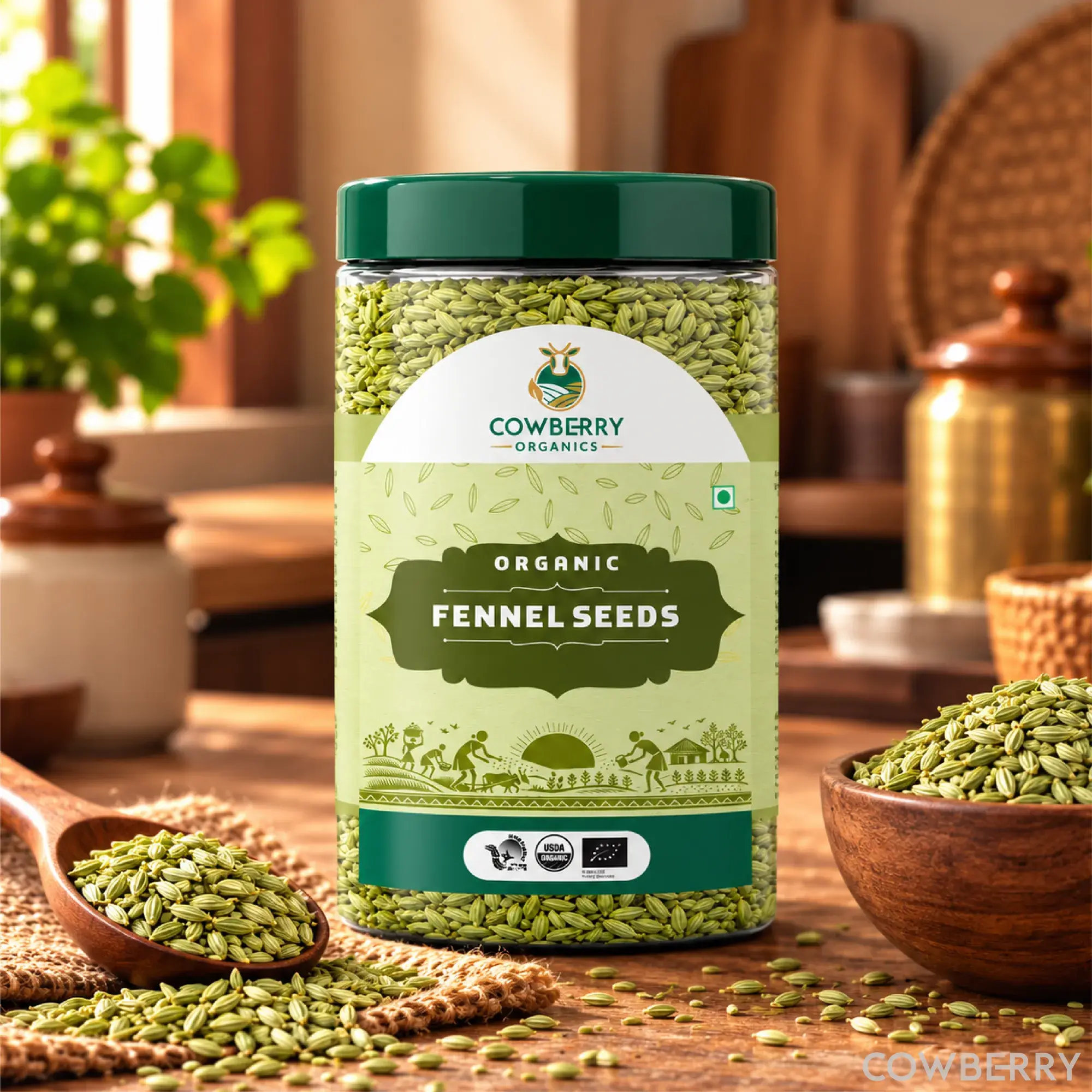
Why COWBERRY's fennel seeds: whole seeds from Rajasthan's plains, grown under cow-based natural farming, cleaned and packed bright green; India Organic, USDA & EU certified.
You can buy Organic Fennel Seeds in 100 g and 200 g packs. The shop comparison of the two seed kinds sits on the which fennel seeds are good guide.
FAQs
What is saunf?
Saunf is the Hindi word for fennel seeds, the dried, pale-green seeds of Foeniculum vulgare, an herb in the Apiaceae family. The USDA food record lists the food in English as Spices, fennel seed. Indian kitchens chew it after meals, steep it into tea and water, and cook it into tadkas, sweets and festive drinks.
Why saunf is eaten after food?
For the flavour, and the fresh finish it gives a meal. Saunf is mildly sweet, and a pinch chewed after lunch or dinner works as the classic Indian mouth freshener, at about 7 kcal a teaspoon. The habit is widespread in Indian homes; the digestion reputation that often rides along with it rests mostly on preclinical studies. Eat it for the taste, and the habit has done its job.
Which fennel seeds are good?
Fresh, bright-green, even-coloured whole seeds — the colour is the quality mark of saunf, and whole seeds hold their aroma longer than ground powder. Buy from a sealed pack, keep the jar airtight in a cool, dark cupboard, and the seed stays good for about a year. For the two shop kinds, see the buying guide above.
Difference between saunf and fennel?
None — two names for the same seed. Saunf is the Hindi word; fennel seeds is the English one, and the USDA record names the food Spices, fennel seed. Whichever name the packet carries, it holds the same dried seed of Foeniculum vulgare.
Is saunf good for health?
As a food, yes, with the scale kept honest: per 100 g saunf carries 39.8 g of fibre and 1200 mg of calcium, but a teaspoon (about 2 g) delivers 0.8 g of fibre and 24 mg of calcium. Fennel research is largely laboratory and animal work, and small culinary doses leave any true benefit hard to pin down. Judge saunf as a flavouring.
Can saunf be eaten in fast?
Yes. Saunf is a spice rather than a grain, and homes commonly keep a pinch of it and a glass of overnight saunf water on fasting days. Keep both plain and unsweetened, and saunf stays a small extra on the fast-day plate.
Does saunf helps in digestion?
The evidence for a digestion effect is mostly not from people. The 2024 fennel review rests largely on laboratory and animal studies, and its human findings — infantile colic, dysmenorrhea, polycystic ovarian syndrome, milk production — do not cover digestion from a kitchen pinch. What the after-meal habit reliably gives is a sweet, fresh finish to a meal.
References
- USDA FoodData Central
- Indian Food Composition Tables (IFCT) 2017, ICMR-National Institute of Nutrition
- Rafieian F, Amani R, Rezaei A et al. Exploring fennel (Foeniculum vulgare): Composition, functional properties, potential health benefits, and safety. Crit Rev Food Sci Nutr, 2024
- Opara EI, Chohan M. Culinary herbs and spices: their bioactive properties, the contribution of polyphenols and the challenges in deducing their true health benefits. Int J Mol Sci, 2014
- Krishnaswamy K. Traditional Indian spices and their health significance. Asia Pac J Clin Nutr, 2008
Shop this article
Keep reading
Coriander water benefits: what dhania water actually does
Peanuts in Hindi (moongfali): groundnut names in Indian languages
Coriander vs cilantro: are they the same herb?