by COWBERRY

8 minute read
What is a substitute for carom seeds? Fennel and ajwain swaps

What is a substitute for carom seeds? For most Indian recipes the answer is cumin seeds (jeera) — the same pinch in the same tadka, khichdi or paratha dough — with fennel seeds (saunf) only where the dish can carry their sweetness. The other direction is easier: jeera and saunf stand in for each other in savoury cooking, while ajwain's sharpness has no sweet stand-in. The fennel seeds hub covers saunf itself.
Carom seeds substitute: the short answer
Ajwain, or carom seeds, is the sharp, hot seed Indian kitchens use a pinch at a time: into paratha and puri dough, pakora batter, khichdi and a handful of tadkas. When the jar is empty, jeera (cumin seeds) is the usual stand-in, because it plays the same role in the same dishes — a warm, savoury background note, added in the same pinch. Saunf (fennel seeds) is not an ajwain substitute in the strict sense: it is sweet where ajwain is hot, so it belongs only in dishes that already lean sweet, and never in a paratha where ajwain's heat is the point. The same rule holds the other way round: saunf's sweetness has no hot replacement either, so the useful swap in an Indian pantry is usually jeera. Start with the same pinch at the same point in the recipe, then taste and adjust. If both jars are empty, skipping the pinch works in tadkas and khichdi — the dish loses a note, not a structure — but a paratha without ajwain or jeera simply tastes plain. Carom seeds themselves — names, nutrition and uses — are covered in the ajwain hub.
The swap table: what works in place of ajwain and saunf
Both seeds have one good stand-in, and it is the same seed: jeera. The table shows the swaps dish by dish; where a row says none, the honest answer is that the dish needs the real thing. In every row the measure follows the original recipe: wherever the dish called for a pinch of ajwain, the same pinch of jeera goes in. In soup, start with a lighter pinch and taste before adding more.
| Dish | In place of carom seeds (ajwain) | In place of saunf (fennel seeds) |
|---|---|---|
| Tadka for dal and sabzi | Jeera, the same pinch | Jeera, the same pinch |
| Paratha, puri and thepla dough | Jeera, the same measure | Jeera, a light pinch |
| Khichdi and plain rice dishes | Jeera, the same pinch | Jeera, the same pinch |
| A curry that simmers whole saunf | Jeera | Jeera; the pot simply loses its faint sweetness |
| Soup | Jeera, a light pinch | Jeera, a light pinch |
| Saunf water and thandai | None — the drinks need the sweet seed | Saunf itself |
| The mouth-freshener bowl after meals | None | None — nothing else tastes like saunf |
Ajwain, saunf and jeera: how the three seeds differ
The three seeds sit at three corners of the Indian spice shelf. Ajwain, which IFCT 2017 records as Omum, is the hot one, used in pinches in doughs and fried batters. Saunf, listed in USDA FoodData Central as Spices, fennel seed, is the sweet one, chewed after meals and steeped in drinks. Jeera, the cumin seeds of IFCT 2017, is the earthy middle, the workhorse of the tadka. IFCT 2017 records Indian-language names for ajwain, from Ajwan in Hindi to Vamu in Telugu, and the table below lists them all. Knowing the names matters when you shop: the packet that says ajwain, omum or vamu holds the same hot seed, and none of them is the sweet one.
| Language | Name (romanised) |
|---|---|
| English | Omum |
| Hindi | Ajwan |
| Marathi | Onva |
| Gujarati | Ajmo |
| Punjabi | Ajwain |
| Bengali | Joan |
| Odia | Juani |
| Assamese | Ajwain |
| Kannada | Oma |
| Telugu | Vamu |
| Tamil | Omum |
| Malayalam | Ayamothakam |
| Urdu | Ajwain |
| Sanskrit | Ajamoda |
| Botanical name | Trachyspermum ammi |
Source: IFCT 2017 (ICMR-NIN) local-names list. — means no name recorded in the source.
Fennel seeds substitute: where saunf's sweetness matters
Ask the question the other way round and the answer changes shape. A fennel seeds substitute in curry or soup is easy: jeera carries the savoury base, and the dish loses only saunf's faint sweetness. A fennel seed substitute in drinks is hard: saunf water, thandai and saunf tea are built on that sweetness, and swapping in jeera makes a different, savoury drink rather than a stand-in. In the same way, a curry that simmers whole saunf for its background sweetness cooks perfectly well without it; the change is subtle, not structural. The mouth-freshener bowl has no substitute at all; only saunf tastes like saunf. The saunf water itself is an overnight soak — see how to make saunf water — and it is the one place where jeera does not belong.
What the three seeds carry per 100 g
Nutrition matters little in a pinch, but the listed values show how differently the three seeds are built, all per 100 g. Fennel seeds give 345 kcal, 39.8 g fibre and 1200 mg calcium. Ajwain gives 358 kcal and 21.11 g fat, more fat than the other two, which carry 16.64 g and 14.9 g. Cumin seeds give 305 kcal, below ajwain's 358 kcal and fennel's 345 kcal, and carry the most iron of the three at 20.58 mg, against 18.5 mg in fennel and 13.65 mg in ajwain. On calcium the order flips: fennel's 1200 mg outdistances ajwain's 1034 mg and cumin's 878 mg. A 2014 Food Chemistry analysis of aromatic spices measured 84.95 micrograms of zinc per gram in ajwain, and reported the toxic trace elements arsenic, cadmium and lead at very low levels in the spices it tested. What a kitchen pinch delivers is smaller still: one teaspoon of fennel seeds, about 2 g, gives roughly 7 kcal and 0.8 g fibre. A tadka pinch is smaller still. Taking a pinch as about 1 g (an assumption, since pinches vary), jeera adds roughly 3 kcal and ajwain roughly 3.6 kcal. Either way, the swap changes the flavour of a dish far more than its nutrition, so choose by taste and by what the recipe needs, not by the numbers.
On health claims, the honest note first: a 2014 review in the International Journal of Molecular Sciences observes that because herbs and spices are eaten in small amounts and alongside other foods, pinning a true health benefit on them is hard. A 2021 review of cumin (Cuminum cyminum) records the seed's traditional uses and concludes that well-designed trials are still needed to demonstrate its role in human health. The same caution covers the swap: no benefit from swapping one seed for another is promised.
| Nutrient | Fennel seeds (USDA) | Ajwain (IFCT 2017) | Cumin seeds (IFCT 2017) |
|---|---|---|---|
| Energy (kcal) | 345 | 358 | 305 |
| Protein (g) | 16 | 16 | 14 |
| Fat (g) | 15 | 21 | 17 |
| Carbohydrates (g) | 52 | 25 | 23 |
| Dietary fibre (g) | 40 | 21 | 30 |
| Iron (mg) | 18 | 14 | 21 |
| Calcium (mg) | 1200 | 1034 | 878 |
| Magnesium (mg) | 385 | 273 | 442 |
| Potassium (mg) | 1690 | 1692 | 1886 |
| Sodium (mg) | 88 | 29 | 125 |
| Zinc (mg) | 3.7 | 5.7 | 4.3 |
| Folate (mcg) | — | 52 | 28 |
| Vitamin C (mg) | 21 | — | — |
Per 100 g raw, edible portion. Composition: USDA FoodData Central (SR Legacy), FDC ID 171323, NDB 2018; IFCT 2017 (ICMR-NIN). — means not reported. These are average values for the food; the label on a pack gives the values for that product.
Swap rules that keep the dish right
Three rules cover nearly every case. First, swap hot for hot and savoury for savoury: jeera replaces ajwain in a savoury dish, pinch for pinch; taste and adjust. Second, do not reach for saunf when the recipe wants ajwain's heat; the sweetness reads as wrong in a paratha or a pakora, just as ajwain would sharpen a sweet drink instead of standing in for it. Third, accept the one loss jeera cannot cover: when saunf's sweetness is the dish — thandai, saunf water, the after-meal bowl — there is no substitute, so keep a small jar of saunf in the cupboard. The same jar doubles as the everyday mouth freshener, so a spice shelf with jeera and saunf covers every swap on this page. When in doubt, taste before serving.
What to buy and how to keep the swap ready
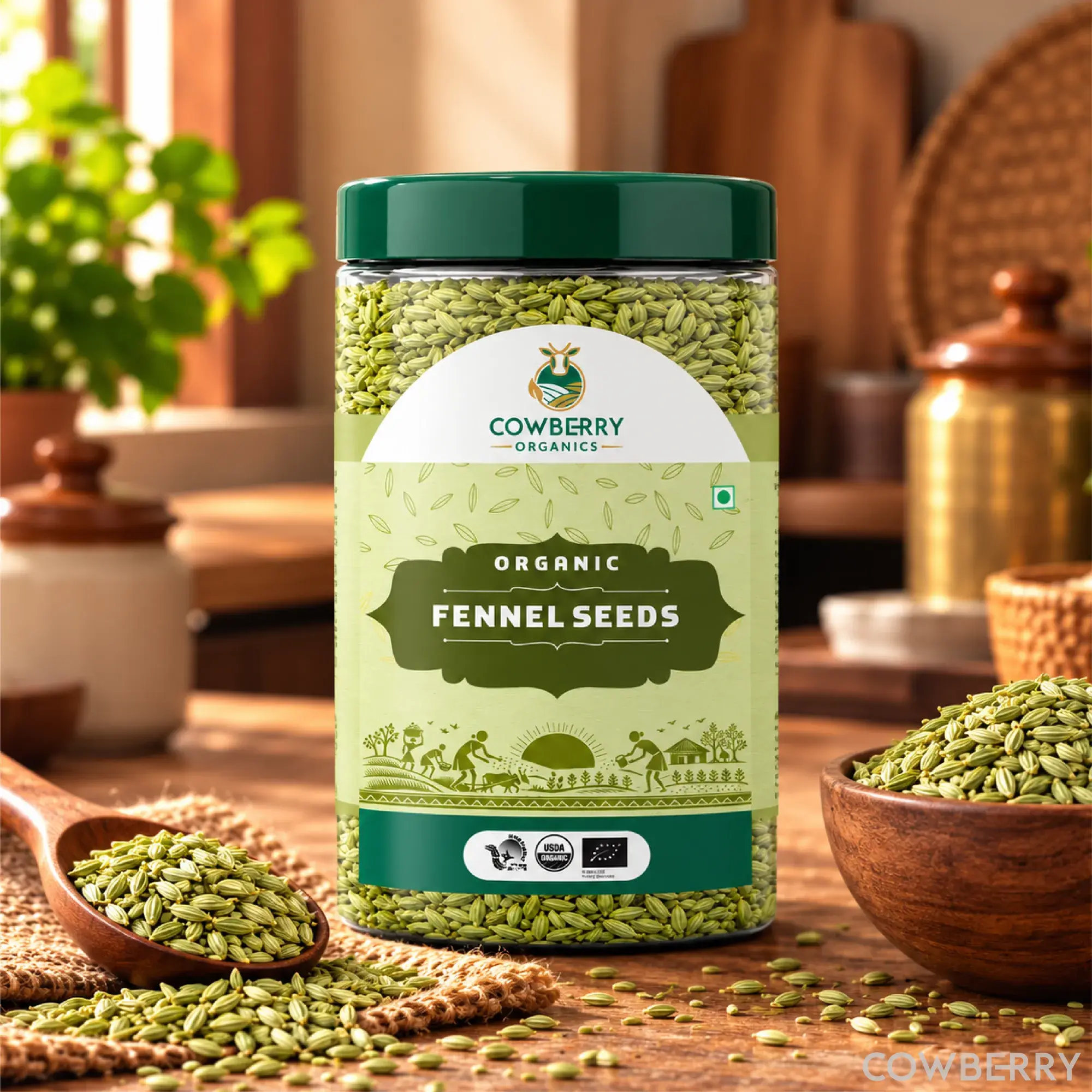
Keep the two workhorse jars full: jeera and saunf, whole seeds. Store both like any whole spice — dry spoon, tight lid, cool dark cupboard — and the details are on the how to store fennel seeds page. COWBERRY packs the sweet half of the swap: fennel seeds from the plains of Rajasthan, grown with cow-based natural farming, cleaned and packed bright green, and India Organic, USDA & EU certified. Organic Fennel Seeds stand in for saunf everywhere a recipe calls for it. If jeera is missing too, a tadka built on mustard seeds still gets dinner to the table, though the flavour moves in a different direction.
FAQs
Is there an alternative to fennel seeds?
For savoury cooking, yes: cumin seeds (jeera) can carry the savoury base, pinch for pinch, and the dish loses only saunf's sweetness. For the mouth-freshener bowl and for drinks like thandai, there is no close alternative; the sweet seed is the point. Keep both jars, and swap only in the savoury pot.
Difference between carom seeds and fennel seeds?
Carom seeds (ajwain) are hot and sharp, used a pinch at a time in doughs, pakora batter and tadkas; fennel seeds (saunf) are sweet, chewed after meals and steeped in drinks. Per 100 g, ajwain gives 358 kcal and 21.11 g fat, fennel 345 kcal and 39.8 g fibre. The two are not interchangeable.
Difference between fennel seeds and cumin seeds?
Fennel seeds taste sweet and mild, cumin seeds earthy and savoury; in the kitchen, saunf suits drinks and the after-meal bowl while jeera runs the tadka. Per 100 g, fennel gives 1200 mg calcium and 18.5 mg iron, cumin 878 mg calcium and 20.58 mg iron. Savoury dishes can trade them; sweet ones cannot.
What is saunf called in english?
Fennel seeds. The USDA food record lists the food as Spices, fennel seed, and the botanical name is Foeniculum vulgare. Saunf is the word Indian kitchens use for the same dried seed, whether it is chewed, steeped in water or toasted for cooking.
Can ajwain replace saunf in saunf water?
Not well. Saunf water leans on fennel's sweetness, and ajwain would make the glass sharp and savoury — a different drink, not a stand-in. If the saunf jar is empty, make the drink another day. The overnight method is on the how to make saunf water page.
What can I use instead of ajwain in pakora batter?
Jeera, the same pinch; taste a test fritter and adjust. Saunf would sweeten the batter, which pakoras do not want. Keep the jeera jar handy for days the ajwain runs out.
References
- Indian Food Composition Tables (IFCT) 2017, ICMR-National Institute of Nutrition
- USDA FoodData Central
- Khan N, Choi JY, Nho EY et al. Determination of minor and trace elements in aromatic spices by micro-wave assisted digestion and inductively coupled plasma-mass spectrometry. Food Chem, 2014
- Opara EI, Chohan M. Culinary herbs and spices: their bioactive properties, the contribution of polyphenols and the challenges in deducing their true health benefits. Int J Mol Sci, 2014
- Singh N, Yadav SS, Kumar S et al. A review on traditional uses, phytochemistry, pharmacology, and clinical research of dietary spice Cuminum cyminum L. Phytother Res, 2021
Shop this article
Keep reading
Coriander water benefits: what dhania water actually does
Peanuts in Hindi (moongfali): groundnut names in Indian languages
Coriander vs cilantro: are they the same herb?