by COWBERRY

8 minute read
Which fennel seeds are good? Types of saunf and how to choose

Which fennel seeds are good? Freshness beats variety: bright-green, even-coloured, whole seeds with a clean sweet smell are good saunf, whether the small everyday green kind or the plumper kind sold for chewing. The food tables print one set of values for all fennel seeds, so the choice is about use and freshness, not ranking. The fennel seeds hub covers the seed.
Which fennel seeds are good: check freshness first
Whatever the shop calls the packet, a good pack of saunf shows four things. The colour is an even, bright green, not a mix of green and brown-grey. The seeds are whole, with few broken pieces and no dust or chaff at the bottom of the packet. The smell is clean and sweet, strongest when a few seeds are crushed between your fingers. And the packet is dry inside, with nothing clumping. Faded colour, a flat smell and broken seeds are all signs of an old batch, and old seeds taste of little. Beyond freshness, there is no ranked list of fennel seeds types to lean on: the food tables carry one entry for fennel seeds, so no kind can claim better numbers than another. Freshness shows the same way in both sizes: the small cooking saunf should be as vividly green as the plump chewing kind, because colour fades long before the seeds become unusable. When the shop keeps its saunf in an open tin near the door, sunlight and humidity have already started that fading, so a sealed packet from a cool shelf is the safer buy.
What fennel seeds are: one seed behind every name
Every kind of saunf in the market is the seed of one plant, Foeniculum vulgare, the fennel of the botanical books. The USDA food record lists it in English as Spices, fennel seed; the Indian food tables, IFCT 2017, carry no fennel entry, which is why the numbers in the sections below come from that USDA record (FDC ID 171323). A 2024 review in Critical Reviews in Food Science and Nutrition describes the plant as a hardy, perennial herb with yellow, umbrella-like flowers, long used as a culinary and medicinal herb. So the fennel seeds varieties a shopper meets are not different plants; as far as the food records show, they are different sizes and shop names of the same dried seed. One pooled entry also means one honest statement: this page cannot split big saunf from small saunf on nutrition, on fibre or on anything else, because no food table prints the split. Its regional names are on the fennel seeds in hindi page.
The two saunf types in Indian shops: big and small
Walk the spice aisle and fennel comes in two familiar forms. The first is the small, green, everyday saunf, the cooking seed, used whole in tempering, in spice blends, in pickles and in drinks like thandai. The second is the bigger, plumper, paler kind that shops keep for the mouth-freshener bowl, sold loose by weight for chewing after meals. Both are Foeniculum vulgare. The size difference is plain to see in the palm, but no food record explains how the two sizes come about, so this page will not guess; and no food table splits the nutrition by size, so big and small saunf get the same per-100 g figures in the section below. Shops usually stock the small kind near the cooking spices and the plump kind near the mouth-freshener mixes, though the same packet may turn up in both aisles. For cooking, the small seeds are also the ones to dry-roast lightly in a pan, which deepens their aroma before grinding; the plump kind is eaten whole and needs no roasting.
Badi saunf and lucknowi saunf: the names behind the questions
Searchers ask about badi saunf and lucknowi saunf, and both names point at the same plump seed. Badi saunf is simply Hindi for big saunf: the larger, paler kind of the section above, and the name carries no other meaning. Lucknowi saunf is a shop label you will meet for that same plump mouth-freshener kind, and the food records print nothing about the label's background or about any special variety behind it, so no honest page can dress it up. The useful difference is the one you can see: plump seeds are the ones chewed after meals, and small green seeds are the ones that go into the tempering pan, the spice blends and the pickles. No study separates the two kinds for health, so pick on use, not on promises. Read labels as pointers, not pedigrees: the packet that says lucknowi tells you the size and the intended use, and nothing more that a source here can stand behind.
Fennel seeds nutrition per 100 g and per teaspoon
The single record behind every kind here prints, per 100 g of raw fennel seeds: 345 kcal, 15.8 g protein, 14.9 g fat, 52.3 g carbohydrate, 39.8 g fibre, 1200 mg calcium, 18.5 mg iron, 385 mg magnesium, 1690 mg potassium and 21 mg vitamin C. One teaspoon of fennel seeds, about 2 g, works out to roughly 7 kcal, 0.8 g fibre, 24 mg calcium and 0.4 mg iron — the amounts a kitchen pinch or a mouth-freshener bowl actually delivers. What that means for health, keep plain: a 2014 review in the International Journal of Molecular Sciences notes that small culinary doses, eaten with other foods, make any true health benefit hard to pin down, and a 2024 review of fennel reports human findings for infantile colic and dysmenorrhea, though not from everyday saunf. The evidence is set out on the fennel seeds benefits page.
| Nutrient | Fennel seeds (USDA) |
|---|---|
| Energy (kcal) | 345 |
| Protein (g) | 16 |
| Fat (g) | 15 |
| Carbohydrates (g) | 52 |
| Dietary fibre (g) | 40 |
| Iron (mg) | 18 |
| Calcium (mg) | 1200 |
| Magnesium (mg) | 385 |
| Potassium (mg) | 1690 |
| Sodium (mg) | 88 |
| Zinc (mg) | 3.7 |
| Vitamin C (mg) | 21 |
Per 100 g raw, edible portion. Composition: USDA FoodData Central (SR Legacy), FDC ID 171323, NDB 2018. — means not reported. These are average values for the food; the label on a pack gives the values for that product.
Which saunf for which use
The size question answers itself once the use is fixed. Cook with the small green saunf: it goes whole into tempering and spice blends, and it is the one to roast or grind for cooking. Chew the plump kind after meals. In many kitchens saunf enters the pot ground rather than whole, because grinding spreads its sweetness through a gravy instead of leaving whole seeds to bite. For saunf water, either size works, since the overnight soak is the same; the method is on the how to make saunf water page. Hot drinks use the same seed: the saunf tea recipe steeps it, and thandai grinds it — see the thandai recipe. And if the confusion is with the other aromatic seed, the ajwain vs saunf page sorts them out.
How to choose saunf at the shop and keep it good
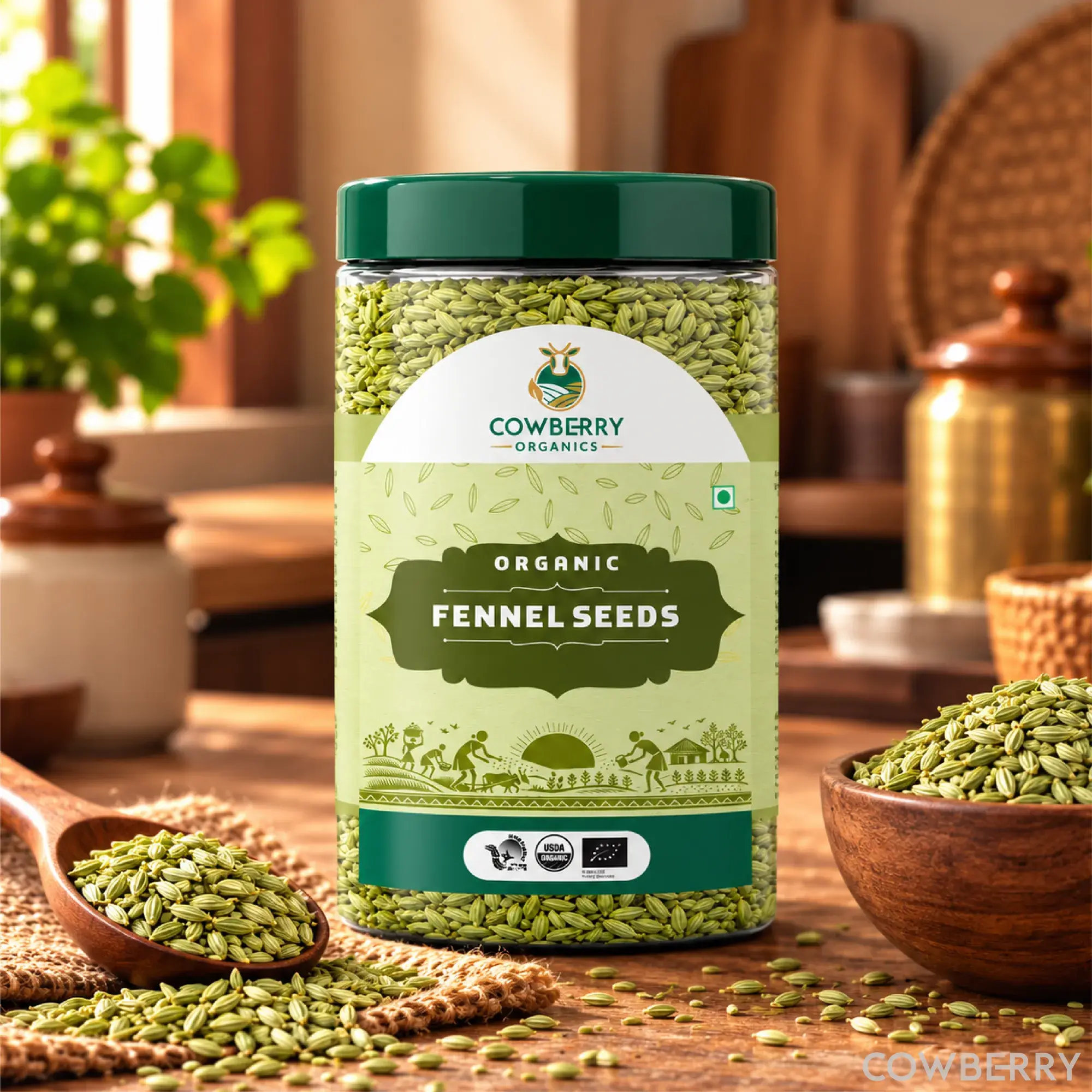
Buy by look, by smell and by the size your own kitchen cooks with. Once home, the seeds want the same care as any whole spice: a dry spoon, a tight lid and a cool, dark cupboard, which is why how to store fennel seeds has its own page. If organic matters to you, look for a certification mark on the pack. COWBERRY's fennel seeds are grown on the plains of Rajasthan with cow-based natural farming, cleaned and packed to hold their bright green, and are India Organic, USDA & EU certified. Organic Fennel Seeds come in 100 g and 200 g packs. One last check at home: tip a few seeds between your palms and smell them; a batch that still smells sweet after weeks in the cupboard was stored right. And if a recipe calls for saunf you do not have, the swap question is answered on the page about a substitute for carom seeds.
FAQs
How many types of saunf?
No official count exists: the food tables print a single entry for fennel seeds. Indian shops sell the seed in two familiar forms: the small green everyday saunf for cooking, and the larger, plumper, paler kind chewed after meals. Both are the seed of Foeniculum vulgare, with one shared nutrition record.
Which saunf is good big or small?
Neither outranks the other; the size matches the job. The small green saunf is the cooking seed, and the plump one is the mouth-freshener seed. Nutrition per 100 g is the same single record for both, so choose by what you will do with it, and pick the freshest packet on the shelf.
Difference between saunf and badi saunf?
Only size. Badi saunf is Hindi for big saunf: the same fennel seed, simply larger and paler, sold mostly for chewing after meals, while the small green seed is the one kitchens cook with. The food tables carry one composition for both, so there is no nutrition difference to print.
Difference between saunf and lucknowi saunf?
Lucknowi saunf is a shop label for the plump, pale kind chewed after meals, and no food record explains the label — no origin story, no separate variety. Tell the two packets apart by what you can see and smell: plump and pale for the after-meal bowl, small and green for the kadhai.
Which fennel seeds are good for digestion?
No trial separates big and small saunf for digestion, so no kind wins that contest. A 2014 review notes that proving a real health benefit from small culinary spice doses is hard; a 2024 review of fennel reports human findings for infantile colic, dysmenorrhea and milk production, though not from shop saunf. A teaspoon of either kind (about 2 g) carries 0.8 g fibre.
Is saunf good for health?
Saunf is a food eaten a teaspoon at a time, and its nutrition is real but small at that scale: 345 kcal and 39.8 g fibre per 100 g, so a teaspoon gives about 0.8 g fibre. The studies behind fennel are mostly laboratory and animal work, per a 2024 review, and small culinary doses make benefit hard to prove, per a 2014 review.
References
- USDA FoodData Central
- Rafieian F, Amani R, Rezaei A et al. Exploring fennel (Foeniculum vulgare): Composition, functional properties, potential health benefits, and safety. Crit Rev Food Sci Nutr, 2024
- Opara EI, Chohan M. Culinary herbs and spices: their bioactive properties, the contribution of polyphenols and the challenges in deducing their true health benefits. Int J Mol Sci, 2014
Shop this article
Keep reading
Coriander water benefits: what dhania water actually does
Peanuts in Hindi (moongfali): groundnut names in Indian languages
Coriander vs cilantro: are they the same herb?