by COWBERRY

10 minute read
Curry leaves (kadi patta): names, nutrition, benefits and uses

Curry leaves are the small aromatic leaves Indian cooks drop into hot oil to start a tadka, sold fresh in market bunches and dried in packets. This hub gathers the leaf's names in Indian languages, its nutrition per 100 g, its benefits and side effects, storage, powder and cooking; each section hands over to the fuller page.
What are curry leaves (kadi patta)?
Curry leaves are the leaves of the curry tree, Murraya koenigii, and everyday Hindi calls the leaf kadi patta; IFCT 2017 records the leaf under the Hindi name Gandhela. The leaf is a seasoning, not a vegetable: a sprig of six to ten leaves drops into hot oil to start a tadka, where it crackles for a few seconds and scents the dal, sambar, rasam or rice that follows, and the fried leaves are eaten with the dish rather than fished out. Around the Indian kitchen the same leaf turns up in upma, poha, chutneys and podis, wherever a tempered aroma is wanted. A 2021 review of three varieties of curry leaves notes that the plants have been widely used in Ayurvedic medicine, and the food tables list the leaf's composition per 100 g in the nutrition section of this page. For the everyday kitchen, the leaf comes in two forms: the fresh bunch from the vegetable market, and the dried leaf in a packet, which needs no refrigeration and drops straight into the oil from the jar.
Curry leaves names in Indian languages
Everyday speech calls the leaf kadi patta, and the food tables' language rows add twelve more Indian names to it: Gandhela in Marathi, Kadi umdo in Gujarati, Kadhi patta in Punjabi, Karhi-pat in Bengali, Bhursanga Patra in Odia, Narasingha paat in Assamese, Karibevu in Kannada, Karivepaku in Telugu, Kariveppilai in Tamil and Malayalam, Kadi ka patta in Urdu, and Sanskrit records Girinimba for the leaf, completing the list — thirteen Indian languages in all, beside the English curry leaves and the botanical Murraya koenigii. On packs and shop signs the English name is usually written curry leaves or curry leaf; the two spellings name the same leaf. The full table, with the everyday names and the classical Sanskrit record separated, is on the kadi patta in english page.
| Language | Name (romanised) |
|---|---|
| English | Curry leaves |
| Hindi | Gandhela |
| Marathi | Gandhela |
| Gujarati | Kadi umdo |
| Punjabi | Kadhi patta |
| Bengali | Karhi-pat |
| Odia | Bhursanga Patra |
| Assamese | Narasingha paat |
| Kannada | Karibevu |
| Telugu | Karivepaku |
| Tamil | Kariveppilai |
| Malayalam | Kariveppilai |
| Urdu | Kadi ka patta |
| Sanskrit | Girinimba |
| Botanical name | Murraya koenigii |
Source: IFCT 2017 (ICMR-NIN) local-names list. — means no name recorded in the source.
Curry leaves nutrition per 100 g
Per 100 g of fresh leaves, IFCT 2017 records 64 kcal, 7.41 g of protein, 1.06 g of fat, 4.51 g of carbohydrate and 16.83 g of fibre. The mineral rows are the strong ones: 659 mg of calcium and 8.67 mg of iron, with 182 mg of magnesium, 584 mg of potassium, 1.18 mg of zinc and just 18.66 mg of sodium, so the salt in a curry leaf dish is nearly all the cook's own; the vitamins printed are 117 mcg of folate and 6.04 mg of vitamin C. No dried-leaf record exists in the food tables, so every figure describes the fresh leaf as sold. No glycemic index figure is printed for curry leaves in the food tables either, so none is given on this page; the carbohydrate count is what a herb can honestly promise, and the leaf's own count is small.
A tadka does not eat 100 g. One teaspoon (5 g) of fresh leaves carries about 3 kcal, 0.4 g of protein, 0.2 g of carbohydrate, 0.8 g of fibre, 33 mg of calcium and 0.4 mg of iron. The comparison column in the table is dried bay leaf, whose per-100 g figures run higher in part because the dried leaf has lost its water. The full table, the per-teaspoon arithmetic for every nutrient and a comparison with bay leaf and coriander powder are on curry leaves nutrition facts 100g.
| Nutrient | Curry leaves, fresh | Bay leaf, dried |
|---|---|---|
| Energy (kcal) | 64 | 313 |
| Protein (g) | 7.4 | 7.6 |
| Fat (g) | 1.1 | 8.4 |
| Carbohydrates (g) | 4.5 | 75 |
| Dietary fibre (g) | 17 | 26 |
| Iron (mg) | 8.7 | 43 |
| Calcium (mg) | 659 | 834 |
| Magnesium (mg) | 182 | 120 |
| Potassium (mg) | 584 | 529 |
| Sodium (mg) | 19 | 23 |
| Zinc (mg) | 1.2 | 3.7 |
| Folate (mcg) | 117 | 180 |
| Vitamin C (mg) | 6 | 46 |
Per 100 g raw, edible portion. Composition: IFCT 2017 (ICMR-NIN); USDA FoodData Central (SR Legacy), FDC ID 170917, NDB 2004. — means not reported. These are average values for the food; the label on a pack gives the values for that product.
Curry leaves benefits and side effects
The measured benefits are the rows above: a little calcium and iron in every sprig, a little fibre, and almost no energy at 64 kcal per 100 g. A teaspoon (5 g) carries about 33 mg of calcium, 0.4 mg of iron, 0.8 g of fibre and 3 kcal, which is exactly the scale the leaf works at. The tradition runs deeper: a 2021 review notes that three varieties of curry leaves have a wide record in Ayurvedic medicine, and it records antioxidant, antidiabetic, anti-inflammatory and antitumor activity shown in in vitro and in vivo models, while calling for comprehensive research to validate efficacy. The hair question gets a straight answer on the benefits page: the reviews record no study of the leaf for hair, so no hair claim is tied to it there. As a food, the leaf comes with no side-effect list, and none is invented; the practical cautions are ordinary ones, such as watching the salt a recipe adds rather than the leaf's own 18.66 mg of sodium per 100 g, and keeping medicines first: spices and supplements are not stand-ins for medicines, so talk to your doctor or dietitian before using them in place of your medicines. No daily amount is printed for the leaf anywhere, and none is set; the amounts cooking uses are a sprig of six to ten leaves or a teaspoon, and seasoning has no dose. Each benefit with the nutrient behind it, the full caution list and the daily amount are on curry leaves benefits, and the same list in Hinglish is kadi patta ke fayde.
Kadi patta and diabetes
For diabetes, the leaf's honest role is a seasoning: carbohydrate is 4.51 g per 100 g and about 0.2 g in a teaspoon, so it fits a plate where every gram is counted. The activity findings behind the leaf come from cell and animal studies, which are not results in people and do not tell anyone what amount to take; the leaf stays in the tadka and the medicines stay as the doctor set them. At 3 kcal and 0.2 g of carbohydrate a teaspoon, the leaf asks for no adjustment to the plate; the adjustments stay in the rice, the dal and the oil, where the meal plan actually lives. The full research picture, including what the two reviews of the leaf report and what they do not, the buttermilk pairing and the plate-level advice, is on kadi patta benefits for diabetes.
Curry leaves vs bay leaf
Both leaves perfume the pot, and the food tables separate them cleanly. Fresh curry leaves record 64 kcal, 16.83 g of fibre and 659 mg of calcium per 100 g; dried bay leaf records 313 kcal, 26.3 g of fibre and 834 mg, figures that run higher, partly because drying has removed the leaf's water. The two leaves also work at opposite ends of a dish: the bay leaf steams inside pulaos and biryanis and is picked out before serving, while curry leaves crackle in the tempering oil and are eaten with the meal. They are not interchangeable in a recipe, and the full side-by-side, with which dish wants which leaf, is on difference between kadi patta and tej patta.
How to store curry leaves
Fresh bunches keep in the fridge for two to three weeks and in the freezer for a few months; dried leaves keep for several months in an airtight jar, and the powder carries no printed keeping time, so the honest test is the smell before use. These are kitchen estimates, not printed shelf lives, and the method matters more than the number: separate the leaves from the stems, dry them completely so trapped moisture cannot blacken them, and pack them in a paper towel inside an airtight box for the fridge or dry and airtight for the freezer. The step-by-step method, with what makes leaves turn black and how to avoid it, is on how to store kadi patta for long time.
How to make curry leaves powder
Dried leaves grind into a powder that finishes a plate rather than starting the pot: a teaspoon over rice, curd rice or a chutney, and a pinch at the end can stand in for the tempering when the oil step is absent. The method runs pick, dry, roast and grind: choose fresh leaves, dry them completely, roast them in a dry pan until crisp and grind them fine; the powder then lives in an airtight jar. Making it at home takes about fifteen minutes of hands-on work plus the drying and cooling waits. The food tables print no figures for the powder, so no numbers are given for it, only the method. The full method is on curry leaves powder how to make.
Curry leaves in cooking: the lemon rice recipe
Wherever the leaf goes, it goes into hot oil first, and lemon rice is its signature: rice cooked with a soak and a drain, cooled, then dressed with lemon juice and turmeric and finished with a tempering in which curry leaves crackle over the pot. The recipe page gives the amounts and the method for a plate at 366 kcal a serving, with about 34 minutes of hands-on work and a little over an hour in all. It is also the leaf's teaching recipe: the tempering order of mustard, dals and curry leaves is the same pattern that repeats across South Indian rice dishes. The full recipe is lemon rice recipe.
How to buy curry leaves: what to look for
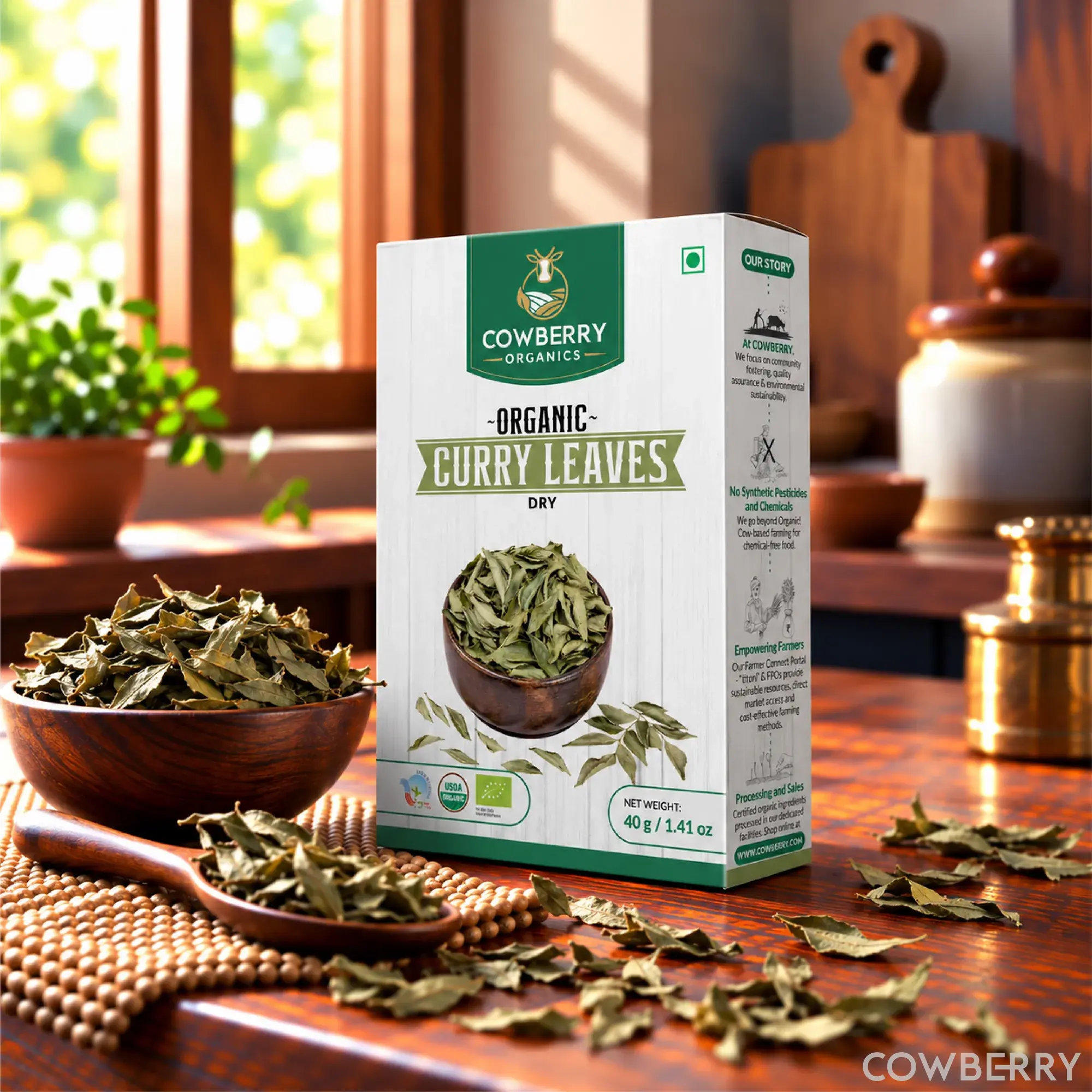
The fresh bunch from the vegetable market should be green and springy, with no blackened or yellowing leaves, and it gets used quickly or stored as the storage section describes. The dried leaf is the pantry form: it needs no refrigeration and sits in the spice shelf until the next tadka. COWBERRY's pack of dried curry leaves is sourced from Andhra Pradesh and naturally dried, from cow-based natural farming with nothing added. Buying is the easy part; the harder part is keeping the bunch green, which is why the storage page separates fridge, freezer and dried-leaf method in a table of its own.
FAQs
What is curry leaves?
Curry leaves are the small aromatic leaves of the curry tree, Murraya koenigii, and everyday Hindi calls them kadi patta. A sprig of six to ten leaves drops into hot oil to start a tadka, and the fried leaves are eaten along with the dish.
What is kadi patta?
Kadi patta is the everyday Hindi name for curry leaves; IFCT 2017 records the leaf under the Hindi name Gandhela. It is the same leaf, Murraya koenigii, sold fresh in market bunches and dried in packets, and used in tadkas across Indian cooking.
Can we eat kadi patta?
Yes. The leaves are eaten in the dish they season, since the fried leaves stay in the dal or rice after the tempering. They also work in chutneys and podis, and dried leaves can be crushed over a finished plate.
How to store kadi patta?
Fresh bunches keep in the fridge for two to three weeks and in the freezer for a few months; dried leaves keep for several months in an airtight jar. These are kitchen estimates; the step-by-step method is on the storage page.
Is kadi patta a medicinal plant?
It is a food herb with a medicinal tradition: a 2021 review records that three varieties of curry leaves have long sat in Ayurvedic practice. The activity findings behind that tradition come from in vitro and in vivo models, and the review calls for comprehensive research.
Can curry leaves be eaten raw?
Yes, fresh leaves can be eaten raw in small amounts, and they usually arrive cooked: the standard use is a sprig crackling in the hot oil of a tadka, after which the fried leaves are eaten with the dish.
References
- Indian Food Composition Tables (IFCT) 2017, ICMR-National Institute of Nutrition
- Abeysinghe DT, Alwis DDDH, Kumara KAH et al. Nutritive Importance and Therapeutics Uses of Three Different Varieties (Murraya koenigii, Micromelum minutum, and Clausena indica) of Curry Leaves: An Updated Review. Evid Based Complement Alternat Med, 2021
Shop this article
Keep reading
Coriander water benefits: what dhania water actually does
Peanuts in Hindi (moongfali): groundnut names in Indian languages
Coriander vs cilantro: are they the same herb?