by COWBERRY

5 minute read
Kadi patta in English (curry leaves): names in Indian languages

Kadi patta in English is curry leaves, the leaf of the curry tree, botanical name Murraya koenigii. The everyday Hindi name is kadi patta itself, while IFCT 2017 records Gandhela for Hindi; the other languages in the table have their own words, from Karibevu in Kannada to Kariveppilai in Tamil. All the names are below, each with its source; the curry leaves hub covers cooking with the leaf.
Kadi patta in English and 13 Indian languages: quick answer
In English, the leaf is curry leaves, which is the food name IFCT 2017 prints for its entry under food code G010, with the botanical name Murraya koenigii. In everyday Hindi it is kadi patta, and IFCT's own local-names list prints Gandhela for Hindi, with the Punjabi and Urdu rows printing near spellings of the everyday word.
Region by region, the table reads like a map of the leaf: in the north, Punjabi Kadhi patta and Urdu Kadi ka patta print near spellings of the everyday Hindi word; in the east and north-east, Bengali keeps Karhi-pat, Assamese Narasingha paat and Odia Bhursanga Patra. In the west, Marathi prints Gandhela and Gujarati Kadi umdo. In the south, Kannada prints Karibevu, Telugu Karivepaku, and Tamil and Malayalam share the same word, Kariveppilai. Sanskrit records Girinimba.
| Language | Name (romanised) |
|---|---|
| English | Curry leaves |
| Hindi | Gandhela |
| Marathi | Gandhela |
| Gujarati | Kadi umdo |
| Punjabi | Kadhi patta |
| Bengali | Karhi-pat |
| Odia | Bhursanga Patra |
| Assamese | Narasingha paat |
| Kannada | Karibevu |
| Telugu | Karivepaku |
| Tamil | Kariveppilai |
| Malayalam | Kariveppilai |
| Urdu | Kadi ka patta |
| Sanskrit | Girinimba |
| Botanical name | Murraya koenigii |
Source: IFCT 2017 (ICMR-NIN) local-names list. — means no name recorded in the source.
The botanical name and the English name
The botanical name of the curry tree is Murraya koenigii, and the 2021 review by Abeysinghe and colleagues covers three varieties of curry leaves, all in the family Rutaceae. The 2024 review by Jachak and colleagues describes the same plant as tropical, native to India and Southeast Asia, and notes that it is sometimes called sweet neem.
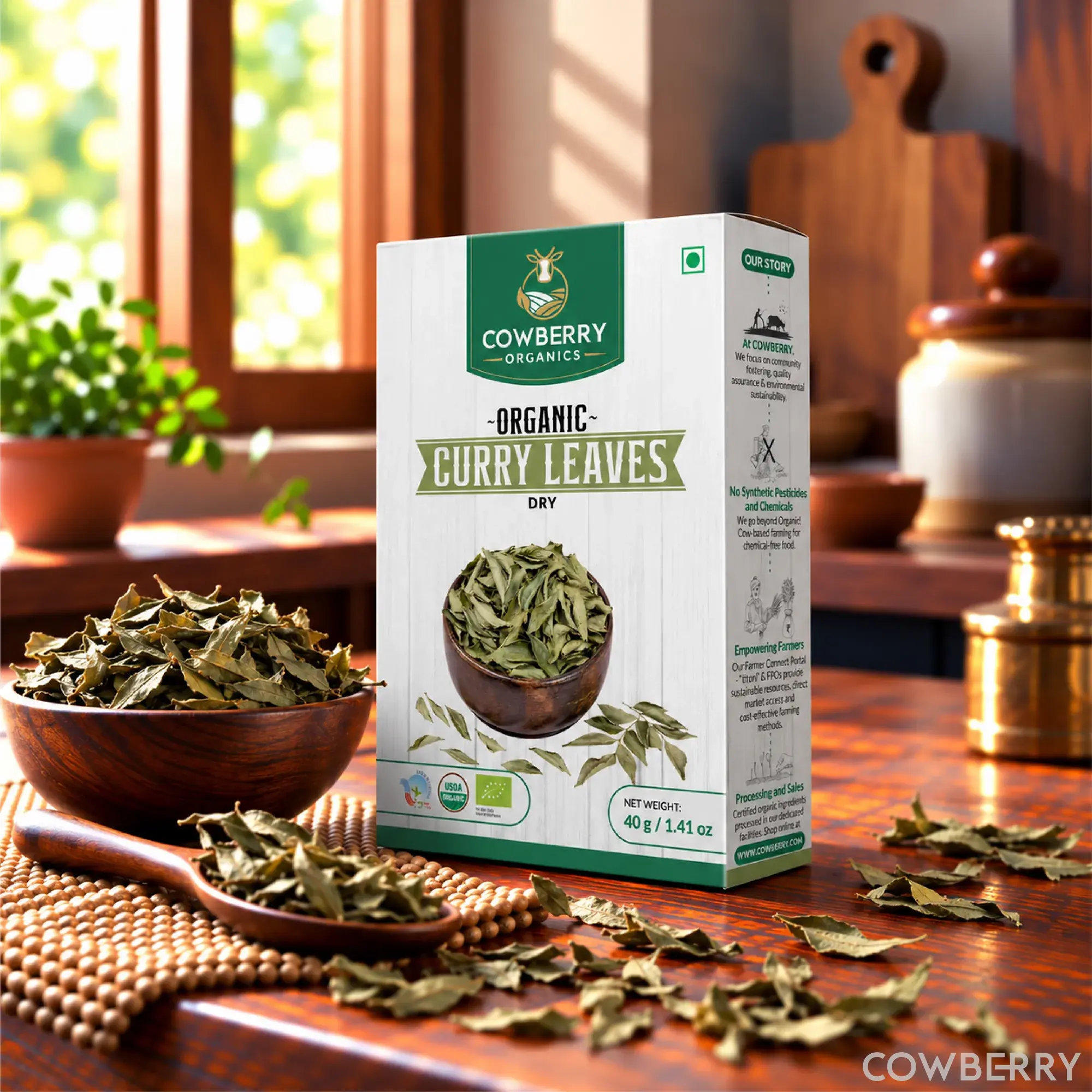
In English the leaf is simply curry leaves, the name IFCT 2017 prints, and kadi patta in English is the same leaf, no translation needed beyond that. On Indian packs and shop signs the spelling varies, curry leaves and curry leaf side by side, but the leaf is one: fresh in a market bunch, dried in a packet, or ground into the powder on curry leaves powder how to make. COWBERRY's dry curry leaves are that same leaf, dried.
Names by region
The table above is IFCT 2017's own local-names list for the leaf, and reading it by region shows how the name travelled with the plant.
North and east
In Hindi, IFCT prints Gandhela while everyday speech says kadi patta; Punjabi prints Kadhi patta and Urdu Kadi ka patta, two spellings of the same everyday word. Bengali keeps its own shape, Karhi-pat, and Assamese its own, Narasingha paat; Odia prints Bhursanga Patra.
West
Marathi prints Gandhela, the same word Hindi uses, and Gujarati prints Kadi umdo, so kadi patta meaning in Gujarati is kadi umdo.
South
Curry leaves in Tamil are kariveppilai, and Malayalam prints the same word, kariveppilai; curry leaves in Telugu are karivepaku, and in Kannada they are karibevu. The three southern words share a shape, but each state says it its own way.
Classical
Sanskrit records Girinimba for the leaf, completing IFCT's list.
Often confused with: neem, tej patta and the other curry leaf varieties
Three mix-ups cover most of the questions this page gets.
Neem. A different tree, and the confusion is fair: the 2024 review notes the curry leaf is sometimes called sweet neem. The curry leaf is the one that goes into the tadka.
Tej patta. The dried bay leaf used whole in pulao comes from another tree entirely, and the two leaves are set side by side on difference between kadi patta and tej patta.
Other curry leaf varieties. The 2021 review covers three varieties of curry leaves, Murraya koenigii, Micromelum minutum and Clausena indica, so a study's curry leaves can be any of the three. The everyday Indian leaf, the one in the market bunch and in the tadka, is Murraya koenigii.
Where curry leaves grow
The curry tree is tropical and native to India and Southeast Asia, as the 2024 review describes it, and India is where the leaf is woven into the cooking: tempered in hot oil for dal, sambar and rasam, folded into lemon rice, and sold dried as well as fresh. COWBERRY's dry curry leaves come from Andhra Pradesh and are naturally dried.
The table above runs to 13 languages. Everything else, cooking, storage and the research picture, starts at the curry leaves hub.
FAQs
What is kadi patta called in english?
Curry leaves. That is the English name IFCT 2017 prints for the leaf, under food code G010, with the botanical name Murraya koenigii. On Indian packs and shop signs the spelling is curry leaves or curry leaf, and both mean the same leaf.
What is curry leaves in hindi?
In everyday Hindi the leaf is kadi patta, and IFCT 2017 records the Hindi name as Gandhela. The Punjabi name IFCT prints, Kadhi patta, and the Urdu name, Kadi ka patta, are spellings of the same everyday word.
Difference between curry leaves and neem?
They are leaves of two different trees: curry leaves come from the curry tree, Murraya koenigii, and neem from the neem tree. The mix-up has a source, since the 2024 review notes the curry leaf is sometimes called sweet neem, but the two trees are not the same plant.
Difference between kadi patta and tej patta?
Tej patta is the dried bay leaf, from a different tree, simmered whole in pulao and lifted out before serving; kadi patta is the fresh green curry leaf fried in hot oil at the start of a tadka. The full comparison is on difference between kadi patta and tej patta.
What is kadi patta?
Kadi patta is the everyday Hindi name for curry leaves, the aromatic leaf of the curry tree, Murraya koenigii, a tropical plant native to India and Southeast Asia. Cooks fry it in hot oil at the start of a tadka, and it is sold fresh in bunches or dried.
What is curry leaves in tamil?
Kariveppilai, the name IFCT 2017 prints for Tamil, and Malayalam prints the same word. In Telugu the leaf is Karivepaku, in Kannada Karibevu, and in Hindi kadi patta, which IFCT records as Gandhela.
References
- Indian Food Composition Tables (IFCT) 2017, ICMR-National Institute of Nutrition
- Abeysinghe DT, Alwis DDDH, Kumara KAH et al. Nutritive Importance and Therapeutics Uses of Three Different Varieties (Murraya koenigii, Micromelum minutum, and Clausena indica) of Curry Leaves: An Updated Review. Evid Based Complement Alternat Med, 2021
- Jachak SM, Thakur MS, Ahirrao P et al. Murraya koenigii (L.) Spreng. as a Natural Intervention for Diabesity: A Review. Curr Pharm Des, 2024
Shop this article
Keep reading
Coriander water benefits: what dhania water actually does
Peanuts in Hindi (moongfali): groundnut names in Indian languages
Coriander vs cilantro: are they the same herb?