by COWBERRY

8 minute read
Curry leaves benefits: what kadi patta offers and its side effects

Curry leaves benefits split into two honest halves: the measured food facts, 659 mg calcium, 8.67 mg iron, 16.83 g fibre and 117 mcg folate per 100 g (IFCT 2017), and the research picture, still laboratory and animal work. Each benefit comes with its nutrient, followed by the side effects, the daily amount and ways to eat the leaf; the curry leaves hub covers the names, storage and buying.
Curry leaves benefits: the nutrients behind them
1. Calcium, 659 mg per 100 g
The calcium row is 659 mg per 100 g of fresh leaves (IFCT 2017). The leaf slips a little calcium into every tempered dish: a teaspoon (5 g) carries about 33 mg. Keep the scale honest, though: a sprig in a dal is a nudge, not a dairy serving.
2. Iron, 8.67 mg per 100 g
The fresh leaf records 8.67 mg of iron per 100 g (IFCT 2017), and a teaspoon (5 g) gives about 0.4 mg. That is a trace beside the dal and vegetables on the plate, but it rides along in every tadka for free.
3. Fibre, 16.83 g per 100 g
Curry leaves hold 16.83 g of total dietary fibre per 100 g, and a teaspoon carries 0.8 g. The leaf is not a fibre plan, since nobody eats it by the 100 g, but the little it adds comes with every sprig.
4. Folate and vitamin C
Among the vitamins, IFCT 2017 lists 117 mcg of folate and 6.04 mg of vitamin C per 100 g of fresh leaves. A teaspoon holds 5.9 mcg of folate and 0.3 mg of vitamin C, a trace that repeats the same honest point: the leaf seasons, it does not dose.
5. Almost no energy
Fresh curry leaves give 64 kcal per 100 g, and a teaspoon comes to about 3 kcal. That is the leaf's cleanest benefit in a kitchen: it adds its fried-leaf aroma to dal, rice and sambar without asking the meal's energy count to move, and it belongs at the start of a tadka as well as at the end of a garnish.
Curry leaves benefits in Ayurveda and what researchers are studying
The Ayurvedic record
The curry leaf has a place in the Indian tradition. A 2024 review in Current Pharmaceutical Design describes the plant as highly valued in Ayurveda for its medicinal properties, with almost every part of it, fresh leaves, fruit, bark and roots, used for various ailments; the fresh leaves appear in the traditional record for piles, inflammation, itching, fresh cuts, dysentery and oedema, and the pairing of curry leaf with buttermilk appears there for amoebiasis, diabetes and hepatitis, as a traditional pairing rather than as a remedy. A 2021 review of three curry leaf varieties in Evidence-Based Complementary and Alternative Medicine records the same point more broadly: the three varieties have been widely used in Ayurvedic medicine. That is the tradition, and it is read here as tradition, not as a clinical finding.
What the laboratory and animal studies suggest
The 2024 review calls the leaf a storehouse of carbazole alkaloids and reports that it has shown anti-obesity and anti-diabetic activity in in vitro and in vivo studies, studies done on cell lines and animals; the review adds that some of those studies require further in-depth analysis and validation. The 2021 review says earlier findings provide strong evidence for antioxidant, antidiabetic, anti-inflammatory and antitumor activity in the three curry leaf species, and that the role of their leading constituents in diabetes and cancer comes from in vitro and in vivo models; it emphasises the need for comprehensive research to validate efficacy.
The missing step: results in people
Neither abstract reports a measured result in people: no change in blood sugar, body weight, hair or anything else. A 2014 review of culinary herbs and spices in the International Journal of Molecular Sciences explains why the step matters: these foods are consumed in small amounts, usually alongside other foods, so their true benefit is hard to pin down. A sprig of curry leaves at a time inside a pot of dal is precisely that situation. The diabetes question, answered the same honest way with the full research detail, is on kadi patta benefits for diabetes.
Are curry leaves good for hair? What the evidence shows
Hair gets a straight answer too. Neither review's abstract mentions a study of the leaf for hair growth, hair fall or grey hair, so no hair claim can be made from the research record; the honest material is the food table, which is real but small: 8.67 mg of iron, 117 mcg of folate and 6.04 mg of vitamin C per 100 g; a teaspoon (5 g) carries 0.4 mg, 5.9 mcg and 0.3 mg of those. What the leaf can promise a head of hair is nothing more than what it promises a plate of dal: its aroma in the tadka. If hair is a worry, talk to your doctor or dietitian rather than loading up on any single herb.
Curry leaves side effects and who should limit it
For many people, curry leaves in cooking amounts are an ordinary everyday herb. The abstracts of the two reviews do not record side effects from the leaf as a food, and no side-effect list is invented. A few practical points still apply.
- Medicines come first. Neither review reports an effect of the leaf in people, so there is nothing it can stand in for: talk to your doctor or dietitian before you use any spice or supplement in place of your medicines, and keep the leaf in the tadka, not on the medicine shelf.
- The salt is the cook's, not the leaf's. The leaf itself records only 18.66 mg of sodium per 100 g, so the salt in a curry leaf chutney or podi is what the recipe adds; anyone watching salt should watch the added salt, not the herb.
- Fibre is a trace, not a flood. A teaspoon adds 0.8 g of fibre, which is a small amount.
- Any food can disagree with someone. If a curry leaf dish unsettles your stomach, note the whole recipe rather than the herb alone, and see a doctor if it keeps happening.
With diabetes, the leaf fits the plate as a seasoning, never as a stand-in for the meal plan or the medicines, which is the full point of kadi patta benefits for diabetes.
How much curry leaves per day
Neither review prints a daily amount of curry leaves, and none is set here; the leaf is a seasoning, and seasoning has no dose. The amounts Indian cooking actually uses run small: a sprig of leaves for the tadka, a teaspoon (5 g) of fresh leaves in a dish, or a teaspoon of the powder on rice, curd rice or a chutney. Used that way, the leaf can season food every day without any counting, because at 3 kcal and 0.2 g of carbohydrate a teaspoon there is little to count. The per-teaspoon arithmetic for every nutrient is on curry leaves nutrition facts 100g.
How to eat curry leaves
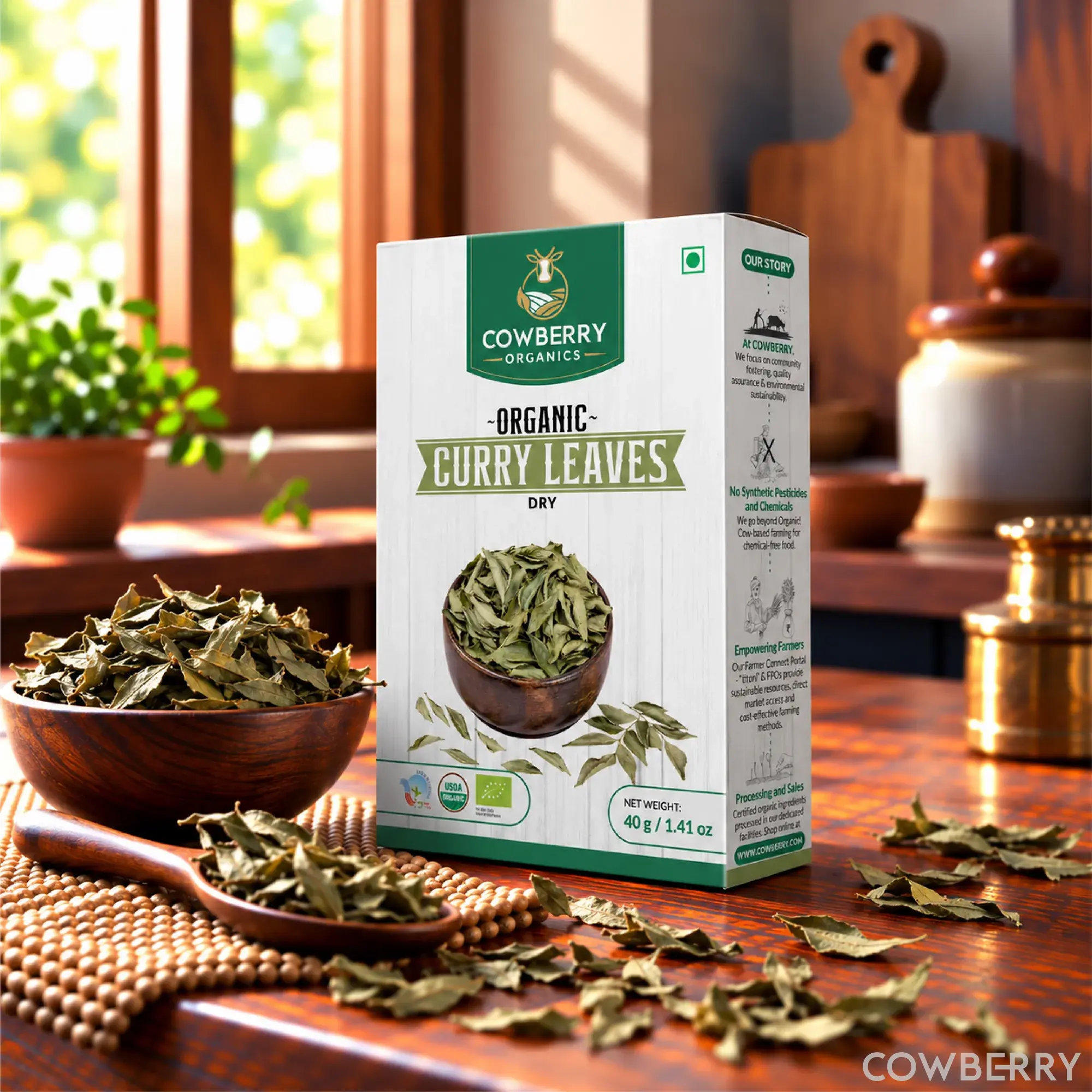
Fresh leaves belong in hot oil: drop a sprig into the oil at the start of a tadka, let it crackle for a few seconds, and the whole dal, sambar, rasam, upma or poha carries the aroma; the fried leaves remain in the dish and get eaten with it. Dried leaves do the same job straight from the jar, which is how COWBERRY's pack is used, and the powder works at the other end of cooking, sprinkled over the finished plate. Lemon rice is a dish built on the leaf, with a tablespoon of dried leaves crackling in the tempering over turmeric-laced rice; the powder's own page is curry leaves powder how to make, and keeping the fresh bunch going is how to store kadi patta for long time. The same list, in Hindi, is kadi patta ke fayde, and everything else about the leaf starts at the curry leaves hub.
FAQs
Is curry leaves good for health?
As a daily flavouring it is an ordinary kitchen herb: the leaf adds its aroma to dal, rice and sambar while carrying calcium, iron and fibre in the food table and almost no energy, 64 kcal per 100 g. As a medicine, neither review reports a result in people; keep it in the tadka and take your health questions to a doctor.
Does kadi patta help in hair growth?
Neither review's abstract mentions a study of kadi patta for hair growth, so the research does not tie the leaf to hair; the measured rows are the food table's: 8.67 mg of iron, 117 mcg of folate and 6.04 mg of vitamin C per 100 g, with only a trace of each in a teaspoon.
Does kadi patta cause acidity?
The abstracts of the two reviews do not record acidity among its effects, and it is eaten a sprig at a time in the tadka. If one dish unsettles your stomach, look at the whole recipe rather than the herb alone, and see a doctor if the problem keeps coming back.
What is kadi patta called in english?
Curry leaves, the English food name IFCT 2017 lists for the leaf, with the botanical name Murraya koenigii. Fresh in the market bunch or dried in the packet, it is the same leaf.
Is kadi patta a medicinal plant?
It is a food herb with a medicinal past: a 2024 review describes it as highly valued in Ayurveda, and a 2021 review records the plant's wide use in Ayurvedic medicine. The modern findings behind that tradition come mainly from laboratory and animal work, not from trials in people.
Is curry leaves good for diabetes?
In the kitchen it seasons dal, sambar and rice, and a teaspoon adds about 0.2 g of carbohydrate. On blood sugar, neither review's abstract reports a trial in people showing the leaf lowering it, so it stays a seasoning, not a medicine; talk to your doctor or dietitian about your blood sugar.
References
- Indian Food Composition Tables (IFCT) 2017, ICMR-National Institute of Nutrition
- Abeysinghe DT, Alwis DDDH, Kumara KAH et al. Nutritive Importance and Therapeutics Uses of Three Different Varieties (Murraya koenigii, Micromelum minutum, and Clausena indica) of Curry Leaves: An Updated Review. Evid Based Complement Alternat Med, 2021
- Jachak SM, Thakur MS, Ahirrao P et al. Murraya koenigii (L.) Spreng. as a Natural Intervention for Diabesity: A Review. Curr Pharm Des, 2024
- Opara EI, Chohan M. Culinary herbs and spices: their bioactive properties, the contribution of polyphenols and the challenges in deducing their true health benefits. Int J Mol Sci, 2014
Shop this article
Keep reading
Coriander water benefits: what dhania water actually does
Peanuts in Hindi (moongfali): groundnut names in Indian languages
Coriander vs cilantro: are they the same herb?