by COWBERRY

7 minute read
Difference between kadi patta and tej patta: taste and uses

The difference between kadi patta and tej patta in one line: kadi patta is the fresh, green, aromatic leaf of the curry tree (Murraya koenigii), fried in hot oil at the start of a tadka; tej patta is the dried Indian bay leaf, a different tree's leaf, simmered whole in pulao and dal and lifted out before serving. The curry leaves hub covers kadi patta in full.
Verdict in three lines
Different trees. Kadi patta is the leaf of the curry tree, Murraya koenigii, sold fresh in market bunches and used green; tej patta is the dried leaf of the Indian bay tree, Cinnamomum tamala, a leaf the food tables record no figures for.
Different jobs. Kadi patta goes into hot oil at the start of a tadka and stays in the dish, leaf and all; tej patta goes into the simmering pot whole and is lifted out before serving.
Not interchangeable. Each leaf has its own dishes, so a recipe that names one is best cooked with that one. Everything below fills in the three lines.
Kadi patta vs tej patta side by side
The table prints the only two rows the food tables hold for these leaves, and they are not a like-for-like pair. The curry leaf row is IFCT 2017's fresh-leaf record, the bay leaf row is the dried Western bay leaf, Laurus nobilis, from the USDA tables; the Indian tej patta itself has no record in either source. Neither leaf is eaten by the 100 g, so read the table as a map of composition, not as a serving.
Read loosely, the pattern is plain: per 100 g, fresh curry leaves hold 64 kcal, 4.51 g of carbohydrate and 16.83 g of fibre, with 8.67 mg of iron and 659 mg of calcium; the dried bay leaf packs 313 kcal, 75.0 g of carbohydrate and 26.3 g of fibre, with 43 mg of iron and 834 mg of calcium, figures that run higher in part because the dried leaf has lost its water. A teaspoon of fresh curry leaves (5 g) comes to about 3 kcal and 0.4 mg of iron, and a single bay leaf flavours a whole pot of pulao. That is the honest size of each leaf's numbers: one is a sprig, the other is a pot seasoner.
| Nutrient | Curry leaves, fresh | Bay leaf, dried |
|---|---|---|
| Energy (kcal) | 64 | 313 |
| Protein (g) | 7.4 | 7.6 |
| Fat (g) | 1.1 | 8.4 |
| Carbohydrates (g) | 4.5 | 75 |
| Dietary fibre (g) | 17 | 26 |
| Iron (mg) | 8.7 | 43 |
| Calcium (mg) | 659 | 834 |
| Magnesium (mg) | 182 | 120 |
| Potassium (mg) | 584 | 529 |
| Sodium (mg) | 19 | 23 |
| Zinc (mg) | 1.2 | 3.7 |
| Folate (mcg) | 117 | 180 |
| Vitamin C (mg) | 6 | 46 |
Per 100 g raw, edible portion. Composition: IFCT 2017 (ICMR-NIN); USDA FoodData Central (SR Legacy), FDC ID 170917, NDB 2004. — means not reported. These are average values for the food; the label on a pack gives the values for that product.
Three leaves, two trees
Two names usually hide a third leaf, so here is the full cast. The curry tree is Murraya koenigii, in the family Rutaceae, a tropical plant native to India and Southeast Asia, sometimes called sweet neem; a 2021 review covers three varieties of curry leaves, but the everyday Indian leaf is Murraya koenigii. Its names across Indian languages are on kadi patta in English.
The bay leaf of the West is Laurus nobilis, the dried leaf the USDA tables record as spices, bay leaf. Indian tej patta is a third leaf, Cinnamomum tamala, with no record in either food table; when an Indian recipe says bay leaf, the packet on the Indian shelf usually says tej patta. The bay leaf hub covers the Western leaf and tej patta in their own detail.
Taste and cooking
Kadi patta is the tadka leaf. Its aroma comes alive when the leaves hit hot oil or ghee, the moment every sambar, rasam, dal and chutney begins; the fried leaves stay in the dish and are eaten with it, and their taste usually runs green and slightly citrus, a South Indian kitchen smell the moment the sprig hits the pan. Dried curry leaves do the same job from the jar, and ground ones become the sprinkle on curry leaves powder how to make.
Tej patta is the simmer leaf. A whole dried leaf goes into the pot of pulao, biryani or a slow dal at the start and comes out before serving, after giving the dish a warm, spiced depth. The kitchen rule that follows is simple: kadi patta for the start of a quick tempering, tej patta for a long, covered simmer.
What the research shows, and what it does not
The research picture for kadi patta is preclinical. A 2024 review appraises studies of the curry leaf against diabetes with obesity that were done on cell lines and animals, and it says some need further validation; a 2021 review describes the leaf's activities from in vitro and in vivo models. Neither abstract reports a result in people, and the full honest reading of the leaf's health side is on kadi patta benefits for diabetes.
For tej patta, the food tables print only composition: figures for the Western bay leaf and none for the Indian one. What applies to both leaves equally is the point a 2014 review makes about culinary herbs and spices: such foods are normally eaten in small amounts with other foods, so their real health benefit stays hard to establish. The verdict of this page is a cooking verdict: both leaves are seasonings here, and no source used on this page supports using either as a medicine.
Cost and where each fits
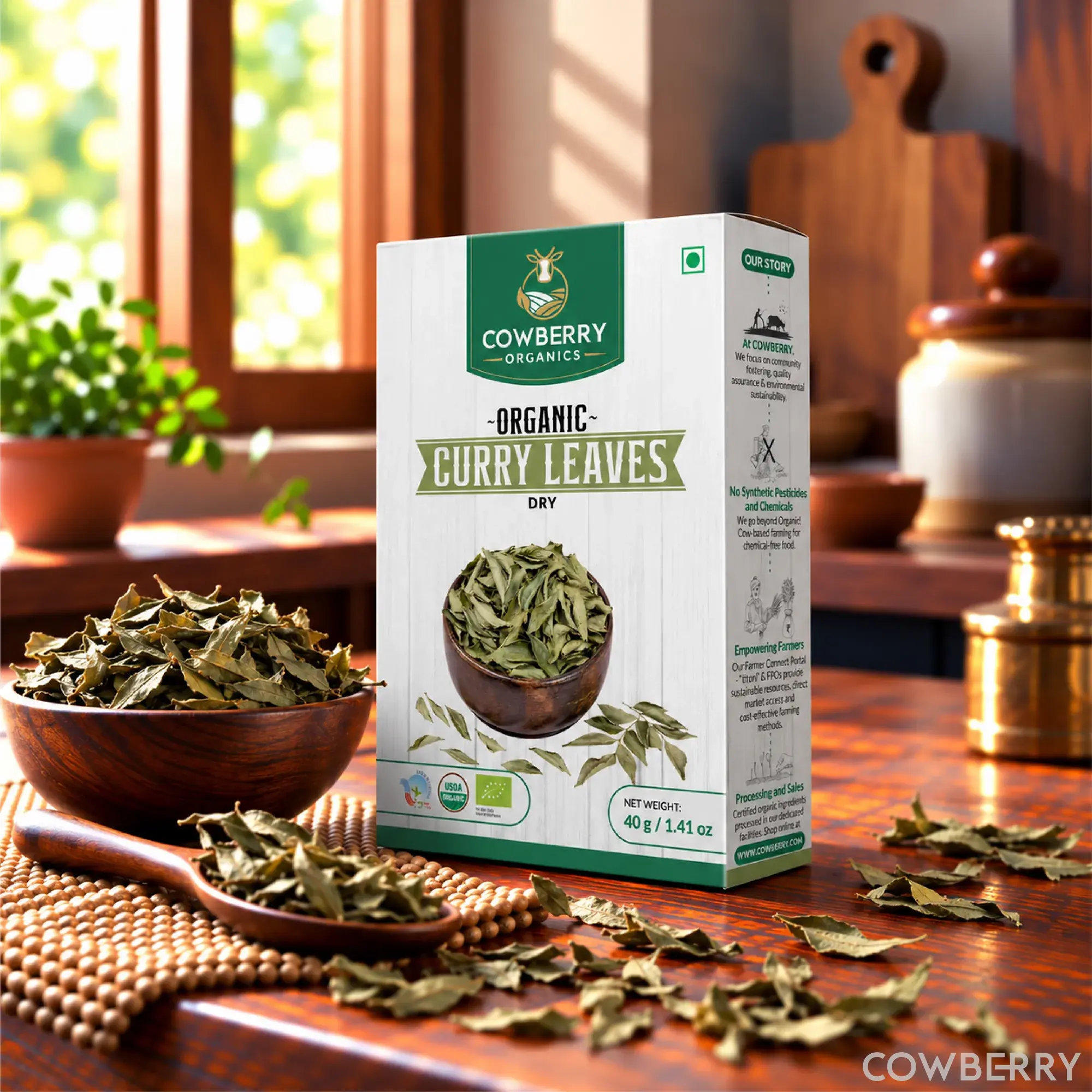
Both leaves are kitchen staples that cost little. Curry leaves are sold fresh in market bunches, and dried leaves in an airtight jar need no fridge, which is how COWBERRY advises keeping its dried curry leaves. Tej patta is sold as a dried packet, and a pot of pulao asks for one or two leaves.
Where each fits follows from taste: kadi patta belongs to the South Indian pot, the sambar, rasam, chutneys, dals and lemon rice; tej patta belongs to pulao, biryani and slow-cooked dals. A kitchen that cooks mostly South Indian food needs curry leaves; one that makes pulao every week needs tej patta; many Indian kitchens keep both.
Which for whom
- South Indian cooking: kadi patta, fresh or dried.
- Pulao, biryani, slow dals: tej patta, whole leaf in, whole leaf out.
- Small kitchen, one jar: dried curry leaves season tadkas and rice dishes from the shelf and need no fridge.
- The fragrance of hot oil: kadi patta; tej patta gives its depth to liquid over time, not to oil in a minute.
- Health questions: neither leaf is a medicine; start from curry leaves hub for the food side and ask your doctor for the medical side.
FAQs
Difference between kadi patta and tej patta?
They are the leaves of two different trees: kadi patta is the fresh green leaf of the curry tree, Murraya koenigii, which crackles in hot oil the moment a tadka starts, and tej patta is the dried bay leaf, Cinnamomum tamala, which simmers through the pulao and is lifted out before serving.
Difference between curry leaves and bay leaves?
Curry leaves are the curry tree's fresh green leaves used in Indian tadkas; bay leaves are the dried leaves of Laurus nobilis, the Western bay tree, used whole in slow-cooked dishes. Indian tej patta is a third leaf, Cinnamomum tamala, for which the food tables record no figures.
Is tej patta and curry leaves same?
No. Tej patta is the dried Indian bay leaf from a different tree, and curry leaves are the fresh green leaf of the curry tree. They go into different dishes, and one is lifted out of the pot while the other is usually eaten.
Is tej patta and kadi patta same?
No, and since kadi patta is only the Hindi name for curry leaves, the two questions are one: tej patta is the bay leaf, kadi patta the curry leaf. The quick way to remember is that kadi patta goes into hot oil and tej patta goes into the simmering pot.
Can I use bay leaf instead of curry leaves?
Not in a tadka. Bay leaf gives its flavour over a long simmer and is lifted out, while curry leaves release theirs the moment they hit hot oil and stay in the dish. Use each in the dish that calls for it.
Why is tej patta removed before serving?
Because the leaf stays whole in the pot and is not meant to be eaten; the flavour it gave the dish is already in the gravy. Curry leaves are fried at the start of a tadka and stay in the dish, where they are usually eaten.
References
- Indian Food Composition Tables (IFCT) 2017, ICMR-National Institute of Nutrition
- USDA FoodData Central
- Abeysinghe DT, Alwis DDDH, Kumara KAH et al. Nutritive Importance and Therapeutics Uses of Three Different Varieties (Murraya koenigii, Micromelum minutum, and Clausena indica) of Curry Leaves: An Updated Review. Evid Based Complement Alternat Med, 2021
- Jachak SM, Thakur MS, Ahirrao P et al. Murraya koenigii (L.) Spreng. as a Natural Intervention for Diabesity: A Review. Curr Pharm Des, 2024
- Opara EI, Chohan M. Culinary herbs and spices: their bioactive properties, the contribution of polyphenols and the challenges in deducing their true health benefits. Int J Mol Sci, 2014
Shop this article
Keep reading
Coriander water benefits: what dhania water actually does
Peanuts in Hindi (moongfali): groundnut names in Indian languages
Coriander vs cilantro: are they the same herb?