by COWBERRY

7 minute read
Curry leaves nutrition facts 100g: calories, vitamins and minerals

Curry leaves nutrition facts 100g, from the Indian Food Composition Tables 2017 for the fresh leaf: 64 kcal, 7.41 g protein, 1.06 g fat, 4.51 g carbohydrate, 16.83 g fibre, 659 mg calcium and 8.67 mg iron. The full table, the same numbers for a teaspoon, and two comparison seasonings follow; the curry leaves hub covers the leaf itself.
Curry leaves nutrition per 100 g: the full table
The table gives curry leaves nutrition per 100 g as the Indian Food Composition Tables 2017 of ICMR-National Institute of Nutrition record it, beside dried bay leaf and coriander powder, two seasonings the food tables also record, so the numbers can be read in company. Energy is 64 kcal, and the rows that catch the eye are the mineral ones: 659 mg of calcium and 8.67 mg of iron, with 16.83 g of fibre. Anyone searching kadi patta nutritional value per 100g gets the same honest framing: these are fresh-leaf figures.
Three points to keep in mind while reading it. First, the figures describe the fresh leaf; neither IFCT 2017 nor the USDA tables hold a dried-leaf record, so no numbers are given for the dried leaf or its powder. Second, per 100 g is not how the leaf is eaten: a tadka takes a sprig of six to ten leaves or a teaspoon, and the next section works out what that teaspoon holds. Third, the two comparison columns are dried foods, so their per-100 g figures run higher in part because drying has taken out the leaf's water; the curry leaf column is the fresh leaf as sold.
| Nutrient | Curry leaves, fresh | Bay leaf, dried | Coriander powder |
|---|---|---|---|
| Energy (kcal) | 64 | 313 | 298 |
| Protein (g) | 7.4 | 7.6 | 12 |
| Fat (g) | 1.1 | 8.4 | 18 |
| Carbohydrates (g) | 4.5 | 75 | 55 |
| Dietary fibre (g) | 17 | 26 | 42 |
| Iron (mg) | 8.7 | 43 | 16 |
| Calcium (mg) | 659 | 834 | 709 |
| Magnesium (mg) | 182 | 120 | 330 |
| Potassium (mg) | 584 | 529 | 1270 |
| Sodium (mg) | 19 | 23 | 35 |
| Zinc (mg) | 1.2 | 3.7 | 4.7 |
| Folate (mcg) | 117 | 180 | 0 |
| Vitamin C (mg) | 6 | 46 | 21 |
Per 100 g raw, edible portion. Composition: IFCT 2017 (ICMR-NIN); USDA FoodData Central (SR Legacy), FDC ID 170917, NDB 2004; USDA FoodData Central (SR Legacy), FDC ID 170922, NDB 2013. — means not reported. These are average values for the food; the label on a pack gives the values for that product.
Curry leaves calories and nutrition per teaspoon
Nobody eats 100 g of curry leaves; a tadka uses a sprig of six to ten leaves or a teaspoon, and the teaspoon is the honest measure. One teaspoon (5 g) of fresh leaves breaks down like this, worked out from the IFCT figures above:
| Nutrient | Per teaspoon (5 g), fresh leaf |
|---|---|
| Energy | 3 kcal |
| Protein | 0.4 g |
| Carbohydrate | 0.2 g |
| Fibre | 0.8 g |
| Calcium | 33 mg |
| Iron | 0.4 mg |
| Magnesium | 9.1 mg |
| Potassium | 29.2 mg |
| Folate | 5.9 mcg |
| Vitamin C | 0.3 mg |
So curry leaves calories come to about 3 kcal a teaspoon, and every other row shrinks the same way: the leaf flavours the pot, it does not feed it. A 2014 review in the International Journal of Molecular Sciences notes for culinary herbs and spices as a group that they are consumed in small quantities, usually with other foods, and that their true benefit is therefore hard to establish. For the dried leaf and the powder no composition figures are printed in the food tables; the curry leaves powder how to make page covers the method, and it too gives the powder no numbers.
Protein and fibre in curry leaves, against two peers
Curry leaves hold 7.41 g of protein per 100 g. That is essentially level with dried bay leaf at 7.61 g, and below coriander powder at 12.4 g, which carries about 67 percent more. Fibre is 16.83 g per 100 g, against 26.3 g in bay leaf, about 56 percent more, and 41.9 g in coriander powder, about two and a half times the leaf. On both counts the two dried columns win per 100 g, and the energy gap runs the same way: 313 kcal for bay leaf, close to five times the leaf's 64 kcal, and 298 kcal for coriander powder, over four and a half times the leaf, in part because drying removes the leaf's water.
The fairer test is the same spoon of each. Five grams of coriander powder delivers 0.6 g of protein and 2.1 g of fibre, against the leaf's teaspoon at 0.4 g and 0.8 g, so even the same-spoon comparison goes to the dried spice. None of this makes curry leaves a poor food; it fixes their role. They are a flavouring that happens to carry minerals, not a protein or fibre course; the dal and vegetables beside it carry the day's fibre and protein, and the leaf carries the aroma.
Glycemic index of curry leaves
No glycemic index figure is printed for curry leaves in IFCT 2017, and without a GI no glycemic load can be worked out either, so this page gives neither. The question barely applies to a herb: carbohydrate is 4.51 g per 100 g of fresh leaves and 0.2 g in a teaspoon, and a sprig dropped into hot oil adds flavour, not a measurable load of carbohydrate. The leaf does its work at the start of the tadka, where it seasons dal, sambar, rasam and rice without asking for a place in the carbohydrate count; how it fits a diabetes meal plan is on kadi patta benefits for diabetes.
Vitamins and minerals in curry leaves
Calcium is the headline: 659 mg per 100 g of fresh leaves. For context, dried bay leaf records 834 mg and coriander powder 709 mg, so the leaf sits just below two dried spices; a teaspoon of fresh leaves still carries about 33 mg. Iron is 8.67 mg per 100 g, magnesium 182 mg, potassium 584 mg and zinc 1.18 mg, while sodium is only 18.66 mg, so nearly all the salt in a curry leaf dish is the salt the cook adds. Among the vitamins, IFCT 2017 prints 117 mcg of folate and 6.04 mg of vitamin C per 100 g.
A 2021 review in Evidence-Based Complementary and Alternative Medicine (Abeysinghe and colleagues) covers three varieties of curry leaves and records that the leaves, seeds, flowers and fruit of these plants contain constituents behind numerous biological processes. What each of these nutrients does for you, and how far the research actually goes, is the full list of curry leaves benefits; the leaf's names, buying notes and storage start at the curry leaves hub, and its everyday use is the lemon rice recipe.
FAQs
Which vitamin in kadi patta?
IFCT 2017 prints two for the fresh leaf: folate at 117 mcg and vitamin C at 6.04 mg per 100 g. A teaspoon (5 g) holds 5.9 mcg of folate and 0.3 mg of vitamin C, so in tadka amounts the leaf adds a trace of each rather than a serving.
Does curry leaves have iron?
Yes. The fresh leaf records 8.67 mg of iron per 100 g (IFCT 2017), beside 659 mg of calcium. In the amount a tadka uses, a teaspoon (5 g) carries about 0.4 mg, so each teaspoon contributes a small amount of iron to the meal, not a lot.
Does kadi patta have protein?
Yes, 7.41 g per 100 g of fresh leaves (IFCT 2017), essentially level with dried bay leaf at 7.61 g and below coriander powder at 12.4 g. A teaspoon (5 g) gives about 0.4 g, so the leaf is a flavouring, not a protein source.
Does kadi patta have calcium?
Yes: 659 mg of calcium per 100 g of fresh leaves (IFCT 2017), and a teaspoon (5 g) carries about 33 mg. Dried bay leaf records 834 mg and coriander powder 709 mg per 100 g, both higher in part because drying removes the water.
Is curry leaves good for hair?
The reviews of the curry leaf record no study of it for hair growth or grey hair, so no hair claim is made; what is measured is the food table: 8.67 mg iron, 117 mcg folate and 6.04 mg vitamin C per 100 g, of which a teaspoon carries a trace.
Is curry leaves good for diabetes?
In cooking, as a herb, yes: dal, sambar and rice take its flavour, and a teaspoon brings about 0.2 g of carbohydrate. For lowering blood sugar, no trial in people has shown that, so the leaf stays in the tadka. The full research picture is on kadi patta benefits for diabetes.
References
- Indian Food Composition Tables (IFCT) 2017, ICMR-National Institute of Nutrition
- Abeysinghe DT, Alwis DDDH, Kumara KAH et al. Nutritive Importance and Therapeutics Uses of Three Different Varieties (Murraya koenigii, Micromelum minutum, and Clausena indica) of Curry Leaves: An Updated Review. Evid Based Complement Alternat Med, 2021
- Opara EI, Chohan M. Culinary herbs and spices: their bioactive properties, the contribution of polyphenols and the challenges in deducing their true health benefits. Int J Mol Sci, 2014
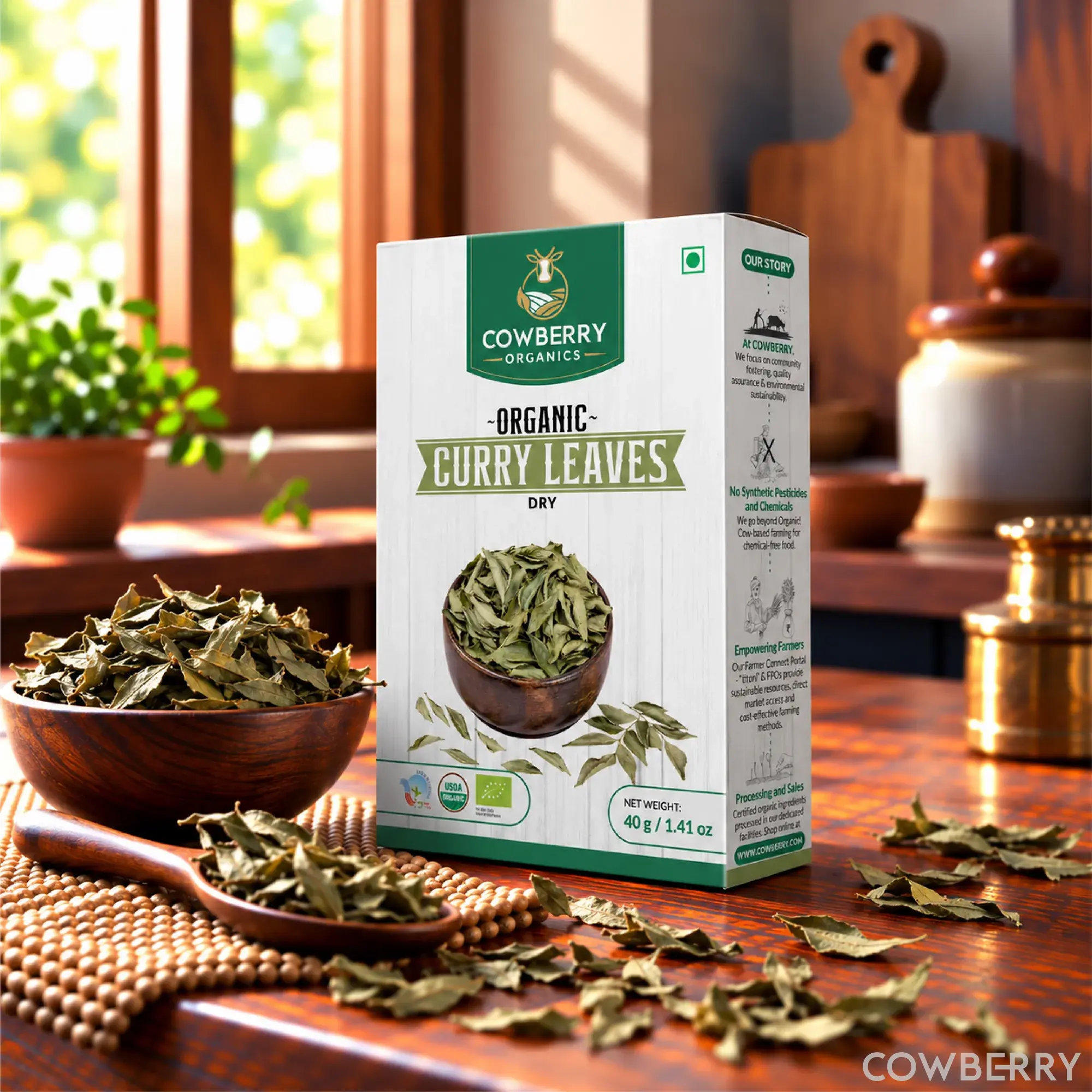
Shop this article
Keep reading
Coriander water benefits: what dhania water actually does
Peanuts in Hindi (moongfali): groundnut names in Indian languages
Coriander vs cilantro: are they the same herb?