by COWBERRY

9 minute read
Kadi patta benefits for diabetes: what the research shows

Kadi patta benefits for diabetes, honestly: curry leaves flavour dal, rice and curries with almost no carbohydrate, but no study in people shows that the leaf lowers blood sugar, so keep it in the tadka as flavour rather than a medicine. The curry leaves hub covers the leaf itself; here is what the research shows and how to use the leaf.
Short answer: is curry leaves good for diabetes?
As a herb in cooking, yes. Curry leaves add the familiar fried-leaf aroma to a dal or sambar while adding almost nothing to the meal's carbohydrate, which is a real help when every gram is being counted. As something that lowers blood sugar, that is a different story: the evidence for kadi patta and diabetes rests mainly on laboratory dishes and animals, not on people, and no amount of the leaf can be recommended for blood sugar on the strength of it.
The research picture is easy to summarise. A 2024 review in Current Pharmaceutical Design gathered the studies on the curry leaf and diabetes with obesity; the studies it appraises were done on cell lines or animals, and its authors note that some of the findings still need deeper analysis and validation. An earlier 2021 review in Evidence-Based Complementary and Alternative Medicine says the same thing another way: the leaf's antioxidant, antidiabetic and anti-inflammatory activities are supported by in vitro and in vivo models, and the review calls for comprehensive research before the findings can be taken as remedies.
So the honest answer to "is curry leaves good for diabetes" is: the leaf is a fine herb for a diabetes-friendly plate, and that is all the evidence allows anyone to promise. The tradition behind it, the numbers, and the ways to use it follow.
What the research says about curry leaves and blood sugar
Jachak and colleagues, in their 2024 review, describe the curry leaf (Murraya koenigii) as a plant highly valued in Ayurveda, and record a traditional Indian pairing of curry leaf with buttermilk used for diabetes along with other complaints. That pairing is a tradition, not a trial: the review's own studies of the leaf against diabetes and obesity come from cell lines and animals, where the plant's carbazole alkaloids and extracts showed anti-diabetic and anti-obesity activity, and the authors write that some of the studies require further validation.
The 2021 review by Abeysinghe and colleagues covers three varieties of curry leaves and reaches the same conclusion. It reports earlier findings as strong support for the leaves' antioxidant, antidiabetic, anti-inflammatory and antitumor activities, but those activities were established in in vitro and in vivo models, and the review emphasises the need for comprehensive research to validate the effects in the remedies they are claimed to support.
What is missing is the step between: trials that give curry leaves to people with diabetes and show lower blood sugar. The 2021 review summarises clinical studies alongside the laboratory work, yet still calls for comprehensive research to validate the leaf's efficacy, and the 2024 review's diabetes evidence comes from cell lines and animals. That gap, not a negative result, is why this page does not promise lower readings.
An older 2014 review on culinary herbs and spices makes the practical caveat behind all of this: these foods are normally eaten a pinch at a time and with other foods, so the health benefit they truly carry is hard to pin down. Curry leaves are exactly that kind of food, a sprig at a time in a pot of dal.
What the numbers say: curry leaves nutrition
The table gives the figures IFCT 2017 records for the fresh leaf, per 100 g. Two rows matter for diabetes: carbohydrate, at 4.51 g, and energy, at 64 kcal, both low for the fresh leaf. A teaspoon of fresh leaves (5 g) comes to about 3 kcal, 0.2 g of carbohydrate, 0.8 g of fibre and 0.4 mg of iron.
The leaf also carries 16.83 g of fibre, 8.67 mg of iron and 659 mg of calcium per 100 g, but the teaspoon is the honest measure: a sprig in a tadka is flavour, not a serving of fibre or minerals. IFCT records the fresh leaf only, and no figures are printed for dried leaves or powder, so no numbers are given for those.
On glycemic index, the question does not really apply. There is no GI value for curry leaves, and a herb eaten by the sprig is not a carbohydrate food. The useful way to read the row is the first one: curry leaves are a way to add taste to a diabetes-friendly meal without adding carbohydrate, which is exactly the job the tadka gives them.
| Nutrient | Curry leaves, fresh |
|---|---|
| Energy (kcal) | 64 |
| Protein (g) | 7.4 |
| Fat (g) | 1.1 |
| Carbohydrates (g) | 4.5 |
| Dietary fibre (g) | 17 |
| Iron (mg) | 8.7 |
| Calcium (mg) | 659 |
| Magnesium (mg) | 182 |
| Potassium (mg) | 584 |
| Sodium (mg) | 19 |
| Zinc (mg) | 1.2 |
| Folate (mcg) | 117 |
| Vitamin C (mg) | 6 |
Per 100 g raw, edible portion. Composition: IFCT 2017 (ICMR-NIN). — means not reported. These are average values for the food; the label on a pack gives the values for that product.
How much and how to eat it
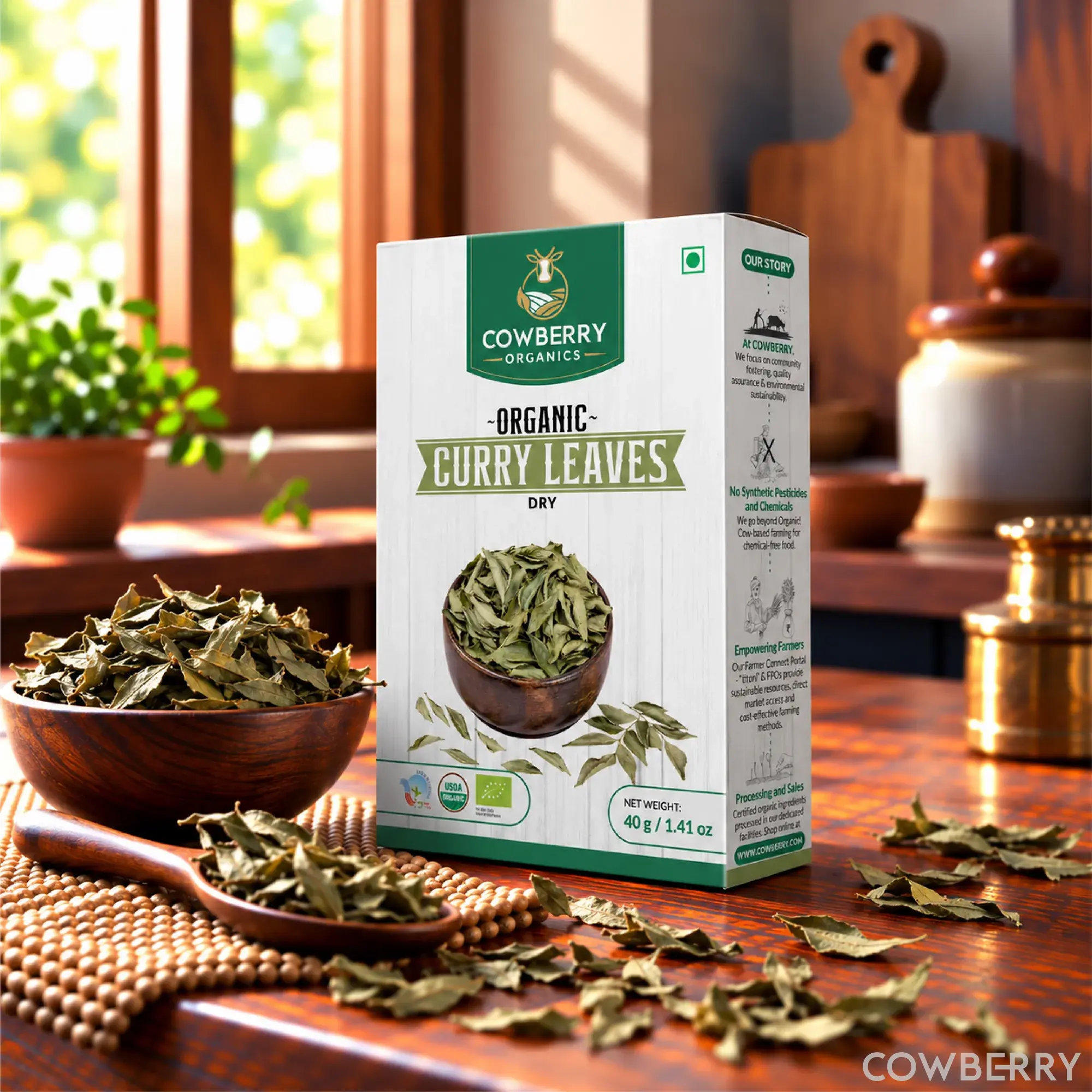
No dose. Neither review gives an amount of curry leaves for diabetes, and this page will not invent one; the leaf is eaten in cooking amounts, and that is where it stays. The everyday measures are a sprig of six to ten leaves dropped into hot oil for a dal, sambar or rasam, a teaspoon (5 g) of dried leaves, or a teaspoon of the powder over rice, curd rice or a chutney. All three are ways to season, not to medicate.
The traditional pairing the 2024 review records is worth keeping for its own sake: a sprig of curry leaves with a glass of buttermilk, a light finish to a meal. And the leaf does its best work in the dishes it belongs to: tempered at the start of a lemon rice, sambar, rasam, upma or poha, where it seasons the whole pot.
For the leaf's names across Indian languages, see kadi patta in English; for drying it into a sprinkle, curry leaves powder how to make has the steps. The rest of the curry leaves guide covers cooking and storage.
Better and worse ways to use curry leaves with diabetes
Better
- A sprig tempered in the tadka of dal, sambar, rasam or upma: flavour, with essentially no carbohydrate.
- A teaspoon (5 g) of dried leaves or powder over curd rice, rice or a chutney.
- Fresh leaves in a glass of unsweetened buttermilk, the traditional pairing the 2024 review records, for flavour rather than as a remedy.
- Leaves cooked into the dish so the aroma seasons everything, as in lemon rice.
Worse
- Curry leaf capsules, powders and extracts sold with diabetes claims. No trial in people has shown them to lower blood sugar, and cell and animal results do not tell anyone what amount to take.
- Expecting the tadka to move the meter. Season the food, take the medicine, and let your readings speak.
- Sweet dishes that happen to contain curry leaves; the sugar in them outweighs any herb.
- Counting a handful of leaves as the day's greens. A teaspoon holds 0.8 g of fibre; the vegetables on the plate are the fibre plan.
What to avoid
- Changing your medicines because you have started cooking with curry leaves. The leaf has no shown effect on blood sugar, so there is nothing for it to replace; any change is your doctor's decision.
- Curry leaf supplements marketed for diabetes. The 2024 review's own authors call for validation of the cell and animal findings, which means the products are ahead of the evidence.
- Frying the leaf in extra oil to make it "healthier". The leaf adds the flavour; the oil adds the calories.
- Counting a kadi patta chutney or drink as a between-meal freebie. It is part of the meal like any other food.
Talk to your doctor or dietitian
Diabetes runs on medicines, monitoring and a meal plan drawn up for one person, and a herb changes none of the three. Curry leaves can season your food every day, but they cannot stand in for your tablets or insulin, and no study says otherwise: talk to your doctor or dietitian before using spices or supplements in place of your medicines, and let the dietitian fit the leaf's pinch of flavour into your meal plan the same way any other ingredient would be fitted in.
FAQs
Is curry leaves good for diabetes?
As a herb in cooking, yes: it flavours dal, sambar and rice while adding almost no carbohydrate, about 0.2 g a teaspoon. As something that lowers blood sugar, that has not been shown in people, so keep the leaf in the tadka and leave the medicines as they are.
Does curry leaves have iron?
Yes. IFCT 2017 records 8.67 mg of iron per 100 g of fresh curry leaves, next to 659 mg of calcium. A teaspoon (5 g) holds about 0.4 mg of iron, so the leaf adds a little to a meal's iron, not a lot.
Which vitamin in kadi patta?
IFCT 2017 lists vitamin C at 6.04 mg and folate at 117 ug per 100 g of fresh curry leaves. In the amounts a tadka uses, a teaspoon (5 g) carries a tiny share of each; the leaf is a flavouring, not a vitamin source.
Is curry leaves a medicinal plant?
It is a food herb with a long Ayurvedic tradition: a 2024 review describes its use in Ayurveda, and a 2021 review notes its wide use in Ayurvedic medicine. The diabetes-related findings, though, come mainly from laboratory and animal studies, not from trials in people.
Does kadi patta cause acidity?
The reviews of the curry leaf do not record acidity as a problem, and the leaf is eaten a sprig at a time in a tadka. If a particular dish unsettles your stomach, note the whole recipe and talk to your doctor if it keeps happening.
Can we eat kadi patta daily?
Yes, in the amounts Indian cooking uses: a sprig in the tadka, or a teaspoon (5 g) of dried leaves or powder over rice or dal. A teaspoon of the fresh leaf comes to about 3 kcal and 0.2 g of carbohydrate; the herb changes the flavour of your food daily, not your medicines.
References
- Indian Food Composition Tables (IFCT) 2017, ICMR-National Institute of Nutrition
- Abeysinghe DT, Alwis DDDH, Kumara KAH et al. Nutritive Importance and Therapeutics Uses of Three Different Varieties (Murraya koenigii, Micromelum minutum, and Clausena indica) of Curry Leaves: An Updated Review. Evid Based Complement Alternat Med, 2021
- Jachak SM, Thakur MS, Ahirrao P et al. Murraya koenigii (L.) Spreng. as a Natural Intervention for Diabesity: A Review. Curr Pharm Des, 2024
- Opara EI, Chohan M. Culinary herbs and spices: their bioactive properties, the contribution of polyphenols and the challenges in deducing their true health benefits. Int J Mol Sci, 2014
Shop this article
Keep reading
Coriander water benefits: what dhania water actually does
Peanuts in Hindi (moongfali): groundnut names in Indian languages
Coriander vs cilantro: are they the same herb?