by COWBERRY

10 minute read
Cumin seeds (jeera): names, nutrition, benefits and how to cook it

Cumin seeds are the dried seeds of the plant Cuminum cyminum, sold whole as jeera and ground as cumin powder, and they crackle at the start of a tadka in Indian kitchens. This cumin seeds guide covers the seed's names, its nutrition per 100 g, what the research does and does not show, the recipes that use it and how to store it.
What is cumin seeds (jeera)?
Cumin seeds are the seeds of Cuminum cyminum, the plant that gives every Indian kitchen its jeera jar. Whole, the seeds open a tadka: dropped into hot ghee or oil, they sizzle and release an earthy, smoky smell that carries through the dal, rice or sabzi that follows. Ground, the same seeds become cumin powder, stirred into dry masalas, curd and raitas, where whole seeds would crunch.
The seed wears both jobs in one small form, and both start from the same entry in IFCT 2017's tables. The seed is small enough that a teaspoon holds about 2.5 g, and strong enough that those 2.5 g carry a whole dish; recipes measure jeera in teaspoons where other ingredients are measured in cups. One naming matter is settled on its own page: the pack label decides between jeera and shahi jeera, because IFCT 2017 has no entry for shahi jeera, and the sorting is on the jeera vs shahi jeera page.
Names of cumin seeds across Indian languages
One seed answers to many names. Hindi, Marathi, Punjabi, Odia and Urdu write jira, spoken jeera; Gujarati writes jiru, Bengali jire, Assamese jeera, Kannada jeerage, Telugu jeelakarra, Tamil and Malayalam jeerakam, and Sanskrit lists jiraka. The English food name is cumin seeds, and the botanical name behind every one of them is Cuminum cyminum, all from the IFCT 2017 local-names list.
The cumin names page carries the complete fifteen-name table with the common packet spellings, and sorts jeera from shahi jeera and saunf. At the market the name changes with the language; the seed in the bag does not, and reading the botanical name on the pack settles any doubt. Ask for jira in Pune, jeerakam in Chennai or jeelakarra in Hyderabad, and the shopkeeper reaches for the same jar; only the word changes at the state border.
| Language | Name (romanised) |
|---|---|
| English | Cumin seeds |
| Hindi | Jira |
| Marathi | Jira |
| Gujarati | Jiru |
| Punjabi | Jira |
| Bengali | Jire |
| Odia | Jira |
| Assamese | Jeera |
| Kannada | Jeerage |
| Telugu | Jeelakarra |
| Tamil | Jeerakam |
| Malayalam | Jeerakam |
| Urdu | Jira |
| Sanskrit | Jiraka |
| Botanical name | Cuminum cyminum |
Source: IFCT 2017 (ICMR-NIN) local-names list. — means no name recorded in the source.
Jeera nutritional value per 100g
The profile IFCT 2017 lists, per 100 g of raw seeds: 305 kcal, 13.91 g of protein, 16.64 g of fat, 22.62 g of carbohydrate, 30.35 g of fibre, 20.58 mg of iron, 878 mg of calcium, 442 mg of magnesium, 1886 mg of potassium, 125 mg of sodium, 4.29 mg of zinc and 27.79 mcg of folate. IFCT 2017 has no vitamin C value and no glycemic index for cumin seeds, so neither is quoted.
Nobody eats 100 g of jeera at a sitting; the honest serving is the teaspoon of 2.5 g, worth about 8 kcal, 0.6 g of carbohydrate, 0.8 g of fibre, 0.35 g of protein, 0.5 mg of iron and 22 mg of calcium. The jeera nutritional value per 100g page sets cumin beside coriander seeds and ajwain and walks each row down to the teaspoon.
| Nutrient | Cumin seeds |
|---|---|
| Energy (kcal) | 305 |
| Protein (g) | 14 |
| Fat (g) | 17 |
| Carbohydrates (g) | 23 |
| Dietary fibre (g) | 30 |
| Iron (mg) | 21 |
| Calcium (mg) | 878 |
| Magnesium (mg) | 442 |
| Potassium (mg) | 1886 |
| Sodium (mg) | 125 |
| Zinc (mg) | 4.3 |
| Folate (mcg) | 28 |
Per 100 g raw, edible portion. Composition: IFCT 2017 (ICMR-NIN). — means not reported. These are average values for the food; the label on a pack gives the values for that product.
Cumin benefits and side effects: what is shown and what is not
The benefits story runs in two halves, and the honest one comes first. As food, jeera contributes small amounts of iron, calcium and fibre; as a remedy, no human trial in the references shows a measurable effect. A 2014 review of culinary herbs and spices explains the gap: spices are eaten in tiny amounts alongside other foods, and their chemistry runs into digestion, bioavailability and food interactions, so their true benefit in people stays unclear.
The strongest test so far sits in a 2021 meta-analysis: eight randomised trials, 552 adults, all testing cumin as a supplement against blood sugar. The pooled fasting reading ended 17.77 mg/dl under placebo, the interval around it stretching from 36.42 mg/dl below to 0.87 mg/dl above; the p value came to .06, and insulin and HOMA-IR did not move significantly. The authors concluded that the trials do not support cumin supplements for glycemic markers, and the meta-analysis supports no claim that cumin lowers blood sugar.
For side effects, none of the studies in the references lists a caution for cumin eaten in kitchen amounts; the cautions they do give are about supplements, not the seed. Traditional use, meanwhile, is real and documented: the 2021 review maps cumin's culinary and traditional record, and the seed stays in the kitchen even where the clinical evidence is thin. The cumin benefits and side effects page takes each nutrient to the teaspoon, and the jeera khane ke fayde aur nuksan page tells the same story in Hinglish. If you manage diabetes or take medicine, keep jeera as a seasoning and ask your doctor before cumin supplements.
Cumin and diabetes: the eight trials, plainly
The diabetes question deserves its own line. When eight randomised trials were pooled in a 2021 meta-analysis, cumin supplements showed no significant effect on fasting blood sugar, insulin or HOMA-IR; the estimates tipped downward but never cleared the significance bar. What jeera reliably does is season a diabetic plate for about 8 kcal a teaspoon and under a gram of carbohydrate.
The cumin for diabetes page lays out the trial numbers in full and separates the seasoning facts from the supplement claims, so a reader knows exactly which of the two they are getting.
How to cook with cumin seeds: tadka, jeera rice, jeera aloo
Whole seeds lead in the pan. In a tadka, drop them into hot ghee or oil at the start and let them crackle for 15 to 20 seconds, until the smoky smell rises, then add onions, tomatoes or dal. Powder comes in later, folded into dry masalas, curd or a finished dish, with turmeric a common partner in the same tadka; turmeric has its own guide on this site.
Two recipes on this site put the seed to work. Jeera rice crackles two teaspoons of whole jeera in ghee, then folds in the rice so every grain carries the aroma. Jeera aloo crackles two teaspoons for 20 to 30 seconds, then cooks the potatoes with the seeds to a dry, cumin-scented finish; the batch serves four and is ready in about 45 minutes. Both keep the seed whole, which is the point of buying seeds rather than only powder. One practical note from the recipe pages: the crackle window is short. Under-crackled seeds stay raw and hard in the mouth; over-crackled seeds turn bitter, so the recipe pages stop the crackle within 15 to 30 seconds.
Cumin seeds vs cumin powder: which to use when
The same spice in two forms, chosen by the job. Whole seeds survive heat and give up their aroma slowly, which is why they start a tadka, flavour jeera rice and steep into drinks; they also stay fragrant for months in the jar. Powder disperses instantly, which is why it finishes a dish, mixes into curd and raita, and rubs into dry masalas, but its aroma fades in weeks and it burns faster in hot oil.
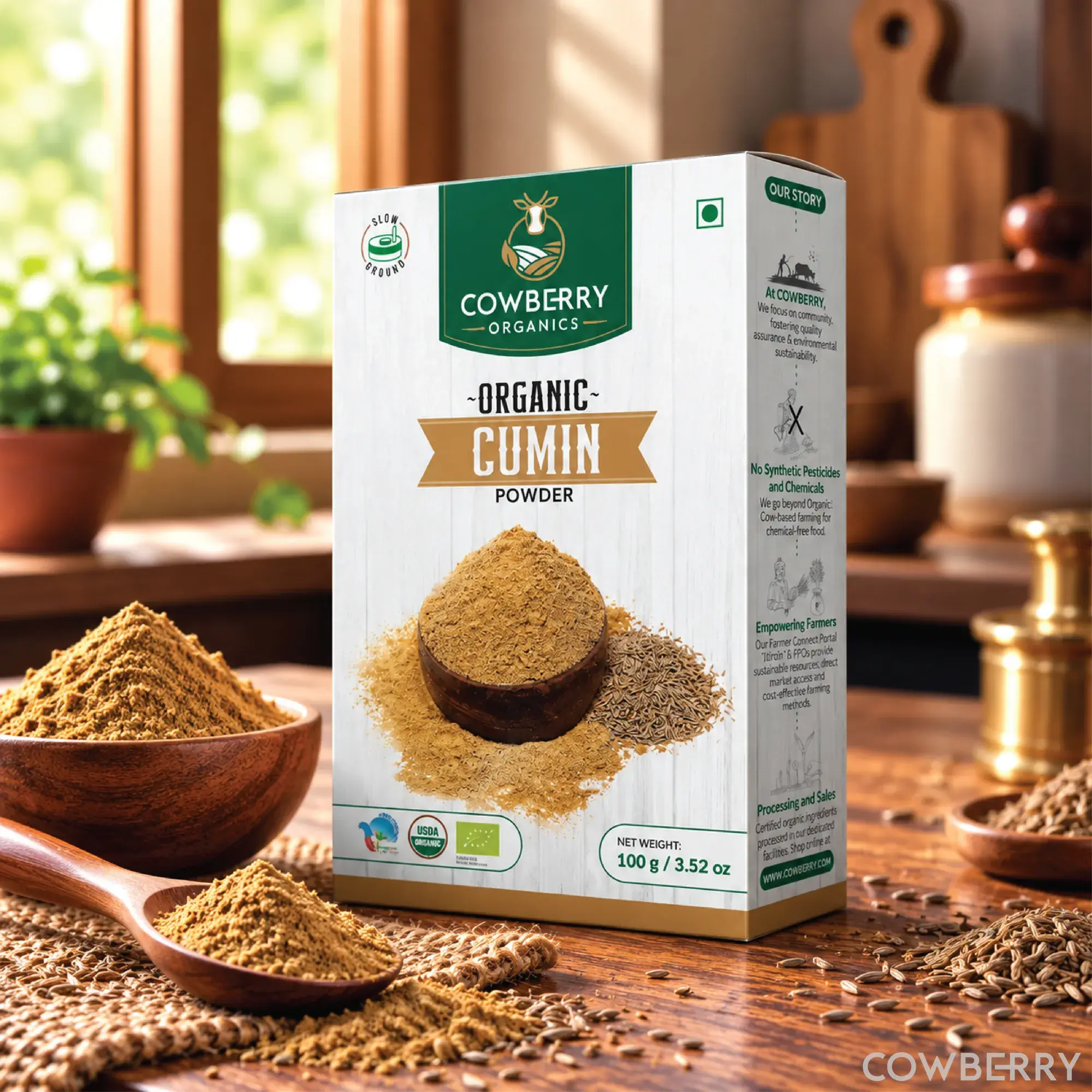
The kitchen rule follows from that: crackle whole, finish ground. A jar of seeds plus a small grinder covers both, since the powder is just the seed milled at home when needed, which is also how the COWBERRY cumin powder on this site is made, slowly ground from whole seeds.
Jeera water and cumin tea: the two drinks
Steeped, the same seed makes two drinks. Jeera water is a teaspoon of seeds in a cup of water, soaked eight to ten hours or boiled five minutes and strained; the cup is light, caffeine-free and unsweetened unless you add something, and the method with timings is on the jeera water page. Cumin tea dry-roasts the seeds for half a minute, simmers them three minutes and steeps them a few more, with honey and lemon as the usual finishes, covered on the cumin tea page.
Both cups start from about 8 kcal of seeds. No source in the references gives either drink a health claim: the drink pages say plainly what a cup holds and stop there, which is the honest way to enjoy them. Keep the drinks to one cup at a time, too; both pages note the water and the tea are best fresh, unlike the seeds themselves.
How to store cumin seeds, and what to buy
Keep the seeds whole in a sealed jar, out of heat and light, and they keep their aroma for months; ground cumin fades in weeks, so grind in small lots. The storage page explains the why: the seed's fat, 16.64 g per 100 g, carries the aroma oils, and air and warmth are what wear them down. IFCT 2017 lists no shelf-life figure, so no fixed date is set; an approximate time in an airtight container is fine.
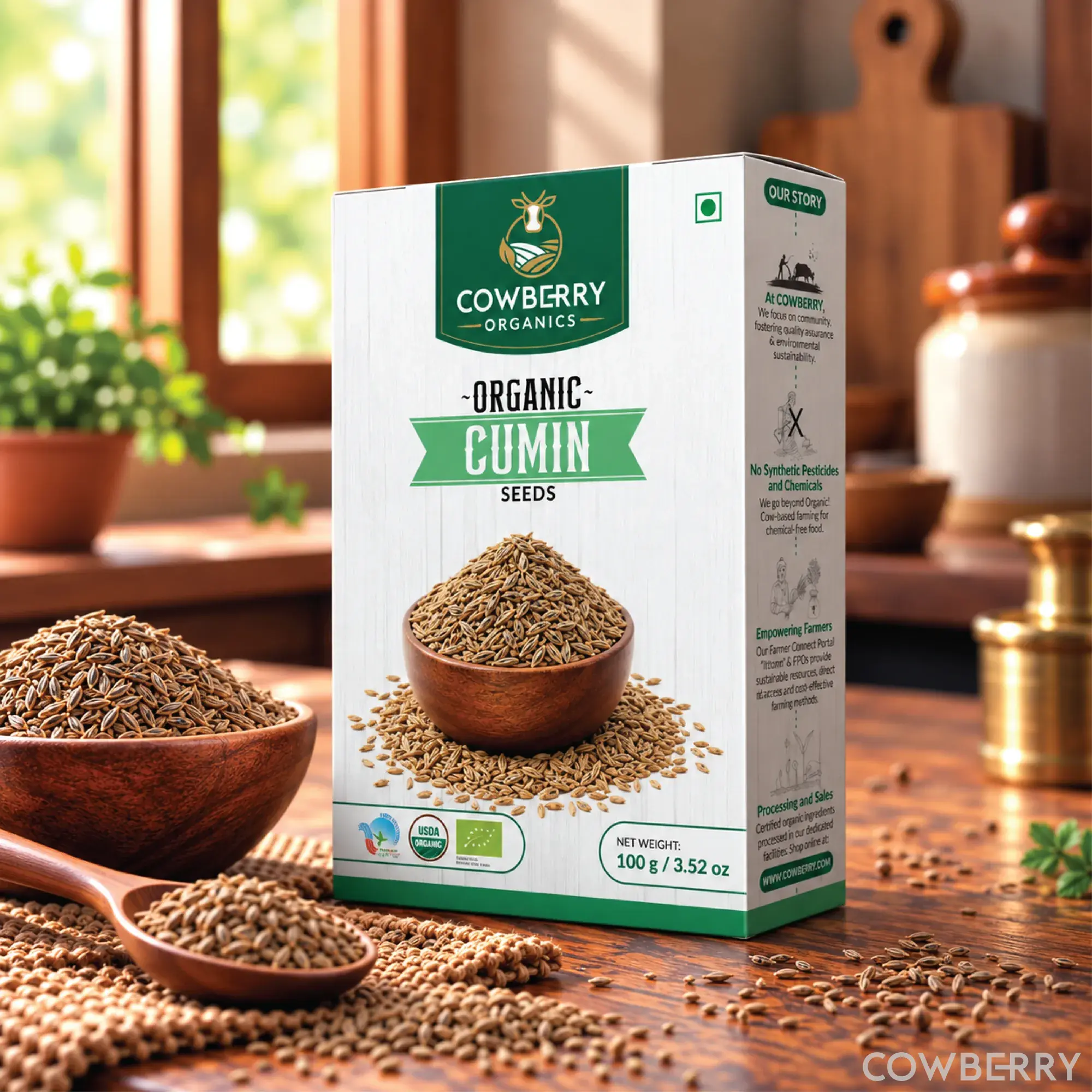
When you buy, prefer whole seeds with a strong jeera smell and read the pack: the botanical name Cuminum cyminum settles any doubt between jeera and shahi jeera. COWBERRY's organic cumin seeds pack whole jeera grown in Rajasthan and Gujarat with cow-based natural farming, cleaned and packed whole, nothing added; India Organic, USDA & EU certified. The cumin powder is ground slowly from the same whole seeds, nothing added; India Organic, USDA & EU certified. One last kitchen habit: keep the jar where you see it, and the seeds will find their way into more dishes than any list can name.
FAQs
What is jeera?
Jeera is the Hindi name of cumin seeds, the dried seeds of Cuminum cyminum. Whole, they open a tadka; ground, they become cumin powder in masalas and curd. The English name cumin and the Hindi jira are the same seed, and the names table above lists every regional word.
Is cumin and jeera the same?
Yes, one seed with two language names: cumin in English, jeera in Hindi, and one botanical name, Cuminum cyminum, behind both. A packet may print either word, and regional labels print their own, but the spice inside is identical. The names page sorts jeera from shahi jeera and saunf, which are different matters.
Why cumin seeds are good?
Because they deliver flavour for next to no cost: a teaspoon of 2.5 g brings about 8 kcal, 0.6 g of carbohydrate, 0.8 g of fibre and 0.5 mg of iron, and per 100 g the seed holds 20.58 mg of iron, 878 mg of calcium and 30.35 g of fibre (IFCT 2017). The benefits page scales every figure to the teaspoon.
What is jeera water?
Cumin-steeped water: one teaspoon of whole seeds in a cup of water, soaked eight to ten hours or boiled five minutes, then strained. The cup holds about 8 kcal and no caffeine or sugar unless added. The method page gives the steps and the keeping time, one day at most.
How long does cumin last?
Whole seeds keep their aroma for months in a sealed jar away from heat and light; ground powder fades in weeks. IFCT 2017 lists no shelf-life figure, so keep to an approximate time in an airtight container and no fixed date. The storage page has the full detail.
What does jeera contain?
Per 100 g (IFCT 2017): 305 kcal, 13.91 g protein, 16.64 g fat, 22.62 g carbohydrate, 30.35 g fibre, 20.58 mg iron, 878 mg calcium, 442 mg magnesium, 1886 mg potassium, 125 mg sodium, 4.29 mg zinc and 27.79 mcg folate. IFCT 2017 lists no vitamin C value and no glycemic index for cumin seeds, so neither figure is claimed.
References
- Indian Food Composition Tables (IFCT) 2017, ICMR-National Institute of Nutrition
- Singh N, Yadav SS, Kumar S et al. A review on traditional uses, phytochemistry, pharmacology, and clinical research of dietary spice Cuminum cyminum L. Phytother Res, 2021
- Karimian J, Farrokhzad A, Jalili C. The effect of cumin (Cuminum cyminum L.) supplementation on glycemic indices: A systematic review and meta-analysis of randomized controlled trials. Phytother Res, 2021
- Opara EI, Chohan M. Culinary herbs and spices: their bioactive properties, the contribution of polyphenols and the challenges in deducing their true health benefits. Int J Mol Sci, 2014
Shop this article
Keep reading
Coriander water benefits: what dhania water actually does
Peanuts in Hindi (moongfali): groundnut names in Indian languages
Coriander vs cilantro: are they the same herb?