by COWBERRY

8 minute read
Cloves nutrition facts 100g: calories, protein and per-clove amounts

Cloves nutrition facts 100g, from IFCT 2017: 187 kcal, 5.86 g protein, 8.41 g fat, 18.73 g carbohydrate, 34.52 g fibre, 567 mg calcium and 9.41 mg iron. Below: the full table, the tiny amounts in a bud, a teaspoon and a cup of chai, cloves against cumin seeds and black pepper, and why no GI figure has been published. The cloves guide has names, uses and buying notes.
Cloves nutrition facts 100g: the full table
The table below is the IFCT 2017 composition of dried whole cloves per 100 g. Two things to keep in mind while reading it. First, these are the values for 100 g of the dry spice, and no kitchen uses 100 g of cloves in one go; the next section works the numbers down to a bud, a teaspoon and a cup of chai. Second, two values in the table are dashes rather than numbers: IFCT 2017 does not report a vitamin C value for cloves, and no GI figure has been published for the spice. A dash means the value was not reported, not that it is zero.
Even at a glance, the profile is unusual for a spice. Fibre is 34.52 g per 100 g, more than a third of the weight of the dried bud, and the mineral list reads like a much bigger food: 567 mg calcium, 334 mg magnesium, 1434 mg potassium and 9.41 mg iron. Sodium sits at 183 mg, the one figure to keep in proportion, and the sections below do that arithmetic.
| Nutrient | Cloves, dried |
|---|---|
| Energy (kcal) | 187 |
| Protein (g) | 5.9 |
| Fat (g) | 8.4 |
| Carbohydrates (g) | 19 |
| Dietary fibre (g) | 35 |
| Iron (mg) | 9.4 |
| Calcium (mg) | 567 |
| Magnesium (mg) | 334 |
| Potassium (mg) | 1434 |
| Sodium (mg) | 183 |
| Zinc (mg) | 1.1 |
| Folate (mcg) | 33 |
Per 100 g raw, edible portion. Composition: IFCT 2017 (ICMR-NIN). — means not reported. These are average values for the food; the label on a pack gives the values for that product.
Cloves nutritional value per clove, teaspoon and cup of chai
Nobody eats 100 g of cloves. The amounts Indian kitchens actually use are a bud, a teaspoon and a cup of chai, and the numbers below come from the IFCT values above and the measures used across the clove pages: ten whole buds weigh about 1 g, and one teaspoon of ground clove is about 2 g.
| How cloves are used | Weight | Energy (kcal) | Carbs (g) | Fibre (g) | Calcium (mg) |
|---|---|---|---|---|---|
| One whole bud | 0.1 g | 0.2 | 0.02 | 0.03 | 0.6 |
| Ten buds (1 g) | 1 g | 1.9 | 0.2 | 0.35 | 5.7 |
| One tsp ground clove (2 g) | 2 g | 3.7 | 0.4 | 0.7 | 11.3 |
| Six buds tempering a dal | 0.6 g | 1.1 | 0.1 | 0.2 | 3.4 |
| A cup of laung chai (2 buds) | 0.2 g | 0.4 | 0.04 | 0.07 | 1.1 |
So a day of cooking with cloves, even a heavy one at around 2 g, adds about 3.7 kcal and 0.4 g of carbohydrate, a rounding error on any plate. The fibre and calcium look better on paper than in the bowl: one gram of buds gives about 0.35 g of fibre and 5.7 mg of calcium, real but garnish-sized. The same bud steeped in hot water is the cup on the cloves tea page, and soaked cold overnight it is the glass on the cloves water benefits page; both carry these same tiny numbers.
Cloves protein and fibre, against cumin seeds and black pepper
Spice numbers only mean something beside other spices, so the table below puts cloves next to cumin seeds and black pepper from the same IFCT 2017 tables. Cloves top the three on fibre and carry the least energy and carbohydrate; cumin seeds lead on calcium, iron, magnesium, potassium and zinc; black pepper sits between the two on fibre but carries the least sodium; and cloves carry the most folate of the three. Cloves carry about 14 percent more fibre than cumin seeds and about 4 percent more than black pepper, and about 40 percent less energy than cumin seeds.
Protein in cloves is 5.86 g per 100 g, below cumin seeds and black pepper, and fat is 8.41 g, a middle value. None of these gaps make or break a plate, because a day of clove use is one or two grams; the comparison only shows where each spice is strong. What the fibre and minerals do in a diet, and where cloves sit against health claims, is on the cloves benefits page.
| Nutrient | Cloves, dried | Cumin seeds | Black pepper |
|---|---|---|---|
| Energy (kcal) | 187 | 305 | 218 |
| Protein (g) | 5.9 | 14 | 10 |
| Fat (g) | 8.4 | 17 | 2.7 |
| Carbohydrates (g) | 19 | 23 | 36 |
| Dietary fibre (g) | 35 | 30 | 33 |
| Iron (mg) | 9.4 | 21 | 12 |
| Calcium (mg) | 567 | 878 | 405 |
| Magnesium (mg) | 334 | 442 | 196 |
| Potassium (mg) | 1434 | 1886 | 1487 |
| Sodium (mg) | 183 | 125 | 24 |
| Zinc (mg) | 1.1 | 4.3 | 1.2 |
| Folate (mcg) | 33 | 28 | 22 |
Per 100 g raw, edible portion. Composition: IFCT 2017 (ICMR-NIN). — means not reported. These are average values for the food; the label on a pack gives the values for that product.
Cloves calories, vitamins and minerals
Cloves calories come to 187 per 100 g, below cumin seeds and black pepper, split into protein 5.86 g, fat 8.41 g and carbohydrate 18.73 g, with fibre at 34.52 g. The mineral list reads better than the macros: iron 9.41 mg, calcium 567 mg, magnesium 334 mg, potassium 1434 mg, zinc 1.13 mg and folate 32.81 mcg per 100 g. Sodium is 183 mg per 100 g, the highest figure a buyer notices, and at a gram of buds a day it amounts to about 1.8 mg, so it changes nothing in practice.
A separate laboratory analysis adds one more mineral to the picture: a 2014 study in Food Chemistry (Khan and colleagues) measured 23 minor and trace elements in aromatic spices and found manganese high in cloves at 649.9 micrograms per gram, after cinnamon and cardamom, and reported that the toxic trace elements arsenic, cadmium and lead were very low across the spices analysed, posing no threat to consumers. Vitamin C is the one value missing: IFCT 2017 does not report a vitamin C figure for cloves. What the micronutrient list means day to day is modest, because the serving is a gram or two; per 100 g, the mineral profile is strong for a spice. Per-dish amounts are on cloves how to use.
Glycemic index of cloves: why no value has been published
Searches for a clove glycemic index end at the same honest answer: no GI figure has been published for cloves, and IFCT 2017 reports none. A glycemic index test feeds ten or more people a serving carrying 50 g of available carbohydrate, then follows their blood glucose over the next two hours, as the University of Sydney describes the test. Getting a portion that size from cloves would need roughly 267 g of the buds, a quantity no kitchen dish comes near.
What a real day of clove carries is a fraction of that: one gram of buds has about 0.2 g of carbohydrate, and even 2 g spread across a day of cooking adds about 0.4 g. Cloves therefore sit outside the GI conversation entirely; the carbohydrate that matters on a diabetic plate comes from the rice, roti or dal around the spice. How that plays out, including the sugar-free laung chai, is on can diabetic eat cloves.
How to read clove numbers on a pack or an app
Ground clove is the same dried bud, milled, so the per-teaspoon figures above apply to powder as well; the one difference is that powder loses its aroma faster, which is why whole buds are the better buy. Apps and pack labels usually quote a serving of a gram or two, so a line like 0.4 g of carbohydrate on a label is the same arithmetic this page shows, not a different spice. Whatever the unit, the honest summary of cloves nutrition is this: a dense, fibrous, mineral-heavy dry spice that a kitchen eats at one or two grams a day, where its contribution is flavour first and the numbers are near zero.
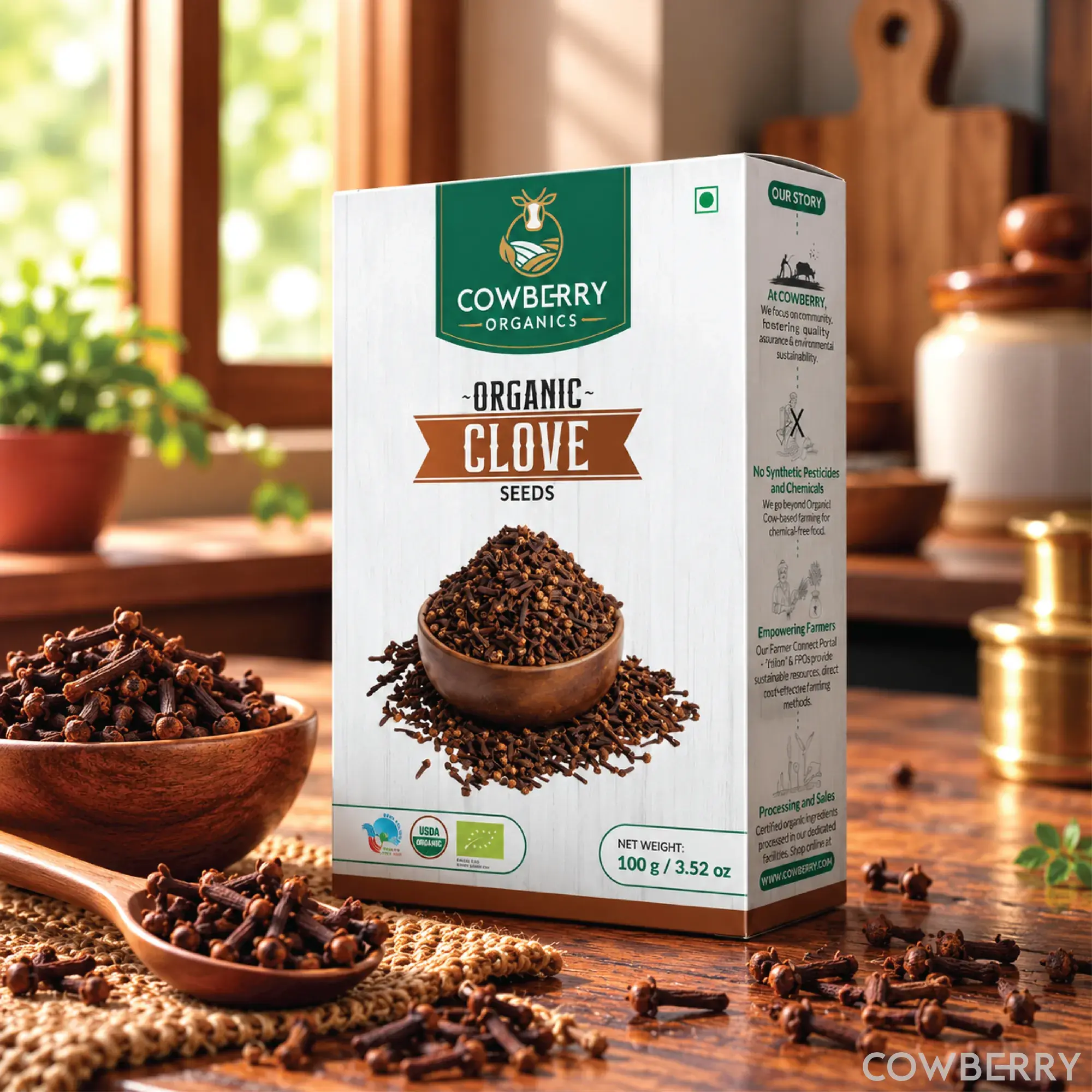
Whole buds with their aroma intact are the buy that makes those numbers worthwhile, and the whole cloves used across the recipes on this site are sun-dried in Kerala. The vegetable pulao recipe seasons its rice with cloves among its whole spices, and the everyday ways to cook with the same bud are on the cloves hub.
FAQs
Does cloves have calories?
Yes, but almost none. IFCT 2017 gives dried cloves 187 kcal per 100 g, and since ten whole buds weigh about 1 g, one bud carries about 0.2 kcal and a whole gram about 1.9 kcal. A day of cooking with cloves, at one to two grams, adds only a few kilocalories, less than the garnish around it.
How much protein is in cloves?
5.86 g per 100 g of dried cloves (IFCT 2017), lower than cumin seeds and black pepper. In the amounts anyone cooks with, it shrinks to nearly nothing: 2 g of cloves, a heavy day, holds about 0.12 g of protein. Cloves are a spice, not a protein source.
What is laung called in english?
Laung is cloves in English: the dried flower buds of the clove tree, Syzygium aromaticum, the botanical name IFCT 2017 gives the spice. The Hindi name in the same tables is Lavang, and laung is the everyday form you will hear in kitchens. Nearly every Indian language has its own name for the same bud, all listed on the laung in english page.
Is laung good for health?
As a spice, yes; as a medicine, no human evidence is there. Per 100 g, cloves hold 34.52 g of fibre and 567 mg of calcium, and a 2014 review reports antioxidant and antimicrobial activity for the spice from laboratory studies. Eaten a few buds at a time, laung is a flavour; the honest reading of the research is on the cloves benefits page.
Can cloves help in hair growth?
Nothing in the clove research shows that. The two published reviews of the spice, from 2014 and 2020, cover laboratory and animal work, and neither reports a finding on hair growth. Cloves belong in the tempering, not in a hair routine; for hair, ask a doctor what actually works.
What is cloves in hindi?
In the IFCT 2017 tables the Hindi name for cloves is Lavang, and the everyday spelling is laung. Kannada and Sanskrit list Lavanga, Tamil and Malayalam list Krambu, and Bengali lists Lobong. One spice, many names; the complete list is on the laung in english page.
References
- Indian Food Composition Tables (IFCT) 2017, ICMR-National Institute of Nutrition
- University of Sydney: about the glycemic index
- Cortes-Rojas DF, de Souza CR, Oliveira WP. Clove (Syzygium aromaticum): a precious spice. Asian Pac J Trop Biomed, 2014
- Khan N, Choi JY, Nho EY et al. Determination of minor and trace elements in aromatic spices by micro-wave assisted digestion and inductively coupled plasma-mass spectrometry. Food Chem, 2014
Shop this article
Keep reading
Coriander water benefits: what dhania water actually does
Peanuts in Hindi (moongfali): groundnut names in Indian languages
Coriander vs cilantro: are they the same herb?