by COWBERRY

10 minute read
Cloves (laung): names, nutrition, benefits and how to use them

Cloves are the dried flower buds of the clove tree, and this hub is the one-page guide to them: the names for laung across Indian languages, the IFCT nutrition numbers per 100 g and per gram, the benefits the research actually shows, how many buds a dish takes, and how to buy good ones. Each section links to the page that goes deeper.
What are cloves? The clove tree and its dried buds
Everything about cloves begins with the cloves tree. Syzygium aromaticum, the clove tree of the myrtle family, produces the aromatic flower buds that become the spice once they are dried, and the whole dark bud is what a jar of cloves holds. In Hindi kitchens the spice is laung, so laung cloves and cloves are the same bud, and the laung tree is the same tree. A clove review from 2014 (Asian Pacific Journal of Tropical Biomedicine) records centuries of use in preserving food, alongside a long list of medicinal purposes, which is why the bud sits in spice boxes well beyond India. Behind that record sits eugenol, the major phenolic compound the reviews keep returning to. The names, the numbers and the uses below all trace back to this one dried bud.
Clove names in Indian languages
One spice, many names. IFCT 2017 records Lavang for Hindi, Marathi and Gujarati, Long for Punjabi, Assamese and Urdu, Lobong for Bengali, Labang for Odia, Lavanga for Kannada and Sanskrit, Lavangu for Telugu and Krambu for Tamil and Malayalam, with laung as the everyday Hindi form. English calls the spice cloves, and the botanical name behind every one of these is Syzygium aromaticum. The names table below prints all thirteen alongside the English name. Whichever name a recipe or a shopkeeper uses, the jar to reach for is the same, and the full list with everyday spellings is on laung in english.
| Language | Name (romanised) |
|---|---|
| English | Cloves |
| Hindi | Lavang, Laung |
| Marathi | Lavang |
| Gujarati | Lavang |
| Punjabi | Long |
| Bengali | Lobong |
| Odia | Labang |
| Assamese | Long |
| Kannada | Lavanga |
| Telugu | Lavangu |
| Tamil | Krambu |
| Malayalam | Krambu |
| Urdu | Long |
| Sanskrit | Lavanga |
| Botanical name | Syzygium aromaticum |
Source: IFCT 2017 (ICMR-NIN) local-names list. — means no name recorded in the source.
Hindi ‘Laung’: spelling variant of the IFCT 2017 name ‘Lavang’.
Cloves nutrition per 100 g, and what a gram of buds holds
Per 100 g, dried cloves hold 187 kcal, 5.86 g of protein, 8.41 g of fat and 18.73 g of carbohydrate, with 34.52 g of fibre and a mineral list that reads like a much bigger food: 567 mg of calcium, 334 mg of magnesium, 1434 mg of potassium and 9.41 mg of iron. Two blanks are worth knowing: IFCT 2017 reports no vitamin C figure for cloves, and no GI value has been published for the spice. Sodium is the one figure to keep in proportion at 183 mg per 100 g; at a gram of buds it comes to about 1.8 mg, changing nothing in practice.
The catch is the serving. Nobody cooks with 100 g of cloves; ten whole buds weigh about 1 g, so a gram of buds carries about 0.2 g of carbohydrate, about 0.35 g of fibre and about 5.7 mg of calcium, and a heavy day of cooking uses a gram or two. That is why cloves season a plate without moving its numbers. The full table, plus the per-bud, per-teaspoon and per-cup amounts, is on cloves nutrition facts 100g.
| Nutrient | Cloves, dried |
|---|---|
| Energy (kcal) | 187 |
| Protein (g) | 5.9 |
| Fat (g) | 8.4 |
| Carbohydrates (g) | 19 |
| Dietary fibre (g) | 35 |
| Iron (mg) | 9.4 |
| Calcium (mg) | 567 |
| Magnesium (mg) | 334 |
| Potassium (mg) | 1434 |
| Sodium (mg) | 183 |
| Zinc (mg) | 1.1 |
| Folate (mcg) | 33 |
Per 100 g raw, edible portion. Composition: IFCT 2017 (ICMR-NIN). — means not reported. These are average values for the food; the label on a pack gives the values for that product.
Cloves benefits: what the reviews support, and the honest limit
The two published clove reviews tell one consistent story. The 2014 review calls cloves a standout source of phenolic compounds, with eugenol, eugenol acetate and gallic acid among them, and records antioxidant and antimicrobial activity above what many fruits, vegetables and other spices show. The 2020 review in Biomolecules adds documented antibacterial, antifungal and antiviral activity for eugenol, pain-relieving reports for the same compound, and an examination of the toxicological activity of clove extracts and oil. All of it is laboratory and animal work on the bud, its oil and its compounds, not results measured in people eating cloves.
The dietary guidelines keep the spice in proportion: turmeric, cumin, ginger, garlic, cinnamon, pepper and cloves all count as antioxidant-rich spices that could be part of a balanced diet. A 2014 review of culinary herbs and spices explains why more is hard to claim, since spices are normally eaten in small quantities with other foods and their true health benefit is unclear. The ten-point list with each claim's source is on cloves benefits, the same page in everyday Hindi is laung khane ke fayde, and the diabetes question gets a page of its own: can diabetic eat cloves.
Cloves side effects, and who should be careful
At the amounts a kitchen uses, cloves are an ordinary spice, and the clove research reports no side effects from a few buds inside a dish. The caution belongs to concentrated forms. The 2020 review looks at the toxicological activity of clove extracts and oil, from laboratory and animal studies, and it names no amounts that are safe for people; with no researched daily amount, there is nothing to exceed or stay under, and food amounts stay far from the amounts those studies use. Clove oil concentrates what the bud holds, so use it a drop at a time, never by the spoonful, and keep it out of a child's reach. The careful tooth habit, one drop on cotton, and when a dentist should take over, are on why cloves for toothache. If you take medicines for any condition, ask your doctor before making cloves a daily routine, and see any clove capsule the same way, since no human trial stands behind one.
How to cook with cloves: how many buds per dish
Whole buds are the form that does the work, and the amounts Indian kitchens use are small: 2 or 3 whole buds sit in a pot of rice as it cooks, 2 to 6 season a dal or curry for four people, and 1 or 2 lightly crushed buds make a cup of chai. With ten whole buds at about 1 g, even the heaviest of these amounts stays well under a gram of spice. The usual method is a tempering: drop the buds into hot oil at the very start, let them sizzle for 20 to 30 seconds, then carry on with the dish, and lift the buds out before the dish is served, as they stay whole and hard. If a recipe wants powder, crush whole buds in a small mortar as you need them, and the aroma stays where it belongs; ready-ground clove fades faster, one more reason to buy whole. Per-dish counts for every preparation, the tempering in detail and the after-meal habit are on cloves how to use.
How to store cloves so they stay strong
Cloves want an airtight jar in a spot that stays cool and dry, with the jar shut against direct sun, stove steam and damp; a dry spoon keeps the buds clean. Cloves go stale by losing their aroma rather than spoiling, so the kitchen test is the nose: open the jar and sniff. Buds that still smell sharp and woody are worth cooking with; buds that smell faint and dusty will give faint food. A small jar bought often beats a large jar bought rarely, since the buds slowly give up their aroma from the day they are packed, and whole buds outlast ground clove either way; that is why the whole-bud habit pays twice, in flavour now and in a jar that lasts. The whole-bud habit in more detail is on cloves how to use.
Clove tea, clove water and recipes that use cloves
Two drinks carry the same few buds further. Clove tea, or laung tea, simmers two lightly crushed buds with half a teaspoon of tea leaves in a cup of water for 3 to 4 minutes, then strains the cup warm and skips the sugar; the method with per-cup numbers is on cloves tea. Clove water, or laung ka pani, is the cold, slow version: two whole buds soak in about 200 ml of water for 6 to 8 hours, usually overnight, and the water is drunk the same morning with the buds lifted out, as cloves water benefits describes.
Neither drink has a human trial behind it, and both stay at the same two-bud scale; they are ways to take the spice, not doses. Both drinks keep to two buds because that is the kitchen scale: two buds weigh about 0.2 g. In recipes, cloves appear among the whole spices of a spiced brew: the masala chai recipe seasons its pot with four whole buds. For the same bud in dal, rice or a tempering, the counts are in the section above.
How to buy cloves
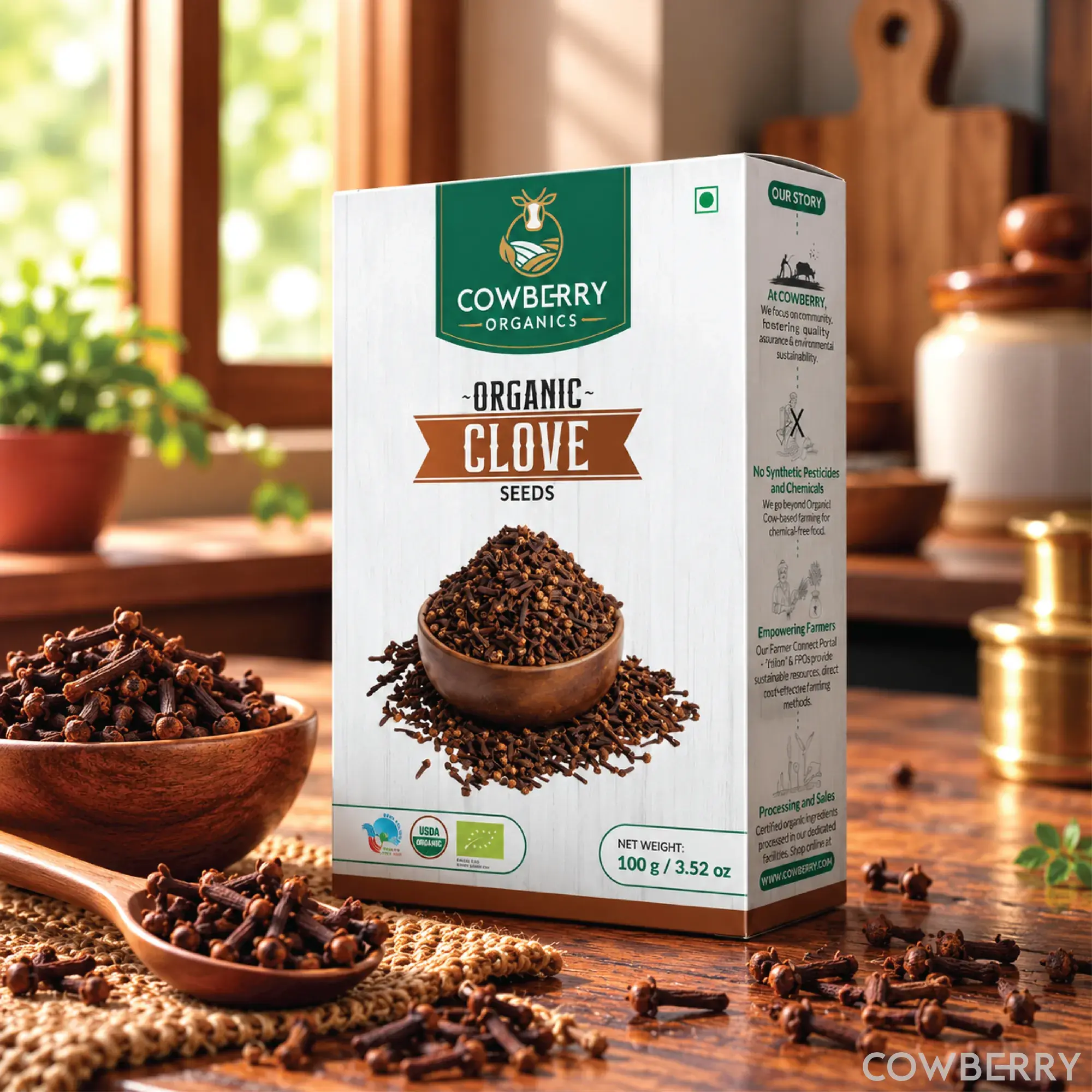
The buying rule from the dietary guidelines is short: since powdered spices are more likely to be adulterated, whole spices, uniform in color, size and shape, should be preferred. A good jar, then, holds whole buds that look alike, and the pack should say how the buds were grown and dried. COWBERRY's Organic Clove is exactly that: cloves grown organically in Kerala's spice gardens, where the warm, coastal climate suits clove trees, sun-dried and packed at peak freshness in a 100 g pack, India Organic, USDA & EU certified. Everything else on this page, the nutrition numbers, the per-dish counts and the two drinks, assumes that same jar of whole buds.
FAQs
What is cloves?
Cloves are the dried flower buds of the clove tree, Syzygium aromaticum, and the whole dark bud is the spice. Hindi calls it laung or Lavang, and every Indian language has its own name, all listed on laung in english. The bud is used whole in dal, rice and chai, with centuries of use behind it as a food preservative.
How cloves are grown?
Clove trees produce the aromatic buds that become the spice, and they thrive in warm, coastal climates. Kerala is known for its spice gardens, where the warm coastal climate suits the clove tree, and COWBERRY's pack comes from those same gardens: grown organically without synthetic pesticides, dried in the sun and packed at peak freshness.
Difference between cloves and garlic?
Two different plants that share one word. Cloves, the spice, are the dried flower buds of the clove tree, Syzygium aromaticum; the cloves of a garlic bulb are the small separate sections inside it. A recipe that lists cloves among its spices means laung, while garlic always means the bulb. The two look, smell and taste nothing alike.
Is laung good for health?
As a spice in food, yes; as a medicine, the trials in people are missing. The clove reviews report both antioxidant and antimicrobial activity, from laboratory studies, and the dietary guidelines count cloves among the spices rich in antioxidants that could be part of a balanced diet. At a few buds at a time, laung stays a flavour. The sourced list is on cloves benefits.
Can diabetic eat cloves?
Cloves bring almost no carbohydrate to a plate: a gram of buds, roughly ten whole cloves, carries about 0.2 g, and no study in people has shown cloves lowering blood sugar. No GI value has been published for the spice, so there is no clove GI figure to consult; the rice or roti on the plate matters far more. The full picture is on can diabetic eat cloves.
Can laung reduce toothache?
The clove reviews report pain-relieving activity for eugenol, the bud's major compound, from laboratory studies, with no trials in people who had toothache behind it. Any comfort from holding a bud against an aching tooth is temporary and local at best, and it does not replace a dentist. The careful home method, and when to see one, are on why cloves for toothache.
Which cloves are best?
Whole buds over powder, and fresh over faded. Whole buds keep their aroma longer, and you can crush just the few a dish needs; a bud that smells sharp and woody the moment the lid comes off is still full of flavour, while a faint, dusty smell means it has faded. Buy uniform dark buds, and the buying section above turns that into a pack choice.
References
- Indian Food Composition Tables (IFCT) 2017, ICMR-National Institute of Nutrition
- Dietary Guidelines for Indians, ICMR-National Institute of Nutrition
- Cortes-Rojas DF, de Souza CR, Oliveira WP. Clove (Syzygium aromaticum): a precious spice. Asian Pac J Trop Biomed, 2014
- Batiha GE, Alkazmi LM, Wasef LG et al. Syzygium aromaticum L. (Myrtaceae): Traditional Uses, Bioactive Chemical Constituents, Pharmacological and Toxicological Activities. Biomolecules, 2020
- Opara EI, Chohan M. Culinary herbs and spices: their bioactive properties, the contribution of polyphenols and the challenges in deducing their true health benefits. Int J Mol Sci, 2014
Shop this article
Keep reading
Coriander water benefits: what dhania water actually does
Peanuts in Hindi (moongfali): groundnut names in Indian languages
Coriander vs cilantro: are they the same herb?