by COWBERRY

9 minute read
10 benefits of cloves (and its side effects)

Cloves benefits split into two kinds: what laboratory studies of the bud and its main compound eugenol show, and what a gram of buds in a day of cooking actually delivers. Here are ten, each tied to its source, then the honest limit, cloves side effects, how much per day and how to eat them. Names, storage and buying are on the cloves hub.
What cloves are, and where their benefits come from
Cloves are the dried flower buds of Syzygium aromaticum, the clove tree, and the spice is a few of those buds in a dal, rice or chai. Their reputation comes from their chemistry. The 2014 review of the spice in the Asian Pacific Journal of Tropical Biomedicine calls clove one of the richest sources of phenolic compounds such as eugenol, eugenol acetate and gallic acid, and a 2020 review in Biomolecules names eugenyl acetate, eugenol and beta-caryophyllene as the most significant phytochemicals in clove oil. The same 2014 review records that cloves have been used for centuries as a food preservative and in many medicinal roles, and India is recognized all over the world for its spices and medicinal plants, as a 2008 review of traditional Indian spices puts it.
Cloves benefits the two reviews support, from laboratory work
1. Antioxidant activity
The 2014 review reports that the antioxidant and antimicrobial activity of clove is higher than that of many fruits, vegetables and other spices. Those are laboratory findings on the spice and its compounds, not measurements from people eating cloves.
2. Antimicrobial activity
The same review highlights clove's antimicrobial activity, and the 2020 review reports documented antibacterial, antifungal and antiviral activity of eugenol against several pathogenic bacteria, including methicillin-resistant Staphylococcus epidermidis and Staphylococcus aureus. Again, this is laboratory work: a curry with cloves is not a medicine cabinet.
3. Food preservation, the use with the longest record
Both reviews start from the same traditional use: cloves have been used for centuries as a food preservative. The 2020 review describes clove as a traditional spice used for food preservation, and the 2014 review says the studies it covers confirm that traditional use. This is the one use here that is a traditional kitchen use, not only a laboratory finding.
4. Pain-relieving reports for eugenol
A 2020 review in Biomolecules reports documented analgesic, or pain-relieving, activity of eugenol. The abstract does not describe trials in people with toothache; any comfort from a clove is likely to be temporary and local at best. The home habit of holding a bud against an aching tooth, and its limits, are on why cloves for toothache.
Cloves benefits by the numbers: what a bud actually carries
5. Fibre in the bud
Dried cloves carry 34.52 g of fibre per 100 g (IFCT 2017), more than a third of the bud's weight. At kitchen scale the number shrinks fast: one gram of buds, about ten whole cloves, holds about 0.35 g of fibre, a garnish-sized amount on any plate. The fibre is real; the portion is tiny.
6. Calcium and the mineral list
Per 100 g, cloves hold 567 mg calcium, 334 mg magnesium, 1434 mg potassium and 9.41 mg iron (IFCT 2017). At a gram a day, that is about 5.7 mg of calcium and about 0.1 mg of iron, useful to know and easy to overrate. The full mineral profile is on cloves nutrition facts 100g.
7. Manganese, with very low toxic trace elements
A laboratory analysis published in Food Chemistry in 2014 measured 23 minor and trace elements across aromatic spices and found cloves high in manganese at 649.9 micrograms per gram, behind cinnamon and cardamom, with arsenic, cadmium and lead very low across the spices analysed and posing no threat to consumers.
8. Almost no energy per bud
Cloves give 187 kcal per 100 g (IFCT 2017), but nobody eats them by the hundred grams. One bud weighs about 0.1 g and carries about 0.2 kcal; even a heavy day of cooking, two grams of buds, adds about 3.7 kcal at two grams. Cloves season a meal without moving its energy count.
9. Eugenol, the compound the reviews keep returning to
Eugenol is the compound the reviews keep coming back to: a major phenolic compound of the bud, and among the most significant phytochemicals in clove oil. The antimicrobial and pain-relieving reports above include reports about eugenol, and clove oil, the concentrated form, is a different thing from a few buds in a curry.
10. A spice with a written medicinal record
The 2014 review records cloves serving for centuries as a food preservative and for many medicinal purposes, and notes the spice's potential for pharmaceutical, cosmetic, food and agricultural applications. The record is long; what it does not include is trials showing a benefit in people who eat kitchen amounts of cloves, which the next section covers.
The honest limit: which clove benefits are not shown in people
The antioxidant, antimicrobial and pain-relieving findings above are not findings from people eating cloves with meals. The two clove reviews, from 2014 and 2020, mostly describe laboratory and animal work on the spice, its oil and its compounds, and neither abstract reports a human trial of cloves eaten as food. A 2014 review in the International Journal of Molecular Sciences, covering culinary herbs and spices, explains why the gap is so hard to close: spices are normally eaten in tiny amounts alongside other foods, so their true health benefit is unclear, and preparation, digestion, absorption and how foods interact may all change the answer.
What follows for the kitchen is simple. Use cloves for what they are, a strong spice with interesting chemistry, and do not dose them like a supplement. The two clove reviews report no human study of cloves lowering blood sugar, which matters to the most common clove health question of all; the detail is on can diabetic eat cloves. If you take medicines for any condition, talk to your doctor before putting spices or supplements in place of the medicines you have been prescribed.
Cloves side effects and who should limit them
In kitchen amounts, cloves are an ordinary spice, and the two clove reviews' abstracts name no side effects from them. The caution attaches to the concentrated forms. The 2020 review examines the toxicological activity of clove extracts and the oil together with its other effects, from laboratory and animal studies, and it names no amounts that are safe for people, so there is no daily clove figure to exceed or stay under.
- Clove oil. The oil concentrates what the bud holds. Use it a drop at a time and never swallow it by the spoonful; for a tooth, one drop on cotton is the cautious form, as the why cloves for toothache page sets out.
- Children. Keep clove oil out of a child's reach, and never use it in a child's mouth unless a dentist or doctor says to.
- Capsules and extracts. No human trial backs a clove supplement for any condition, and the review evidence stops at laboratory and animal work. See any clove capsule as a supplement decision for your doctor or dietitian, not a kitchen habit.
- A heavy daily habit. Chewing handfuls of dry buds every day is not a traditional use and nothing in the reviews supports it; keep cloves to the amounts a recipe uses.
If a clove dish disagrees with you, or you take medicines for a condition, talk to your doctor or dietitian before making cloves a daily routine.
How many cloves per day
The two clove reviews give no daily amount of cloves. The amount that makes sense is what a kitchen uses: 2 to 6 whole buds temper a dal or curry for four people, 2 or 3 go into a pot of rice, and 1 or 2 crushed buds flavour a cup of chai. Since ten whole buds weigh about 1 g, one dish of cloves weighs well under a gram, and a heavy day of cooking with cloves is a gram or two. Per-dish counts, the tempering method and how to store the buds are on cloves how to use.
How to eat cloves
Whole buds are the usual form to buy. Drop them into hot oil at the start of a dal or curry, into the rice pot before it boils, or crush one or two into chai, then scoop the buds out before serving, as they stay whole and hard. Two drinks stretch the same few buds further: the cloves tea page has the laung tea method with per-cup numbers, and the cloves water benefits page covers laung ka pani, the overnight soak. For a one-pot start, the masala chai recipe seasons its brew with whole buds among its spices.
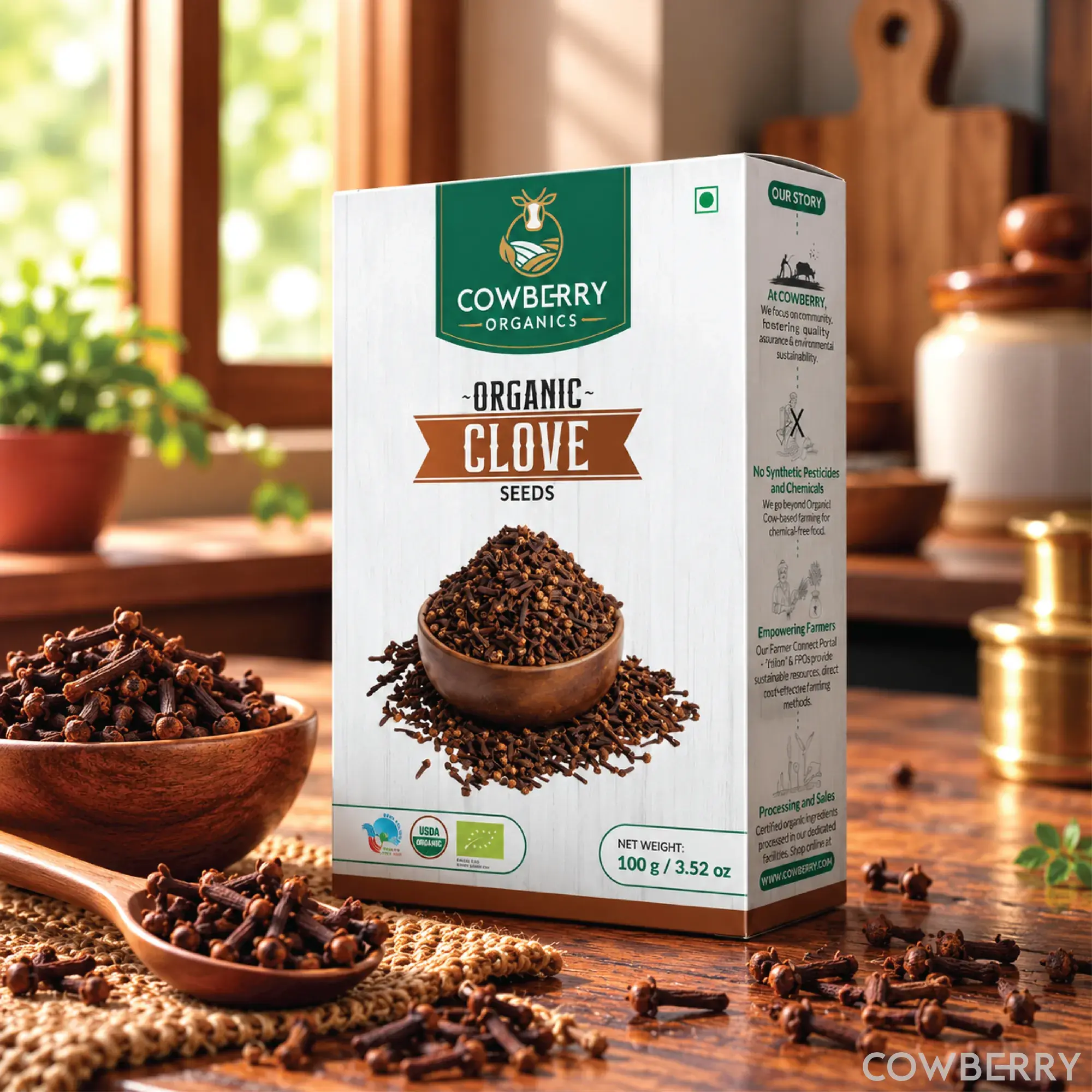
When you buy, COWBERRY's whole cloves are grown organically in Kerala without synthetic pesticides, sun-dried and packed at peak freshness, India Organic, USDA & EU certified. The same bud behind every benefit above, its names and its nutrition, is on the cloves hub.
FAQs
Is laung good for health?
In food, laung is a regular Indian spice; its medicinal side rests on laboratory work, with no human trial in the reviews. Per 100 g, the spice holds 34.52 g of fibre, 567 mg of calcium and 9.41 mg of iron (IFCT 2017), and the clove reviews report antioxidant and antimicrobial activity from laboratory studies. In the few buds a kitchen uses at a time, laung is a flavour that adds almost nothing to the plate.
Is eating laung good for health?
A bud or two chewed after a meal is a common home habit, and cloves have been used for centuries for medicinal purposes. The clove reviews report no study of that habit in people, and a 2014 review of culinary spices points out that tiny culinary doses make any true health benefit hard to prove. Eat laung for the taste, in kitchen amounts.
What are the benefits of laung?
The sourced list: antioxidant and antimicrobial activity from the clove reviews, a centuries-old food-preservation use, pain-relieving reports for eugenol from laboratory studies, and per 100 g, 34.52 g fibre, 567 mg calcium and 9.41 mg iron. All of it is laboratory or composition evidence; the reviews describe no human trial showing a benefit from kitchen amounts of cloves.
Does laung cause acidity?
Neither the 2014 nor the 2020 review's abstract mentions acidity from food amounts of the spice, which are a few buds inside a cooked dish. If acidity troubles you regularly, ask your doctor rather than removing a spice on a guess.
Does laung help in cough?
Neither review reports a study on cough in people, and nothing in them makes a clove a cough medicine. A clove in chai usually feels warm on the throat, which is a taste of the drink, not a remedy; a cough that does not clear needs a doctor.
Can cloves help in hair growth?
The clove reviews' abstracts report no finding on hair growth. The 2014 and 2020 reviews are mainly laboratory and animal work, and hair growth is not among their findings. Keep cloves in the tempering; for hair, ask a doctor what actually works.
References
- Indian Food Composition Tables (IFCT) 2017, ICMR-National Institute of Nutrition
- Cortes-Rojas DF, de Souza CR, Oliveira WP. Clove (Syzygium aromaticum): a precious spice. Asian Pac J Trop Biomed, 2014
- Batiha GE, Alkazmi LM, Wasef LG et al. Syzygium aromaticum L. (Myrtaceae): Traditional Uses, Bioactive Chemical Constituents, Pharmacological and Toxicological Activities. Biomolecules, 2020
- Khan N, Choi JY, Nho EY et al. Determination of minor and trace elements in aromatic spices by micro-wave assisted digestion and inductively coupled plasma-mass spectrometry. Food Chem, 2014
- Opara EI, Chohan M. Culinary herbs and spices: their bioactive properties, the contribution of polyphenols and the challenges in deducing their true health benefits. Int J Mol Sci, 2014
- Krishnaswamy K. Traditional Indian spices and their health significance. Asia Pac J Clin Nutr, 2008
Shop this article
Keep reading
Coriander water benefits: what dhania water actually does
Peanuts in Hindi (moongfali): groundnut names in Indian languages
Coriander vs cilantro: are they the same herb?