by COWBERRY

11 minute read
Brown rice: names, nutrition, benefits and how to cook it

Brown rice is whole-grain rice: the inedible husk comes off and the bran layer stays on. That bran is where the extra nutrition sits, and IFCT 2017 records 4.43 g of fibre and 93.91 mg of magnesium per 100 g, against 2.81 g and 19.3 mg in milled white rice. Here are its names, nutrition, benefits and the cooking and storage basics.
What is brown rice?
Brown rice is rice milled to exactly one stage: the inedible husk of the paddy is removed, and the grain stops there with its bran layer on. White rice is the same paddy polished further, until that bran is stripped away, so the two rices differ by one milling step, not by variety. The ICMR-NIN dietary guidelines want at least half of the day's cereals to be whole grains, and brown rice is one of the whole grains that fills that half.
Because brown is a milling stage rather than a variety, the word can sit in front of any rice's name; red and black rice, by contrast, are varieties with pigmented bran, as the red rice vs brown rice comparison explains. Brown basmati is basmati kept whole, its bran intact; plain brown rice may be any variety, and the pack tells you which you are buying. IFCT 2017 names the food 'Rice, raw, brown', and its botanical name Oryza sativa is the single species behind every rice. The rice (chawal) guide covers the family, the basmati rice guide the aromatic branch, and types of rice in India the whole shelf.
Brown rice names in Indian languages
IFCT 2017 records seven regional names for brown rice: Chawal in Hindi, the same word it gives for milled rice, so Hindi uses one name for both; Kathai chokha in Gujarati; Bhura choul in Punjabi; Matia rangar chaul in Assamese; Dampudu biyyam in Telugu; Arisi in Tamil; and Kuthari in Malayalam. Its English food name is 'Rice, raw, brown'. Marathi, Bengali, Odia, Kannada, Urdu and Sanskrit are left blank in the list. The language-by-language list, spellings included, is on the brown rice in Hindi page.
| Language | Name (romanised) |
|---|---|
| English | Rice, raw, brown |
| Hindi | Chawal |
| Marathi | — |
| Gujarati | Kathai chokha |
| Punjabi | Bhura choul |
| Bengali | — |
| Odia | — |
| Assamese | Matia rangar chaul |
| Kannada | — |
| Telugu | Dampudu biyyam |
| Tamil | Arisi |
| Malayalam | Kuthari |
| Urdu | — |
| Sanskrit | — |
| Botanical name | Oryza sativa |
Source: IFCT 2017 (ICMR-NIN) local-names list. — means no name recorded in the source.
Brown rice nutrition per 100 g
Per 100 g of raw grain, IFCT 2017 gives brown rice 354 kcal, 9.16 g of protein, 1.24 g of fat, 74.8 g of carbohydrate and 4.43 g of fibre. The mineral column is where the bran shows: 93.91 mg of magnesium, 199 mg of potassium, 10.93 mg of calcium, 1.02 mg of iron, 1.68 mg of zinc, 3.64 mg of sodium and 11.51 mcg of folate; vitamin C is not reported. The white column holds IFCT's pooled figures for raw milled rice, 357 kcal and 2.81 g of fibre, about 63 percent of brown's, because IFCT has no basmati entry of its own.
In the bowl, one katori of cooked brown rice comes from about 40 g of raw grain: roughly 142 kcal, 30 g of carbohydrate and 1.8 g of fibre, against 143 kcal and 1.1 g for white. The brown rice nutrition per 100g page breaks every figure down, and the brown rice vs white rice comparison sets the two columns against each other.
| Nutrient | Brown rice (raw) | White rice (IFCT raw milled rice) |
|---|---|---|
| Energy (kcal) | 354 | 357 |
| Protein (g) | 9.2 | 7.9 |
| Fat (g) | 1.2 | 0.5 |
| Carbohydrates (g) | 75 | 78 |
| Dietary fibre (g) | 4.4 | 2.8 |
| Iron (mg) | 1 | 0.7 |
| Calcium (mg) | 11 | 7.5 |
| Magnesium (mg) | 94 | 19 |
| Potassium (mg) | 199 | 108 |
| Sodium (mg) | 3.6 | 2.3 |
| Zinc (mg) | 1.7 | 1.2 |
| Folate (mcg) | 12 | 9.3 |
| Glycemic index (GI) | 58 | 50 |
Per 100 g raw, edible portion. Composition: IFCT 2017 (ICMR-NIN). GI: University of Sydney GI database. — means not reported. These are average values for the food; the label on a pack gives the values for that product.
Benefits of brown rice
Four claims come up again and again about brown rice. Each one traces back to the nutrition table, and the full list with its sources sits on the brown rice benefits page.
Fibre
Brown rice carries 4.43 g of fibre per 100 g against 2.81 g in milled rice, and the ICMR-NIN guidelines count what that fibre does: it slows the uptake of carbohydrate and fat, adds to a meal's fullness, and its bulk supports regular bowel function.
Minerals
The bran holds minerals that polishing removes: 93.91 mg of magnesium per 100 g against 19.3 mg in milled rice, with potassium at 199 mg and zinc at 1.68 mg. Those are IFCT 2017 figures for the raw grain.
Blood sugar
An India-tested brown rice, the parboiled, unpolished Bapatla variety pressure cooked, scores 58 in the University of Sydney GI database, the medium band just above the low cut-off of 55. In a 2022 BMJ Open meta-analysis, the cohort studies that compared the highest and lowest intakes tied more brown rice to a lower type 2 diabetes risk, while the randomised substitution trials stayed inconsistent, with HDL the only significant difference. White rice has no single GI: the India-tested white basmati sits at 50 in the low band, while other white rices tested in India score high. What the number means is unpacked on the brown rice glycemic index page and the plate-side arithmetic on brown rice for diabetes. If diabetes shapes your meals, talk to your doctor or dietitian about where brown rice fits.
Weight
The calories barely move between the two rices, 354 against 357 per 100 g, so brown rice earns its weight-loss place as a swap: the same katori, more fibre. The portion maths is on brown rice for weight loss and the wider picture on chawal for weight loss. Set the portions with a dietitian, and talk to your doctor or dietitian before building a plan around any single food.
Brown rice side effects and who should limit it
For most people brown rice is an everyday grain. Two points about the bran deserve a clear look before it becomes your staple; the full list is on the brown rice benefits and side effects page, with the same facts in Hindi on brown rice khane ke fayde.
Phytic acid
The bran that carries brown rice's minerals also carries phytic acid, the storage form of phosphorus in cereals. A 2015 review in the Journal of Food Science and Technology notes that phytic acid chelates micronutrients such as iron and zinc, which lowers how much of them the body takes up. The guidelines name the everyday fix as brown rice's own cooking method: boiling or pressure cooking brings the phytic acid in cereals and legumes down to a great extent, leaving minerals like iron, calcium, magnesium and zinc ready for the body to absorb.
Arsenic
Rice can take up arsenic from soil and water. Polishing the grain reduces the total arsenic in cooked rice, as reported by a 2019 review in Environment International, so the brown grain retains more of it. In a US FDA study, excess-water cooking removed about 50 percent of brown rice's inorganic arsenic, and the losses of iron and B vitamins were significantly smaller than for enriched polished rice. The dietary guidelines advise adding only the water the cooking needs, because B vitamins may be lost if the cooking water is poured away.
How to cook brown rice
Plain brown rice starts from a 1:2 measure: one cup of rice, which weighs 200 g, with twice that volume of water. None of the references gives a water ratio for brown basmati, so use 1:2 as the starting point and let the grain decide. Cover and cook on a low flame for 30 to 40 minutes, the time COWBERRY's product page gives and puts down to the bran layer, until the water is absorbed and the grains turn tender. Press a grain between finger and thumb: done means it squashes soft all the way through, without a firm centre; a firm grain wants a splash more water and a few more minutes.
There is no soak to schedule. A brief soak while the rest of the meal cooks is a choice, not a step, and an overnight one is not needed; a long-soaked grain drinks some of its water early, so it wants a little less water and time. Wash the grains thoroughly, then stop: the ICMR-NIN guidelines note that washing rice again and again loses some of its minerals and vitamins. The pressure cooker takes the same measure in less time, COWBERRY gives no whistle count, and the soft-through test is the way to know it is done either way. A 200 g cup cooks into roughly five katoris. The khichdi recipe below soaks its rice as part of its own one-pot method; that step belongs to the recipe, not to plain rice. The full walkthrough is on how to cook brown rice.
How to store brown rice
Cooked brown rice keeps for up to two days in the fridge, the UK Food Standards Agency's rule for leftovers: cool it, refrigerate it within an hour or two, and finish it inside two days; the freezer holds it longer. Reheat only the portion you will eat.
The dry grain is simpler. COWBERRY's product page says to keep brown rice in an airtight container, somewhere cool and dry, and it gives no shelf life, so cook the pack steadily rather than hoarding it. Buy an amount your household finishes, and keep the container sealed between uses.
Brown rice recipes
Three recipes on this site cook the grain three ways, and the brown rice recipes roundup collects ten ideas in all.
- Brown rice khichdi: brown rice and split green moong pressure cooked soft with carrot and peas over a ghee, cumin and hing tempering. The rice soaks for 30 minutes, then the pot cooks to the first whistle and 15 minutes on low: ready in about 75 minutes, serves four, about 282 kcal a bowl.
- Brown rice upma: the Tamil arisi upma, brown rice soaked for two hours, ground to a coarse rava and cooked in tempered water with vegetables. Once the rice is ground, the pot is done in about 25 minutes; serves four, about 250 kcal a bowl.
- Brown rice laddu: Kerala-style ari unda, whole brown rice dry-roasted and ground to flour, bound with jaggery syrup and ghee. Sixteen laddus in about 36 minutes, plus cooling; each one about 103 kcal.
How to buy brown rice
Read the pack before you pay: the grain should be whole and unpolished, with the bran visibly on, and a good pack states where the rice was grown and how it was processed. For organic rice, check that the pack carries a certification mark you can verify rather than taking the word organic on trust. Choosing between the two basmatis is its own question, answered on brown basmati vs white basmati.
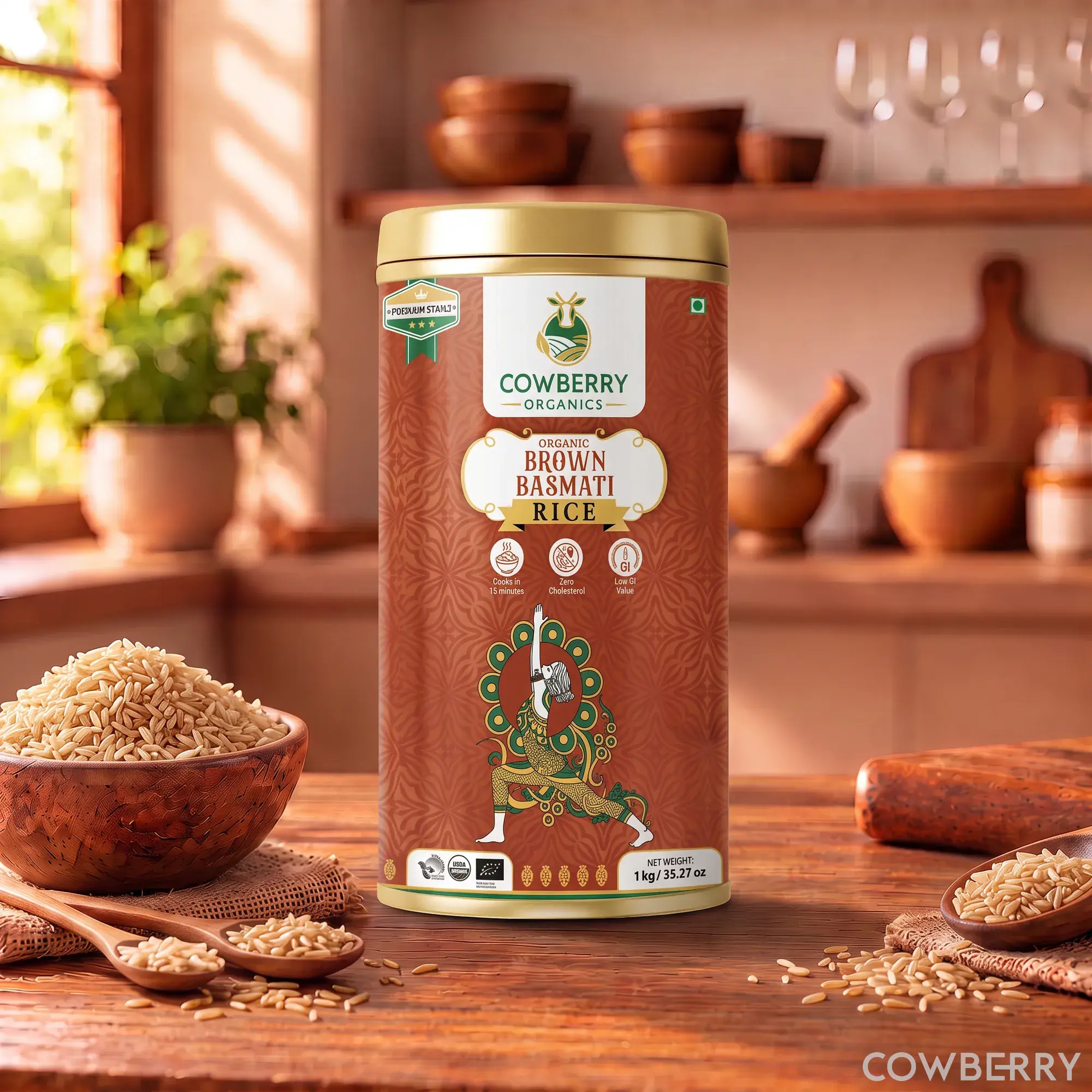
COWBERRY's Organic Brown Basmati Rice is grown organically in Uttarakhand and Punjab without synthetic chemicals, processed lightly so the bran layer stays on; it carries the India Organic, USDA & EU certified assurance.
FAQs
What is brown rice?
Brown rice is rice husked but not polished, so the bran layer stays on the grain: a whole grain; brown is about milling, not variety, since any rice can be sold brown. IFCT 2017 names it 'Rice, raw, brown', with the botanical name Oryza sativa, and it holds more fibre and minerals than milled rice.
What is brown basmati rice?
Brown basmati rice is basmati with the bran layer left on after husking, so the long-grain variety stays whole. COWBERRY's product page cooks it like other brown rice, 30 to 40 minutes on the stove with the longer time put down to the bran layer, and no GI test is listed for it in the University of Sydney database.
Is brown basmati rice whole grain?
Yes. The husk is removed and the bran and germ stay on the grain, which is what makes any rice a whole grain, brown basmati included. Milled white rice loses the bran in polishing. The dietary guidelines recommend that at least half of the recommended cereals be whole grains, and brown basmati fits that half.
What is brown rice made of?
Three parts under an inedible husk: bran, germ and endosperm, as in every rice grain. Husking takes only the husk, so all three remain in brown rice; the polishing step that makes white rice strips the bran away. What stays behind shows in the numbers: 4.43 g of fibre per 100 g against 2.81 g in milled rice.
Does brown rice contain arsenic?
Rice can, and brown keeps more of it, because polishing brings down the total arsenic in cooked rice, as a 2019 review in Environment International reports. Cooking brown rice in excess water removes about half of its inorganic arsenic, a US FDA study reports, and brown rice loses significantly less iron and B vitamins that way than enriched polished rice does. The dietary guidelines prefer using only the water the cooking needs.
Should you soak brown basmati rice before cooking?
It is optional, not required. Plain brown rice needs no soak: it cooks from dry in 30 to 40 minutes with the 1:2 water measure, so at most let it sit briefly while the rest of the meal is prepped. After an overnight soak, drain and give the grain a little less water and less time.
Difference between brown rice and white rice?
The milling. Brown rice is paddy husked only, bran still on; white rice is the same grain polished until the bran is gone. IFCT 2017 shows what the bran carries, 4.43 g of fibre and 93.91 mg of magnesium per 100 g against 2.81 g and 19.3 mg, while calories stay level at 354 and 357. The full brown rice vs white rice page compares them point by point.
References
- Indian Food Composition Tables (IFCT) 2017, ICMR-National Institute of Nutrition
- Dietary Guidelines for Indians, ICMR-National Institute of Nutrition
- University of Sydney glycemic index database (GI search)
- Yu J, Balaji B et al. White rice, brown rice and the risk of type 2 diabetes: a systematic review and meta-analysis. BMJ Open, 2022
- UK Food Standards Agency: How to chill, freeze and defrost food safely
- Gray PJ, Conklin SD, Todorov TI, et al. Cooking rice in excess water reduces both arsenic and enriched vitamins in the cooked grain. Food Addit Contam Part A Chem Anal Control Expo Risk Assess, 2016
- Kumarathilaka P, Seneweera S, Ok YS, et al. Arsenic in cooked rice foods: Assessing health risks and mitigation options. Environ Int, 2019
- Gupta RK, Gangoliya SS, Singh NK. Reduction of phytic acid and enhancement of bioavailable micronutrients in food grains. J Food Sci Technol, 2015
Shop this article
Keep reading
Red rice vs brown rice: the fibre, GI and honest verdict
Red rice vs black rice: nutrition, glycemic index and which to choose
Red rice nutrition per 100g: calories, protein, fibre and GI