by COWBERRY

10 minute read
Basmati rice: names, nutrition, benefits and how to cook it

Basmati rice is the long, fragrant grain behind biryani and pulao: grains that grow longer in the pot, a delicate aroma, and rice that stays light and fluffy when served. This page gathers the grain in one place — what it is, its names across India, the per-100 g numbers, the glycemic index, benefits, limits, cooking, storage and buying.
What is basmati rice?
Basmati is a long-grain variety of rice, Oryza sativa to botanists, and what marks it out is the grain itself: long and slender, with a delicate aroma and a light, fluffy, non-sticky pot when cooked — the features the pack prints for it. The grains are aged naturally before packing, which is where the fragrance and full length come from, and the royal grade is an extra-long-grain variety of the same rice. COWBERRY's basmati is grown on well-irrigated plains across Uttarakhand and Punjab and farmed organically.
In the kitchen it carries the big rice dishes — biryani, pulao and the festive kheer — and the same bag does everyday dal-chawal. Two pages go deeper: basmati rice in English, Hindi and other Indian languages for the names, and the difference between basmati rice and normal rice for what separates it from the everyday grain.
Basmati rice names: what is basmati chawal?
In English the grain needs no translation: it is basmati rice, or simply basmati. In the other Indian languages the name follows one two-part pattern, basmati plus that language's word for rice, so the grain is basmati chawal in Hindi, basmati akki in Kannada and basmati arisi in Tamil; the table below carries the full list.
Ask the same question as basmati chawal kya hai and the answer does not change: chawal is Hindi for rice. A word about the table below: IFCT 2017 has no basmati entry of its own, so the table shows its pooled 'Rice, raw, milled' entry (food code A015) — the word each language uses for rice, not a name for the basmati variety itself. Where IFCT has no word, for Malayalam, Urdu and Sanskrit, the blanks stay blank rather than inventing a name. The whole story is on basmati rice in English, Hindi and other Indian languages.
| Language | Name (romanised) |
|---|---|
| English | Rice, raw, milled |
| Hindi | Chawal |
| Marathi | Tondool |
| Gujarati | Choka |
| Punjabi | Chaul |
| Bengali | Chowl |
| Odia | Chaula |
| Assamese | Milat khunda chaul |
| Kannada | Akki |
| Telugu | Biyyam |
| Tamil | Arisi |
| Malayalam | — |
| Urdu | — |
| Sanskrit | — |
| Botanical name | Oryza sativa |
Source: IFCT 2017 (ICMR-NIN) local-names list. — means no name recorded in the source.
Basmati rice nutrition per 100 g
Per 100 g of raw grain, the numbers come from IFCT 2017's pooled entry for raw milled rice — IFCT 2017 has no basmati-specific entry, so the figures sit under the name 'Rice, raw, milled' — and they read 357 kcal, 78.24 g of carbohydrate, 7.94 g of protein, 0.52 g of fat and 2.81 g of fibre. Cooked servings scale from those dry figures: a katori of cooked rice, from 40 g of raw grain, lands at 143 kcal, 31.3 g of carbohydrate, 3.2 g of protein and 1.1 g of fibre.
Beside brown rice the split is clean: energy is nearly level at 354 kcal, but the brown grain keeps the bran and with it 4.43 g of fibre and 9.16 g of protein, against the white grain's 2.81 g and 7.94 g. One number is measured on basmati itself: the glycemic index of 50, the one entry in the University of Sydney database tested on plain white basmati in India — polished grain, cooked 26 minutes in an electric rice cooker with a 1:2 rice-to-water ratio, and measured in 12 subjects for a 2016 study in Nutrients. The database counts 55 and below as low, so 50 sits in the low band. The full per-100 g breakdown is on basmati rice calories, and the test behind the 50 is on basmati rice glycemic index.
| Nutrient | Basmati rice (raw) | Brown rice (raw) |
|---|---|---|
| Energy (kcal) | 357 | 354 |
| Protein (g) | 7.9 | 9.2 |
| Fat (g) | 0.5 | 1.2 |
| Carbohydrates (g) | 78 | 75 |
| Dietary fibre (g) | 2.8 | 4.4 |
| Iron (mg) | 0.7 | 1 |
| Calcium (mg) | 7.5 | 11 |
| Magnesium (mg) | 19 | 94 |
| Potassium (mg) | 108 | 199 |
| Sodium (mg) | 2.3 | 3.6 |
| Zinc (mg) | 1.2 | 1.7 |
| Folate (mcg) | 9.3 | 12 |
| Glycemic index (GI) | 50 | 58 |
Per 100 g raw, edible portion. Composition: IFCT 2017 (ICMR-NIN). GI: University of Sydney GI database. — means not reported. These are average values for the food; the label on a pack gives the values for that product.
Basmati rice benefits
The full list, ten of them with the number behind each, sits on its own page; here is the short version.
Energy, low fat, low sodium
Almost everything in the grain is carbohydrate — 78.24 g per 100 g — which makes it a fuel food first. Fat is 0.52 g and sodium 2.34 mg per 100 g, under both FSSAI low lines — low fat and low sodium — so nearly all the salt in the pot is what the cook chooses to add.
Protein that dal completes
Protein is 7.94 g per 100 g, and cereal protein is shorter on lysine than pulse protein. The dietary guidelines' fix is the two together: pairing cereals with pulses at 3:1 (raw weight) covers the need for every essential amino acid. Dal-chawal is the pairing, served daily.
Naturally gluten-free
The pack prints it: naturally gluten-free, and that is the whole story.
A low-band GI of 50
Covered in the section above: the India-tested reading is 50, the low band, and the page linked there has the full test, the bands and what can move the number.
Each of these, with the numbers worked, is on basmati rice benefits, and the Hinglish version is on basmati chawal khane ke fayde aur nuksan.
Side effects: who should limit basmati rice
Plain basmati, eaten in normal portions, is an ordinary staple for most people. The cautions below are the honest corners.
- It is still white rice. Across the cohort studies of a 2022 BMJ Open systematic review and meta-analysis, more white rice tracked with a rising risk of type 2 diabetes, while brown rice tracked the other way. A low-band GI helps only at the edges; the portion and everything else on the plate carry the bigger share of that conversation.
- Polished, not whole. With 2.81 g of fibre per 100 g the grain does a fraction of a whole grain's job; the guidelines want whole grains to make up at least half of the day's cereals. Rotate basmati with brown rice, millets and whole wheat across the week.
- A tested GI is not a fixed label. A 2023 Foods review finds a rice's glycemic index shifting with its variety, nutrient composition, processing and the accompanying factors; a 2017 Sri Lankan study saw the reading stay put when the grain was polished to 10 or 100 percent.
- The second katori. A second katori takes the meal's carbohydrate from 31.3 g to 62.6 g — a portion problem, not a basmati problem.
Basmati is food, not medicine. If your meals follow a medical plan, the portions are worked through on is basmati rice good for diabetes, and the amounts for your plate are one to settle with your doctor or dietitian.
How to cook basmati rice
The everyday method is simple and forgiving. The pack's own guidance is around 1:1.5 — one cup of rice, 200 g, to roughly 300 ml of water — with the rice rinsed once or twice first. The dietary guidelines put it plainly: wash the grain well, but do not repeat the washing, because rice washed over and over loses minerals and vitamins. A 20 to 30 minute soak is optional, and the covered pot then simmers on the gentlest flame until the water is gone, rests five minutes off the heat, and is fluffed with a fork. Steps, mistakes and the full method are on how to cook basmati rice.
Biryani is the one exception, cooked in plenty of boiling water and drained partway. There is a safety side to that method: in a 2016 US FDA study, long-grain polished rice cooked in surplus water and drained lost 40 percent of its inorganic arsenic, and enriched rice cooked that way lost 50 to 70 percent of its added iron, folate, niacin and thiamin. So the absorption pot stays the daily method, and the drain method stays with biryani. One more kitchen habit: rice chilled for a day and reheated holds about 2.6 times the resistant starch of the fresh pot — 1.65 g against 0.64 g per 100 g — and in a 2015 trial of 15 healthy adults the reheated bowl produced a lower glycemic response.
How to store basmati rice
Dry basmati is an easy keeper: a sealed container in a cool, dry place holds the grain and its fragrance for many months, and the pack's own advice is the same — airtight, cool and dry. Keep the container away from strong-smelling spices, which can creep into the grain.
Cooked rice follows the same rule: refrigerate within one to two hours and eat within two days, or freeze it, per the UK Food Standards Agency.
Basmati rice recipes
The site's basmati recipe so far is the basmati rice khichdi: basmati and yellow moong dal, pressure cooked one-to-one with whole spices — bay leaf, cloves and peppercorns — and finished with a ghee tempering. It serves three, takes about 50 minutes from soak to bowl, and a bowl comes to roughly 318 kcal with 10.6 g of protein. The grains hold their shape and the pot comes out soft and fragrant rather than mushy.
Biryani and pulao have no dedicated recipes here yet; the water-ratio page above carries the biryani method — plenty of boiling water, drained and steamed to the finish. The grain itself asks for nothing more than dal, sabzi and curd around it.
How to buy basmati rice: what to look for
For the plate, pick a plain long-grain basmati, nothing flavoured or coloured added to the bag — the India-tested reading of 50 was measured on that plain polished grain, so it describes the plain bag. Look for packs that say the grain was aged: ageing is what brings out the fragrance and the full length, and the pack's own feature list is long-grain, slender and fluffy, light and non-sticky, aged for flavour.
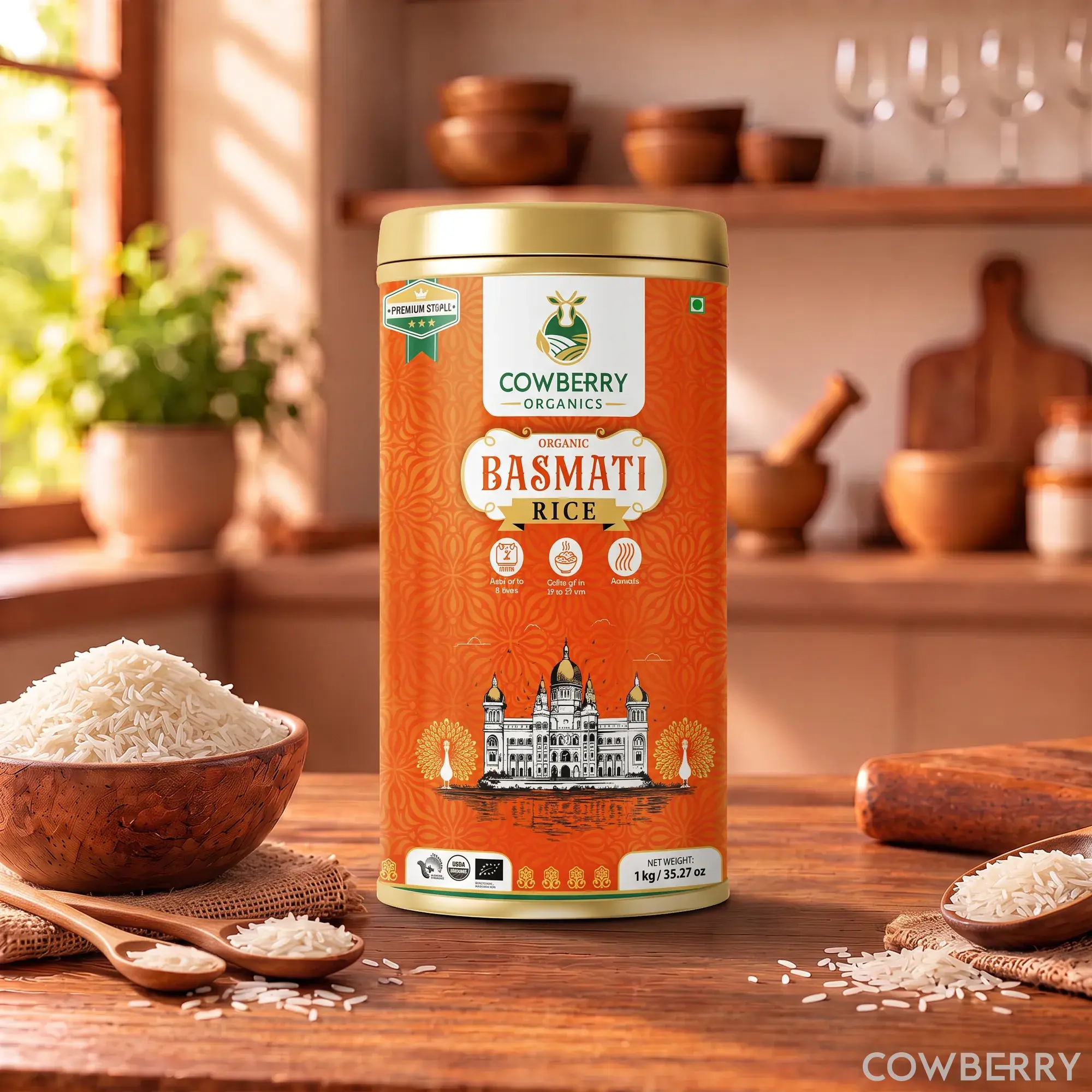
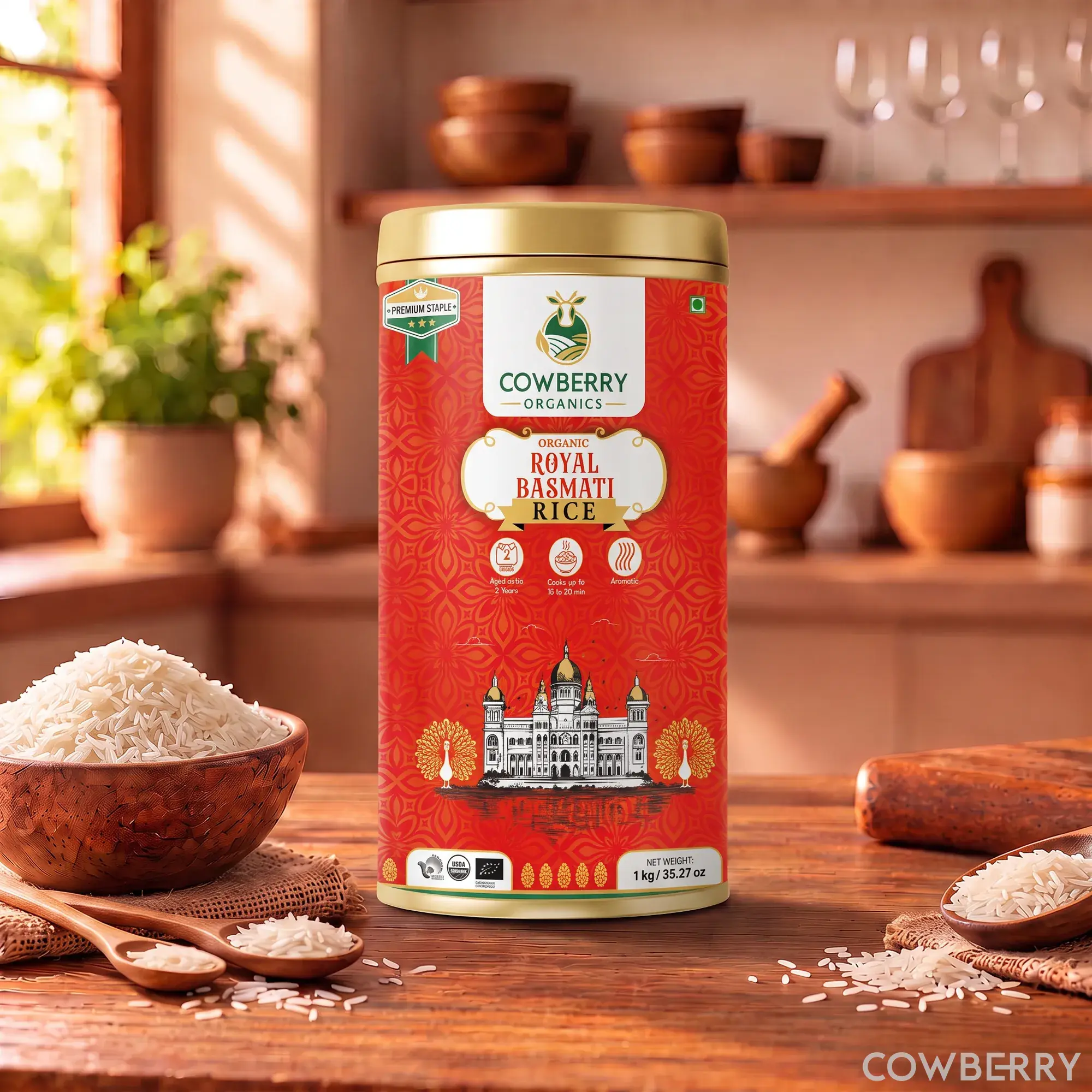
For an organic claim, check the pack for a certification mark, since the word on the label needs that backing. COWBERRY's basmati comes from organic farms in Uttarakhand and Punjab, using cow-based methods and natural ageing for its aroma and length, and it is India Organic, USDA & EU certified.
FAQs
What is basmati rice?
Basmati is a long-grain aromatic rice: slender grains that grow longer in the pot, a delicate fragrance, and a cooked pot that stays light, fluffy and non-sticky. The grain is aged naturally before packing to develop that aroma and length, and it is the rice biryani and pulao are built around. Its names, numbers and cooking live across the sections of this page.
Is basmati rice gluten free?
Yes. The pack prints it plainly: naturally gluten-free, so a plain pot of cooked basmati belongs in a gluten-free kitchen. If gluten matters medically, keep one set of ladles and a colander for rice only, and check the label on any masala mix that goes in with it.
Is basmati rice indian rice?
COWBERRY's is: its packs come from Uttarakhand and Punjab, northern India, where the rice is farmed organically on well-irrigated land and naturally aged for fragrance and length. For any pack, the label's own words are the honest place to read where the grain was grown, rather than the name alone.
Can basmati rice be eaten daily?
Yes — one cereal among several, not the whole week's grain. One katori of cooked rice is made from 40 g of raw grain and carries 143 kcal with 31.3 g of carbohydrate, an easy slot in a day's meals. Let whole grains cover at least half of the day's cereal allowance, let basmati take turns through the week with brown rice and millet rotis, and on a medical plan, set amounts with your doctor or dietitian.
Why is basmati rice expensive?
The honest answer is the steps, not a price: natural ageing develops the grain's fragrance and full length, and careful processing keeps the long grains whole, both named among the pack's features as long-grain and aged for flavour. What those steps buy on the plate is covered above.
How basmati rice is grown?
COWBERRY's answer, from its own pack: the rice comes from Uttarakhand and Punjab, where it is farmed with cow-based organic methods, then naturally aged so the fragrance and length develop and carefully processed to protect the long grains. That is one producer's method; other packs describe their own.
Is basmati rice healthy?
Yes, within a mixed plate: one katori supplies 31.3 g of carbohydrate, the day's fuel, the India-tested GI of 50 lands in the low band, and fat, sodium and gluten barely register. It earns that yes only when dal, sabzi and curd share the plate — rice alone makes no meal.
References
- Indian Food Composition Tables (IFCT) 2017, ICMR-National Institute of Nutrition
- Dietary Guidelines for Indians, ICMR-National Institute of Nutrition
- University of Sydney glycemic index database (GI search)
- University of Sydney: about the glycemic index
- FSSAI Food Safety and Standards (Advertising and Claims) Regulations 2018, compendium (PDF)
- Yu J, Balaji B et al. White rice, brown rice and the risk of type 2 diabetes: a systematic review and meta-analysis. BMJ Open, 2022
- Ngo TV, Kunyanee K et al. Insights into recent updates on factors and technologies that modulate the glycemic index of rice and its products. Foods, 2023
- Somaratne GM, Prasantha BDR, Dunuwila GR, et al. Effect of polishing on glycemic index and antioxidant properties of red and white basmati rice. Food Chem, 2017
- UK Food Standards Agency: How to chill, freeze and defrost food safely
- Gray PJ, Conklin SD, Todorov TI, et al. Cooking rice in excess water reduces both arsenic and enriched vitamins in the cooked grain. Food Addit Contam Part A Chem Anal Control Expo Risk Assess, 2016
- Sonia S, Witjaksono F, Ridwan R. Effect of cooling of cooked white rice on resistant starch content and glycemic response. Asia Pac J Clin Nutr, 2015
Shop this article
Keep reading
Red rice vs brown rice: the fibre, GI and honest verdict
Red rice vs black rice: nutrition, glycemic index and which to choose
Red rice nutrition per 100g: calories, protein, fibre and GI