by COWBERRY

8 minute read
Mustard seeds types: yellow vs black, big vs small and which to use

The mustard seeds types you meet in Indian cooking are three: black, brown and yellow. Black is the rai of the tadka and the only type with a composition entry in IFCT 2017; brown is Brassica juncea, the species a 2025 review covers; and yellow turns up in the oil trade, though IFCT 2017 records no composition figures for it, for a reason this guide explains.
The three mustard seeds types at a glance
The three types are told apart by colour, and they do different jobs. IFCT 2017, the Indian food composition tables, lists the seed as "Mustard seeds" under food code H013 with the botanical name Brassica nigra; that is black mustard, the seed of the Indian tadka. If a recipe names a mustard seeds variety by colour, the map is short: black for tempering and pickles, brown for the species behind the greens, yellow for the oil press.
Two search phrasings are really one question each. "Mustard seeds vs black mustard seeds" is not a contest: the composition entry is black mustard, so the two phrases point at one seed. "Mustard seeds vs rai" is a question of language, not botany, and the answer sits on the mustard seeds in hindi page. The nutrition side, calories and all, is on mustard seeds nutritional value per 100g.
Black mustard seeds: size, heat and the per 100 g numbers
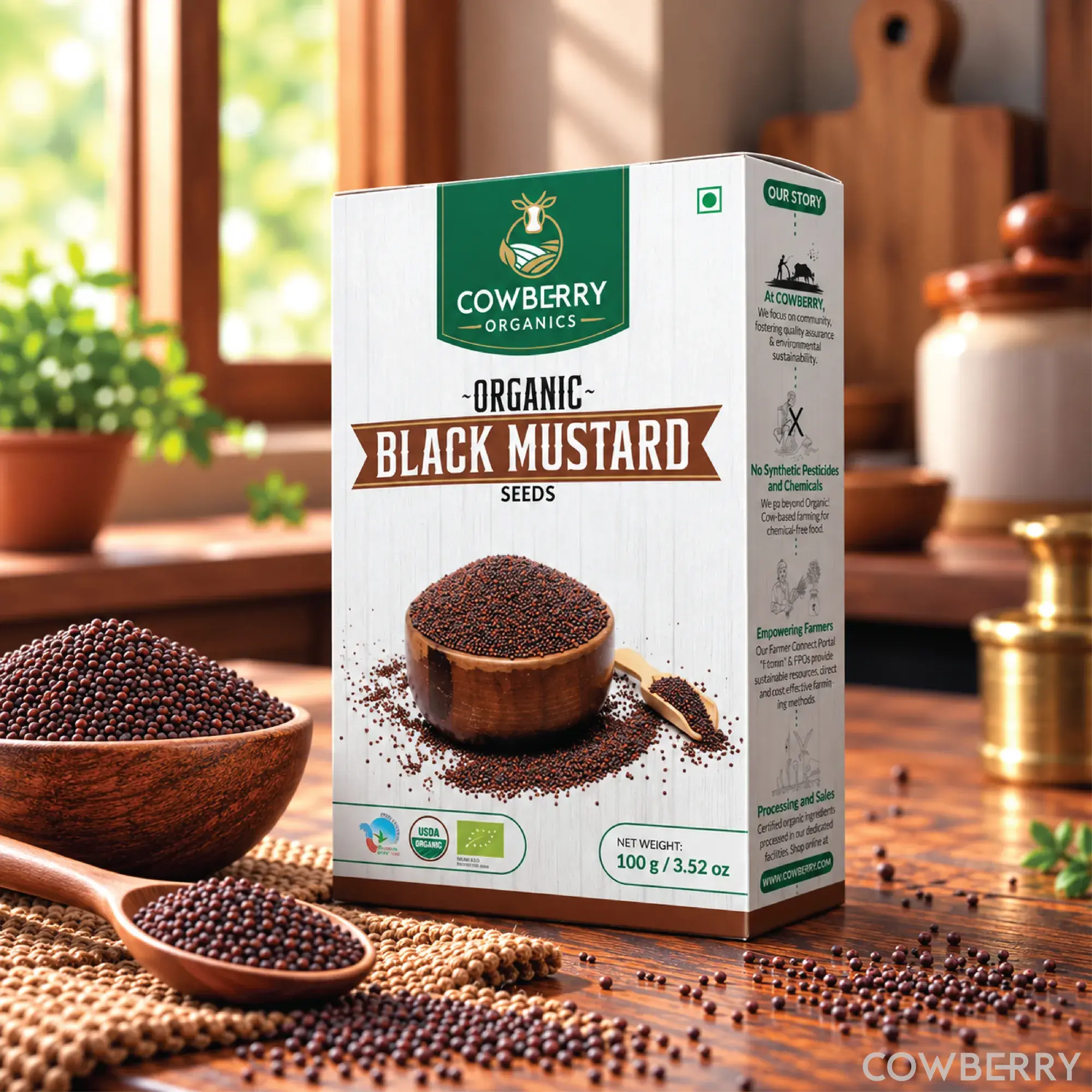
Black mustard is the rai Indian cooking actually uses, and the only type of the three with a composition entry in IFCT 2017. It is the small seed: COWBERRY sells it under the name Organic Black Mustard Seeds (Small), and the pack's name list carries Small Rai, Small Mustard Seeds and Desi Rai, all names for the one small kind. COWBERRY's seeds are grown in Rajasthan and Bengal with cow-based farming and packed whole, raw and natural.
On heat, the pack calls black mustard the spiciest of the common mustard seeds and points to allyl isothiocyanate, the same chemical that puts the heat in wasabi, as the culprit. That sharpness is the point of the tadka, and pickles lean on the same seed.
Per 100 g, IFCT 2017 records 510 kcal, 19.5 g protein, 40.2 g fat, 16.8 g carbohydrate and 14.1 g fibre, with 402 mg calcium, 13.5 mg iron, 266 mg magnesium, 694 mg potassium, 4 mg zinc and 94.9 mcg folate. A level teaspoon of rai (about 5 g) carries 25.5 kcal and 20.1 mg of calcium. The ICMR-NIN dietary guidelines put the omega-3 side in numbers too: their Table 7.1 counts 2 g of mustard seed as furnishing a minimum of 100 mg of n-3 PUFA (ALA).
| Nutrient | Black mustard seeds (IFCT 2017) |
|---|---|
| Energy (kcal) | 510 |
| Protein (g) | 20 |
| Fat (g) | 40 |
| Carbohydrates (g) | 17 |
| Dietary fibre (g) | 14 |
| Iron (mg) | 13 |
| Calcium (mg) | 402 |
| Magnesium (mg) | 266 |
| Potassium (mg) | 694 |
| Sodium (mg) | 4 |
| Zinc (mg) | 4 |
| Folate (mcg) | 95 |
Per 100 g raw, edible portion. Composition: IFCT 2017 (ICMR-NIN). — means not reported. These are average values for the food; the label on a pack gives the values for that product.
Brown mustard seeds: Brassica juncea and the 2025 review
Brown mustard is Brassica juncea, the species a 2025 review in Frontiers in Nutrition takes as its subject and describes as a globally cultivated cruciferous plant. The review maps the species' phytochemicals: glucosinolates, phenolic compounds and erucic acid, and it reports laboratory findings on their antioxidant and anti-inflammatory activity. None of that is a claim about what a kitchen portion does in people; the review stays at the level of chemistry, and so does this page.
On processing, the review highlights fermentation, low-sodium brining and high-pressure processing as techniques studied for keeping these compounds stable and available. The same species stands behind the greens: IFCT 2017 lists mustard leaves under food code C026 with the botanical name Brassica juncea, the leaves known in Hindi as sarson ka sag. Which word names which part of the plant is untangled on the rai vs sarso page.
Mustard seeds yellow vs black: what the records show
The yellow type is real in the market and thin in the records. COWBERRY's mustard oil pack lists yellow mustard oil and black mustard oil side by side among its names, so the yellow seed is pressed for oil as its own type. What IFCT 2017 does not record is a composition entry for yellow mustard seeds, so this page gives the yellow type no nutrition numbers, and no benefit claim either.
The one printed colour fact runs the other way. In the FSSAI Eat Right India check for mustard seeds, a mustard seed pressed open shows yellow inside. The test records that inside colour to catch argemone seeds, which are black and rough outside and white inside; the yellow interior is a kitchen-check fact, not a type of mustard. The check matters because argemone seeds are the lookalike the test is written to catch, and the check needs nothing beyond a glass plate. The tables also record no glycemic index for the seed, so this page gives none.
Big vs small: which rai fits pickles, tempering and curries
Size decides the job, and Indian cooking wants the small one. "Small" is part of the product name COWBERRY uses for its black mustard, and the pack's name list carries Small Rai outright. The small seed pops fast in hot oil, and its sharpness spreads through the dish, which is what a tadka needs; the full method is on the mustard seeds how to use page.
Tempering. Rai goes into hot oil first, before the aromatics, and the pop is the signal to move on. Over dal, sambar, upma or poha, this is the everyday use of the seed.
Pickles. Pickles take black mustard whole and ground; the lemon pickle recipe on this site is built on black mustard seeds, and the seed's sharpness holds its own against a pickle jar's salt and sourness.
Curries. A finishing tadka of rai, curry leaves and dry red chilli poured over the cooked pot carries the aroma into vegetable curries and dals without changing their body. The ICMR-NIN "My Plate for the Day" files mustard under spices and herbs, beside turmeric, ginger, pepper and cumin: a small flavouring, not a portion.
Sambar and upma. The same small seed seasons the south Indian sambar pot and the everyday upma tempering; whichever dish calls, the method stays the same: oil first, seeds next, wait for the pop, then the rest of the tadka.
Is mustard seed good for health? The honest reading
Per 100 g the black seed is dense: 19.5 g protein, 14.1 g fibre, 402 mg calcium, 13.5 mg iron, 266 mg magnesium and 94.9 mcg folate. The catch is the spoon. A tadka uses about a teaspoon, 5 g, so the meal gets 25.5 kcal, 20.1 mg of calcium and 0.67 mg of iron, not the per 100 g figures.
The evidence for benefits stays small in the same way. A 2014 review in the International Journal of Molecular Sciences notes that herbs and spices are normally eaten in small quantities and in combination with other foods, so their true benefit from a health perspective is unclear. For mustard specifically, the 2025 review reports laboratory findings on its compounds, and no human trial is quoted here. The one printed number with a dietary context is the omega-3 line: the ICMR-NIN dietary guidelines count 2 g of mustard seed as furnishing a minimum of 100 mg of n-3 PUFA (ALA) and name mustard among the ALA sources in Indian food, next to fenugreek seeds and leafy vegetables.
Buying follows the same honesty. An organic pack carries a certification mark such as India Organic, and the word natural on its own certifies nothing, which is what the FSSAI claims rules exist to police. Kept airtight in a cool, dry spot, rai stays pungent for months, so one small jar covers a season of tadkas. For storage and the seed's wider story, the mustard seeds hub has the rest.
FAQs
Which mustard seeds are used in pickle?
Black mustard. The lemon pickle recipe on this site is built on black mustard seeds, whole and ground, and the pack for the seed calls black mustard the spiciest of the common mustard seeds, a sharpness that holds its own in a pickle jar. Pickle recipes grind the seed to spread that pungency through the masala.
Which mustard seeds are used in poha?
The small black rai, the same seed as every tadka. It goes into the hot oil before the curry leaves and peanuts, and the poha is tossed through once the seeds have popped. The poha tempering calls for black rai, the small kind.
Why mustard seeds taste bitter?
The seed's own chemistry. COWBERRY's pack traces the bite to allyl isothiocyanate, the chemical wasabi is known for, and a 2025 review counts glucosinolates among what the seed carries. Chewed raw, the seed reads sharp and bitter; popped in hot oil, it keeps the aroma and drops the rawness. The tadka leans on that change.
Is mustard seeds good for health?
Per 100 g the seed carries real nutrients, 402 mg of calcium, 13.5 mg of iron and 14.1 g of fibre among them, but a tadka uses about a teaspoon, and the benefit evidence is thin at that dose. A 2014 review notes that spices eaten in small amounts with other foods make their true health benefit hard to establish. Enjoy rai as flavour.
What is mustard seeds?
Mustard seeds are the seeds of mustard plants, sold whole as a spice. The composition entry in IFCT 2017, which this site follows, is black mustard, Brassica nigra, the seed Indian kitchens pop in hot oil for the tadka. Whole, ground or soaked, the same seed goes into pickles, pastes and oil pressing.
Difference between mustard seeds and rai?
None: rai is mustard seeds. In the Hindi names IFCT 2017 records, the seed is rai; the English name in the same list is mustard seeds, so both phrases point at one seed, Brassica nigra. The confusion comes from sarson, which in the same lists attaches to the leaves and the oil; that split is explained on the rai vs sarso page.
References
- Indian Food Composition Tables (IFCT) 2017, ICMR-National Institute of Nutrition
- Dietary Guidelines for Indians, ICMR-National Institute of Nutrition
- Hu Y, Yan Z. Comprehensive advances in phytochemical components, bioactive functionality, and processing applications of mustard (Brassica juncea (L.) Czern.): a review. Front Nutr, 2025
- Opara EI, Chohan M. Culinary herbs and spices: their bioactive properties, the contribution of polyphenols and the challenges in deducing their true health benefits. Int J Mol Sci, 2014
- FSSAI Eat Right India: DART (Detect Adulteration with Rapid Test), salt, spices and condiments tests
- FSSAI Food Safety and Standards (Advertising and Claims) Regulations 2018, compendium (PDF)
Shop this article
Keep reading
Coriander water benefits: what dhania water actually does
Peanuts in Hindi (moongfali): groundnut names in Indian languages
Coriander vs cilantro: are they the same herb?