by COWBERRY

10 minute read
Mustard seeds (rai): names, nutrition, uses and how to cook them

Mustard seeds are the small black seeds of the Indian tadka, the rai that pops in hot oil over dal, sambar and poha and sits whole in pickle jars. IFCT 2017 records them as Brassica nigra, black mustard, at 510 kcal and 40.2 g of fat per 100 g.
What are mustard seeds?
Mustard seeds are what the mustard plant carries: whole seeds, sold dry for the spice shelf. IFCT 2017's composition entry for the seed is food code H013, whose botanical name is Brassica nigra: black mustard, the grain that goes into the tadka pan. The same tables keep two more mustard entries, the leaves (Brassica juncea, sarson ka sag in Hindi) and the oil (sarson ka tel), each a separate food, and rai, the Hindi word, names the seed alone.
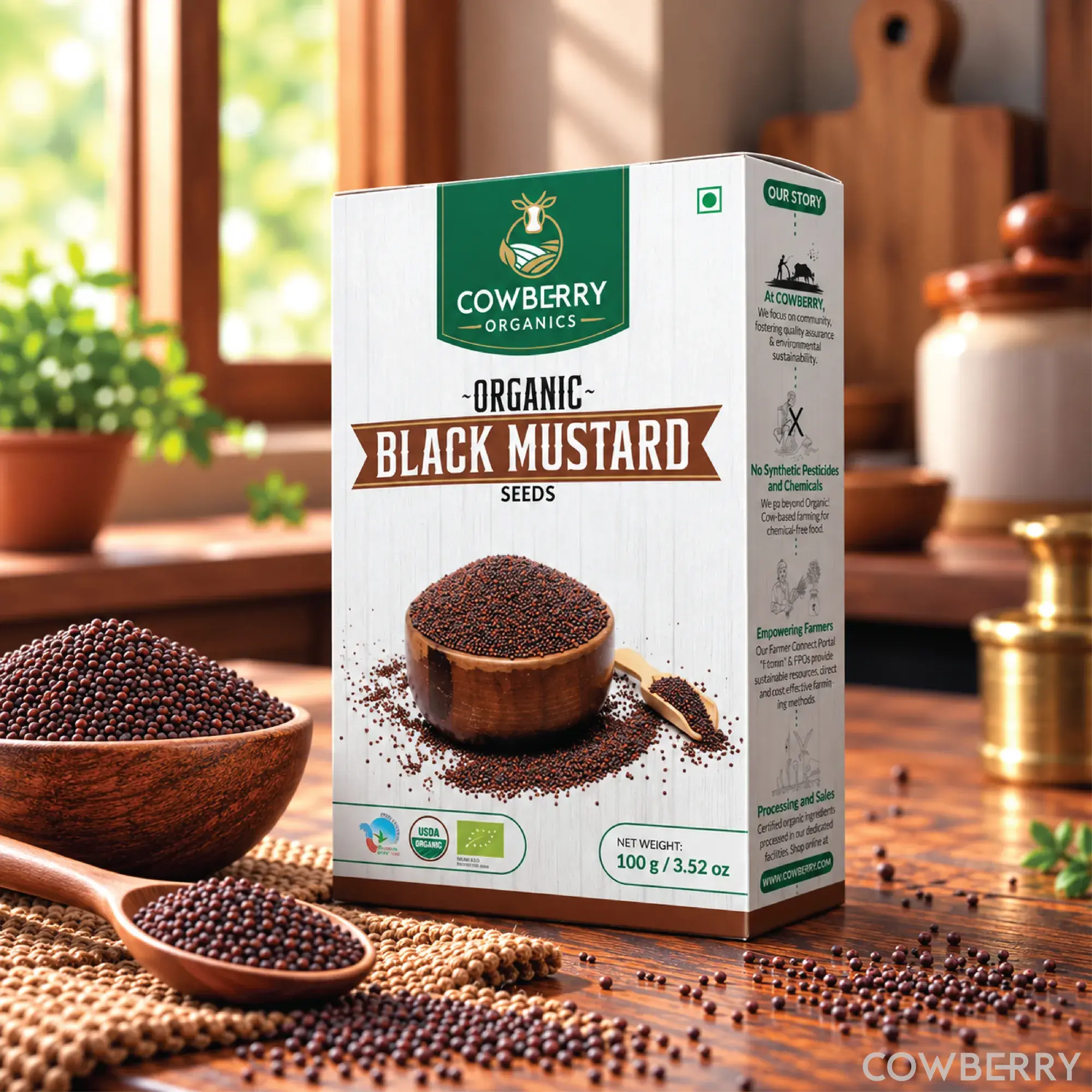
ICMR-NIN's "My Plate for the Day" files mustard in the spices and herbs group, along with turmeric, ginger, pepper and cumin, as the meal's flavouring set. Brown and yellow mustard exist in the market too, and the colour map sits in the types guide. COWBERRY's own pack carries the name Organic Black Mustard Seeds (Small): black rai grown in Rajasthan and Bengal under cow-based farming, packed whole, and sold under the extra names Small Rai, Desi Rai and Small Mustard Seeds. The seed-leaf-oil sorting, word by word with the Hindi and Sanskrit names, is laid out on the rai vs sarso page.
Mustard seeds names: rai dana and the regional words
Rai dana is the trade name for the seed, printed among the aliases of the pack COWBERRY sells as Organic Black Mustard Seeds (Small). The formal list comes from IFCT 2017. Rai is the Hindi name, and the same rai serves Gujarati, Punjabi and Urdu; Marathi has mohori, Bengali sorse, Odia sorisa, Assamese soriyah, Kannada sasuve, Telugu avalu, Tamil and Malayalam kadugu, and Sanskrit sarssapa. Thirteen Indian languages name the seed in those tables, rai carrying four of them.
The language-by-language list, with the botanical and English names beside each regional word, is on the mustard seeds in hindi page, which also untangles the seed from mustard oil and black mustard.
| Language | Name (romanised) |
|---|---|
| English | Mustard seeds |
| Hindi | Rai |
| Marathi | Mohori |
| Gujarati | Rai |
| Punjabi | Rai |
| Bengali | Sorse |
| Odia | Sorisa |
| Assamese | Soriyah |
| Kannada | Sasuve |
| Telugu | Avalu |
| Tamil | Kadugu |
| Malayalam | Kadugu |
| Urdu | Rai |
| Sanskrit | Sarssapa |
| Botanical name | Brassica nigra |
Source: IFCT 2017 (ICMR-NIN) local-names list. — means no name recorded in the source.
Mustard seeds nutrition per 100 g
Per 100 g of raw seed, IFCT 2017 prints 510 kcal, 19.5 g protein, 40.2 g fat, 16.8 g carbohydrate and 14.1 g fibre, with 402 mg calcium, 13.5 mg iron, 266 mg magnesium, 694 mg potassium, 4.0 mg zinc and 94.9 mcg folate, against just 3.97 mg of sodium. Vitamin C has no reported figure, and no glycemic index is printed anywhere for the seed, so none is given here.
Those are per-100 g figures for an oilseed; a real serving is a teaspoon of about 5 g, carrying 25.5 kcal, 20.1 mg of calcium and 0.67 mg of iron. In a meal the seed's job is flavour: a half-teaspoon tadka seasons a whole pot of dal, and the per-100 g figures shrink accordingly. The full table, the per-teaspoon arithmetic and the comparison against other spice seeds are on the mustard seeds nutritional value per 100g page.
| Nutrient | Mustard seeds (rai) |
|---|---|
| Energy (kcal) | 510 |
| Protein (g) | 20 |
| Fat (g) | 40 |
| Carbohydrates (g) | 17 |
| Dietary fibre (g) | 14 |
| Iron (mg) | 13 |
| Calcium (mg) | 402 |
| Magnesium (mg) | 266 |
| Potassium (mg) | 694 |
| Sodium (mg) | 4 |
| Zinc (mg) | 4 |
| Folate (mcg) | 95 |
Per 100 g raw, edible portion. Composition: IFCT 2017 (ICMR-NIN). — means not reported. These are average values for the food; the label on a pack gives the values for that product.
Mustard seeds and health: what the evidence shows
The honest summary first: no human trial on mustard seeds is quoted on this page, and the sources quoted support no health claim for a kitchen portion of rai. The International Journal of Molecular Sciences carried a 2014 review that puts the limit in one line: culinary spices arrive at the table in such small amounts, mixed with everything else, that pinning a true health benefit on them is hard.
What the records do show is composition. A 2025 review in Frontiers in Nutrition catalogues mustard's phytochemicals, erucic acid alongside glucosinolates and phenolic compounds, and reports antioxidant and anti-inflammatory activity found in laboratory work; those are chemistry-level results, not claims about people. A 2008 review of traditional Indian spices notes that Indian traditional systems put spices to many uses and that much of the supporting evidence comes from laboratory and animal work.
One printed number adds a dietary frame: ICMR-NIN's Table 7.1 pairs 2 g of mustard seed with a minimum of 100 mg of n-3 PUFA (ALA); the same guidelines place mustard among the ALA sources in Indian food, alongside fenugreek seeds and leafy vegetables.
Side effects and cautions
No human side-effect data for culinary amounts of mustard seeds appears in these sources, so none is claimed. The cautions that are printed are practical.
The first is the bite. Raw, rai tastes sharp and bitter; popped in hot oil, it turns aromatic, and the tempering method lives on the how to use mustard seeds page. The second is the lookalike. The FSSAI Eat Right India check uses a glass plate: a few mustard seeds tipped onto it look smooth, and pressing one open shows a yellow inside, while argemone seeds, the lookalike that sometimes gets mixed in, come out grainy, rough-coated, black outside and white inside. A batch with rough black seeds among the smooth ones should not be cooked.
No portion limit is printed for the seed; a teaspoon in a dal or sabzi is the everyday amount. If a medical condition makes you unsure about any food, ask your doctor or dietitian.
How to cook with mustard seeds
The everyday use is the tadka: warm a spoon of oil or ghee, drop in about half a teaspoon of rai, and wait for the pop. Once most seeds have crackled, the aromatics follow — curry leaves, dry red chillies or hing — and the whole pan goes over dal, sambar, poha or a vegetable curry. The pop is the signal; a couple of seeds staying silent is normal. Start with a half-teaspoon of rai for a dal or sabzi for four and add more once the dish tells you it wants it.
Beyond the tadka the seed does three more jobs. Whole, it sits in pickle jars for the whole pickling time. Ground, it spreads its sharpness through pickle masalas and chutneys. Soaked for a few hours, it softens for grinding into pastes; drain before grinding.
The full method, the common mistakes and the identification check are covered on the how to use mustard seeds guide.
Recipes: the lemon pickle and the everyday uses
The one full recipe built on the seed is the lemon pickle: lemons cut into wedges, salted and left in the sun for 10 to 12 days, then tempered with black mustard seeds and hing in cold pressed mustard oil. The hands-on part runs under half an hour, split across two short sessions; the sun does the rest. The seed appears twice in the jar, ground into the spice mix and popped in the tempering, and one jar makes about 24 two-tablespoon servings. The pickle's own page carries the full method, from cutting the lemons to the final rest in the jar. It goes with dal-rice, parathas or plain khichdi.
Around the pickle, the seed's other dishes are plain uses rather than recipes: a dal or sambar tempering, a poha toss, an upma finish. Any of them starts the same way: hot oil, rai, the pop. The pickle is where the seed gets a written recipe of its own.
How to store mustard seeds
Whole rai keeps simply: a clean, dry jar with a tight lid, kept cool and away from the stove's steam, stays pungent for many months. ICMR-NIN's guidelines hold for food grains too: dry them adequately and keep them in airtight containers, safe from moisture, moulds and insects. The seed needs no fridge; a closed jar on a dark shelf does the job. The same airtight rule covers the pickle jar once the lemon pickle is made: a dry spoon in, and the jar back in the cool, dry spot.
Buying mustard seeds organic: what to look for
Mustard seeds organic is a buying claim to check, not a word to trust. An organic pack carries a certification mark, and the FSSAI advertising and claims rules police the word natural: a food may be called natural only when nothing has been added and processing has been limited, and phrases like natural goodness are not allowed on labels.
The ICMR-NIN guidelines give the buying rule for spices: always buy certified products, and prefer whole spices, uniform in colour, size and shape, since powders are more likely to be adulterated. For loose rai, the glass-plate check from the cautions above sorts mustard from argemone on the spot.
COWBERRY's Organic Black Mustard Seeds (Small) come from Rajasthan and Bengal, grown under cow-based organic farming and packed whole, raw and natural; the pack is India Organic, USDA & EU certified. Whole spice, in 100 g and 250 g packs.
FAQs
What is mustard seeds?
Mustard seeds are the seeds of the mustard plant, sold dry and whole as a spice. IFCT 2017 carries one entry for them, food code H013: Brassica nigra, black mustard, the seed that pops in hot oil for the tadka. Per 100 g the same tables print 510 kcal and 40.2 g of fat. Whole, ground, soaked or pressed for oil, the one seed feeds the pickle jar and the tadka pan alike.
What is mustard seeds used for?
Mostly the tadka: dropped into hot oil, the seed pops and its sharpness moves into the oil, which carries it into dal, sambar, poha, upma and vegetable curries. Pickles take it whole and ground, as in the lemon pickle recipe. Soaked, it softens for pastes, and pressed, it becomes mustard oil.
Is mustard seeds good for health?
Rai's health case is decided by the spoon: a tadka takes about a teaspoon of seed, 5 g, with 25.5 kcal, 20.1 mg of calcium and 0.67 mg of iron, real nutrients but far from the per-100 g figures. A 2014 review notes the snag: spices are eaten in such small amounts, usually mixed with other foods, that a true health benefit is hard to pin down. Rai is a flavouring first.
Does mustard seeds cause gas?
Neither direction has a source: no human study and no printed table supports a claim about mustard seeds and gas. What is printed is the portion: the seed is eaten by the teaspoon, about 5 g in a tadka, and its 14.1 g of fibre per 100 g shrinks to 0.7 g in that spoon. So the honest answer is: not shown, either way.
Why mustard seeds are used in baby pillow?
No record quoted on this page supports a reason for putting mustard seeds in a baby pillow; the records cover the seed as a food. What is printed about the seed is culinary: a whole spice eaten by the teaspoon in tadkas and pickles. Nothing in these records describes any use of the seed outside cooking.
Why mustard seeds taste bitter?
The bite is built in. COWBERRY's pack traces it to allyl isothiocyanate, the same compound behind wasabi's heat, and a 2025 review records glucosinolates among mustard's phytochemicals. Chewed raw, that chemistry reads sharp and bitter; heated in oil until the seeds pop, the same seed turns aromatic. The tadka works with the second form.
Which mustard seeds is best?
No ranking is printed anywhere in these records, so none is given. What the tables do print is one composition entry: black mustard, Brassica nigra, the seed behind every number on this page. Choosing is a job question, not a rank question: black rai for tadkas and pickles, and the colour map with the uses is on the mustard seeds types guide.
References
- Indian Food Composition Tables (IFCT) 2017, ICMR-National Institute of Nutrition
- Dietary Guidelines for Indians, ICMR-National Institute of Nutrition
- FSSAI Food Safety and Standards (Advertising and Claims) Regulations 2018, compendium (PDF)
- Hu Y, Yan Z. Comprehensive advances in phytochemical components, bioactive functionality, and processing applications of mustard (Brassica juncea (L.) Czern.): a review. Front Nutr, 2025
- Opara EI, Chohan M. Culinary herbs and spices: their bioactive properties, the contribution of polyphenols and the challenges in deducing their true health benefits. Int J Mol Sci, 2014
- Krishnaswamy K. Traditional Indian spices and their health significance. Asia Pac J Clin Nutr, 2008
- FSSAI Eat Right India: DART (Detect Adulteration with Rapid Test), salt, spices and condiments tests
Shop this article
Keep reading
Coriander water benefits: what dhania water actually does
Peanuts in Hindi (moongfali): groundnut names in Indian languages
Coriander vs cilantro: are they the same herb?