by COWBERRY

7 minute read
Mustard seeds nutritional value per 100g: calories, protein and more

Mustard seeds nutritional value per 100g (raw, IFCT 2017): 510 kcal, 19.5 g protein, 40.2 g fat, 16.8 g carbohydrate, 14.1 g fibre, 402 mg calcium and 13.5 mg iron, no GI printed. The 40.2 g of fat is what sets rai apart from other spice seeds. One level teaspoon carries 25.5 kcal, and the yellow-vs-black question is answered at the end; the mustard seeds hub covers names and cooking.
Mustard seeds nutrition per 100 g: the full table
The table below gives mustard seeds nutrition per 100 g of raw, whole seed, the values IFCT 2017 (the Indian Food Composition Tables of ICMR-National Institute of Nutrition) prints for food code H013, black mustard (Brassica nigra). Fenugreek seeds and cumin seeds from the same tables sit beside it, so the numbers can be read against other spice seeds.
Three notes before you read. These are raw values, and the seed is eaten by the teaspoon, so the per-100 g figures do not describe a serving; the next section does the teaspoon arithmetic. The entry is the black seed, the only mustard-seed entry IFCT 2017 lists, and the last section explains the yellow-vs-black difference. Pack labels may print other figures; every number on this page follows IFCT 2017.
| Nutrient | Mustard seeds (rai) | Fenugreek seeds | Cumin seeds |
|---|---|---|---|
| Energy (kcal) | 510 | 235 | 305 |
| Protein (g) | 20 | 25 | 14 |
| Fat (g) | 40 | 5.7 | 17 |
| Carbohydrates (g) | 17 | 11 | 23 |
| Dietary fibre (g) | 14 | 48 | 30 |
| Iron (mg) | 13 | 8.5 | 21 |
| Calcium (mg) | 402 | 135 | 878 |
| Magnesium (mg) | 266 | 167 | 442 |
| Potassium (mg) | 694 | 891 | 1886 |
| Sodium (mg) | 4 | 40 | 125 |
| Zinc (mg) | 4 | 3.8 | 4.3 |
| Folate (mcg) | 95 | 51 | 28 |
Per 100 g raw, edible portion. Composition: IFCT 2017 (ICMR-NIN). — means not reported. These are average values for the food; the label on a pack gives the values for that product.
Mustard seeds calories: per teaspoon and the omega-3 line
Mustard seeds calories work out small in the amounts actually eaten. A level teaspoon of whole seeds weighs about 5 g, so one teaspoon carries 25.5 kcal, 1.0 g of protein, 2.0 g of fat, 0.84 g of carbohydrate and 0.7 g of fibre. That teaspoon is the everyday tadka measure, and the how to use mustard seeds page runs through the tempering step by step.
| Nutrient | Per teaspoon (5 g) |
|---|---|
| Energy | 25.5 kcal |
| Protein | 1.0 g |
| Fat | 2.0 g |
| Carbohydrate | 0.84 g |
| Fibre | 0.7 g |
| Calcium | 20.1 mg |
| Iron | 0.67 mg |
ICMR-NIN's Table 7.1 carries the dietary context: it sets 2 g of mustard seed as carrying at least 100 mg of n-3 PUFA (ALA); the guidelines also name mustard as an ALA source in Indian food, beside fenugreek seeds and leafy vegetables. The lemon pickle recipe uses the same seed two ways: ground into the spice mix, then popped in the tempering.
Mustard seeds protein and fibre, against fenugreek and cumin
Does mustard seeds have protein? Yes: 19.5 g per 100 g, above cumin seeds at 13.9 g and below fenugreek seeds at 25.4 g. On fibre the order turns around: mustard's 14.1 g is the lowest of the three, against cumin's 30.4 g and fenugreek's 47.6 g. Every comparison here is raw against raw, per 100 g, the same basis as the table above.
The number that defines mustard is fat. At 40.2 g per 100 g it is an oilseed, about seven times fenugreek's 5.7 g and more than twice cumin's 16.6 g, and its energy of 510 kcal stands against cumin's 305 kcal and fenugreek's 235 kcal. A 2025 review in Frontiers in Nutrition counts erucic acid among mustard's phytochemicals; the oil side of the same plant is the sarson ka tel covered on the rai vs sarso page.
Mustard seeds glycemic index: no figure in IFCT 2017
For mustard seeds glycemic index, the honest answer is that IFCT 2017 prints no figure for the seed, and none of the other references carries one. Without a GI figure, no glycemic load can be worked out, so none is given here, and any number seen elsewhere is not from IFCT 2017.
What the IFCT entry gives is composition, not blood sugar: 16.8 g of carbohydrate per 100 g, which is 0.84 g in a teaspoon, and 14.1 g of fibre per 100 g. For people with diabetes the facts to weigh are those two IFCT lines, the missing GI, and that no human study on the seed appears in the references.
Mustard seeds micronutrients: calcium, iron and the rest
Calcium in mustard seeds is 402 mg per 100 g, with 13.5 mg of iron, 266 mg of magnesium, 694 mg of potassium, 4.0 mg of zinc and 94.9 mcg of folate; sodium is low at 3.97 mg, and vitamin C is not reported for the seed in IFCT 2017. Against the two peers, cumin leads on calcium at 878 mg and on iron at 20.6 mg; mustard's own lead is folate at 94.9 mcg, and at 694 mg of potassium it sits below both.
Per teaspoon the minerals shrink with the portion: 20.1 mg of calcium, 0.67 mg of iron, 13.3 mg of magnesium, 34.7 mg of potassium and 4.7 mcg of folate. Those are real but small amounts, the size that accumulates across a month of daily tadkas rather than a single meal.
Yellow vs black mustard seeds: which numbers belong to which
Every number on this page belongs to the black seed. IFCT 2017 records one composition entry for the seed: food code H013, whose botanical name is Brassica nigra, and that is black mustard. For the yellow type the same tables print no entry at all; the mustard entries they carry are the seed (H013), the leaves (C026) and the oil (T006). The yellow seed therefore gets no numbers, and no benefit claim is made.
The one yellow fact the references record runs the other way. In the FSSAI Eat Right India check, pressing a mustard seed shows a yellow inside; the test notes that inside colour as the way to spot argemone seeds, which are rough, black outside and white inside. It is a kitchen-check fact, not a nutrition figure. The black-brown-yellow map in words is on the mustard seeds types guide, and the wider story of the seed sits on the mustard seeds hub.
FAQs
Is mustard seeds good for health?
The seed is dense per 100 g: 19.5 g of protein, 14.1 g of fibre, 402 mg of calcium and 13.5 mg of iron, but a tadka takes about a teaspoon, 5 g, so a meal gets 25.5 kcal and small amounts of each nutrient. A 2014 review points out that the small amounts in which people eat spices, usually beside other foods, make a true health benefit hard to prove. Count rai as a flavouring, not a supplement.
Can mustard seeds be eaten raw?
Yes, you can eat them raw. Chewed as they are, the seeds taste sharp and bitter; once they are popped in hot oil, the heat takes away the rawness and the aroma stays. Some pickles keep whole raw seeds in the jar, letting the salt and acid mellow them over the weeks. The tempering steps are on the how to use mustard seeds page.
Is mustard seed good for diabetes?
IFCT 2017 prints no figure to answer this directly: no glycemic index for mustard seeds, and no human study on mustard seeds and blood sugar appears in the references. What IFCT 2017 does print is the composition above and the portion: a teaspoon carries 25.5 kcal and 0.84 g of carbohydrate. With diabetes, settle the portion with your doctor or dietitian.
Does mustard seeds cause gas?
None of the references says mustard seeds cause gas, and none says they settle it. The numbers are small: the tadka spoon holds about 5 g of seed and brings 0.7 g of fibre, from the seed's 14.1 g per 100 g. A teaspoon in a dal is a flavour amount, not a fibre amount.
Why mustard seeds are not digested?
The honest answer is that none of the references answers it. No human study or food table in the references supports a claim about whether whole mustard seeds pass through undigested. What IFCT 2017 prints is the composition: the seed is eaten whole or popped, in teaspoon amounts of about 5 g, with 14.1 g of fibre per 100 g and 0.7 g in a teaspoon. The references describe the seed's path no further.
Why mustard seeds taste bitter?
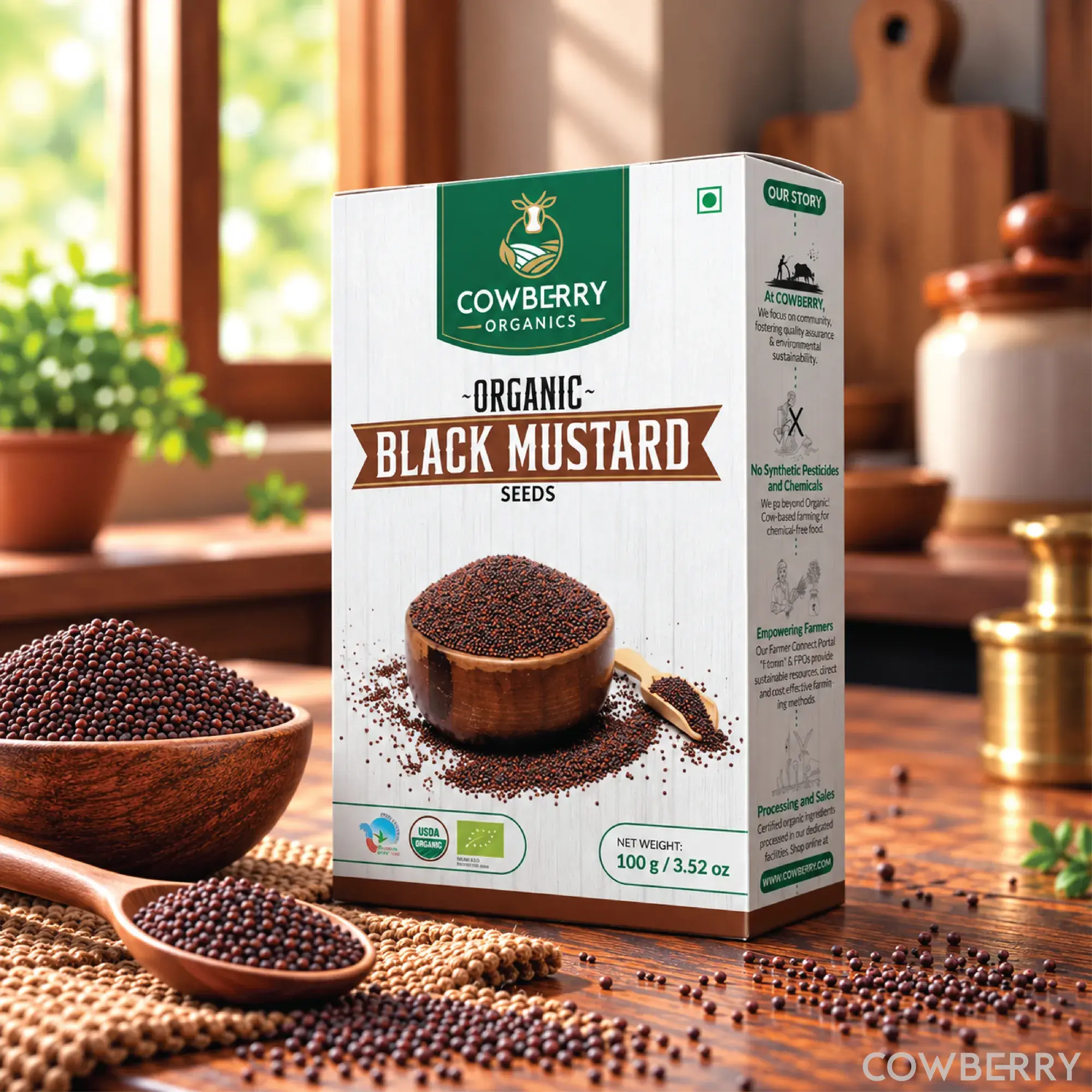
It is the seed's chemistry: glucosinolates among its compounds, recorded by a 2025 review, and a wasabi-like bite that COWBERRY's pack traces to allyl isothiocyanate. Chewed raw, rai reads bitter; heated in oil until it pops, the same seed turns aromatic. Cooking with that change is the whole point of the tadka.
References
- Indian Food Composition Tables (IFCT) 2017, ICMR-National Institute of Nutrition
- Dietary Guidelines for Indians, ICMR-National Institute of Nutrition
- Hu Y, Yan Z. Comprehensive advances in phytochemical components, bioactive functionality, and processing applications of mustard (Brassica juncea (L.) Czern.): a review. Front Nutr, 2025
- Opara EI, Chohan M. Culinary herbs and spices: their bioactive properties, the contribution of polyphenols and the challenges in deducing their true health benefits. Int J Mol Sci, 2014
- FSSAI Eat Right India: DART (Detect Adulteration with Rapid Test), salt, spices and condiments tests
Shop this article
Keep reading
Coriander water benefits: what dhania water actually does
Peanuts in Hindi (moongfali): groundnut names in Indian languages
Coriander vs cilantro: are they the same herb?