by COWBERRY

6 minute read
Rai vs sarso: mustard seeds and greens, explained

Rai vs sarso: in the name lists IFCT 2017 keeps for these foods, rai belongs to mustard seeds, the small dark seeds of the tadka, while the sarson words attach to the leaves and the oil. The seed entry is Brassica nigra; the leaf entry is Brassica juncea. This page sorts the three words and their foods; the mustard seeds hub covers the seed's cooking.
The verdict in three lines
Rai is the seed. IFCT 2017 records rai as the Hindi name for mustard seeds, and its composition entry is Brassica nigra, the black seed sold small and dark for tempering and pickles.
Sarso is the leaf and the oil. In the same IFCT name lists, sarson ka sag is the Hindi name for mustard leaves and sarson ka tel for mustard oil. The sarson words follow the plant's leaves and its pressed oil, not a separate seed.
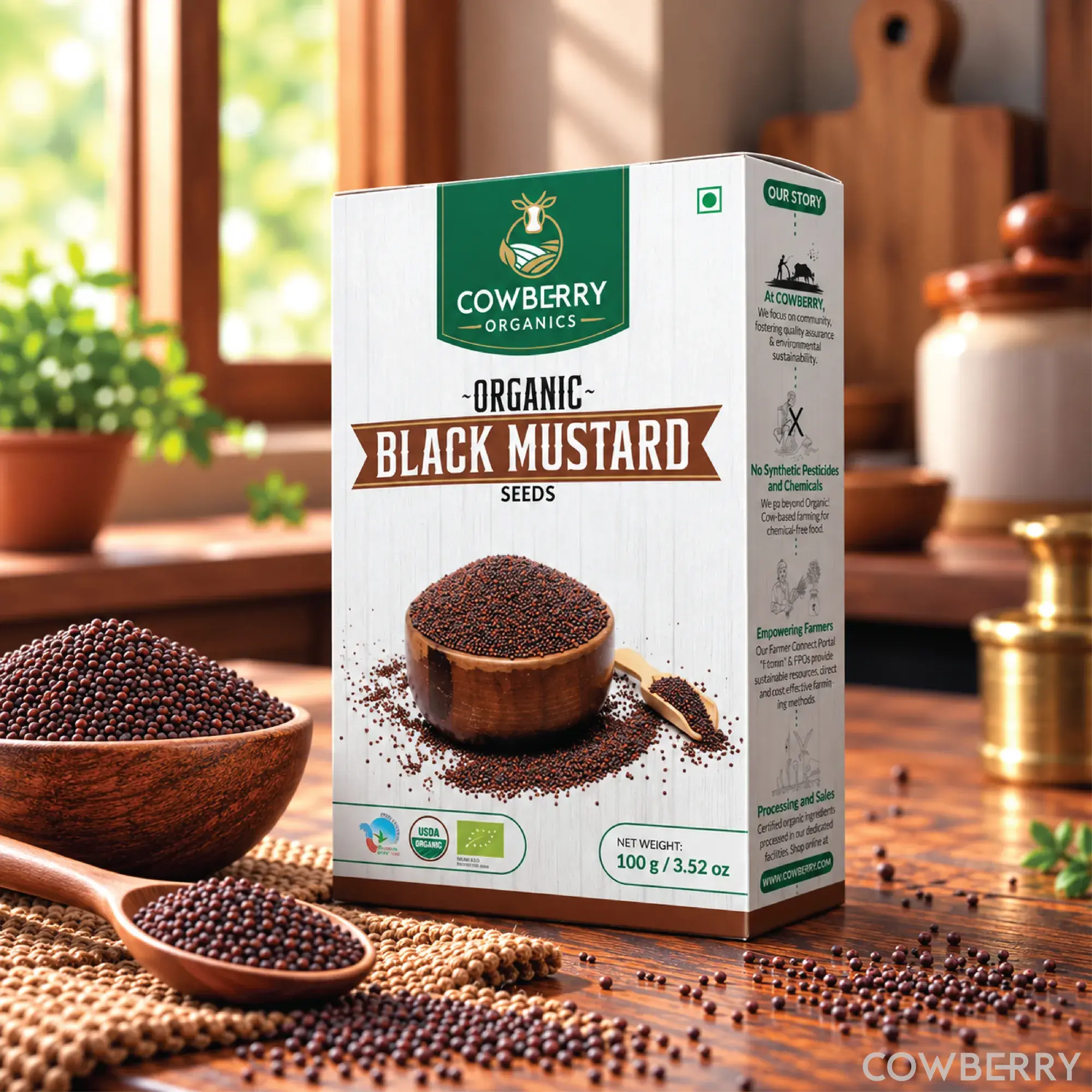
Packs blur the line. The seed itself is also sold under sarson spellings: COWBERRY's black mustard pack is sold under Sarson Dana, Kala Sarson and Black Sarson Seeds too. When the jar matters more than the word, read the label.
Rai vs sarso: the names side by side
IFCT 2017 carries all three Hindi names, one per food. Read across the columns and the rai vs sarso question answers itself: the seed is rai, the leaf is sarson ka sag, the oil is sarson ka tel.
| Food | Hindi name (IFCT 2017) | Sanskrit (IFCT 2017) | Botanical name |
|---|---|---|---|
| Mustard seeds | Rai | Sarssapa | Brassica nigra |
| Mustard leaves | Sarson ka sag | - | Brassica juncea |
| Mustard oil | Sarson ka tel | Sarshapa taila | Brassica spp. |
The dash means IFCT 2017 records no Sanskrit name for the leaves. The English names in the same lists are mustard seeds, mustard leaves and mustard oil, and the seed is the only one of the three eaten whole as a spice. The full 13-language seed list is on the mustard seeds in hindi page.
Nutrition: the seed has numbers, the leaf does not
The composition tables this page follows carry a full entry for the seed and one for the oil, and nothing for the greens. Per 100 g, mustard seeds give 510 kcal, 19.5 g protein, 40.2 g fat, 16.8 g carbohydrate and 14.1 g fibre, with 402 mg calcium and 13.5 mg iron; the oil is 884 kcal and essentially all fat. No composition entry is printed for mustard leaves in those tables, so no numbers are given for the greens.
In the amounts a kitchen actually uses, a level teaspoon of the seed (about 5 g) carries 25.5 kcal, and a teaspoon of mustard oil (5 g) about 44.2 kcal. The omega-3 side is the one place the guidelines compare the two directly: ICMR-NIN's Table 7.1 credits a 2 g spoonful of the seed with a minimum of 100 mg of n-3 PUFA, and 0.7 g of mustard or rapeseed oil with the same. The seed and its oil both belong to the n-3 side of the Indian pantry.
| Nutrient | Mustard seeds (rai) | Mustard oil (sarson ka tel) |
|---|---|---|
| Energy (kcal) | 510 | 884 |
| Protein (g) | 20 | 0 |
| Fat (g) | 40 | 100 |
| Carbohydrates (g) | 17 | 0 |
| Dietary fibre (g) | 14 | 0 |
| Iron (mg) | 13 | 0 |
| Calcium (mg) | 402 | 0 |
| Magnesium (mg) | 266 | 0 |
| Potassium (mg) | 694 | 0 |
| Sodium (mg) | 4 | 0 |
| Zinc (mg) | 4 | 0 |
| Folate (mcg) | 95 | 0 |
| Vitamin C (mg) | — | 0 |
Per 100 g raw, edible portion. Composition: IFCT 2017 (ICMR-NIN); USDA FoodData Central (SR Legacy), FDC ID 172337, NDB 4583. — means not reported. These are average values for the food; the label on a pack gives the values for that product.
Taste and cooking: the seed pops, the leaf wilts, the oil carries heat
Rai's flavour comes out in hot oil: fried until the seeds pop, it turns sharp and aromatic, and COWBERRY's pack names allyl isothiocyanate, the compound that gives wasabi its heat, as the source of the bite. The popped seed is the signature of dal, sambar, poha and upma tempering, and the mustard seeds how to use page runs through the full method.
The leaves cook like other greens: the ICMR-NIN dietary guidelines list mustard leaves among green leafy vegetables, and the Hindi name sarson ka sag is the dish as well as the vegetable. Washed, chopped and simmered down, the leaves are cooked into saag, with the tempering often finished with the same rai.
The oil is the cooking fat of the same plant: COWBERRY's is cold-pressed and unrefined, sold as Organic Cold Pressed Mustard Oil (Sarson Ka Tel), and its name list keeps yellow mustard oil and black mustard oil as separate oils.
Cost and where each fits
Rai is a small spice buy: the seed comes in 100 g and 250 g packs, and one jar covers months of tadkas because a dish uses half a teaspoon at a time. The greens are a fresh vegetable, bought by the bunch and cooked within a day or two of purchase. Mustard oil is a cooking fat, bought by the bottle and used where a pungent oil is wanted, in pickles and the stronger-flavoured curries.
Each of the three has its own slot, and none replaces another: the seed flavours, the leaf is the vegetable, the oil is the fat. Storage and the wider cooking story sit on the mustard seeds hub.
Which for whom
- For the tadka and the pickle jar: rai, the small black seed; the lemon pickle recipe is built on it.
- For saag: the leaves, bought fresh under sarson ka sag.
- For the frying pan: mustard oil, sarson ka tel, where a pungent cooking fat is wanted.
- For anyone searching the difference between rai and sarso: the seed is rai; sarson names the leaves and the oil; the mustard seeds types page covers black, brown and yellow.
FAQs
Difference between rai and sarso?
Rai is the seed: the Hindi name IFCT 2017 records for mustard seeds, Brassica nigra, the small dark seed of the tadka. Sarson, in the same name lists, belongs to the leaves and the oil: sarson ka sag for mustard leaves and sarson ka tel for mustard oil. The seed has no sarson name in those lists, though packs sell it under sarson spellings.
Does mustard seeds come from mustard greens?
Both come from mustard plants, but the food tables keep them apart: the seed entry is Brassica nigra and the leaf entry Brassica juncea, two species recorded as two foods. The seed eaten in the tadka and the greens cooked as saag are separate purchases and separate dishes, one a spice and one a vegetable.
Is mustard seeds and rai same?
Yes, the same seed. Rai is the Hindi word, mustard seeds the English word, and IFCT 2017 records both for one entry, Brassica nigra. Every regional name, from sorse to kadugu, points at the same small dark seed, and the sarson names on packs are the same seed again.
Difference between mustard seeds and black mustard seeds?
None. The composition entry in IFCT 2017 is black mustard, Brassica nigra, so black mustard seeds are the mustard seeds of the Indian kitchen. The word black marks the seed's colour against the brown and yellow types, not a different seed; the mustard seeds types page compares the three.
References
Shop this article
Keep reading
Coriander water benefits: what dhania water actually does
Peanuts in Hindi (moongfali): groundnut names in Indian languages
Coriander vs cilantro: are they the same herb?