by COWBERRY

8 minute read
Difference between tamarind and malabar tamarind: taste and uses

The difference between tamarind and malabar tamarind comes down to what is documented: tamarind (imli) carries a full IFCT 2017 entry, and malabar tamarind (kokum) carries none in IFCT 2017 or any other cited source. So this page compares the printed facts, adds lemon as the third souring option, and says plainly where they run out. The tamarind hub covers the fruit itself.
Verdict in three lines
Tamarind (imli): the documented one. IFCT 2017 prints its composition, its names and its food code, and the product record lists it in rasam, sambhar, chutneys, curries, dals, marinades, sauces and beverages.
Malabar tamarind (searched as kokum or kudampuli): the undocumented one. IFCT 2017 has no entry for it, and none of the cited sources prints its taste, form, nutrition or price, so no numbers and no claims are given for it.
Lemon: the fresh third option. No composition figures are given for lemon, so it appears only as the juice swap cooks reach for when tamarind is missing, with the amounts on the substitute page.
If you want the numbers first, the table below is the whole comparison; for choosing in your own kitchen, skip to which for whom.
Tamarind vs malabar tamarind: side by side
The table compares what the cited sources print; "No data" marks a gap in what they print, not a fact about the food.
| Aspect | Tamarind (imli) | Malabar tamarind (kokum) | Lemon |
|---|---|---|---|
| What it is | The fruit of Tamarindus indica, a tropical tree of the Fabaceae family (Nutrients, 2026); sold as the pulp, food name "Tamarind, pulp" (IFCT 2017) | A different fruit, searched under the names kokum and kudampuli; no facts about it appear in any cited source | A fresh fruit whose juice sours dishes; no composition figures are given for it |
| Form sold | Pressed block of dried pulp with seeds and fibre, and the paste and water made from it | No data | Fresh fruit, squeezed for juice |
| Nutrition per 100 g | 289 kcal, 67.35 g carbohydrate, 5.31 g fibre, 9.16 mg iron, 149 mg calcium (IFCT 2017) | No entry | No entry |
| Taste | Naturally tangy, with an authentic sourness and a rich, deep flavour (product record) | No data | No data |
| Use | Rasam, sambhar, chutneys, curries, dals, marinades, sauces, beverages (product record) | No data | The souring swap when tamarind runs out (see the substitute page) |
| Keeping | Dry block in a sealed jar for many months; extracted pulp chilled or frozen | No data | No data |
The one row where the two fruits cannot be compared at all is the facts row: everything below the name is blank on the kokum side. For the table's tamarind numbers in detail, see tamarind nutrition facts per 100 g, and its names across Indian languages are on the imli in English page.
Tamarind vs kokum: nutrition, one full row and one blank
The tamarind vs kokum nutrition question has a one-sided answer. IFCT 2017 prints a complete entry for tamarind pulp: 289 kcal, 67.35 g of carbohydrate, 5.31 g of fibre, 0.15 g of fat and 2.92 g of protein per 100 g, with 9.16 mg of iron, 149 mg of calcium, 836 mg of potassium and 3.62 mg of vitamin C; the same entry also gives magnesium, zinc and folate. No glycemic index is reported for tamarind. For malabar tamarind IFCT 2017 prints nothing: no energy, no minerals, no entry at all, under kokum, kudampuli or malabar tamarind.
One caution belongs on the tamarind side. A 2017 study measured zinc, iron, magnesium, phosphorus, sodium, potassium and calcium in tamarind pulp and seeds from different growing zones of Uganda and found the mineral levels varied significantly between zones, with every pulp mineral except phosphorus and sodium affected, and the seeds generally richer in minerals than the pulp. IFCT's printed entry is therefore an average to cook by, not a constant to cite, and the study's samples are Ugandan, not Indian.
| Nutrient | Tamarind pulp, raw |
|---|---|
| Energy (kcal) | 289 |
| Protein (g) | 2.9 |
| Fat (g) | 0.1 |
| Carbohydrates (g) | 67 |
| Dietary fibre (g) | 5.3 |
| Iron (mg) | 9.2 |
| Calcium (mg) | 149 |
| Magnesium (mg) | 83 |
| Potassium (mg) | 836 |
| Sodium (mg) | 25 |
| Zinc (mg) | 0.6 |
| Folate (mcg) | 9.8 |
| Vitamin C (mg) | 3.6 |
Per 100 g raw, edible portion. Composition: IFCT 2017 (ICMR-NIN). — means not reported. These are average values for the food; the label on a pack gives the values for that product.
Taste and cooking
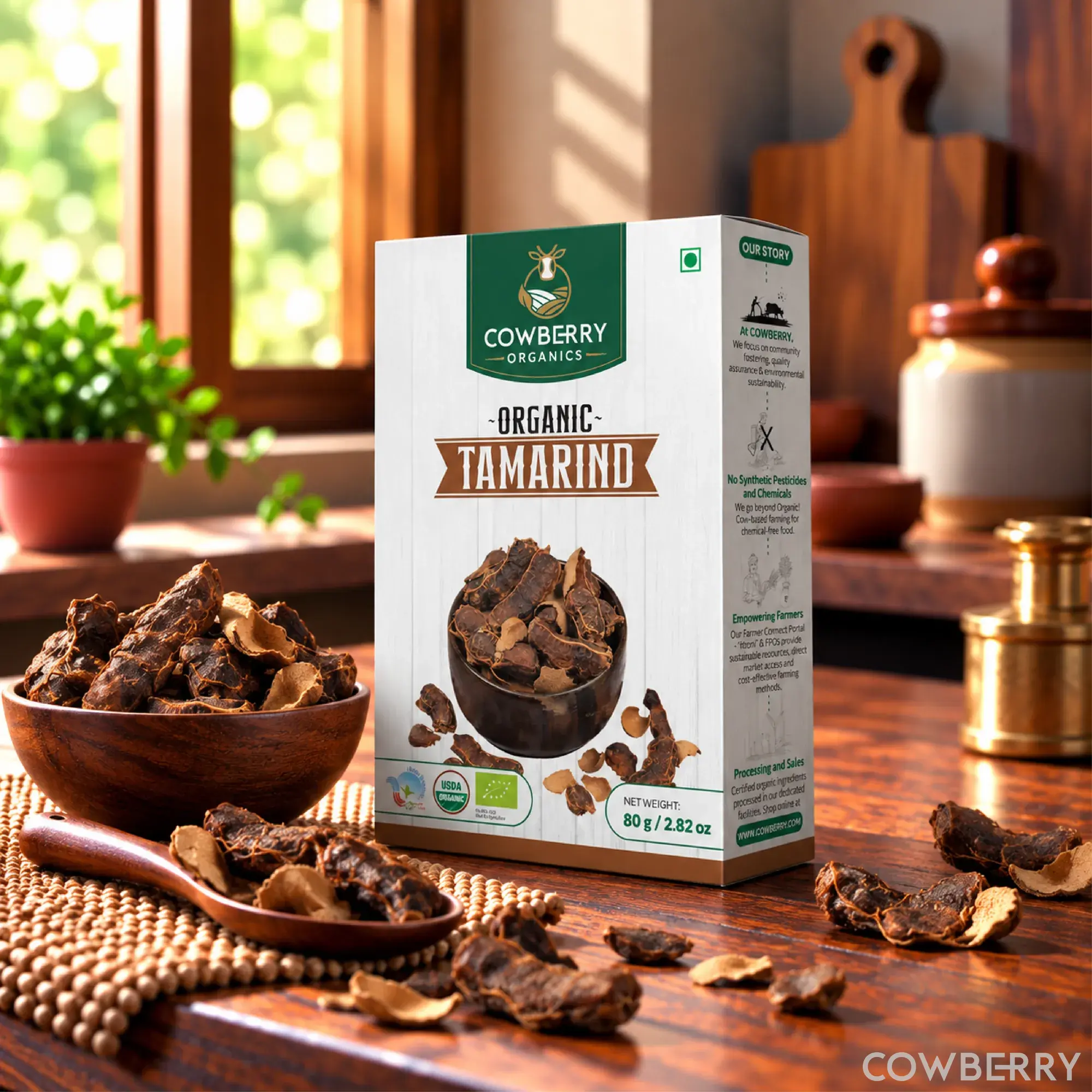
For tamarind, the taste story is short and clear. The product page describes it as naturally tangy, with an authentic sourness and a rich, deep flavour, and credits Karnataka and Kerala's warm climate and rich soil for its deep brown colour. In the kitchen it is a block of dried pulp that soaks into extract: one 10 g piece in warm water sours a pot of sambar, and the method, from soaking time to straining out seeds and fibre, is on tamarind how to use. It also keeps: the dry block in a sealed jar lasts many months, per the tamarind how to store page.
For malabar tamarind, the honest answer to how it tastes is that the cited sources do not say: IFCT 2017, the reviews and the product pages print no flavour, no form and no recipe amount for it, so the page gives it none of the three. A reader who needs kokum facts will find none here; a reader who needs tamarind facts will find them all.
Lemon sits between the two as the swap, not the subject: it brings a sharp, bright sourness, and the substitute page says how much sweetness to add. The tamarind vs lemon amounts per dish are on the tamarind substitute page.
Cost and where each fits
On cost, the printed facts cover only tamarind. COWBERRY sells it as a small pack of the dry block, and because one soaked piece sours a whole pot, a single pack covers a long stretch of sambar; no price is quoted, and none is needed to make that point. For malabar tamarind and for lemon, no pack, price or shelf form is printed in any of the cited sources, so nothing about their cost can be said.
Where each fits follows the same line. Tamarind is the everyday souring agent of rasam, sambhar, chutneys, curries and dals; lemon is the fresh, bright stand-in for a dish already cooking; and malabar tamarind, which has no entry in IFCT 2017 or the product pages, gets no place claimed for it. Recipes that name kokum or kudampuli keep their own instructions, which the cited sources cannot check or expand.
Which for whom
- South Indian daily cooking: tamarind, the souring agent the product record lists for rasam, sambhar, chutneys, curries, dals, marinades and sauces.
- Anyone asking imli vs kokum for health: only tamarind has a documented record in IFCT 2017 and the reviews, and even its health story is mostly laboratory work; for kokum IFCT 2017 prints no composition and the reviews report no study, so nothing can be weighed on that side.
- A dish that asks for kokum or kudampuli: follow the recipe's own amounts; the cited sources print no amounts or swaps for it.
- A bright finish when tamarind runs out: lemon juice, in the per-dish amounts on the substitute page.
- Anyone who wants numbers: tamarind is the only one of the three with any. Its full story, names to nutrition, is on the tamarind hub.
Cook with it: try Tomato rasam, Imli chutney.
FAQs
Difference between tamarind and malabar tamarind?
Tamarind (imli) is documented: IFCT 2017 prints its full composition, from 289 kcal to 149 mg of calcium per 100 g, and its names. Malabar tamarind (kokum) has no entry in IFCT 2017 and no printed facts in any of the cited sources, so the comparison is between a documented food and an undocumented one; lemon is the third option, as the juice swap.
Difference between tamarind and kudampuli?
Kudampuli is one of the names under which malabar tamarind is searched, so the question is the kokum question again: tamarind has a full printed record across the cited sources, and kudampuli has none. IFCT 2017 prints no entry under kudampuli, kokum or malabar tamarind, so no taste, nutrition or price facts can be given for it.
Can imli reduce blood pressure?
None of the studies in the references shows imli reducing blood pressure. IFCT 2017 gives tamarind pulp 836 mg of potassium per 100 g, but that is a composition figure, not a trial of tamarind against blood pressure. Blood pressure is a matter for your doctor, not for a souring fruit.
Does tamarind help in hair growth?
None of the studies in the references connects tamarind with hair growth. The 2026 review covers the fruit's compounds and their laboratory effects on free radical scavenging and inflammatory mediators, and does not test tamarind for hair. A claim that imli grows hair has no support in the cited studies.
What is tamarind?
Tamarind (imli) is the fruit of Tamarindus indica, a tropical tree of the Fabaceae family, as a 2026 Nutrients review describes it. The food form is the pulp, which IFCT 2017 lists as "Tamarind, pulp" with 289 kcal per 100 g. It is the souring agent behind rasam, sambhar and chutneys; the kokum comparison is the rest of this page.
References
- Indian Food Composition Tables (IFCT) 2017, ICMR-National Institute of Nutrition
- Martinez CR, Diaz YA, Cianciosi D et al. The Health Benefits of Tamarindus indica: A Focus on the Relationship Between Phytochemical Composition and Physiological Effects. Nutrients, 2026
- Okello J, Okullo JBL, Eilu G et al. Mineral composition of Tamarindus indica LINN (tamarind) pulp and seeds from different agro-ecological zones of Uganda. Food Sci Nutr, 2017
Shop this article
Keep reading
Coriander water benefits: what dhania water actually does
Peanuts in Hindi (moongfali): groundnut names in Indian languages
Coriander vs cilantro: are they the same herb?