by COWBERRY

10 minute read
10 benefits of star anise (and its side effects)

Star anise benefits are easier to state honestly than to inflate: the published record covers the spice's flavour chemistry, its traditional uses and laboratory work on extracts, not health promises for those who eat the pods. Ten follow, each kept to what a source or the kitchen shows, then side effects, how much to use and how to eat it; names, storage and buying are on the star anise hub.
Star anise benefits in the kitchen: flavour, uses and the cup
1. Anethole, the essential oil behind the flavour
The spice is the dried fruit of the tree Illicium verum, an aromatic evergreen, and its pods carry aromatic essential oils, particularly anethole, which gives them the sweet, licorice-like flavour and lingering fragrance that COWBERRY's description of its own pods names. On the chemistry, a 2011 review from the Journal of Ethnopharmacology lists the compound groups identified in Illicium verum — volatiles, seco-prezizaane-type sesquiterpenes, phenylpropanoids, lignans and flavonoids, among other constituents. The kitchen benefit sits in that anethole: one or two pods carry enough of it to scent a whole pot. Do not confuse these pods with anise seed, a different plant; the two sit side by side on the page about the difference between star anise and anise seed.
2. One or two pods season a whole biryani or curry
In Indian cooking the pods cook whole in the pot for biryani, curry, masala and slow-cooked dishes, and they come out again before the pot reaches the table; the pod itself is never eaten. The warm, mildly sweet profile does the work, usually alongside cinnamon, cloves and ginger. That is the everyday star anise benefit: a small whole spice that gives a large pot its depth, with nothing to grind and nothing left in the dish but the flavour.
3. Desserts, drinks and herbal teas
The same pods work on the sweet side. COWBERRY's use list runs to desserts and herbal teas beside the savoury pots, and the sweet, licorice-like note carries into desserts and spiced chai; two pods simmered with tea leaves in 120 ml of milk plus 120 ml of water, held at a gentle simmer for three to four minutes, turn an ordinary chai into a spiced one.
4. A caffeine-free cup: the steeped tea
The tea is an infusion of the pods, not a tea-leaf blend, so the cup carries the spice's flavour and none of tea-leaf caffeine. Cover two whole pods in just-boiled water and give them five to seven minutes to steep, then strain the pods out and throw them away. The full method, plus the milk tea and the overnight star anise water, is on the page about star anise how to make tea.
Star anise benefits in tradition: the record across China and Asia
5. A long record in traditional Chinese medicine
In traditional Chinese medicine the fruit has long been used with three recorded actions: dispelling cold, regulating the flow of Qi and relieving pain, as the 2011 review states. Those are traditional-use descriptions, not modern clinical findings, and the same review records that the fruit has also long served the food industry. The honest reading is a spice with a long traditional standing, where the claim of benefit belongs to the tradition rather than to any trial.
6. Traditional uses recorded throughout Asia and Northern America
The 2011 review records traditional uses of Illicium verum throughout Asia and Northern America, where it has been used for more than 10 types of disorders. That breadth is the point of the record: the spice's traditional reach is wide, while the modern findings the review lists are laboratory work on extracts, as the next section shows. The same pod is chakra phool in Indian kitchens, and the two names cover one spice; every name the spice goes by is on the page about chakra phool in english.
Star anise benefits in the laboratory, stated carefully
7. The major source of shikimic acid, the Tamiflu ingredient
Star anise is, in the 2011 review's words, the major source of shikimic acid, a primary ingredient of Tamiflu, the antiflu drug. The link is real, but it belongs to the drug supply chain, not the spice rack: shikimic acid is extracted for medicine, and eating the pods is not taking the drug. Keep the claim where the review puts it — a source of the ingredient, nothing more.
8. Antimicrobial activity, in extracts
Modern pharmacology studies reviewed in 2011 found that crude extracts and active compounds of Illicium verum show wide pharmacological actions, antimicrobial activity among them. Note the setting: laboratory studies on extracts and compounds, not findings for a pod or two in a pot of biryani. The difference matters, and it runs through the next two points as well.
9. Antioxidant activity, in extracts
The same review lists antioxidant activity among the wide pharmacological actions of the extracts and active compounds. Again the setting is the laboratory, not the plate: the review's list does not extend that activity to the person eating the dish. The finding is the review's, at the extract level, and it stays there.
10. Analgesic and sedative activity, in extracts
The extract studies also showed analgesic, sedative and convulsive activities — sedative and convulsive in the same list. That makes these laboratory findings only, not a guide to dosing yourself. This is where the sleep question meets the record: extracts in laboratory studies, not cups of tea in people. For the tea and what it honestly offers, see the caffeine-free cup above.
What the studies do not show. A 2014 review published in the International Journal of Molecular Sciences states the general rule for this whole shelf: herbs and spices are normally eaten in small quantities and mixed into other foods, so what their true benefit is from a health perspective is unclear. Star anise fits that rule exactly, eaten a pod or two at a time inside a dish. None of the findings above is a documented health benefit for the person eating the spice, and no such promise is made.
Side effects of star anise: who should limit it
For the true pods, the 2011 and 2014 reviews print no list of side effects from ordinary culinary use, and none is invented. The one real caution is not about eating star anise at all; it is about eating the wrong fruit.
- The toxic look-alikes. The 2011 review records that the true pods are sometimes contaminated with two toxic fruits: the Japanese star anise (Illicium anisatum) — highly toxic in the review's words — and the poisonous star anise (Illicium lanceolatum); together the two carry several neurotoxic sesquiterpenes. Those two are not spices and must never be used in place of the true pods. What they are and what to check is covered on the page named which star anise is toxic.
- Who should limit it. The 2011 and 2014 reviews set no limit for any group, so none is set. What it does set is the culinary measure: a pod or two per dish, lifted out before serving. Anyone on a prescribed diet can keep that measure and ask their doctor or dietitian about anything more.
One honest note on the evidence: because the spice is eaten in such small amounts, the 2014 review concludes that its true health benefit is hard to establish, a reason to read the benefits above with care.
How much star anise per day
No dose. None of the published sources — the 2011 review, the 2014 spices review, the food composition tables — prints a daily amount of star anise, and none is invented. The working quantity is culinary, not medicinal: one or two pods for a pot of biryani, curry or dal, two pods for a cup of tea, a five to seven minute steep, and the pods lifted out before anyone eats. That is the measure recipes use. A pod or two per dish is the honest answer to how much star anise per day.
Storage keeps the pods ready for that daily use: a sealed, airtight jar kept cool and dry, away from sunlight. Names, buying and the rest are on the star anise page.
How to eat star anise: tea, biryani and the sweet pot
Star anise is never a snack and the pod never lands on the plate; it is a flavouring that leaves the pot. Three ways cover the everyday uses:
- Star anise tea: two pods steeped under a lid in just-boiled water for five to seven minutes, then strained. The milk tea version simmers the pods with tea leaves in milk and water.
- Biryani, curry, masala and soup: drop one or two pods into the pot while it simmers, with cinnamon, cloves and ginger if you like, and take the pods out before serving.
- Desserts and drinks: the sweet, licorice-like note suits desserts and spiced chai; pods in, pods out, the same as everywhere else.
Buy the pods whole, in a sealed, labelled pack, and the pod shape is the first check: an eight-pointed star of carpels around a central axis. The label checks sit on the how to check star anise purity page.
FAQs
Is star anise good for health?
No honest yes or no sits in the sources in the references. Spices reach the table in small amounts and mixed with other foods, and a 2014 review concludes that this leaves their true health benefit hard to pin down. For star anise, the research covers laboratory extracts, not people eating the pods. Use it as a flavouring; the full, honest list is in the sections above.
What is star anise benefits?
The honest list: anethole for flavour and aroma, a long traditional record in Chinese medicine and across Asia, a place in biryanis, curries, masalas, desserts and tea, and laboratory findings — antimicrobial, antioxidant, sedative — that stay at the extract level. Plus one industrial one: the pods are the major source of shikimic acid, an ingredient in the antiflu drug Tamiflu.
Does star anise help with sleep?
The two reviews in the references report no trial in people on better sleep from this tea. The sedative activity in the 2011 review comes out of laboratory studies on extracts, and an extract study is not a cup of tea; the review holds extracts, not cups. Drink the tea for its flavour, and take the sleep question to your doctor.
Does star anise lower blood sugar?
The two reviews in the references report no trial in people on star anise and blood sugar. The 2011 review's pharmacology findings are on extracts and compounds, not on blood sugar in people. In a diabetes kitchen the pods stay a flavour: one or two per dish. For blood sugar itself, follow your doctor's plan.
How to use chakra phool?
Whole pods in, whole pods out. Add one or two to biryani, curry, masala or soup while the pot simmers, and lift them out before serving; for tea, cover two pods in just-boiled water, steep five to seven minutes, strain. Chakra phool is the Hindi name for star anise, so the use is the same pod either way.
What is the nutritional value of star anise?
There is no value to give. IFCT 2017, the Indian food composition tables, has no star anise entry, so it prints no composition numbers for it. The USDA food database's anise seed record belongs to Pimpinella anisum, a different plant, and its figures are not these pods' figures. Where the sources carry no numbers, none are given.
Which star anise is toxic?
Not the kitchen spice: the toxic ones are the two look-alikes that sometimes contaminate it. The 2011 review names the Japanese star anise (Illicium anisatum) — highly toxic in the review's words — and the poisonous star anise (Illicium lanceolatum); both carry several neurotoxic sesquiterpenes. The true spice, Illicium verum, is the food; the other two never are.
References
- Wang GW, Hu WT, Huang BK et al. Illicium verum: a review on its botany, traditional use, chemistry and pharmacology. J Ethnopharmacol, 2011
- Opara EI, Chohan M. Culinary herbs and spices: their bioactive properties, the contribution of polyphenols and the challenges in deducing their true health benefits. Int J Mol Sci, 2014
- Indian Food Composition Tables (IFCT) 2017, ICMR-National Institute of Nutrition
- USDA FoodData Central
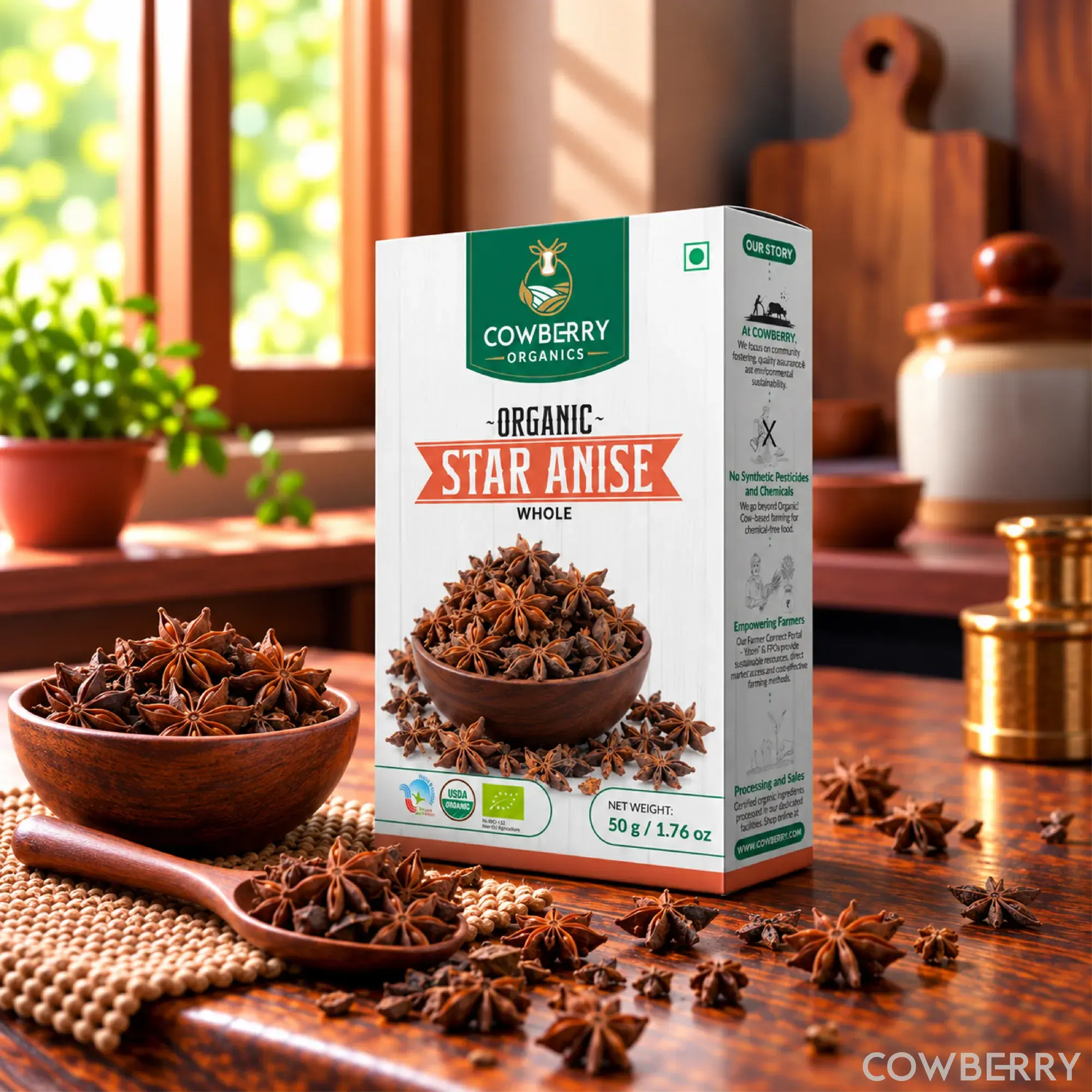
Shop this article
Keep reading
Coriander water benefits: what dhania water actually does
Peanuts in Hindi (moongfali): groundnut names in Indian languages
Coriander vs cilantro: are they the same herb?