by COWBERRY

6 minute read
Which star anise is toxic, and how to check star anise purity

Which star anise is toxic: not the kitchen spice, but the two look-alike fruits that sometimes travel with it. True star anise (Illicium verum) is sometimes contaminated with highly toxic Japanese star anise (Illicium anisatum) and the poisonous star anise (Illicium lanceolatum), a 2011 review records. The checks at home and on the label follow; the spice itself is covered on the star anise hub page.
Which star anise is toxic: the short answer
The spice is the dried fruit of Illicium verum, also called Chinese star anise; the same 2011 review in the Journal of Ethnopharmacology notes that its fruit has long been used in traditional Chinese medicine and in the food industry. The toxic ones are two close relatives that must never be used in place of it: the Japanese star anise, Illicium anisatum, which the review calls highly toxic, and the poisonous star anise, Illicium lanceolatum. Both look-alikes contain several neurotoxic sesquiterpenes, and that is what makes them dangerous. The answer in one line: the true spice is food, the other two are not.
Why contamination happens
The 2011 review records plainly that the true spice is sometimes contaminated with the two toxic look-alikes. The review does not say where in the chain the mix happens; what it does print is that the risk is real. FSSAI's own manual on detecting adulterants explains why this matters: adulteration of food deceives the consumer and can put their health at risk, and the manual exists to list the common ways of detecting the adulterants generally found in India. For star anise specifically, that manual prints no test at all, and the honest reading of that silence is set out below.
Home checks: what you can see on the pod
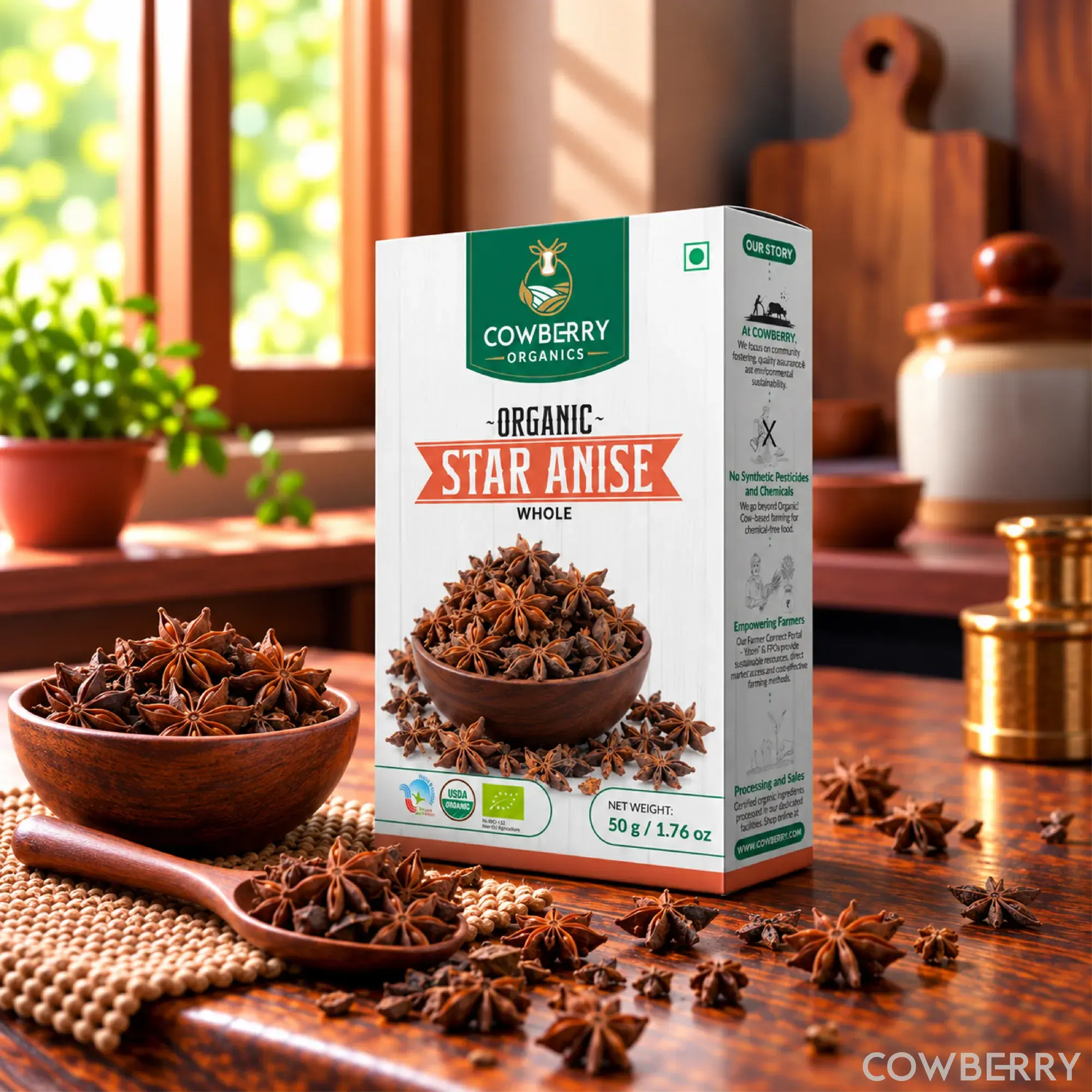
What a buyer can check at home is small, and this page states exactly that small thing. The true spice is a whole dried fruit: an eight-pointed star whose carpels sit around a central axis, reddish-brown, with a naturally sweet, licorice-like aroma. That description is COWBERRY's, and the star of eight points is the first thing to look for on the pods in the pack.
What no published manual offers is an at-home test that separates the true pods from the toxic ones. FSSAI's manual covers spices in detail, with quick tests for hing mixed with foreign resin and soapstone, black pepper with papaya seeds and light black berries, chilli with artificial colours and sawdust, saffron, powdered spices with sawdust and bran, and cloves that look small and shrunken. FSSAI's manual lists no test for star anise. So no water test, burn test or smell test is given on this page, because no published manual lists one; a made-up test is worse than none.
Lab tests and FSSAI's spice-test manual
The organised way to test foods in India is FSSAI's Detect Adulteration with Rapid Test manual, whose section on salt, spices and condiments runs eighteen quick tests designed to be done without a full laboratory, each naming the adulterant a food is commonly mixed with. The manual also has a sensory section: cloves that have been exhausted of oil, for instance, are caught by their small, shrunken look.
For star anise the manual is silent: no entry, no test, no adulterant listed. The science that tells the fruits apart does exist. The 2011 review records that the toxic look-alikes carry several neurotoxic sesquiterpenes, and it calls the true fruit a major source of shikimic acid, the primary ingredient in the antiflu drug Tamiflu. That is laboratory chemistry, not a kitchen test. In India the practical protection is therefore the pack and its label, which the next section covers.
What to read on the label
FSSAI's labelling and claims rules give a buyer real checks, and they apply to every pack of star anise sold in India.
- The licence number. A food pack must carry the licence number of its maker, a declaration the Packaging and Labelling Regulations, 2011 make mandatory. A pack without the number fails that rule.
- The word pure. The rules reserve pure for a single-ingredient food to which nothing has been added and which is free from avoidable contamination, which is exactly what a star anise pack should be; a pack labelled pure must meet that standard.
- Disclaimers. If the brand name uses words like natural, fresh, pure, original or traditional in a way likely to mislead the buyer, the rules require a disclaimer on the label in lettering of at least 3 mm. Its absence is a label fault.
- Claims. The rules allow only truthful, scientifically substantiated claims, and they do not allow a pack to promise a medical effect for a food. A star anise pack that promises health is breaking the rules, and that is itself a reason to choose another pack.
Buy whole pods in a sealed, labelled pack, and keep the pods in an airtight container somewhere cool, dry and away from sunlight. Everything else about the true spice, from its names to its tea, starts from the star anise hub page.
FAQs
Which star anise is toxic?
Two look-alike fruits, neither of which is the kitchen spice: Japanese star anise (Illicium anisatum), which a 2011 review calls highly toxic, and poisonous star anise (Illicium lanceolatum). Both carry several neurotoxic sesquiterpenes. The safe spice is Illicium verum, the dried star-shaped fruit sold as star anise.
Is star anise poisonous?
The true spice is not. Illicium verum, the dried star-shaped fruit, has long been used in the food industry, as a 2011 review records. What is poisonous are the look-alikes that sometimes contaminate it. Buying whole pods in a sealed, labelled pack from a known brand keeps the two apart.
Which star anise is safe?
Star anise from Illicium verum: the whole dried fruit with eight carpels around a central axis and a naturally sweet, licorice-like aroma. COWBERRY's pods are grown organically in Arunachal Pradesh, naturally dried and gently cleaned, and sealed in a 50 g pack.
Which star anise is edible?
Star anise, the fruit of Illicium verum, and nothing else in the family. It is edible as a flavouring: whole pods steep or simmer in tea, biryani and curries and come out before serving. The Japanese star anise and the poisonous star anise are not edible at all, which is the point of the 2011 review's contamination warning.
What is chakra phool?
The Hindi name for star anise, the dried star-shaped fruit of Illicium verum. The pods carry a naturally sweet, licorice-like flavour; Indian kitchens simmer them whole in biryanis, curries, masalas and teas and lift them out before the dish is served.
References
- Wang GW, Hu WT, Huang BK et al. Illicium verum: a review on its botany, traditional use, chemistry and pharmacology. J Ethnopharmacol, 2011
- FSSAI DART: Detect Adulteration with Rapid Test, common quick tests for food adulterants at household (Eat Right India)
- FSSAI Food Safety and Standards (Advertising and Claims) Regulations 2018, compendium (PDF)
Shop this article
Keep reading
Coriander water benefits: what dhania water actually does
Peanuts in Hindi (moongfali): groundnut names in Indian languages
Coriander vs cilantro: are they the same herb?