by COWBERRY

10 minute read
Star anise (chakra phool): names, benefits, uses and purity check

Star anise is the star-shaped whole spice Indian kitchens call chakra phool: the dried fruit of Illicium verum, the evergreen tree, sold as pods of eight carpels around a central axis and prized for a naturally sweet, licorice-like flavour. This hub covers what the spice is, its names, the honest nutrition picture, benefits, the toxicity caution, cooking, storage and buying.
What is star anise?
Star anise is a whole spice, and a whole spice only: the dried fruit of Illicium verum, sold exactly as it dries, pod by pod. A 2011 review published in the Journal of Ethnopharmacology describes the source plant as an aromatic evergreen belonging to the family Illiciaceae; the review adds that the fruit has long served traditional Chinese medicine as well as the food industry, and it gives the spice's other English name, Chinese star anise. The star shape comes from the carpels: eight of them set around one central axis, which is COWBERRY's description of its own pods. One pod is one whole fruit, so recipes count the spice in pods and never in pinches. It is also not anise seed — that is the seed of Pimpinella anisum, a different plant — and the two are compared on the page for the difference between star anise and anise seed.
Star anise names in India
In Hindi the spice is called chakra phool, and COWBERRY's product page pairs the two languages as Organic Star Anise (Chakra Phool). Botanically the pods are Illicium verum, and an older English word for the same pods is badian, which the Wikipedia article on Illicium verum prints. Beyond that pair, the name record is genuinely thin: IFCT 2017, the Indian food composition tables, carries no entry for this spice, so no Tamil, Kannada or Telugu names are guessed at either. Every name that a source actually prints, English ones included, is collected on the chakra phool in english page.
Star anise nutrition per 100 g
Star anise gets no nutrition table on this page, because no source prints one. IFCT 2017, the Indian food composition tables, leaves the spice out entirely, so no Indian per-100 g values exist to quote. The USDA food database's anise seed record describes Pimpinella anisum, another plant, and its numbers must not be borrowed for these pods. So the honest section is an absence, stated in words.
What the published record does say about the spice shelf as a whole comes from a 2014 review on culinary herbs and spices: these foods are eaten in small quantities, normally combined with other foods, which leaves their true health benefit hard to establish. Even a complete table would describe a flavouring, not a portion food: the pods season a pot two at a time and leave it before serving, so the spice is eaten in pinches of flavour. The numbers that do matter are kitchen ones — a pod or two per dish, two pods per cup of tea — and those are set out in the cooking sections below.
Benefits of star anise
The honest list has three layers, and the full ten points with their sources are on the star anise benefits page; the same list in Hindi is on the chakra phool ke fayde page.
In the kitchen
Anethole, the aromatic essential oil the pods are rich in, gives the spice its sweet, licorice-like flavour (COWBERRY's description). A pod or two seasons a whole biryani, curry or masala pot, and the same pods go into desserts, herbal teas and spiced chai; steeped alone, they make a caffeine-free cup, since the pods carry no tea leaves. Two pods is the working measure everywhere on this hub: two for a cup, one or two for a pot.
In the traditional record
The 2011 review records the fruit's long use in traditional Chinese medicine — dispelling cold and relieving pain among the recorded actions — and traditional uses throughout Asia and Northern America for more than 10 types of disorders. These are traditional-use records, not modern clinical findings.
In the laboratory
The same review calls the spice the major source of shikimic acid, a primary ingredient in the antiflu drug Tamiflu, and reports that crude extracts and active compounds showed antimicrobial, antioxidant, sedative and other activities in pharmacology studies. All of that is extract work; the 2011 review reports no such effects in people eating the pods, and the benefits page keeps that line clear.
Side effects: which star anise is toxic
For the true pods, the 2011 and 2014 reviews carry no side-effect list for ordinary kitchen use, and none is invented; a pod or two in a pot is a flavouring. The caution that does exist is about the wrong fruit. A 2011 review records that the spice is sometimes contaminated with two look-alike fruits: the poisonous star anise (Illicium lanceolatum) and the Japanese star anise (Illicium anisatum), called highly toxic by the review; both carry several neurotoxic sesquiterpenes. Neither is a spice, and neither belongs in a pot. Where in the chain the two get mixed is not something the review states; it prints only that the risk is real. What the look-alikes are, why no published manual offers an at-home test for them and what the label should carry is on the page for which star anise is toxic. Beyond the look-alikes, no published guidance limits the spice for any group; anyone on a prescribed diet can keep the pod-and-two measure and take any further question to their doctor or dietitian.
How to cook and use star anise
In the pot, the rule is simple: whole pods go in while the dish simmers and come out before serving, because the pod is never eaten. The pods' home is biryani, masala, curry, soup and slow-cooked dishes, usually with cinnamon, cloves and ginger beside them (COWBERRY's pairing), and the same spice crosses to the sweet side for desserts and spiced chai. For the cup, two whole pods steeped in a covered 240 ml cup of just-boiled water, five to seven minutes under the lid, make the caffeine-free cup, with the method on the star anise tea page. The milk tea on that page simmers two pods with tea leaves for one cup in a pan holding 120 ml of milk and 120 ml of water, kept at a gentle simmer, three to four minutes in all, and then strained. The overnight star anise water is the same spice without heat: two or three whole pods sit in a glass of clean water, covered, on the counter until morning. There is nothing to grind and nothing to crush; the flavour stays in the liquid, and the pod leaves the pot.
How to store star anise
Dry pods want one thing: an airtight container kept somewhere cool and dry, away from sunlight and moisture — which is also COWBERRY's own storage advice for its pack. No month count for star anise pods appears in the published record, so none is given; the pod's smell and colour are the everyday check, and pods that have gone dull and faint are past their best. The jar needs no fridge and no ritual; cool, dry and dark is the whole of it. Buying the spice whole and keeping it whole is the way the pods stay aromatic longest, since nothing is ground until a recipe calls for it, which for these pods is never.
Star anise recipes: the tea and the pot uses
The cluster's full recipe is the tea: the star anise how to make tea page walks through the plain cup, the milk tea and the overnight star anise soak, with a time-and-quantity table. Beyond the tea, the pods are an addition to other recipes rather than a recipe of their own: a pod or two dropped into any biryani, curry, dal or stew while it simmers, and into desserts and spiced chai on the sweet side, then lifted out before the dish reaches the table. The pairing with cinnamon, cloves and ginger is COWBERRY's own suggestion for the pods, and it changes no method: everything still simmers, and everything still gets lifted out.
How to buy star anise: the buying guide
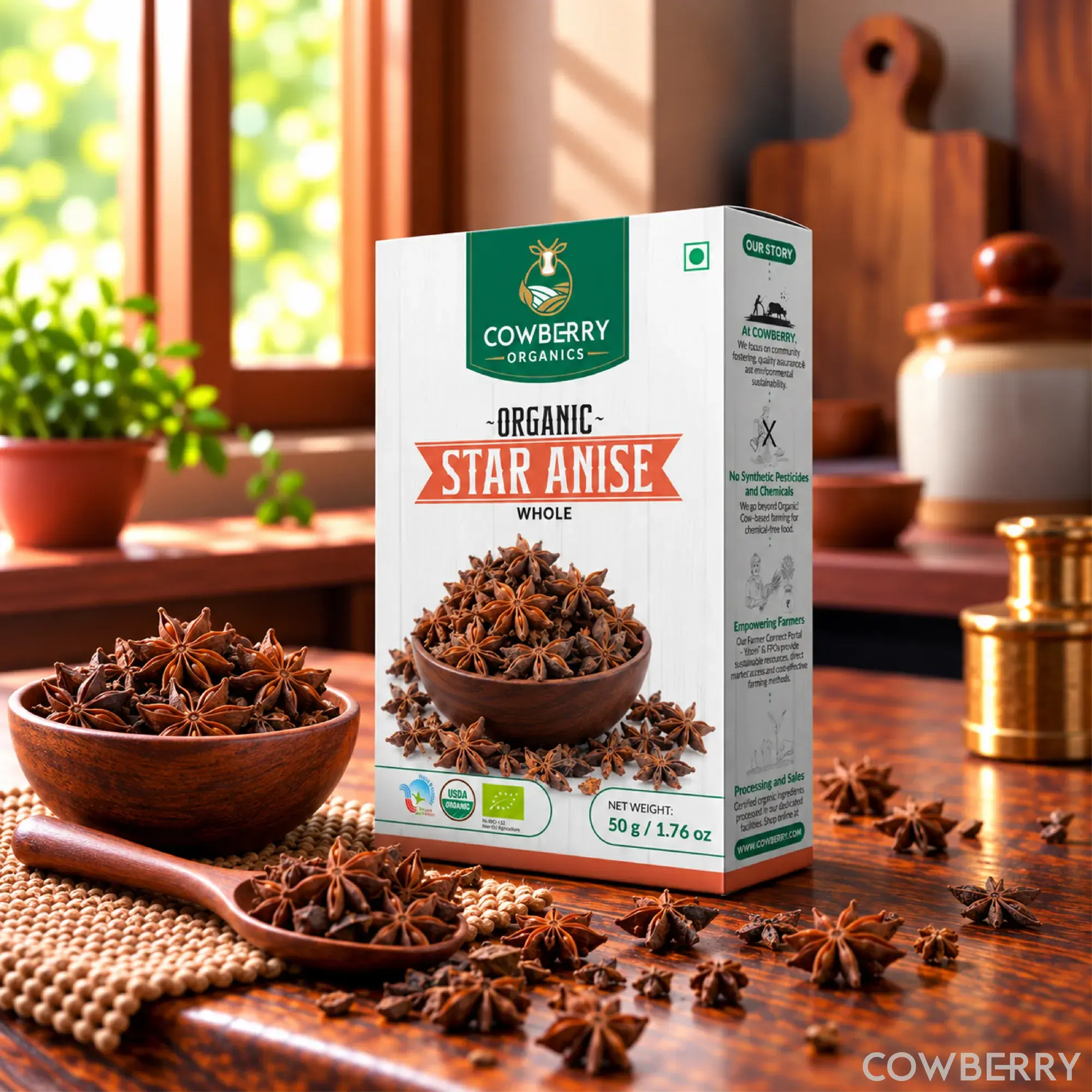
Buy the spice as whole pods, sealed and labelled in their pack; the label is the one honest defence against the look-alikes, because it says what the pack holds. On the pod itself, look for the full shape: all eight carpels around a central axis, a complete star. FSSAI's labelling and claims rules give every pack sold in India four label checks. The licence number: the Packaging and Labelling Regulations, 2011 make the maker's licence number a mandatory declaration on the pack. The word pure: the rules reserve it for a single-ingredient food with nothing added and free from avoidable contamination. Disclaimers: a brand name that leans on natural, fresh, pure, original or traditional where it could mislead the buyer must carry a disclaimer on the label, its lettering at least 3 mm tall. Claims: only truthful, scientifically substantiated claims are allowed, and no pack may promise a medical effect for a food. COWBERRY's star anise is grown organically in Arunachal Pradesh, carefully harvested, naturally dried and gently cleaned, packed whole in a 50 g pack with no artificial colours, flavours or preservatives, and it is India Organic, USDA & EU certified; it is sold as organic star anise. The full label checklist is on the page for how to check star anise purity.
FAQs
What is star anise?
A whole spice: the dried fruit of Illicium verum, the aromatic evergreen tree in the family Illiciaceae, as a 2011 review published in the Journal of Ethnopharmacology describes it. Each pod is the fruit's eight carpels set around one central axis. It is sold whole, never ground, and it is the spice Indian kitchens call chakra phool.
Which star anise is toxic?
Japanese star anise (Illicium anisatum) and the poisonous star anise (Illicium lanceolatum) — the two fruits a 2011 review says sometimes travel with the true pods, and both carry several neurotoxic sesquiterpenes. Illicium verum, the true star anise, is the food; the other two are never eaten. A sealed, labelled pack of whole pods is what separates them.
What is chakra phool?
The Hindi name for star anise: chakra phool is what Indian kitchens call the dried fruit of Illicium verum, the same whole pods that English calls star anise. One name, one pod — a recipe that says chakra phool and one that says star anise want the identical spice, nothing else.
Is star anise good for health?
Not in the way a medicine is. A 2014 review on culinary herbs and spices notes that these foods are consumed in small quantities, normally with other foods, and calls their true health benefit unclear for that reason. Star anise's own research is laboratory work on extracts. The honest reading: a flavouring; the studies are laid out on the star anise benefits page.
What is 1 star anise?
One whole dried fruit: the eight-pointed pod that is the smallest unit of the spice. Recipes measure star anise by the pod because nothing smaller is usable — two pods steep for one cup of tea, one or two season a biryani — and the pod's seeds stay inside it, so nothing is ground or crushed.
How to use chakra phool?
As a whole pod that flavours and then leaves. Drop a pod or two into biryani, curry, masala, soup or any slow-simmering pot, and fish the pods out before the dish reaches the table; for tea, steep two pods and strain. Chakra phool is simply the Hindi name, so both names call for the same pod and the same lift-out.
What can I use instead of star anise?
No published source names anything that stands in for the pods, so none is given; anise seed is a different plant's seed, not a swap the sources sanction. A recipe that wants star anise wants the pods; the difference between star anise and anise seed page sets out why — restock rather than guess.
References
- Wang GW, Hu WT, Huang BK et al. Illicium verum: a review on its botany, traditional use, chemistry and pharmacology. J Ethnopharmacol, 2011
- Opara EI, Chohan M. Culinary herbs and spices: their bioactive properties, the contribution of polyphenols and the challenges in deducing their true health benefits. Int J Mol Sci, 2014
- Indian Food Composition Tables (IFCT) 2017, ICMR-National Institute of Nutrition
- USDA FoodData Central
- FSSAI Food Safety and Standards (Advertising and Claims) Regulations 2018, compendium (PDF)
Shop this article
Keep reading
Coriander water benefits: what dhania water actually does
Peanuts in Hindi (moongfali): groundnut names in Indian languages
Coriander vs cilantro: are they the same herb?