by COWBERRY

5 minute read
Chakra phool in English: star anise names in Indian languages

Chakra phool in English is star anise: the whole, star-shaped spice pods sold for biryanis, masalas and tea. The Hindi name is chakra phool, the botanical name is Illicium verum, and the table below sets out every name with its source. The spice itself, its uses and buying are on the star anise hub page.
Chakra phool in English: the quick answer
One line per question: chakra phool in English is star anise, and star anise in Hindi is chakra phool. The two names are one spice, so a recipe asking for star anise and one asking for chakra phool want the same pods. In English the spice is also written star aniseed and Chinese star anise, and an older name for it is badian; each appears in the table with its source.
The table is an honest one. IFCT 2017, the Indian food composition tables, has no entry for star anise, so it prints no Indian-language names for the spice, and the rows for those languages stand empty rather than guessed at. The English names come from the Wikipedia article on Illicium verum, which spells them exactly as the table does.
| Language | Name (romanised) |
|---|---|
| English | Star anise, Star aniseed, Chinese star anise, Badian |
| Hindi | — |
| Marathi | — |
| Gujarati | — |
| Punjabi | — |
| Bengali | — |
| Odia | — |
| Assamese | — |
| Kannada | — |
| Telugu | — |
| Tamil | — |
| Malayalam | — |
| Urdu | — |
| Sanskrit | — |
| Botanical name | — |
Source: no source found. — means no name recorded in the source.
English ‘Star anise’: Wikipedia: Illicium verum. English ‘Star aniseed’: Wikipedia: Illicium verum. English ‘Chinese star anise’: Wikipedia: Illicium verum. English ‘Badian’: Wikipedia: Illicium verum.
Star anise in English: botanical name, family and what the spice is
Star anise in English is the everyday name; the scientific name is Illicium verum Hook. f., and the spice is the dried fruit of that tree. A 2011 review in the Journal of Ethnopharmacology describes Illicium verum as an aromatic evergreen tree of the family Illiciaceae, its fruit long in use across traditional Chinese medicine and the food industry. The same review calls the spice by its other English name, Chinese star anise.
The shape is where the English name comes from: the pod is a star of eight carpels arranged around a central axis. One pod is one whole fruit, which is why recipes count star anise in pods and never in pinches. The spice sold in Indian kitchens as chakra phool is this same dried fruit.
Star anise names by region in India
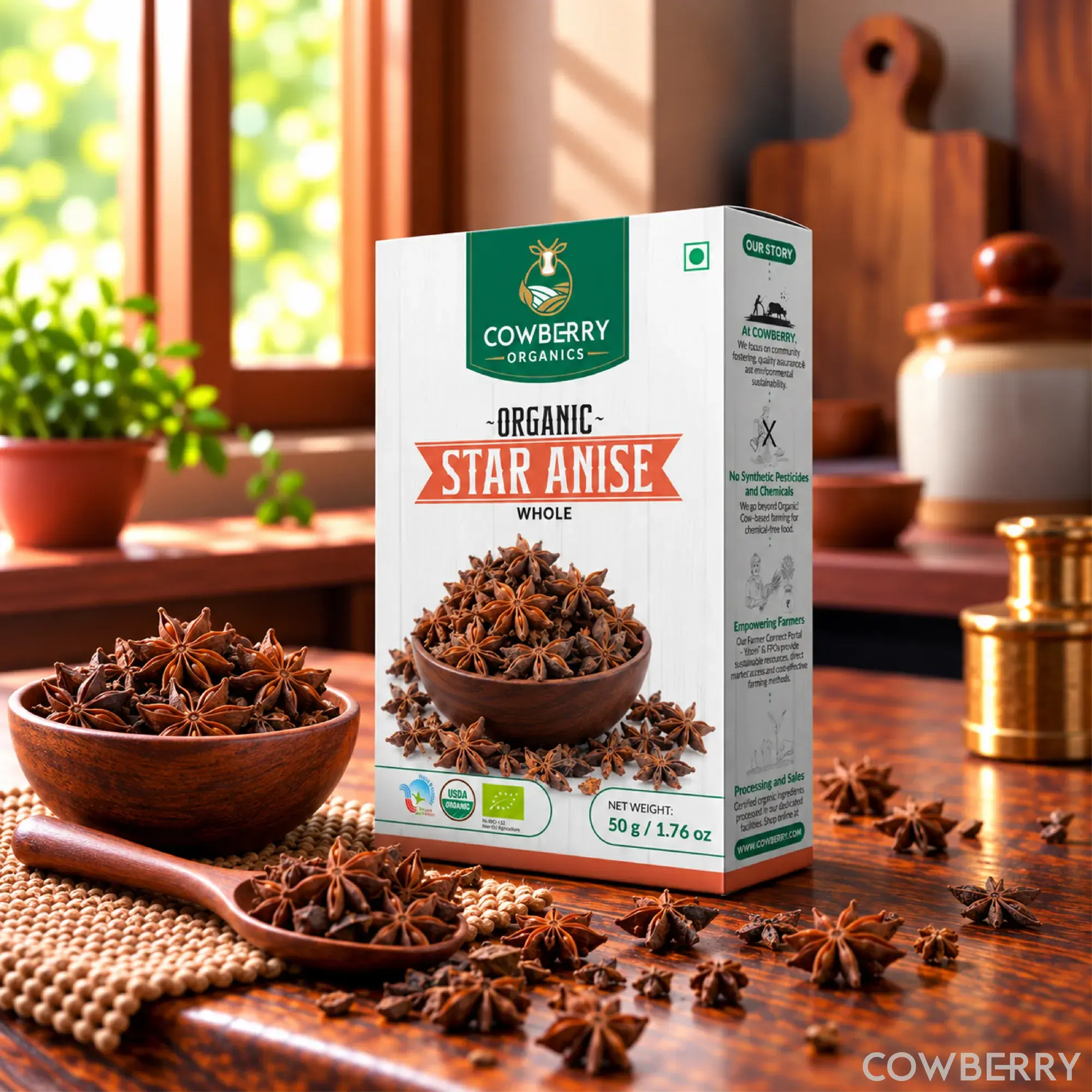
In Hindi the spice is chakra phool, and COWBERRY's own product page keeps both names together: it calls the spice organic star anise (chakra phool). Beyond Hindi and English, the name record thins out. IFCT 2017 has no star anise entry at all, so its local-names list gives nothing for any Indian language.
People do search for star anise in Tamil, star anise in Kannada, star anise in Telugu and star anise meaning in Gujarati. For those languages, none of the published sources — IFCT 2017, the Wikipedia article and the 2011 review — prints a name, so none is given rather than guessing; a wrong regional name would send a reader to the wrong spice. What is certain is the pair that travels together: star anise on the pack, chakra phool in Hindi speech.
Often confused with: star anise vs anise seed and Japanese star anise
Three names get tangled with chakra phool.
- Anise seed (aniseed). A different plant. Star anise is the fruit of Illicium verum; anise seed is the seed of Pimpinella anisum, as the USDA food database records. The shared English word anise is where the confusion starts, and the full comparison is on the difference between star anise and anise seed page.
- Japanese star anise (Illicium anisatum). The one to be careful about: a 2011 review records that true star anise is sometimes contaminated with this highly toxic fruit and with the poisonous star anise (Illicium lanceolatum). What the look-alikes are and what to buy is on the page about which star anise is toxic.
- Badian. Not a different spice at all: badian is an older English name for star anise itself, recorded in the Wikipedia article the table above cites.
Where star anise grows
The 2011 review describes Illicium verum as an aromatic evergreen tree, and its traditional uses are recorded throughout Asia and Northern America. COWBERRY's pods come from a nearer source: the spice is grown organically in Arunachal Pradesh, in a cool growing region where traditional cultivation produces well-formed pods, then harvested, naturally dried and gently cleaned. COWBERRY's star anise is India Organic, USDA & EU certified, and it is sold whole as organic star anise. For the spice's cooking, storage and buying, start from the star anise hub page.
FAQs
What is chakra phool in English?
Star anise. Chakra phool is the Hindi name for the whole spice, the dried star-shaped fruit of Illicium verum. It is also written star aniseed and Chinese star anise, and both the English and the Hindi name appear together on COWBERRY's own product page for the spice.
What is chakra phool in Hindi?
Chakra phool in Hindi is chakra phool: the word itself is Hindi, and it names the spice that English calls star anise. So the two questions are one and the same — the Hindi name is chakra phool, the English name is star anise, and the spice under either name is the dried fruit of Illicium verum.
What is chakra phool?
A whole spice: the dried, star-shaped fruit of Illicium verum, an aromatic evergreen tree. Each pod is a star of eight carpels around a central axis, with a naturally sweet, licorice-like flavour. Indian kitchens use the whole pods in biryanis, curries, masalas, soups and teas, and lift them out before serving.
What is star anise called in Hindi?
Chakra phool. A recipe for chakra phool wants the same pods as a recipe for star anise; only the language changes. The botanical name that covers both is Illicium verum.
What is 1 star anise?
One pod, which is one whole dried fruit. A single pod is the star of eight carpels around a central axis that gives the spice its name, and recipes count star anise in pods: two pods for a cup of tea, one or two in a pot of biryani. It is not a seed and not a powder.
References
Shop this article
Keep reading
Coriander water benefits: what dhania water actually does
Peanuts in Hindi (moongfali): groundnut names in Indian languages
Coriander vs cilantro: are they the same herb?