by COWBERRY

8 minute read
Sesame oil for cooking: uses, benefits and how to store it

Sesame oil for cooking is the oil pressed from til, the seeds of Sesamum indicum. Indian kitchens use it for tadka, stir-fries and frying, and the dietary guidelines cap every cooking oil, sesame included, at a measured daily amount. The seed itself, with its nutrition, is on the sesame seeds hub.
What til oil is and how it is made
Til oil is the oil of the sesame seed, and sesame is an old oil crop: a 2022 review in Nutrients calls it one of the first oil crops used in humans and describes the seed as rich in protein and lipids, with a mellow flavour. The seed itself, under its Indian names, is on the sesame names page.
The dietary guidelines describe how seed oils are made: crude vegetable oils are pressed from seeds such as sunflower, soyabean, mustard and sesame by mechanical expelling, and a cold-pressed oil (kachi ghani tel) is obtained the same way, without the application of heat, so antioxidants and phytonutrients are preserved, though, like crude oil, it also contains undesirable compounds. The same guidelines note that refining does not alter the fatty acid composition but modifies the minor components.
One honest gap: IFCT 2017 prints a full composition entry for the seed (520 kcal, 21.7 g of protein and 43 g of fat per 100 g) but gives the oil pressed from it only a fatty-acid profile, with no energy or composition values, so every composition number on this page comes either from IFCT 2017 (the seed) or from USDA (the other oils).
Til oil how to use in Indian cooking
Three ways to use it:
Tadka and tempering
Heat a teaspoon of til oil in the kadai, drop in the mustard seeds and curry leaves or the usual dal tadka spices, and pour the tempering over the cooked dish. A teaspoon of cooking oil is 5 g, so a tadka is a small share of the day's limit.
Stir-frying
The dietary guidelines describe stir-frying as cooking cut vegetables in a little oil on high heat with constant stirring; cooked briefly without water, the method keeps most of the B vitamins. Sesame's mellow flavour suits greens, cabbage, beans and the dry sabzis cooked this way.
Frying
The guidelines' caution is about frequency: the main disadvantage of frying, if used often, is that it increases how much fat and oil you eat, and extended contact between hot oil and air can generate oxidised products. So fry when the dish calls for it, not as the daily default.
The seeds themselves, not the oil, go into the festival sweet; the til ke laddu recipe roasts them dry. The ways to eat the seed are in our guide to eating sesame seeds.
Sesame seeds oil benefits: what the research says
Most published analyses behind til oil's reputation study sesame as a food in general; the line about the oil itself comes from the dietary guidelines: lignans in sesame oil reduce blood cholesterol.
A 2017 meta-analysis in the Journal of the Science of Food and Agriculture pooled eight controlled trials with 843 participants and reported that sesame consumption reduced systolic blood pressure by 7.83 mmHg and diastolic by 5.83 mmHg. When the analysis was restricted to the four higher-quality trials, systolic fell by 3.23 mmHg, a significant drop, while diastolic fell by 2.08 mmHg, which was not significant; the authors asked for larger and better-designed trials.
A 2016 meta-analysis in the British Journal of Nutrition, from ten controlled trials, found sesame made no significant difference to total, LDL or HDL cholesterol, while serum triglycerides fell by 0.24 mmol/l. Its conclusion: the evidence is not enough to support a cholesterol-lowering claim.
A 2022 review in Nutrients lists antioxidant, cholesterol reduction, blood lipid regulation and cardiovascular protection among the effects seen in studies of sesame. Read these as findings about sesame as a food, not as a licence to pour: the next sections give the daily limit and the storage rules.
How sesame oil differs from groundnut and mustard oil
These three oils differ less in their composition figures than in their seeds.
Groundnut oil and mustard oil each list 884 kcal and 100 g of fat per 100 g in USDA's composition data, as pressed oils do; IFCT 2017 gives sesame oil only a fatty-acid profile, with no energy entry, so the table below shows the seed it comes from (520 kcal and 43 g of fat per 100 g, IFCT 2017). The two oils also carry no carbohydrate, so no glycemic index applies to them.
The differences the records do show are about what else is in the oil. For sesame, that is the lignans noted above. For mustard, the same guidelines count rapeseed/mustard among the oilseeds that are good sources of both n-6 and n-3 fats, and their table says 0.7 g of mustard oil supplies the minimum 100 mg of n-3 PUFAs. For groundnut oil they print no such note. The guidelines also ask cooks to moderate oils high in n-6 fats; their chart of oil compositions includes sesame, though the guidelines print no numbers for it.
| Nutrient | White sesame seeds | Mustard oil | Groundnut oil |
|---|---|---|---|
| Energy (kcal) | 520 | 884 | 884 |
| Protein (g) | 22 | 0 | 0 |
| Fat (g) | 43 | 100 | 100 |
| Carbohydrates (g) | 11 | 0 | 0 |
| Dietary fibre (g) | 17 | 0 | 0 |
| Iron (mg) | 15 | 0 | 0 |
| Calcium (mg) | 1283 | 0 | 0 |
| Magnesium (mg) | 372 | 0 | 0 |
| Potassium (mg) | 460 | 0 | 0 |
| Sodium (mg) | 15 | 0 | 0 |
| Zinc (mg) | 7.8 | 0 | 0 |
| Folate (mcg) | 131 | 0 | 0 |
| Vitamin C (mg) | — | 0 | 0 |
Per 100 g raw, edible portion. Composition: IFCT 2017 (ICMR-NIN); USDA FoodData Central (SR Legacy), FDC ID 172337, NDB 4583; USDA FoodData Central (SR Legacy), FDC ID 171410, NDB 4042. — means not reported. These are average values for the food; the label on a pack gives the values for that product.
Sesame seed oil how to store it
Two sets of rules: one for the fresh bottle, one for oil that has fried something.
For fresh til oil, keep the bottle tightly closed in a cool, dry cupboard away from the stove. The dietary guidelines add a related point in their fats chapter: the natural minor components in fats and oils are mostly antioxidants, and these are what keep fats from going rancid; refining modifies them.
Used frying oil follows stricter rules. Repeated heating oxidises the polyunsaturated fats in the oil and generates compounds the guidelines call harmful or toxic, which may raise the risk of cardiovascular disease and cancer. At home, the guidelines say, oil once used for frying should be filtered and may be used for curry preparation, but not for frying again, and it should be consumed within a day or two; storing used oil for long should be avoided, because it deteriorates fast.
How much sesame oil a day
The dietary guidelines set one limit for every visible fat, their term for cooking oils, ghee and butter. Visible fat is limited to 20 to 50 g per person per day, or 4 to 10 teaspoons, depending on energy needs; adult women and men with sedentary lives are asked to keep to 20 g and 30 g respectively, and a reference day of about two thousand kilocalories needs no more than 27 to 30 g of cooking oil. A level teaspoon is 5 g, so those limits are 4 teaspoons at the low end.
The same chapter adds two points. If a diet already carries enough nuts, oilseeds, pulses and beans, there is no strict need for visible fat at all; since almost every recipe uses some, the practical advice is to limit its use. And during pregnancy and lactation the guidelines ask for visible fat to be restricted while trans fats are avoided.
Buying sesame seeds and til oil: what to look for
For til oil, read the label for what the oil is pressed from; a bottle that is simply 'vegetable oil' tells you less than one that names sesame. An organic product carries a certification mark on the pack. Beyond that, follow the fresh-oil habits above.
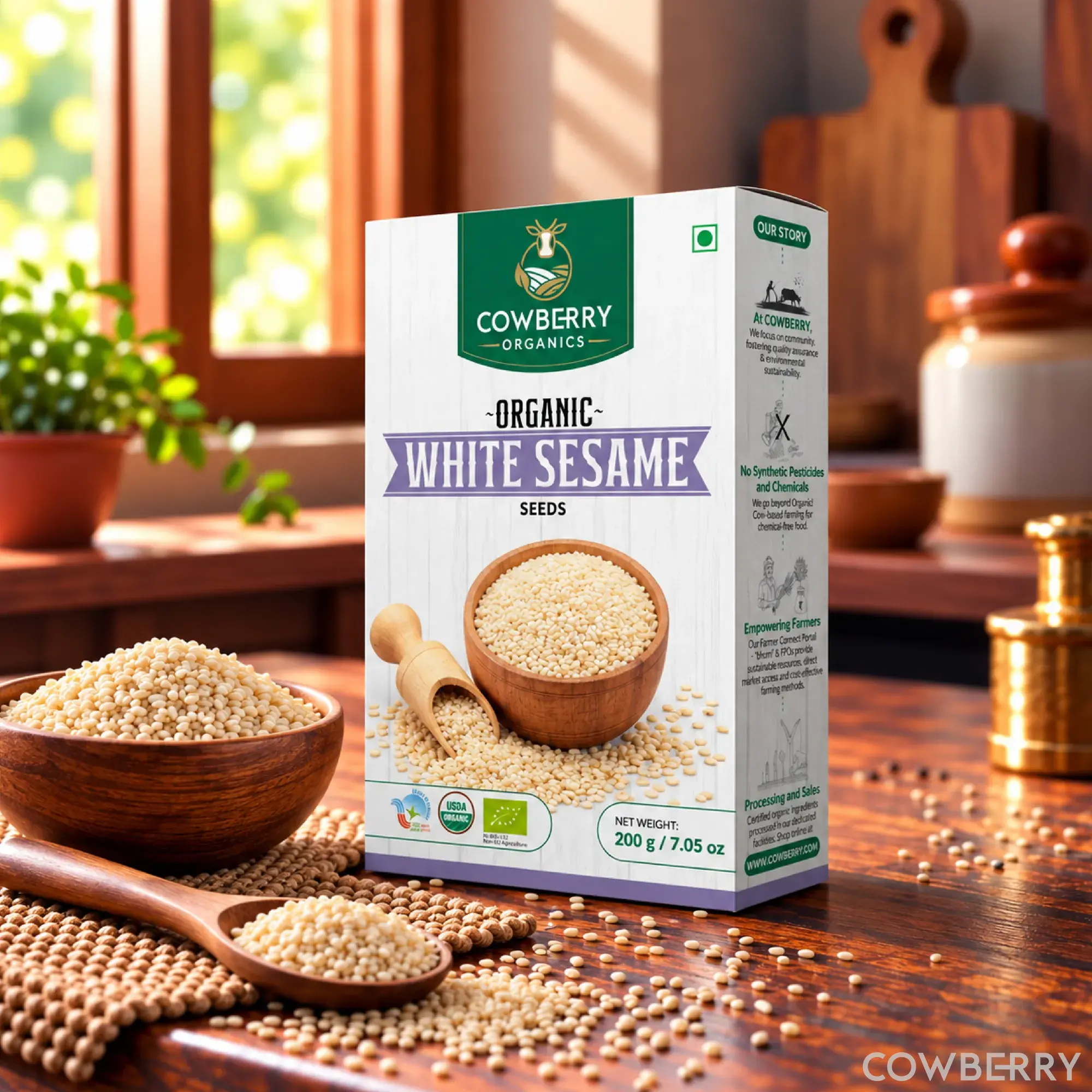
For the seed itself, COWBERRY's Organic White Sesame Seeds are grown on the black-soil plains of Madhya Pradesh and Gujarat, cleaned and sorted, and are India Organic, USDA & EU certified. What the seed gives per 100 g is on the sesame seeds nutrition page, the evidence behind its benefits on the sesame seeds benefits page, and the whole cluster starts at the sesame seeds hub.
FAQs
Is sesame seeds good for health?
The seed earns its place on numbers, not slogans: 520 kcal, 21.7 g of protein and 1283 mg of calcium per 100 g (IFCT 2017), with 43 g of fat. In controlled trials, sesame consumption reduced blood pressure and triglycerides with no significant change in cholesterol; the details and the trial counts are in the benefits section above. The guidelines class the fat in nuts and seeds as invisible fat, apart from the cooking-oil limit.
Does sesame seeds have iron?
Yes: 15 mg of iron per 100 g of white sesame seeds (IFCT 2017). That is the raw seed; a 20 g portion gives about 3 mg, so til adds a little iron to a meal rather than carrying the whole day. The oil pressed from the seed is the separate topic this guide covers.
What is sesame seeds?
Sesame is the seed of Sesamum indicum, an oilseed pressed for til oil and eaten whole in Indian kitchens. IFCT 2017 records it as 'Gingelly seeds, white', with the Hindi name til, and a 2022 review calls it one of the first oil crops used in humans. Its names in Hindi and other Indian languages are on the sesame names page.
Does sesame seeds have protein?
Yes, in the seed: 21.7 g of protein per 100 g (IFCT 2017), and the dietary guidelines count sesame among the nuts and seeds with substantial protein. Mustard oil and groundnut oil in USDA's data list no protein at all, so the protein belongs to the seed, not to the bottle of oil.
Which sesame seeds are good white or black?
IFCT 2017 lists white, brown and black sesame as separate entries and ranks none above the others. The numbers quoted above, and the til ke laddu recipe's, are for the white seed, and the COWBERRY sesame used in that recipe is white seed from Madhya Pradesh and Gujarat.
References
- Indian Food Composition Tables (IFCT) 2017, ICMR-National Institute of Nutrition
- Dietary Guidelines for Indians, ICMR-National Institute of Nutrition
- USDA FoodData Central
- Wei P, Zhao F, Wang Z et al. Sesame (Sesamum indicum L.): a comprehensive review of nutritional value, phytochemical composition, health benefits, development of food, and industrial applications. Nutrients, 2022
- Khosravi-Boroujeni H, Nikbakht E, Natanelov E, et al. Can sesame consumption improve blood pressure? A systematic review and meta-analysis of controlled trials. J Sci Food Agric, 2017
- Khalesi S, Paukste E, Nikbakht E, et al. Sesame fractions and lipid profiles: a systematic review and meta-analysis of controlled trials. Br J Nutr, 2016
Shop this article
Keep reading
Coriander water benefits: what dhania water actually does
Peanuts in Hindi (moongfali): groundnut names in Indian languages
Coriander vs cilantro: are they the same herb?