by COWBERRY

10 minute read
Sesame seeds (til): names, nutrition, benefits and how to eat them

Sesame seeds are the small oil-rich seeds of Sesamum indicum, called til in Hindi, that carry 520 kcal, 21.7 g of protein and 1283 mg of calcium per 100 g (IFCT 2017). Indian kitchens dry-roast them for til ke laddu, sprinkle them over curd and press them for til oil. This hub walks through names, nutrition, benefits, cooking, storage and buying.
What is sesame seeds (what is til)
Sesame seeds are the seeds of Sesamum indicum, an oilseed plant. IFCT 2017's entry for the seed carries the English name 'Gingelly seeds, white', so gingelly is simply another word for the same oilseed, not a second seed. A 2022 review in Nutrients places sesame among the earliest oil crops humans used, notes that it is widely grown, and describes the seeds as rich in protein and lipids with a mellow flavour; the same review adds that sesame finds use in food, feed and cosmetics.
The plant gives Indian kitchens two things they use daily: the whole seed, eaten raw, roasted or soaked, and til oil, pressed from the same seed for tadka and cooking. Dry-roast a spoonful and the seeds pop, swell and turn nutty. Til shows up all over the Indian year: folded into jaggery for Makar Sankranti sweets, spooned over winter greens, and pressed into the oil that tempers dals. The white seed is the one COWBERRY packs, and every sesame number on this hub is the white seed's IFCT 2017 value. On the shelf, sesame is sold as whole white seed; hulled and roasted forms exist in groceries, and the COWBERRY pack is the whole seed, cleaned and sorted. This hub follows the whole seed through its names, numbers and kitchen uses.
Sesame seeds names in India
One quick line first: Hindi, Marathi, Punjabi, Bengali, Urdu and Sanskrit all say til; Gujarati says safed tal; Odia rasi; Assamese boga til; Kannada acchellu; Telugu nuvvulu; and Tamil and Malayalam share ellu. The pattern is easy to remember: the north and east mostly share til, the west splits between til and safed tal, and the south has its own three words. If a southern recipe calls for ellu or nuvvulu, that is still the same seed this hub describes. The table below carries the full list, and IFCT 2017's local-names record is the source for every row.
The name-by-name walk, with the English and botanical names, is on the til in english page. Til is also the word behind til ke laddu and til oil, so the name does double duty for the seed and for the things made from it.
| Language | Name (romanised) |
|---|---|
| English | Gingelly seeds, white |
| Hindi | Til |
| Marathi | Til |
| Gujarati | Safed tal |
| Punjabi | Til |
| Bengali | Til |
| Odia | Rasi |
| Assamese | Boga til |
| Kannada | Acchellu |
| Telugu | Nuvvulu |
| Tamil | Ellu |
| Malayalam | Ellu |
| Urdu | Til |
| Sanskrit | Til |
| Botanical name | Sesamum indicum |
Source: IFCT 2017 (ICMR-NIN) local-names list. — means no name recorded in the source.
Sesame seeds nutrition per 100 g
The headline numbers per 100 g of raw seed: 520 kcal, 21.7 g of protein, 43 g of fat and 1283 mg of calcium, with 15 mg of iron and 17 g of fibre. Groundnut sits beside sesame in the table below so the profile is easy to read: the two are near twins on energy and far apart on calcium and iron.
Read the gaps: groundnut lists 54 mg of calcium against sesame's 1283 mg, and 3.44 mg of iron against 15.04 mg; sesame's fibre, at 16.99 g, also clears groundnut's 10.38 g. IFCT 2017 prints no glycemic index for sesame, and its carbohydrate is a modest 10.83 g per 100 g. The smaller minerals in the same entry are 372 mg of magnesium, 7.77 mg of zinc and 460 mg of potassium, and its vitamin entry is 131 mcg of folate; for vitamin C IFCT 2017 prints nothing, its way of marking a value below the detectable limit.
How that translates to a real serving: a 20 g portion gives 104 kcal, 4.3 g of protein, 257 mg of calcium and 3 mg of iron, which is how the seed usually enters a meal. The 43 g of fat per 100 g is what makes til an oilseed in the first place, and the same fat is why a small serving is enough and why storage matters, as the later sections explain. The dietary guidelines' vegetarian plate sets one combined allowance for every nut and seed, 35 g a day on a day of about two thousand kilocalories, and til belongs inside that allowance, not beside it. Every number, the per-serving table and the oilseed comparisons are on the sesame seeds nutrition page.
| Nutrient | White sesame seeds | Groundnut |
|---|---|---|
| Energy (kcal) | 520 | 521 |
| Protein (g) | 22 | 24 |
| Fat (g) | 43 | 40 |
| Carbohydrates (g) | 11 | 17 |
| Dietary fibre (g) | 17 | 10 |
| Iron (mg) | 15 | 3.4 |
| Calcium (mg) | 1283 | 54 |
| Magnesium (mg) | 372 | 197 |
| Potassium (mg) | 460 | 679 |
| Sodium (mg) | 15 | 12 |
| Zinc (mg) | 7.8 | 3.2 |
| Folate (mcg) | 131 | 91 |
| Glycemic index (GI) | — | 11 |
Per 100 g raw, edible portion. Composition: IFCT 2017 (ICMR-NIN). GI: University of Sydney GI database. — means not reported. These are average values for the food; the label on a pack gives the values for that product.
Sesame seeds benefits
The single-number highlights: 1283 mg of calcium per 100 g, with the seed on the dietary guidelines' calcium-rich list, then 15 mg of iron, 21.7 g of protein and 17 g of fibre, with the lignans that sit in the seed and in its oil. The guidelines also suggest using oilseed and nut pastes in place of extracted refined oils, and the whole seed keeps its fibre and minerals where the pressed oil leaves them behind.
In controlled trials, sesame consumption lowered blood pressure, in a 2017 meta-analysis of eight trials, and triglycerides, in a 2016 meta-analysis of ten trials, while total, LDL and HDL cholesterol did not change significantly; the researchers asked for larger studies before firm claims. For bones and blood, the two mineral numbers matter most, and the guidelines add the pairing that helps plant iron along: a little vitamin C from guava, citrus or a coriander and green chilli chutney with the meal. Each claim, with its number and its source, is on the sesame seeds benefits page, and the story in Hinglish is on the til khane ke fayde page.
Sesame seeds side effects: who should limit them
Sesame's first caution is its density: 520 kcal per 100 g, so the serving that makes sense is a 20 g portion inside the day's nuts and seeds, not a bowl at tea. Its 17 g of fibre per 100 g goes best with enough fluids, as the dietary guidelines note for fibre-containing foods. And for pregnancy, the guidelines include nuts and oilseeds in their balanced day, with no warning against til; if your doctor or dietitian advises otherwise, follow that advice.
Allergy is a further caution: the dietary guidelines warn that a food someone is allergic to can cause a severe reaction even in small quantities, so anyone who has reacted to til should avoid it and read the allergen declaration on packed foods. A practical habit for the energy density: spoon out a serving instead of eating from the packet, because 520 kcal per 100 g arrives faster than it looks. The full side-effect list, one point at a time, is on the sesame seeds benefits page.
How to cook or use sesame seeds
Four ways, all simple. Raw seeds need nothing: sprinkle them over salads, curd, smoothies or stir-fries. Soaked overnight in plain water, they soften enough for chutney and curry pastes. Dry-roasted in a heavy kadai on a low flame, they pop in about 5 minutes and turn nutty, and the roasted seed goes over sabzis, dals and fruit; someone new to the seed can begin with a 10 g spoonful. Bound with jaggery syrup, the same roasted seed becomes til ke laddu, the winter sweet; the syrup must stop at the soft-ball stage, where a drop in cold water forms a soft ball, or the laddus crumble or set like stone. Each method suits a different dish: raw for crunch on curd, soaked for smooth chutneys, roasted for aroma over sabzis, and laddu for festivals.
The step-by-step methods, with timings and the mistakes to avoid, are in our guide to eating sesame seeds; the oil pressed from the same seed has its own rules in the sesame oil for cooking guide.
How to store sesame seeds
Raw sesame seeds keep for many months in an airtight container, stood in a cool, dry corner of the kitchen, which is how COWBERRY advises storing its pack. Roasted seeds are the shorter-lived ones: keep them in a closed jar and use them within a few weeks. Laddus made from the seed keep up to two weeks at room temperature in an airtight jar. Soaked seeds are the exception: after draining, refrigerate them, finish them quickly, and discard the batch if it turns sour.
The enemy of stored sesame is its oil going stale: an old pack smells of stale oil, so keep every pack airtight and away from the stove. Storage for every form, side by side in one table, is in our guide to eating sesame seeds.
Sesame recipes
The sesame sweet of Indian winters is til ke laddu, the Makar Sankranti laddu of roasted white sesame bound with jaggery: a cup of sesame (144 g) is dry-roasted until it pops, folded into jaggery syrup taken to the soft-ball stage and rolled warm into 12 laddus. The work takes about half an hour, with 10 minutes for the laddus to set, and each small laddu works out to about 114 kcal by the recipe's own sums.
In Maharashtra the same sweet is called tilgul, and in Gujarat the same mix is pressed flat into tal sankli; the finished laddus keep up to two weeks in an airtight jar at room temperature.
Buying guide: what to look for when buying sesame seeds
When you buy sesame seeds, look for a pack of whole, clean, unbroken seed, and a certification mark on the pack if you want organic. Sesame's oil is the part that ages, so a pack with a clear date and an airtight seal beats a loose scoop; store it airtight the moment it is opened, and a small pack used up fast beats a large one sitting for months. Whole seeds, a clean pack and a certification mark are the three things to check.
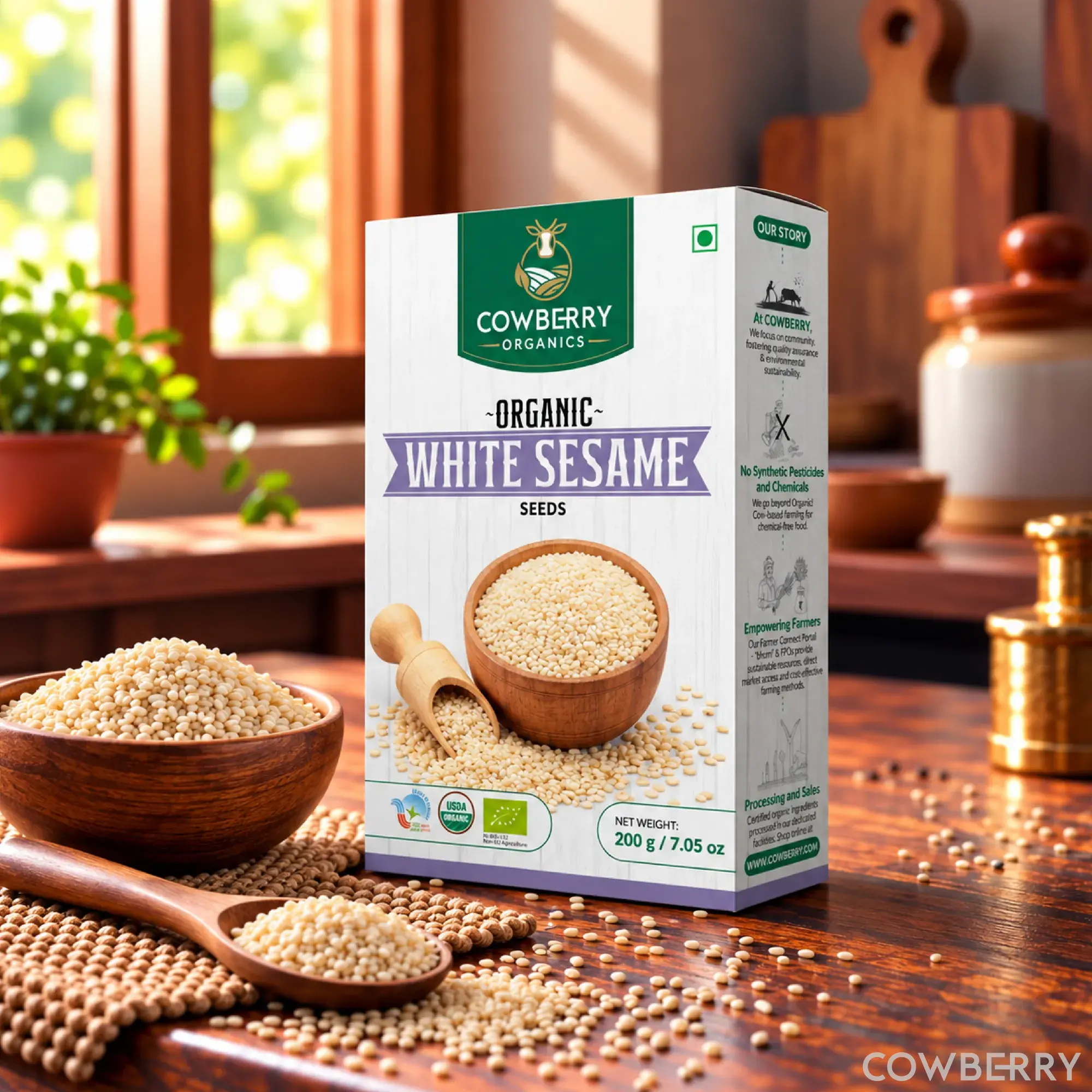
COWBERRY's Organic White Sesame Seeds are organically grown on the black-soil plains of Madhya Pradesh and Gujarat, carefully cleaned and sorted, and packed at peak freshness; the seed is India Organic, USDA & EU certified. That is the white seed every page of this hub is written around.
FAQs
What is sesame seeds?
Sesame is the seed of Sesamum indicum, called til in Hindi and recorded in IFCT 2017 as 'Gingelly seeds, white'. A 2022 review in Nutrients places it among the earliest oil crops humans used; the seed is eaten whole, dry-roasted and as til oil, with its nutrients in the table above.
Is sesame seeds good for health?
On the numbers, yes: 520 kcal, 21.7 g of protein and 1283 mg of calcium per 100 g, with 15 mg of iron and 17 g of fibre. Controlled trials also showed lower blood pressure and triglycerides with sesame, though cholesterol did not change significantly. It is food, not medicine; the details are in the benefits section.
Which sesame seeds are good white or black?
IFCT 2017 gives white, brown and black sesame an entry each and puts no colour above the rest. The entry behind this hub's numbers is the white seed's — the sesame COWBERRY sells, grown in Madhya Pradesh and Gujarat, and the same seed the til ke laddu recipe uses.
How sesame seeds grow?
The sesame plant is widely grown, per a 2022 review in Nutrients. COWBERRY's white sesame comes from the black-soil plains of Madhya Pradesh and Gujarat, where warm temperatures and organic farming suit the crop; the seed is grown without synthetic pesticides.
What foods contain sesame seeds?
Til ke laddu, the jaggery-bound sweet; a sprinkle of raw or roasted seed over curd, salads, sabzis and dals; the soaked seed ground into chutney; and til oil pressed from the same seed for tadka and stir-fries. The recipe and the methods are linked in the sections above.
Does sesame seeds have calcium?
Yes: 1283 mg of calcium per 100 g of white sesame (IFCT 2017), and a 20 g portion gives 257 mg. The dietary guidelines also list til among calcium-rich foods, alongside milk and curd.
References
- Indian Food Composition Tables (IFCT) 2017, ICMR-National Institute of Nutrition
- Dietary Guidelines for Indians, ICMR-National Institute of Nutrition
- Wei P, Zhao F, Wang Z et al. Sesame (Sesamum indicum L.): a comprehensive review of nutritional value, phytochemical composition, health benefits, development of food, and industrial applications. Nutrients, 2022
- Khosravi-Boroujeni H, Nikbakht E, Natanelov E, et al. Can sesame consumption improve blood pressure? A systematic review and meta-analysis of controlled trials. J Sci Food Agric, 2017
- Khalesi S, Paukste E, Nikbakht E, et al. Sesame fractions and lipid profiles: a systematic review and meta-analysis of controlled trials. Br J Nutr, 2016
Shop this article
Keep reading
Coriander water benefits: what dhania water actually does
Peanuts in Hindi (moongfali): groundnut names in Indian languages
Coriander vs cilantro: are they the same herb?