by COWBERRY

9 minute read
Is red rice good for diabetes? GI 46 to 76 and the honest verdict

Is red rice good for diabetes? It can be, as a measured portion that replaces white rice, never as an extra bowl. Plain cooked unpolished red rice averages a GI of 62 across seven database tests (spread 46 to 76), and the nearest IFCT 2017 entry lists 77.16 g of carbohydrate per 100 g. The grain itself sits on the red rice hub.
Short answer: is red rice good for diabetes?
Red rice earns a place on a diabetes plate only when two things hold: the katori is measured, and the grain swaps in for the white rice or refined-wheat food rather than joining it. The advantages are real but modest — fibre in the bran, and pigmented-rice trials pointing the same way, detailed below.
The limits are just as real. Red rice is a carbohydrate food, and its average GI of 62 belongs to the medium band, not the low one. Two katoris, or a sweetened kheer, will move blood glucose like any other rice. So red rice can sit inside a diabetes diet; it does not manage the condition on its own, and it does not stand in for medication. The wider picture of the grain, side effects included, is on red rice benefits and side effects.
Glycemic index of red rice: 46 to 76, not one number
The table under this section comes from IFCT 2017, shown per 100 g of raw grain, and it needs a preface: the tables carry no red-rice row, so this column borrows the closest entry, parboiled milled rice, while the GI tests below are of unpolished red rice. For diabetes, watch the carbohydrate, fibre and GI columns as one set.
Seven tests, no single number
Seven entries for plain cooked red rice sit in the University of Sydney database, gathered in the UK, Indonesia and Malaysia — none tested in India. They spread from 46 to 76, and their mean is 62. By the database's cut-offs, low runs 55 and below, high 70 and above, so the average falls in the medium band even while individual tests land on either side of it. So no one GI stands for red rice: a 2023 review in Foods finds the GI of rice shifts with variety, composition, processing and whatever it is eaten with.
Carbohydrate and fibre in a real portion
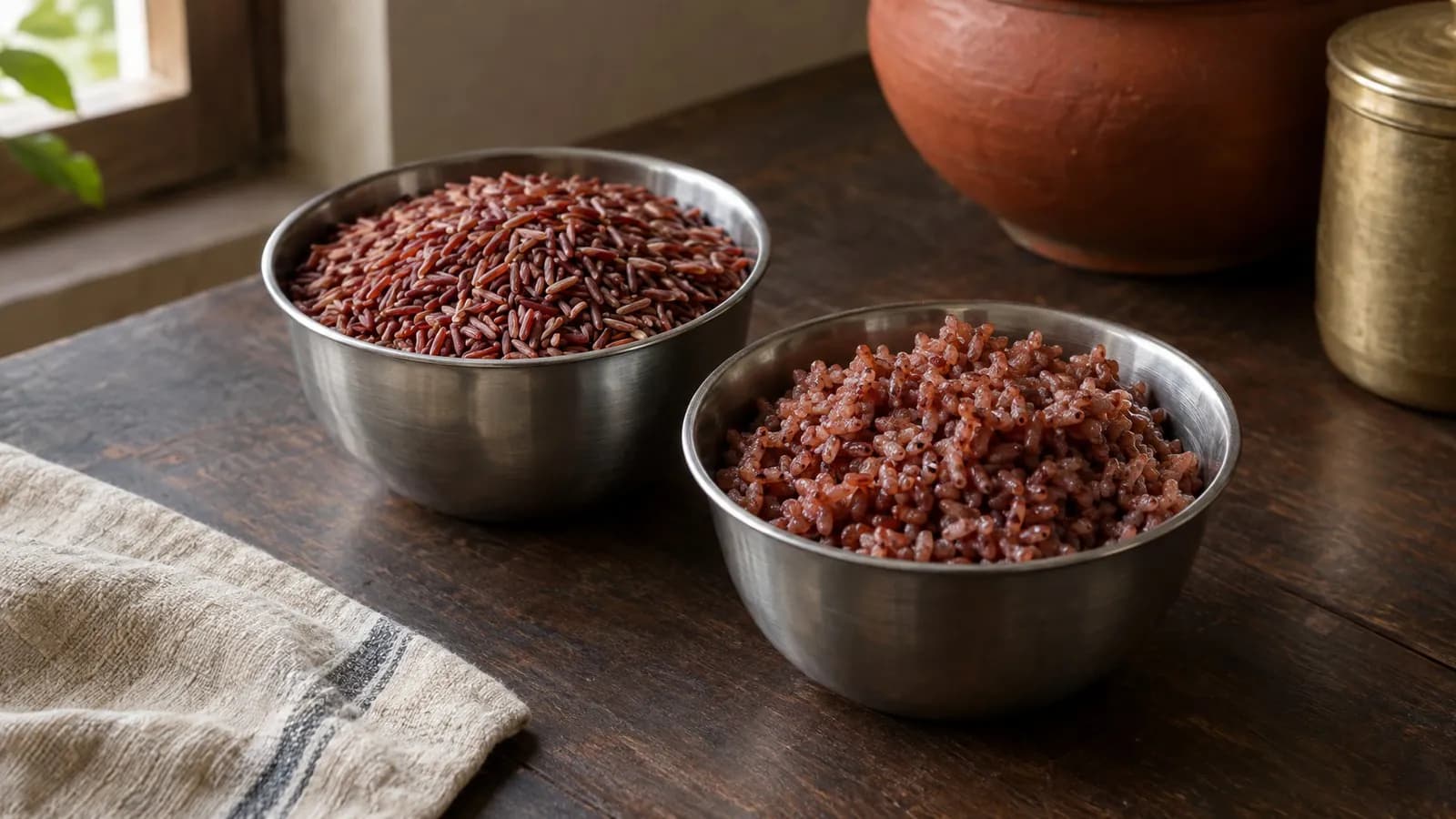
For the test itself, ten or more people eat a set portion carrying 50 g of digestible carbohydrate, and their blood glucose over the next two hours is what the number sums up — so the figure describes the grain as tested, not your meal. Cook a katori of red rice from about 40 g of raw grain and it lands on about 31 g of carbohydrate, 1.5 g of fibre and 141 kcal. The rice also lists 3.74 g of fibre per 100 g, and the dietary guidelines explain what that fibre does: it delays carbohydrate and fat absorption and adds to satiety. That is the argument for the measured katori: the second one doubles the carbohydrate. The full per-100 g breakdown lives on red rice nutrition per 100g.
| Nutrient | Red rice (parboiled, milled) |
|---|---|
| Energy (kcal) | 352 |
| Protein (g) | 7.8 |
| Fat (g) | 0.6 |
| Carbohydrates (g) | 77 |
| Dietary fibre (g) | 3.7 |
| Iron (mg) | 0.7 |
| Calcium (mg) | 8.1 |
| Magnesium (mg) | 27 |
| Potassium (mg) | 142 |
| Sodium (mg) | 3.2 |
| Zinc (mg) | 1.1 |
| Folate (mcg) | 9.8 |
| Glycemic index (GI) | 62 |
Per 100 g raw, edible portion. Composition: IFCT 2017 (ICMR-NIN). GI: University of Sydney GI database. — means not reported. These are average values for the food; the label on a pack gives the values for that product.
What the research says about pigmented rice and blood sugar
Mendoza-Sarmiento and colleagues pooled seventeen pigmented-rice randomised controlled trials in a 2023 systematic review in Current Nutrition Reports. In the acute trials, one pigmented-rice meal pushed plasma antioxidant activity up and after-meal glucose and insulin down. In the longer trials, pigmented rice tracked with slightly lower fasting glucose, weight and diastolic (lower-number) blood pressure; total cholesterol, LDL, HDL, triglycerides and body mass index did not change. The authors caution that the studies are few and their designs differ, so these numbers are early rather than final.
Two nearby findings complete the picture. A 2022 meta-analysis in BMJ Open found that people who ate white rice heavily carried a higher type 2 diabetes risk, and those who ate brown rice a lower one; red rice was not part of it. And a 2017 Sri Lankan study of red and white basmati sorts the red ones as low GI and the white as medium; polishing made no difference to the GI. Red basmati is one kind of red rice, not all of it — the seven database tests above show how wide the family spreads.
How much red rice and how to eat it
Portion first, then pairing, then the plate.
How much
One katori of cooked red rice per meal, from about 40 g of raw grain, standing in for whatever rice or roti that meal usually has. That katori works out to about 31 g of carbohydrate, and at a GI of 62 its glycemic load is about 19 — check both against the carbohydrate allowance your dietitian has set. ICMR-NIN's general daily plate, not a diabetes plan, shows 250 g of cereals and asks that at least half of them be whole grains; red rice counts toward that half, and your own cereal total is for your dietitian to set.
What to eat it with
The dal and sabzi do half the work. The guidelines pair cereals with pulses in a 3:1 ratio, and say adequate intake of fibre-rich foods — pulses, whole grains, vegetables, fruit — supports steadier blood glucose, insulin and blood-fat levels. Red rice under dal, sambar and greens, or as a khichdi with moong dal, is that pattern on one plate.
How to cook it
Wash the grains well, but do not repeat the washing — the guidelines warn that repeated washing of rice loses minerals and vitamins. Cook the rice in one measure of rice to two of water; COWBERRY's product page suggests 30 to 40 minutes of cooking for the grains to soften. The red rice hub carries the full cooking method.
Red rice against the rest of the rice shelf
Where does red rice sit among the rices a person with diabetes might choose?
- Against white rice: the swap is the point. Red rice keeps the whole-grain bran that polishing removes, and every katori of it stands in for a katori of polished rice. The average GI is not red rice's strongest card, so the case rests on the swap, not the number.
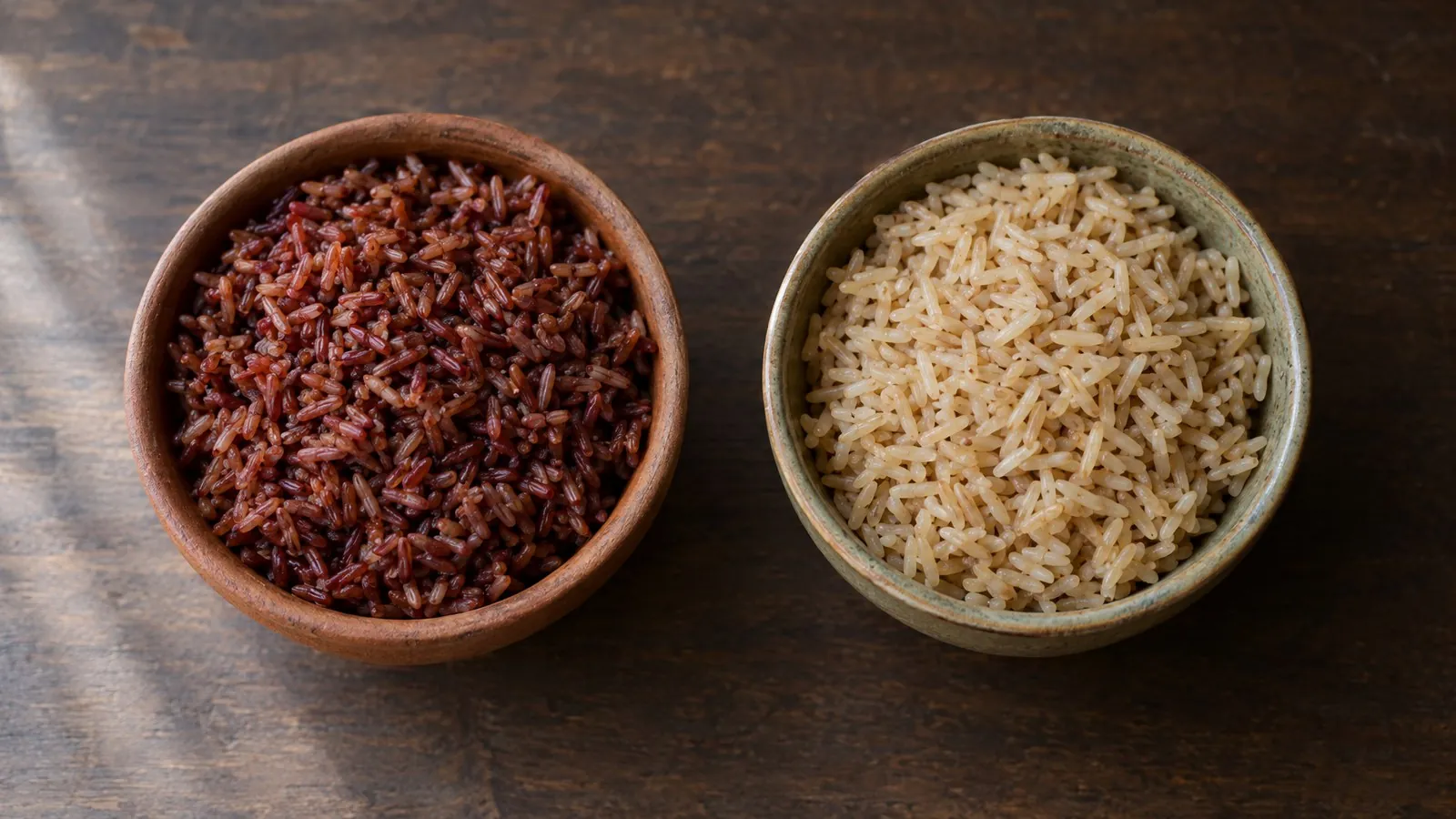
- Against brown rice: brown rice has more fibre per 100 g in IFCT 2017 and carries one GI tested in India; red rice's seven tests average 62 from abroad. The measured comparison is on red rice vs brown rice.
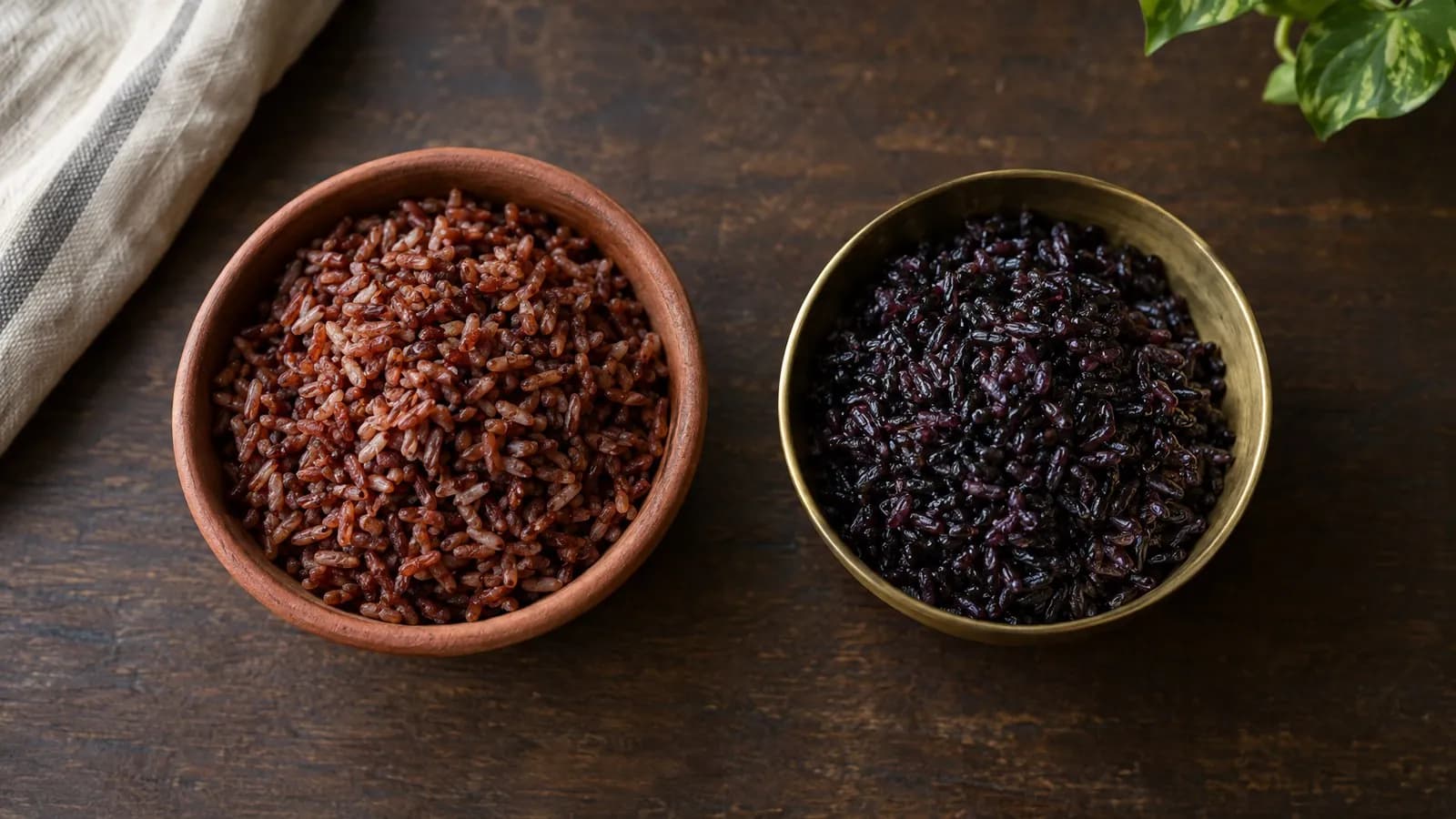
- Against black rice: black rice's three database tests average higher than red rice's mean of 62, though its fibre reads a little higher too. The side-by-side is on red rice vs black rice.
- The wider shelf: low GI rice in India ranks the common rices by tested GI, and types of rice in India walks through each grain.
What to avoid
- Changing your medication on your own. If your readings improve after the switch to red rice meals, take the log to your doctor; the dosing call is theirs.
- A second katori. Two katoris of cooked red rice are about 62 g of carbohydrate, which lands like any double rice portion.
- Sweetened red rice dishes. Kheer, pongal or payasam made with jaggery or sugar put the sugar on top of the grain's own carbohydrate.
- Red rice as an “extra”. Served beside the usual rotis and white rice, it doubles the cereal on the plate rather than replacing it.
- A sudden jump in fibre. If red rice suddenly appears at every meal, drink more water alongside; the guidelines note fibre increases stool bulk, and fluids help it along.
- The GI over your own meter. The database figure is an average of tests on other people; your reading two hours after your meal is the one that counts.
Talk to your doctor or dietitian
Diabetes care rests on three legs — the medication, the glucose readings and a food plan written for one person — and changing the daily rice moves all three. A change in your usual rice can move your readings in either direction, so talk the change through with your doctor and show your logbook at the next appointment. Ask a dietitian to set the rice portion against your carbohydrate budget and calorie needs. Give red rice a trial as part of that plan — and before it becomes your everyday rice, talk to your doctor or dietitian.
FAQs
Which red rice is good for diabetes?
Any whole, unpolished red rice, cooked plainly, in a measured katori. The database's seven tests of plain cooked red rice average a GI of 62 and come from outside India, so no Indian variety has a tested figure of its own; the bran-on grain is the one to buy. Check the label for whole grains and nothing added, and let your meter confirm your own response.
Can red rice increase blood sugar?
Yes. Red rice is a carbohydrate food, with 77.16 g of carbohydrate per 100 g, and its mean GI of 62 is in the medium band, so a meal of it raises blood glucose like any rice. How far the reading climbs follows the portion and the company on the plate: one katori under dal and sabzi is the gentle version; a sweetened or doubled portion is not.
Is Kerala red rice good for diabetes?
It can be, handled like any red rice: one measured katori standing in for white rice, nothing sweetened on it. The glycemic index database holds no entry tested in India for red rice of any origin, so there is no tested figure for Kerala red rice itself; the seven foreign tests, averaging 62, are the closest guide. Portion and pairing decide the meal, wherever the grain is grown.
Does red rice have a low glycemic index?
Not on the tested numbers. The seven database entries for plain cooked red rice run from 46 to 76, with a mean of 62 — medium on the University of Sydney's scale — while individual tests fall in the low band and some above it. Because the spread is wide, no single low-GI claim for red rice holds up — control the portion instead.
How much red rice can a diabetic eat per day?
One katori at a meal, cooked from about 40 g of the dry grain, standing in for the usual rice or roti — and the exact daily total is yours to set with your dietitian, since it follows your carbohydrate target, your medicines and your readings. For scale, ICMR-NIN's general daily plate, which is not a diabetes plan, shows 250 g of cereals, at least half of it whole grain; red rice can fill part of that half.
Is red rice better than brown rice for diabetes?
Neither wins outright. Brown rice lists more fibre per 100 g and carries one India-tested GI, in the medium band; red rice's seven foreign tests average 62, also medium. Red rice's case rests on the pigmented-rice evidence, brown rice's on its fibre and its tested number. The side-by-side numbers sit on red rice vs brown rice.
References
- Indian Food Composition Tables (IFCT) 2017, ICMR-National Institute of Nutrition
- Dietary Guidelines for Indians, ICMR-National Institute of Nutrition
- University of Sydney glycemic index database (GI search)
- University of Sydney: about the glycemic index
- Mendoza-Sarmiento D, Mistades EV, Hill AM. Effect of Pigmented Rice Consumption on Cardiometabolic Risk Factors: A Systematic Review of Randomized Controlled Trials. Curr Nutr Rep, 2023
- Yu J, Balaji B et al. White rice, brown rice and the risk of type 2 diabetes: a systematic review and meta-analysis. BMJ Open, 2022
- Ngo TV, Kunyanee K et al. Insights into recent updates on factors and technologies that modulate the glycemic index of rice and its products. Foods, 2023
- Somaratne GM, Prasantha BDR, Dunuwila GR, et al. Effect of polishing on glycemic index and antioxidant properties of red and white basmati rice. Food Chem, 2017
Shop this article
Keep reading
Red rice vs brown rice: the fibre, GI and honest verdict
Red rice vs black rice: nutrition, glycemic index and which to choose
Red rice nutrition per 100g: calories, protein, fibre and GI