by COWBERRY

10 minute read
Red rice (lal chawal): what it is, nutrition, benefits and cooking

Red rice is whole-grain rice with the red bran left on, sold in India as lal chawal. This page covers what makes it red, its names, nutrition per 100 g, a glycemic index that averages 62, benefits and side effects, soaking and cooking. Six deeper pages on this site take each thread further.
What is red rice?
Red rice is ordinary rice grown and kept unpolished: the hull is removed but the bran stays, and the bran is red. Botanically it is Oryza sativa, the species every rice on the shelf belongs to; what separates red rice is the pigment in its bran, not a different plant. COWBERRY's product page describes the rice as minimally processed so the red bran layer stays on, and the dietary guidelines say at least half of the day's cereals should be whole grains — with the bran on, red rice counts toward that half.
Unpolished against polished is the real contrast: polished white rice has the bran milled away, and with it the pigments, the fibre and a share of the minerals; red rice keeps the layer. How red rice compares with every other grain on the shelf is on types of rice in India, and where it sits on the blood-sugar scale is on low GI rice in India.
Lal chawal: the names of red rice in India
In Hindi, red rice is lal chawal — lal means red, chawal means rice. One honest note before the table: IFCT 2017 carries no red-rice entry, so the names table below uses the nearest IFCT 2017 entry, parboiled milled rice, and only the English cell has been corrected to red rice. The other cells show that entry's own names — the words each language uses for parboiled rice, not for red rice — so the table's Hindi cell reads Usna chawal, the parboiled word, rather than lal chawal. The regional names on COWBERRY's product page are: Lal Chawal, Lal Tandul, Lal Chokha, Lal Akki, Lal Arisi, Lal Biyyam, Chuvanna Ari, Kempu Akki and Sivappu Arisi.
The botanical name is Oryza sativa. The Hindi side of this grain — what is lal chawal, its fayde and nuksan — sits on lal chawal khane ke fayde aur nuksan.
| Language | Name (romanised) |
|---|---|
| English | Red rice |
| Hindi | Usna chawal |
| Marathi | Ukadla tandool |
| Gujarati | Bafela Chokha |
| Punjabi | Biga hua chawal |
| Bengali | Siddha chowl |
| Odia | Usuna chaula |
| Assamese | Ukhua chaul |
| Kannada | Kusubalakki |
| Telugu | Uppudu biyyam |
| Tamil | Puzhungal arisi |
| Malayalam | Puzhungal ari |
| Urdu | — |
| Sanskrit | — |
| Botanical name | Oryza sativa |
Source: IFCT 2017 (ICMR-NIN) local-names list. — means no name recorded in the source.
English: IFCT 2017 prints ‘Rice, parboiled, milled’; ‘Red rice’ per Wikipedia: Red rice.
Why red rice is red
The red comes from pigments in the bran: COWBERRY's product page calls the grain naturally rich in anthocyanins, the plant pigments that also give several fruits and grains their deep reds and purples. In 2017, Sri Lankan researchers put numbers to the difference — the red sort scored higher on total phenolics, total anthocyanins and antioxidant activity than the white sort, while polishing left the glycemic index of both unchanged. Mill the bran away and the rice turns white, because the colour lives in the layer that polishing removes.
Red rice nutrition per 100 g
The table below shows the red column beside brown rice and raw milled white rice, all per 100 g of raw grain, with the standing caveat: IFCT 2017 carries no red-rice entry, so this column uses the figures of the nearest IFCT 2017 entry, parboiled milled rice, and the figures are indicative rather than a measured profile of one variety. The column reads 352 kcal, 7.81 g of protein, 0.55 g of fat, 77.16 g of carbohydrate, 3.74 g of fibre, 26.72 mg of magnesium, 142 mg of potassium, 0.72 mg of iron, 1.08 mg of zinc and 8.11 mg of calcium.
Cooked portions scale from those dry numbers: one katori, cooked from about 40 g of dry grain, comes to roughly 141 kcal and 31 g of carbohydrate once the cooking water is weighed in. The full per-100 g page — calories, protein, fibre, GI and the micronutrient list — is red rice nutrition per 100g.
| Nutrient | Red rice (parboiled, milled) | Brown rice (raw) | White rice (raw, milled) |
|---|---|---|---|
| Energy (kcal) | 352 | 354 | 357 |
| Protein (g) | 7.8 | 9.2 | 7.9 |
| Fat (g) | 0.6 | 1.2 | 0.5 |
| Carbohydrates (g) | 77 | 75 | 78 |
| Dietary fibre (g) | 3.7 | 4.4 | 2.8 |
| Iron (mg) | 0.7 | 1 | 0.7 |
| Calcium (mg) | 8.1 | 11 | 7.5 |
| Magnesium (mg) | 27 | 94 | 19 |
| Potassium (mg) | 142 | 199 | 108 |
| Sodium (mg) | 3.2 | 3.6 | 2.3 |
| Zinc (mg) | 1.1 | 1.7 | 1.2 |
| Folate (mcg) | 9.8 | 12 | 9.3 |
| Glycemic index (GI) | 62 | 58 | 50 |
Per 100 g raw, edible portion. Composition: IFCT 2017 (ICMR-NIN). GI: University of Sydney GI database. — means not reported. These are average values for the food; the label on a pack gives the values for that product.
Red rice glycemic index: 46 to 76
One number cannot carry the grain: the University of Sydney database holds seven GI tests of plain cooked red rice, run in the UK, Indonesia and Malaysia — none in India — and they range between 46 and 76, with a mean of 62. The database counts 55 and below as low, 70 and above as high, which puts the mean in the middle while the seven tests land on both sides of it. A 2023 review in Foods adds that a rice's GI moves with its variety, composition, processing and what accompanies it on the plate, so the number is a guide, not a verdict.
Served as a katori with about 31 g of carbohydrate, the mean GI of 62 works out to a glycemic load of about 19. For a diabetes plate, the portion and what sits beside the rice move the reading more than the colour, and the full arithmetic lives on is red rice good for diabetes. The two colour comparisons have their own pages: red rice vs black rice, and for the brown comparison red rice vs brown rice.
Red rice benefits in short
The wider benefits page takes each of these further; here is the honest short version.
A whole grain with the bran on
The bran is where red rice's story lives — COWBERRY's red rice keeps the layer intact through minimal processing, and the guidelines want whole grains to fill at least half of the day's cereals — a share red rice can take.
3.74 g of fibre per 100 g
Its 3.74 g of fibre per 100 g sits about a third above raw milled rice's 2.81 g; the guidelines credit fibre with slower absorption of carbohydrate and fat, added satiety and stool bulk.
Anthocyanins in the red bran
The pigments are measured, not marketing: in a 2017 study, Sri Lankan researchers found red basmati higher than white in total phenolics, anthocyanins and antioxidant activity.
Protein completed by dal
7.81 g of protein per 100 g, short on lysine like all cereal protein; the guidelines' fix is cereals with pulses at three to one, which together cover all the essential amino acids.
Naturally gluten-free and low-sodium
COWBERRY's product page lists the grain as naturally gluten-free, and its 3.16 mg of sodium per 100 g leaves the salt to the cook.
The full list, with side effects and portions, is on red rice benefits and side effects.
Red rice side effects in brief
Red rice's side effects are the side effects of fibre and of rice as a crop, and they are dose-dependent. The fibre — 3.74 g per 100 g — can mean gas and bloating for a fast switcher, so start with a smaller katori and drink more water alongside the fibre. The bran carries phytic acid, which can bind iron and zinc; normal boiling or pressure cooking brings it down substantially, per the guidelines, and soaking improves digestibility. And rice takes up arsenic from soil and water: a 2019 review notes that polishing, sequential washing and excess-water cooking all reduce it in the cooked grain, with a US FDA study measuring 40 percent removal for polished rice, 60 percent for parboiled and 50 percent for brown. If you live with diabetes, kidney disease or another condition where fibre, carbohydrates or minerals matter, talk to your doctor or dietitian before switching your rice. The full side-effect list is on red rice benefits and side effects.
Soaking, cooking time and storage
No soak step appears in the references: the product page's method is to rinse the rice thoroughly and cook it with a 1:2 rice-to-water ratio for about 30 to 40 minutes on the stove. A soak remains optional — the guidelines list soaking among the processes that improve the digestibility and bioavailability of nutrients from whole grains — but the product page lists no soak time, and none is invented. Wash well once, not repeatedly: repeated washing strips rice of minerals and vitamins, per the same guidelines. Storage follows the product page's own line: keep red rice in a sealed container somewhere cool and dry, where the dry grain keeps for many months. Cooked red rice keeps for up to two days in the fridge, per the UK Food Standards Agency's leftover guidance.
How to eat red rice
Plain and boiled is the everyday form: rinse once, cook at 1:2 for 30 to 40 minutes, and the grain comes out firm and nutty — the texture and flavour the product page describes. The same product page points cooked red rice toward salads, where the firm texture holds up. On the Indian plate, red rice takes the same job as white rice — dal-chawal, sambar rice, curd rice — with the pulse pairing doing the protein work described above. That salad suggestion is the simplest recipe to start from — the grain's firm texture and nutty flavour are built for it.
Buying red rice
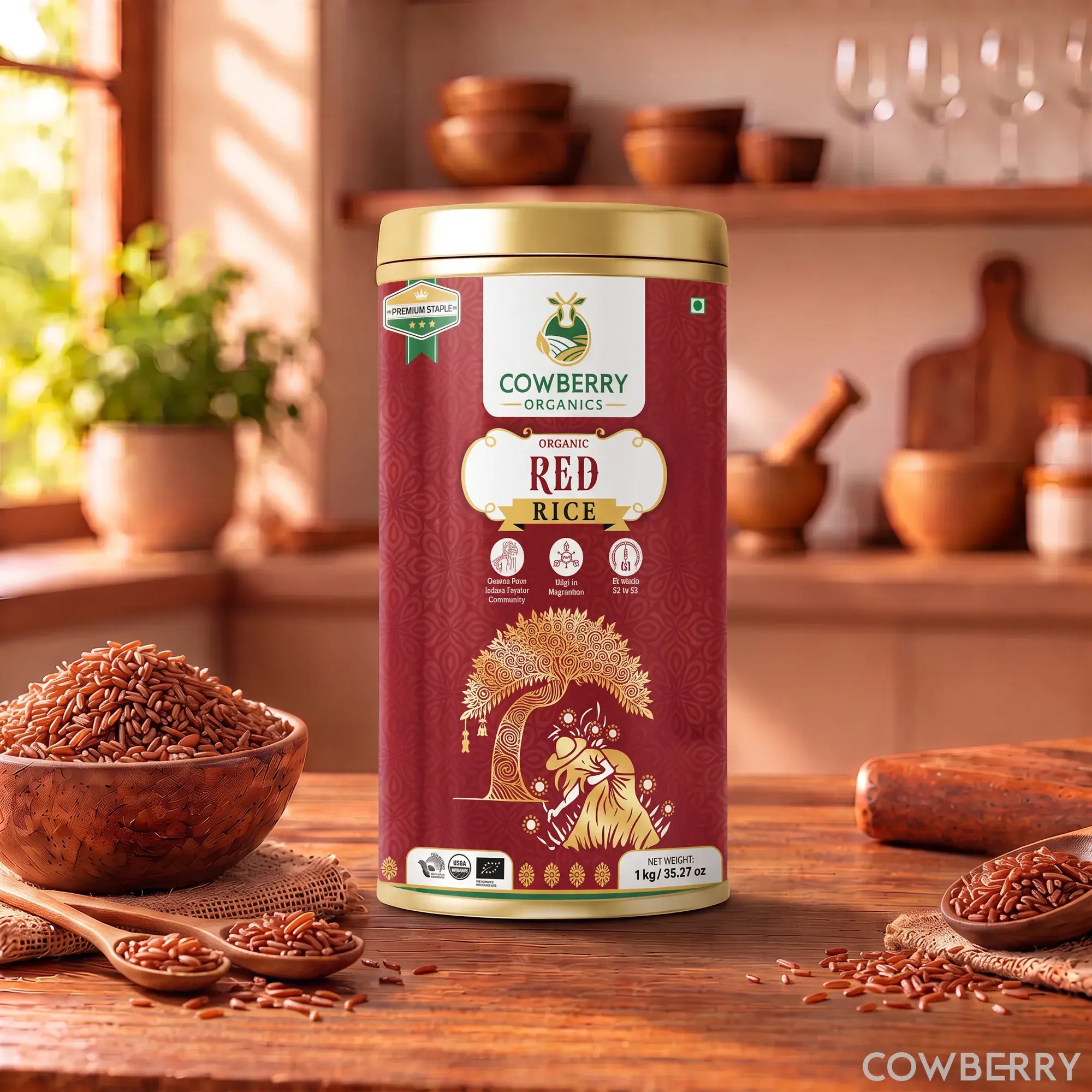
When you buy red rice, look for two things on the pack: that the grain is described as unpolished or bran-intact, and that a certification mark is shown on the label — the mark is the shopper's evidence that the claim was checked, since the colour of the grain alone is not proof. COWBERRY's organic red rice is grown in Kerala and Tamil Nadu without synthetic chemicals and is India Organic, USDA & EU certified, with the grain minimally processed to keep the red bran layer intact. Whatever pack you choose, the portion guidance on this page stays the same.
FAQs
What is red rice?
Red rice is whole-grain rice with the bran still on, and the bran is red because it carries anthocyanin pigments. COWBERRY's organic red rice keeps the bran: the product page describes minimal processing with the red bran layer intact, and counts anthocyanins among its natural riches. It is not a separate species — it is Oryza sativa, the rice species, grown unpolished. Everything else — nutrition, GI, cooking — follows from the bran staying on.
Why red rice is red?
From the pigments in its bran: anthocyanins, the red plant pigments the product page counts among red rice's natural strengths. In a 2017 study, Sri Lankan researchers recorded higher total anthocyanins, phenolics and antioxidant activity in the red sort than in the white. Polished white rice lacks the bran and, with it, the colour.
What is lal chawal?
Lal chawal is Hindi for red rice: lal means red and chawal means rice, so lal chawal in English is red rice. The same grain travels under the regional names on COWBERRY's product page — Lal Tandul, Lal Chokha, Lal Akki, Lal Arisi, Lal Biyyam, Chuvanna Ari, Kempu Akki and Sivappu Arisi. The lal chawal khane ke fayde aur nuksan page tells the same story in Hinglish.
Does red rice need to be soaked?
No: the method on the product page is a thorough rinse and cooking at a 1:2 rice-to-water ratio for about 30 to 40 minutes. The dietary guidelines do note that soaking is one of the processes that improve the digestibility of whole grains, so a soak before cooking is optional, not required.
Is red rice good for diabetes?
It is a medium-GI whole grain, not a special diabetes rice: seven published GI tests of plain cooked red rice, all from outside India, run between 46 and 76 and average 62. The portion and the rest of the plate move your reading at least as much as the grain. The katori arithmetic and the plate pairings sit on the page is red rice good for diabetes.
Can red rice be soaked overnight?
Nothing in the references lists an overnight soak for red rice; the product page asks for a rinse and then cooking at a 1:2 ratio for 30 to 40 minutes. The guidelines list soaking among the processes that improve the digestibility and bioavailability of nutrients in whole grains, so any soak you add is optional, and no soak time is given.
Can red rice cause constipation?
Not by itself — the risk usually sits on the other side. Its 3.74 g of fibre per 100 g increases the bulk of the stools, an effect the dietary guidelines credit to fibre, so the grain is more likely to help than hinder; drink plenty of water alongside the fibre. If constipation persists, ask your doctor or dietitian.
References
- Indian Food Composition Tables (IFCT) 2017, ICMR-National Institute of Nutrition
- Dietary Guidelines for Indians, ICMR-National Institute of Nutrition
- University of Sydney glycemic index database (GI search)
- University of Sydney: about the glycemic index
- Ngo TV, Kunyanee K et al. Insights into recent updates on factors and technologies that modulate the glycemic index of rice and its products. Foods, 2023
- Somaratne GM, Prasantha BDR, Dunuwila GR, et al. Effect of polishing on glycemic index and antioxidant properties of red and white basmati rice. Food Chem, 2017
- Gray PJ, Conklin SD, Todorov TI, et al. Cooking rice in excess water reduces both arsenic and enriched vitamins in the cooked grain. Food Addit Contam Part A Chem Anal Control Expo Risk Assess, 2016
- Kumarathilaka P, Seneweera S, Ok YS, et al. Arsenic in cooked rice foods: Assessing health risks and mitigation options. Environ Int, 2019
- Gupta RK, Gangoliya SS, Singh NK. Reduction of phytic acid and enhancement of bioavailable micronutrients in food grains. J Food Sci Technol, 2015
- UK Food Standards Agency: How to chill, freeze and defrost food safely
Shop this article
Keep reading
Red rice vs brown rice: the fibre, GI and honest verdict
Red rice vs black rice: nutrition, glycemic index and which to choose
Red rice nutrition per 100g: calories, protein, fibre and GI