by COWBERRY

11 minute read
Black rice (kala chawal): what it is, nutrition, benefits and cooking

Black rice is a whole rice with a deep, almost purple-black bran, grown in Manipur and the broader Northeast, and in Hindi it is kala chawal. The USDA record lists 370 kcal, 4.2 g of fibre and 113 mg of magnesium per 100 g; its three GI tests average 91. The sections that follow cover what makes it black, the benefits and their limits, cooking, storage and buying.
What is black rice
Black rice is a variety of pigmented rice — Oryza sativa, the rice species — sold as an unpolished whole grain whose outer bran runs deep purple to black. The colour comes from anthocyanins, the dark pigments a 2019 Food Chemistry review names among its components; polished white rice loses exactly that layer, which is also where much of the grain's fibre and minerals sit. COWBERRY's listing calls the taste earthy and mildly nutty, and the deep colour is the point of the grain.
How the grain is made is simple: after harvest the rice is hulled but not polished, so the dark bran stays on every grain — the opposite of white rice, which is milled and polished until only the pale core remains. In India the grain is grown in Manipur and the broader Northeast belt, where COWBERRY sources its black rice. The other name you will hear is kala chawal, the Hindi name for the same grain, and the listing records the older story: black rice was once reserved exclusively for royalty, and the grain is also called forbidden rice — a rarity story, not a claim about the grain's powers. It sits in the family beside the other whole rices — types of rice in India maps the shelf.
Black rice names in Indian languages
Name first: in Hindi the grain is kala chawal, and in English the USDA food database records it as Rice, black, unenriched, raw. The word "unenriched" in that label is the database's own: it means no vitamins were added back to the grain after milling, unlike some enriched white rices. That USDA record is the source for the names table below, and it lists no Indian-language names, so the table shows only the English entry. The product listing, by contrast, carries a long alias list for the same grain — forbidden rice, emperor's rice, kala chawal, kala tandul, kala bhat, kala akki, karuppu arisi, karutha ari, nalla biyyam and kalo chal — the grain travels under many regional names even though the database records one. Where Hindi is the everyday language, the Hindi page kala chawal khane ke fayde carries the same facts in Hinglish.
| Language | Name (romanised) |
|---|---|
| English | Rice, black, unenriched, raw |
| Hindi | — |
| Marathi | — |
| Gujarati | — |
| Punjabi | — |
| Bengali | — |
| Odia | — |
| Assamese | — |
| Kannada | — |
| Telugu | — |
| Tamil | — |
| Malayalam | — |
| Urdu | — |
| Sanskrit | — |
| Botanical name | — |
Source: USDA FoodData Central record 2710825 (English and scientific name only; no Indian-language names in source). — means no name recorded in the source.
Black rice nutrition per 100 g
The numbers below come from two sources, and the split matters. IFCT 2017, the Indian tables, carry no black-rice entry, so the black column is a USDA FoodData Central record; the white column is an IFCT 2017 entry, raw milled rice standing in for everyday white rice. Per 100 g of raw grain the record lists 370 kcal, 4.2 g of fibre and 7.57 g of protein; the table below fills in the rest of the set. The minerals lead the story: magnesium 113 mg, potassium 256 mg, iron 1.12 mg, zinc 1.72 mg and calcium 14 mg per 100 g. The record also shows what the grain does not have: it lists sodium at zero, and carries no value for folate or vitamin C in the raw grain. Fat is the widest gap between the two grains — 3.44 g in black rice against 0.52 g in white rice — still small next to what the cooking itself adds.
One katori of cooked black rice, made with about 40 g of raw grain, holds about 148 kcal, with 1.7 g of fibre, 3 g of protein and 31 g of carbohydrate; a second katori doubles the plate. The full table and every figure sit on black rice nutrition per 100g.
| Nutrient | Black rice (raw) | White rice (sona masoori), raw |
|---|---|---|
| Energy (kcal) | 370 | 357 |
| Protein (g) | 7.6 | 7.9 |
| Fat (g) | 3.4 | 0.5 |
| Carbohydrates (g) | 77 | 78 |
| Dietary fibre (g) | 4.2 | 2.8 |
| Iron (mg) | 1.1 | 0.7 |
| Calcium (mg) | 14 | 7.5 |
| Magnesium (mg) | 113 | 19 |
| Potassium (mg) | 256 | 108 |
| Sodium (mg) | 0 | 2.3 |
| Zinc (mg) | 1.7 | 1.2 |
| Folate (mcg) | — | 9.3 |
| Glycemic index (GI) | 91 | 72 |
Per 100 g raw, edible portion. Composition: USDA FoodData Central (Foundation), FDC ID 2710825, NDB 100349; IFCT 2017 (ICMR-NIN). GI: University of Sydney GI database. — means not reported. These are average values for the food; the label on a pack gives the values for that product.
Benefits of black rice
Black rice benefits rest on four legs, each with a number behind it.
Fibre
At 4.2 g per 100 g, black rice carries about one-and-a-half times the fibre of white rice, and the dietary guidelines spell out what fibre does: it slows the absorption of carbohydrates and fats, adds satiety and stool bulk, and sits behind steadier glucose, insulin, cholesterol and triglyceride levels.
Anthocyanins and the trials
The dark pigments are real components — the 2019 review names anthocyanins, phenolic compounds, dietary fibre, vitamins and minerals. On people, the evidence is modest and not black-rice-specific: a 2023 systematic review of seventeen pigmented-rice trials — the coloured family black rice belongs to — found a single meal raised plasma antioxidant activity and brought after-meal glucose and insulin down, and weeks of intake tracked slightly lower fasting glucose, weight and diastolic blood pressure — small studies, and the authors ask for more.
Minerals
Magnesium 113 mg against white rice's 19.3 mg, potassium 256 mg against 108 mg, iron 1.12 mg against 0.65 mg, zinc 1.72 mg against 1.21 mg — the bran keeps what polishing removes.
Protein, dal and gluten
Black rice carries 7.57 g of protein per 100 g — cereal protein, which the guidelines complete with one pairing: cereals with pulses at 3:1 lift the protein quality of a meal, which is where dal beside the rice earns its place. It is also naturally gluten-free, which fits kitchens that keep gluten out. The full list, with the side effects, is on black rice benefits and side effects.
Side effects: who should limit black rice
Three honest caveats follow the grain, and none of them should scare a measured plate away.
- The fibre start. Jumping from polished rice straight to 4.2 g of fibre in every 100 g can bring gas, bloating or loose motions at first; add black rice one katori at a time and give the gut room to adjust.
- Phytic acid. Phytic acid sits in the 2019 review's component list, and it binds minerals like iron and zinc, cutting their uptake; soaking and fermenting bring it down.
- The GI. The database's three tests of plain cooked black rice — 64, 100 and 109 — average 91, which the University of Sydney scale counts as high, and no test among the three was run in India, so portion discipline matters; people managing diabetes should talk to their doctor or dietitian about the swap. The numbers are on black rice for diabetes, and India-tested figures across the family are on low GI rice in India.
For most kitchens all three caveats come down to the same fix: start with one measured katori and let the week decide.
How to cook black rice
Black rice cooks like other whole rices, with two steps that decide the pot.
Rinse, but once
Wash the grain well once before cooking — the point of washing, per the guidelines, is cleaning off pesticide residues and other extraneous material, and one good swirl does that.
Water and doneness
COWBERRY's own instruction is one cup of black rice to two cups of water — the 1:2 ratio — simmered until every grain is tender through the middle. There is no single set time — cooking time varies with the variety, so judge doneness, not the clock. A soak is not required: COWBERRY's instruction calls only for rinsing, and soaking overnight simply shortens the pot time and softens the grain, so count it as optional. Soaking also trims phytic acid, per a 2015 grain-processing review.
Arsenic, briefly
Rice takes up arsenic from soil and water. A 2016 study found that cooking in excess water — more than the grain absorbs, drained away — cut inorganic arsenic by 40 to 60 percent in the rices it tested, while a quick rinse alone changed little. The trade-off sits in the B vitamins: excess water washes added vitamins from enriched rice, and the USDA record calls black rice unenriched, so this grain has none to lose.
Serving and leftovers
Serve black rice the way you would any rice: with dal, sambar, rasam or a dry sabzi, and it also works in khichdi, cooked with dal in the same pot. Cooked black rice goes into the fridge and is best eaten within two days, per the UK Food Standards Agency's guidance on stored food. On occasion days its colour suits rice puddings; keep the added sugar small there.
How to store black rice
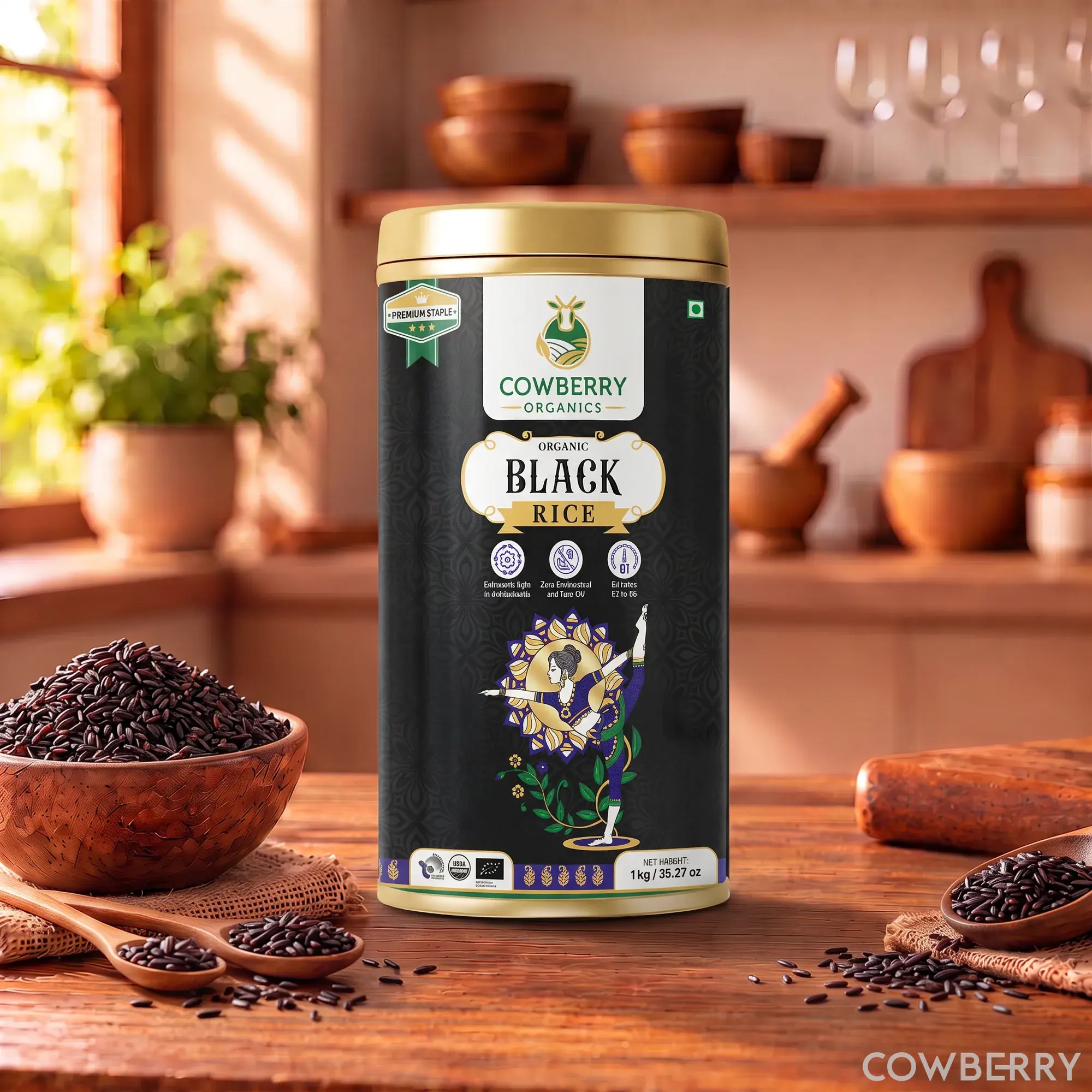
Dry black rice keeps like other whole grains: in an airtight container in a cool, dry place — COWBERRY's own guidance — and away from direct heat and light. The sealed lid is what does the work — it keeps moisture out, and moisture is what spoils a stored grain — so dry rice needs no refrigeration in an Indian kitchen. The bran keeps oils that polishing removes — the 2019 review lists functional lipids among black rice's components — so a sealed, cool, dark spot suits this grain more than polished white rice. Stored that way, the raw grain keeps for many months, so buy a pack size you will use up while it is fresh. COWBERRY's black rice comes in a 1 kg pack, which suits trying the grain before it becomes a staple. Cooked rice keeps by different rules: fridge, and eaten within two days.
Buying black rice: what to look for
On the shelf, look for whole, unbroken grains with the deep colour even across the pack — the pigment is the point of the grain, and a pack of dull, broken grains is a pack that has sat. The origin line should say where the rice was grown; COWBERRY's says Manipur and the Northeast. COWBERRY's own pack carries the certification line India Organic, USDA & EU certified, which pins down how the grain was grown; on other packs, look for a certification mark rather than vague words. A pack that names the variety and the state it was grown in tells you more than one that only says black rice. How it compares with the white grain is on black rice vs white rice, and against the red grain on red rice vs black rice.
FAQs
What is black rice?
Black rice is the unpolished whole rice whose outer bran runs deep purple to black from anthocyanins. In India it is grown in Manipur and the Northeast, and in Hindi it is kala chawal. Per 100 g the USDA record lists 370 kcal, 4.2 g of fibre and 113 mg of magnesium, and its three GI tests average 91.
What makes black rice black?
Anthocyanins — the dark plant pigments also found in blueberries. A 2019 Food Chemistry review lists anthocyanins as one of black rice's components, together with phenolic compounds and dietary fibre, and the pigment sits in the bran, which is why polished white rice loses the colour. The pigment is real and listed; it carries no medical promise by itself.
Why is black rice called forbidden rice?
The listing tells the old story: black rice was once reserved exclusively for royalty — a rarity story, not a health claim. The same grain is kala chawal in Hindi, and both names describe one rice. Nothing about the name changes the USDA numbers behind it.
Is black rice the same as forbidden rice?
Yes — forbidden rice is another name for the same grain; the listing's story has it once reserved exclusively for royalty. Nutrition-wise nothing changes: the USDA numbers (370 kcal, 4.2 g fibre, 113 mg of magnesium per 100 g) describe the same grain under either name.
What is kala chawal?
Kala chawal is simply the Hindi name for black rice — one grain, two names, and the same USDA numbers sit behind both. The listing carries the other aliases too, kala tandul and kala bhat among them. The full story in Hinglish sits on kala chawal khane ke fayde aur nuksan.
Should black rice be soaked overnight?
Not required — COWBERRY's instruction is simply rinse, cook at a 1:2 rice-to-water ratio, and judge by doneness, since time varies with the variety. A soak is optional: it shortens the pot time and softens the grain, so soak when the schedule suits. A soak also helps on the phytic-acid side, per a 2015 grain-processing review.
Is black rice available in India?
Yes — it is grown in Manipur and the broader Northeast, where COWBERRY sources its black rice, and it comes in 1 kg packs. It is a smaller specialty grain than white rice, so it usually costs more and is bought in smaller quantities, often for coloured dishes and occasion meals.
References
- USDA FoodData Central
- Indian Food Composition Tables (IFCT) 2017, ICMR-National Institute of Nutrition
- Dietary Guidelines for Indians, ICMR-National Institute of Nutrition
- University of Sydney glycemic index database (GI search)
- University of Sydney: about the glycemic index
- Mendoza-Sarmiento D, Mistades EV, Hill AM. Effect of Pigmented Rice Consumption on Cardiometabolic Risk Factors: A Systematic Review of Randomized Controlled Trials. Curr Nutr Rep, 2023
- Ito VC, Lacerda LG. Black rice (Oryza sativa L.): A review of its historical aspects, chemical composition, nutritional and functional properties, and applications and processing technologies. Food Chem, 2019
- Gupta RK, Gangoliya SS, Singh NK. Reduction of phytic acid and enhancement of bioavailable micronutrients in food grains. J Food Sci Technol, 2015
- UK Food Standards Agency: How to chill, freeze and defrost food safely
- Gray PJ, Conklin SD, Todorov TI, et al. Cooking rice in excess water reduces both arsenic and enriched vitamins in the cooked grain. Food Addit Contam Part A Chem Anal Control Expo Risk Assess, 2016
- Kumarathilaka P, Seneweera S, Ok YS, et al. Arsenic in cooked rice foods: Assessing health risks and mitigation options. Environ Int, 2019
Shop this article
Keep reading
Red rice vs brown rice: the fibre, GI and honest verdict
Red rice vs black rice: nutrition, glycemic index and which to choose
Red rice nutrition per 100g: calories, protein, fibre and GI