by COWBERRY

8 minute read
Moong dal for babies: from which month, how to cook and serve

Moong dal for babies can start soon after six months, when complementary feeding begins. The Dietary Guidelines for Indians open this stage with a thin but not watery dal gruel, and their six-to-eight-month chart builds a first meal of rice with dal. This page gives the month-wise portions, the first recipe and the form of moong to use, with the moong dal hub covering the dal itself.
From which month: moong dal for babies
Six months is the starting line, and the two guidance documents agree. The WHO recommends that infants start complementary foods at 6 months of age in addition to breast milk, moving through pureed, mashed and semi-solid foods, with two to three feeds a day between 6 and 8 months. The Dietary Guidelines for Indians ask for homemade semi-solid complementary foods soon after six months, and their worked example of a first food is a dal preparation: begin with a thin but not watery porridge, illustrated with dal gruel, for 4 to 5 days, then gradually increase its thickness to a well-mashed slurry.
The same Guidelines' diet chart for 6 to 8 months prints a meal of rice at 10 g with red gram dal at 5 g, and their weekly menu for the same age uses green gram dal at 5 g with bajra at 10 g. Before six months the recommendation is breast milk alone, so dal is not a food for a younger baby; the moong dal hub covers the dal's cooking and nutrition in full.
Moong dal for babies 6 months: the first recipe
The first bowl is the plainest possible: rinse a teaspoon (5 g) of yellow moong dal, the menu amount, boil or pressure cook it in water until the grains crush between two fingers, mash smooth and thin to a runny-paste texture — the dal gruel of the Guidelines, thin but not watery. Offer the same food daily for 4 to 5 consecutive days; the Guidelines say this settles acceptance and also shows whether there is any food intolerance or allergy. If the baby refuses a food, they advise reintroducing it after a few days, and seeking medical advice if an intolerance persists.
What stays out matters as much as what goes in. The Guidelines say sugar or salt need not be added to complementary foods, and they say added sugar must be totally avoided for children under two years. The chart's dal meals also carry oil or ghee at 5 g, about a teaspoon; feed from a clean spoon, and keep the food semi-solid rather than liquid.
What moong dal gives a baby
IFCT 2017 prints the raw green gram dal values per 100 g, shown in the table below; a baby eats far less, so read them through a small portion. The Guidelines' meal for a 9-to-12-month-old sets the dal at 10 g, and 10 g of moong dal carries about 2.4 g of protein and 33 kcal. Their food-group table allows a 7-to-12-month infant 12 g of pulses and beans a day, which a daily 10 g serving of moong dal nearly fills.
Protein quality counts as much as quantity. In a 2019 study in the American Journal of Clinical Nutrition, Indian children under two years digested mung bean protein less completely than the other complementary foods tested: mean true ileal digestibility was 65.2 percent for mung bean, against 78.5 percent for rice and 87.4 percent for egg. The same paper found that adding egg or milk to complementary diets theoretically improved their DIAAS from 80 to 100, and the authors stress including animal-source foods in these diets. The Dietary Guidelines agree: combining cereals with pulses in a ratio of 3:1 can meet the requirement for every essential amino acid, and adding milk improves the quality further.
| Nutrient | Green gram dal (moong dal) |
|---|---|
| Energy (kcal) | 326 |
| Protein (g) | 24 |
| Fat (g) | 1.4 |
| Carbohydrates (g) | 53 |
| Dietary fibre (g) | 9.4 |
| Iron (mg) | 3.9 |
| Calcium (mg) | 43 |
| Magnesium (mg) | 155 |
| Potassium (mg) | 1268 |
| Sodium (mg) | 10 |
| Zinc (mg) | 2.5 |
| Folate (mcg) | 92 |
| Glycemic index (GI) | 38 |
Per 100 g raw, edible portion. Composition: IFCT 2017 (ICMR-NIN). GI: University of Sydney GI database. — means not reported. These are average values for the food; the label on a pack gives the values for that product.
Nine to twelve months: more moong, more texture
The Guidelines' chart for 9 to 12 months steps the dal up, printing "any dal" at 10 g in the meal, and the WHO timeline moves with it: most infants can manage finger foods by 8 months, and by 12 months most can eat the family's foods. So the moong dal porridge for babies graduates — at six months a thin dal gruel, by nine months a soft dal-rice porridge, and near the first birthday dal with soft rice and well-cooked vegetables, mashed less and less. Two to three feeds a day at 6 to 8 months become three to four from 9 months onward, and the Guidelines' 9-to-12-month chart puts a pulse in each of its three meals. For more ways to work dal into these meals, the moong dal recipes roundup starts with khichdi.
Whole moong beans wait until the child chews well, and even then the bean should be soaked, cooked until soft and cut or mashed for a child under one; the WHO warns against foods in a form that may cause choking, naming whole grapes and raw carrots as examples.
Which moong for a baby: yellow first, then green, whole last
Start with yellow moong dal (dhuli): it is the skinned split dal, so there is no husk for a baby to chew, and it cooks soft in about 20 minutes and mashes smooth. Green split moong (chilka) keeps its green skin and brings more texture, so it suits an older baby who chews well, cooked until fully soft. Whole green moong comes last: soak the beans overnight, pressure cook until they crush easily, then cut or mash them for a child under one. IFCT 2017 prints one entry for green gram dal, the skinned kind, and a separate one for the whole bean; it has no entry for the skin-on split, so read chilka as sitting between the two. The full breakdown of all four forms is in the moong dal types guide.
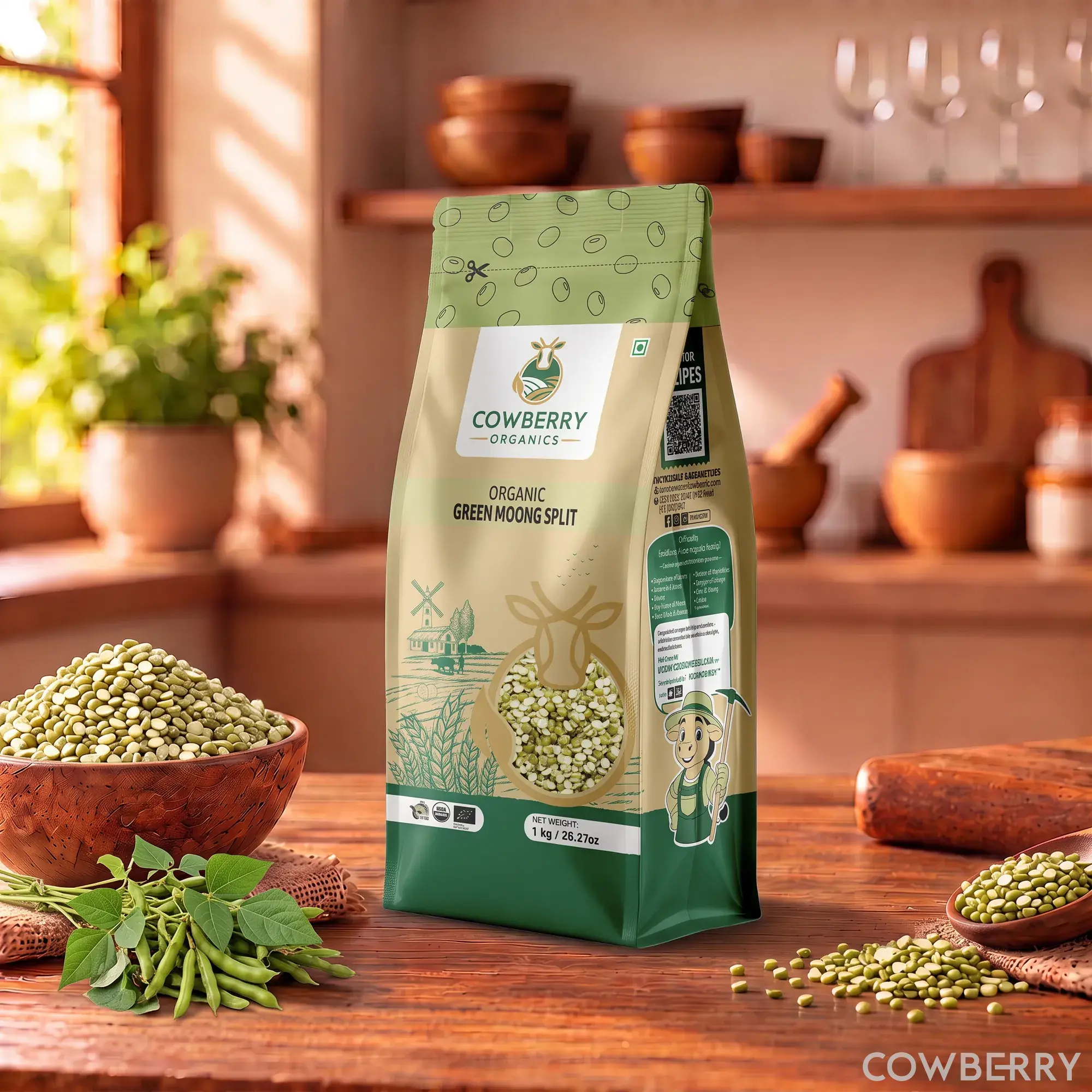
One form stays off the baby menu: raw sprouts. The US FDA says children should avoid raw or lightly cooked sprouts of any kind, moong sprouts included, because the warm, damp conditions in which sprouts grow suit bacteria; skip the sprouts for a baby and serve the cooked dal instead. A skin-on split like organic green moong split is a middle step for toddlers.
Introducing moong: one food at a time
Add moong dal on its own, not in a mix. The Guidelines advise introducing a new food one at a time and continuing it for 4 to 5 consecutive days, which lets acceptance build and makes any associated food intolerance or allergy easy to spot; only after that does another new food come in. If the child does not accept the dal, the same Guidelines say to reintroduce it after a few days, and to seek medical advice for diagnosis if an intolerance shows and persists. Their list of good protein sources for infants names pulses such as lentils, chickpea, kidney beans, cowpea and black gram; moong is not on that list, though their sample infant menus use green gram dal.
Because the dal becomes part of the baby's daily diet, talk to your paediatrician or doctor about when to start moong dal for your baby, the portion to begin with and what to watch for, especially if the family has a history of food allergy.
FAQs
Does moong dal have protein?
Yes, it does. IFCT 2017 prints 23.88 g of protein per 100 g of raw green gram dal, which makes a baby's 10 g portion about 2.4 g of protein. Green gram dal appears in the Dietary Guidelines' sample menus for infants, beside other pulses such as red gram dal, chana and lentil.
Can moong dal cause gas?
Pulses can cause gas in some people, though the research is on pulses in general, not on babies. It notes that most people who get flatulence adjust within a few weeks if the intake is kept up; for a baby, the practical answer is to start with a small portion, cook the dal until fully soft and watch how the child takes it; ask your paediatrician about the first portions.
Which moong dal is best green or yellow?
For a baby, yellow moong dal (dhuli) first: it is the skinned split dal, so it cooks soft fastest and has no husk to chew. Green split moong (chilka) keeps its skin and comes later, when the child chews well; whole green moong comes last, soaked and cooked until soft. IFCT 2017 prints no entry for the skin-on split, only for the skinned dal and the whole bean.
From which month can I give moong dal to my baby?
From six months onward. The WHO recommends starting complementary foods at 6 months of age, and the Dietary Guidelines for Indians say soon after six months, beginning with a thin but not watery dal gruel. Before six months the recommendation is breast milk alone, so moong dal waits until the half-year mark.
Can I give my baby moong sprouts?
Not raw. The US FDA says children should avoid raw or lightly cooked sprouts of any kind, moong sprouts included, because sprouts are grown in warm, damp conditions that suit bacteria, and the agency gives no cooking method that makes them safe for a child. Skip the sprouts for a baby and serve the cooked dal instead.
References
- Dietary Guidelines for Indians, ICMR-National Institute of Nutrition
- WHO: complementary feeding (health topic)
- Shivakumar N, Kashyap S et al. Protein-quality evaluation of complementary foods in Indian children. Am J Clin Nutr, 2019
- Indian Food Composition Tables (IFCT) 2017, ICMR-National Institute of Nutrition
- US FDA: Selecting and Serving Produce Safely
- Thompson HJ. Improving human dietary choices through understanding of the tolerance and toxicity of pulse crop constituents. Curr Opin Food Sci, 2019
Shop this article
Keep reading
Green gram plant: crop, varieties and how it grows in India
Rajma vs lobia: difference, nutrition and which to choose
Rajma plant: how rajma is grown in India (it is not a tree)