by COWBERRY

10 minute read
Low cholesterol oil: which cooking oils to choose and avoid

No vegetable oil contains cholesterol, so the search for a low cholesterol oil comes down to saturated fat: cholesterol exists only in animal-source foods, as the ICMR-NIN guidelines note, and saturated fat is what moves blood cholesterol. The questions are which oils carry less of it, and how much of any oil to use. This guide ranks the Indian cooking fats, with the label numbers for mustard and groundnut oil.
Which cooking oil is low in cholesterol: the short answer
Which cooking oil is low in cholesterol? If the oil comes from a plant, it contains no cholesterol at all. The guidelines are blunt: only animal-source foods carry cholesterol, so plant foods contain none. That covers sunflower, soybean, mustard, groundnut, sesame, coconut and every other vegetable oil. Ghee, butter and lard are the animal fats, and they are where dietary cholesterol enters the kitchen.
The oil question that actually matters is saturated fat, because saturated fatty acids raise serum total and LDL-cholesterol, the guidelines note, and add to inflammation and the blood's tendency to clot. WHO's 2023 guideline recommends 10 percent of total energy as the ceiling for saturated fatty acids, a strong recommendation, and suggests, conditionally, less than 10 percent; it also strongly recommends swapping saturated fat for polyunsaturated fat. Swapping saturated fat for unsaturated fats lowers LDL-cholesterol on high-certainty evidence, and the effect grows with every gram swapped.
How each Indian cooking fat sits on that scale is the ranking below; the two oils COWBERRY presses get their own sections first.
Does mustard oil increase cholesterol?
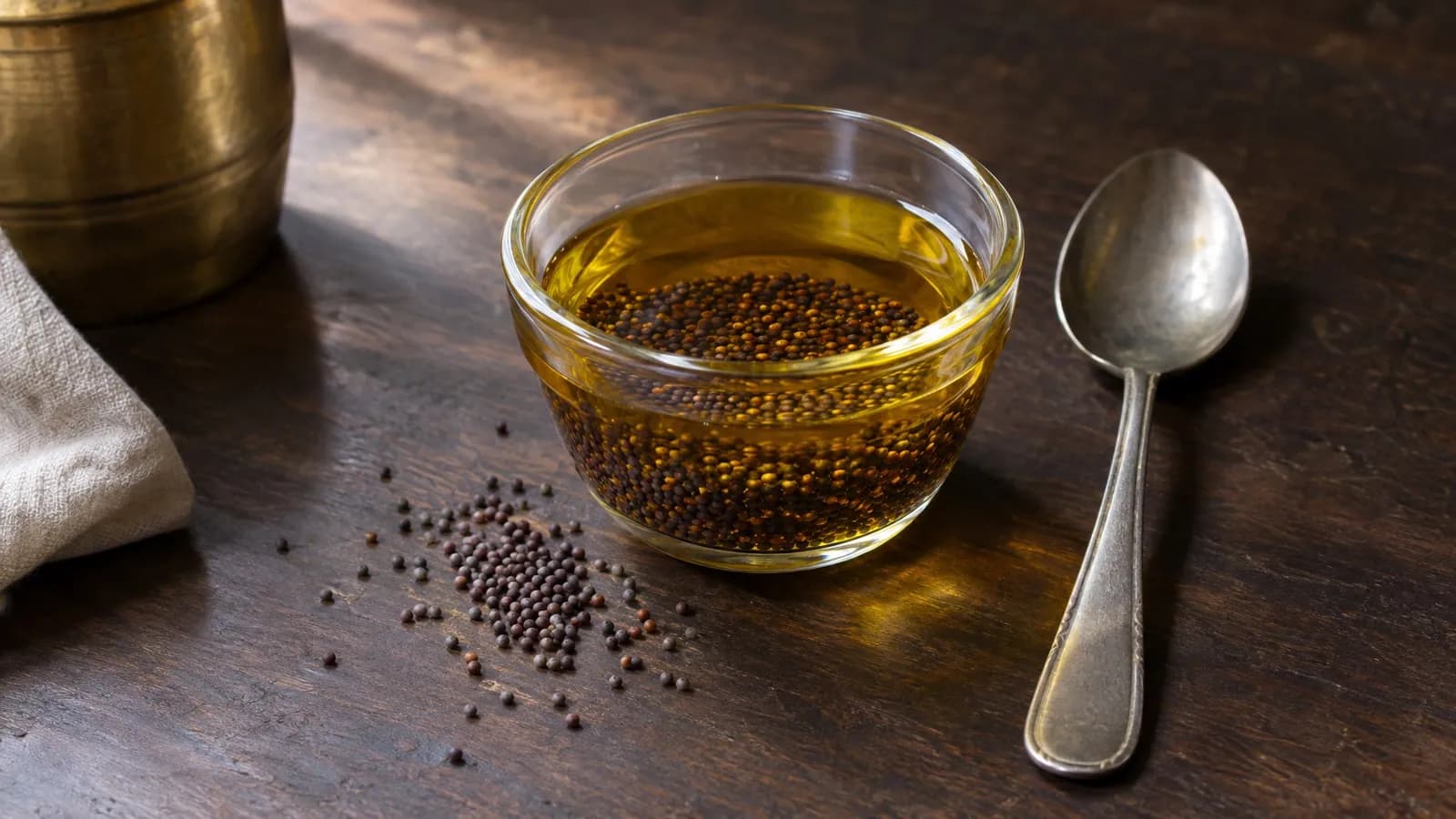
No, in the plain sense: mustard oil contains no cholesterol, because no plant food does. Does mustard oil increase cholesterol through its fat? On that, the sources are specific. A 2022 Journal of Clinical Lipidology review describes mustard oil as low in saturated fat and popular in South Asia, and records the Lipid Association of India's recommendation of it as heart-healthy; its concern is not the fat but erucic acid, a fatty acid that makes up a large proportion of mustard oil and that rodent studies link to myocardial lipidosis, the reason the US FDA bans it for cooking while Australia, New Zealand and the European Union set upper limits.
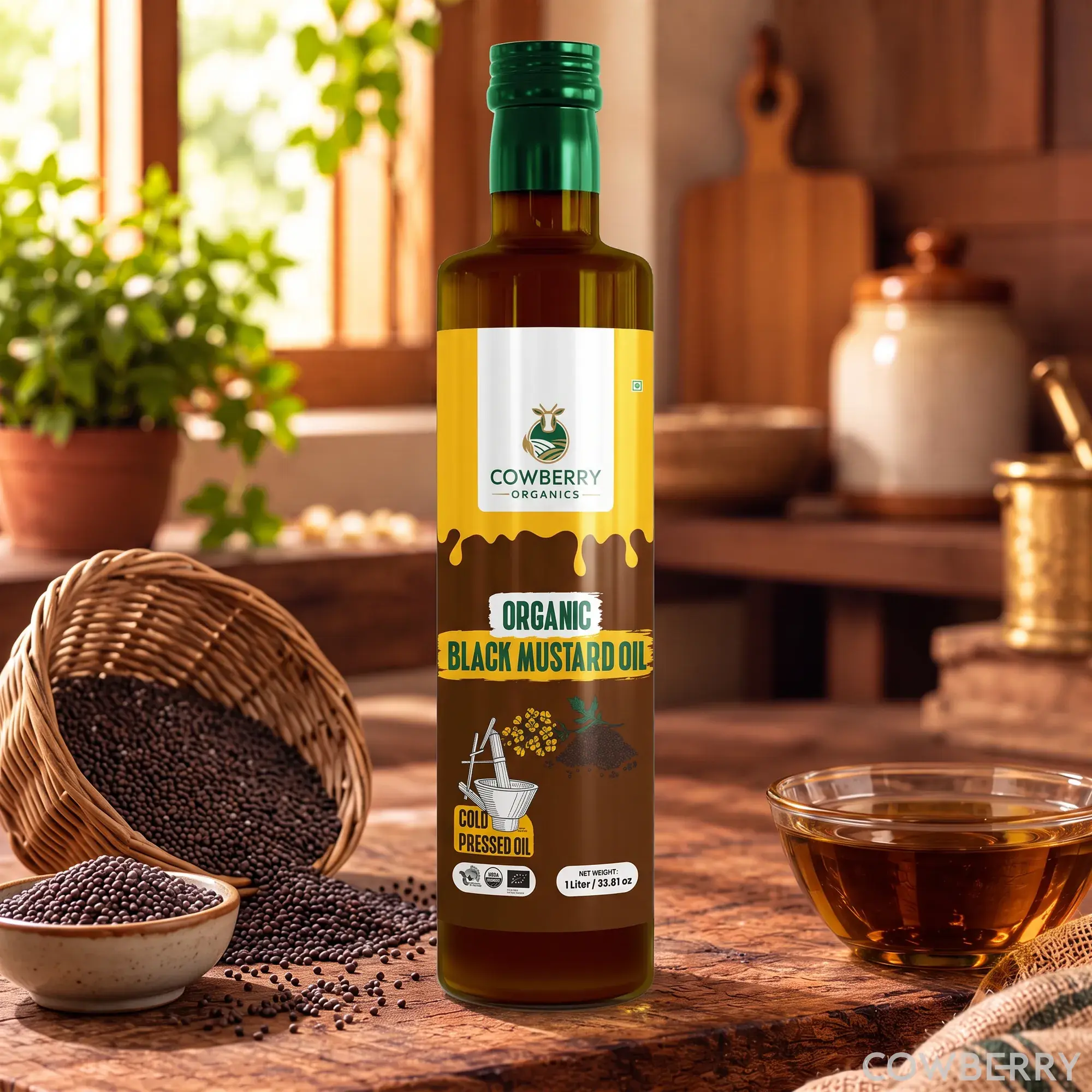
The numbers: COWBERRY's cold-pressed mustard oil pack labels 11.98 g of saturated fat per 100 g; the USDA FoodData Central entry for the same oil gives 884 kcal per 100 g with 100 g of fat. Under FSSAI's claims rules the words 'low in saturated fat' may appear only when a product carries not more than 1.5 g of saturated fat per 100 g for solids or 0.75 g per 100 ml for liquids, so even the review's description does not make the label claim. Mustard oil also supplies omega-3: the guidelines' table puts 100 mg of n-3 PUFA in 0.7 g of mustard/rapeseed oil. In a moderate amount, as part of the fat budget below, it is a reasonable everyday oil; the full picture is on the mustard oil hub.
Groundnut oil and cholesterol: what the numbers say
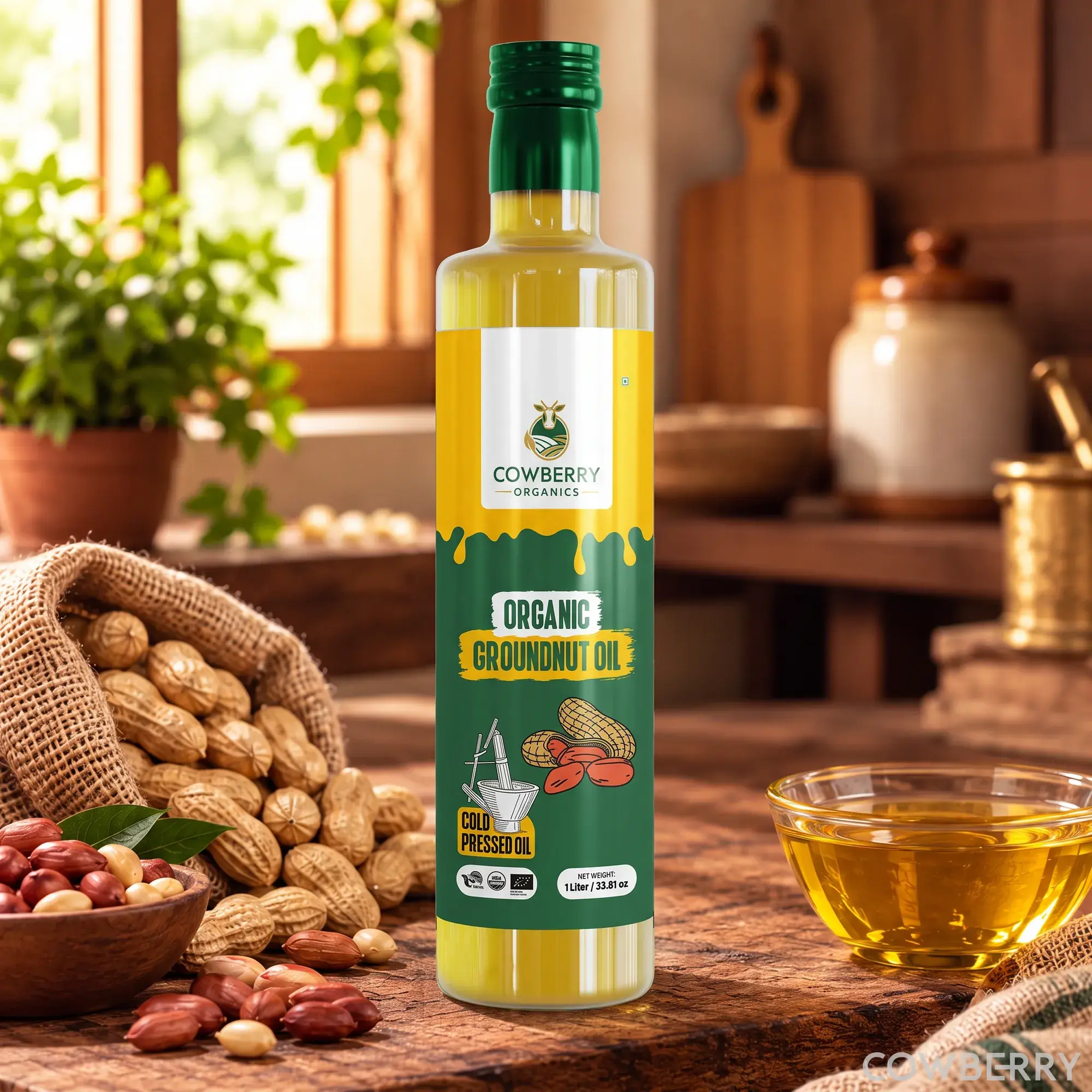
Groundnut oil is another plant oil, so it too carries no cholesterol, and its saturated fat share sits higher than mustard's: COWBERRY's cold-pressed groundnut oil pack labels 18.48 g of saturated fat per 100 g. The USDA FoodData Central entry reads 884 kcal per 100 g, all of it fat, with 0.03 mg of iron and 0.01 mg of zinc, and no carbohydrate. In spoon terms that is 44 kcal a teaspoon (5 g) and 133 kcal a tablespoon (15 g).
A 2014 review in Critical Reviews in Food Science and Nutrition describes peanut oil as carrying a well-balanced fatty acid and antioxidant profile, and links its organoleptic properties to cardioprotective and anti-inflammatory properties reported in the literature; the paper is a review of studies, not a trial, and it makes no cholesterol claim. For cholesterol, the guideline logic above applies to groundnut oil exactly as to any oil: what matters is its saturated fat, the amount used and what it replaces. The oil's own story is on the groundnut oil hub.
Indian cooking fats ranked by saturated fat
The guidelines print a twelve-fat chart drawn from IFCT 2017 data, listed in this order: coconut, ghee, palmolein, cotton seed, rice bran, groundnut, soyabean, corn, sesame, sunflower, safflower and mustard. The same chapter names ghee, butter, coconut oil and palm oil as the saturated-fat sources to limit, so the list's first entries sit among the fats the text names; mustard sits at the far end of the list. In the middle sit groundnut and soyabean, and the two COWBERRY pack labels put numbers on that middle and that end: 18.48 g of saturated fat per 100 g for groundnut oil, 11.98 g for mustard oil.
Three notes keep the ranking honest. First, neither of the two oils may use the words 'low in saturated fat' on a label under FSSAI's claims rules: the line for liquids is 0.75 g of saturated fat per 100 ml, and the two packs print 11.98 g and 18.48 g per 100 g. The same rules attach that saturated-fat line to the 'low cholesterol' and 'cholesterol free' claims, so neither oil can carry those words either, even though no plant oil contains cholesterol. Second, the guidelines credit specific oils elsewhere: components in rice bran oil and sesame oil, they note, reduce blood cholesterol. Third, WHO's swap logic makes the ranking relative: an oil with more saturated fat can still fit the day when it replaces ghee.
How much oil a day, and how to cook it
Amount matters as much as the bottle. The guidelines set the visible fat budget, cooking oil, ghee and butter together, at 20 to 50 g (4 to 10 teaspoons) a person a day, and 27 to 30 g is enough on a 2000 kcal diet; sedentary women are given 20 g and sedentary men 30 g. A teaspoon of either oil here is 44 kcal and a tablespoon 133 kcal, so the budget is quick to spend.
Then the method. The guidelines ask for sauteing, steaming, grilling, boiling or baking instead of frying, and warn against repeated heating, which oxidises polyunsaturated fats and generates harmful compounds. Oil used for frying may be filtered and used for curry preparation, but not for frying again, and it should be used up in a day or two; FSSAI's used-oil guidance sets the discard line at 25 percent total polar compounds and describes the warning signs: blue-grey smoke, tough foam, a dark murky look or changed consistency. A 2019 review in Critical Reviews in Food Science and Nutrition adds that frying oils heated again and again form polycyclic aromatic hydrocarbons, some of them reported as carcinogenic, and that the studies it collected associate heavy use with cancers of the lung, colorectum, breast and prostate. A dish that fits the gentle-cooking side: brown rice upma.
What else matters: dal, sesame and the doctor's list
Oil is not the whole answer. A 2026 meta-analysis in the Journal of the American Heart Association pooled 38 trials and found whole dietary pulses decrease LDL-cholesterol by 0.14 mmol/L and non-HDL-cholesterol by 0.22 mmol/L, with an inverse dose-response for beans up to 1 cup a day; the authors rate the certainty moderate to high. Cook a dal alongside: masoor dal dosa.
Sesame is the other common question, and the evidence there is thinner: a 2016 meta-analysis of ten controlled trials found sesame did not significantly change total, LDL or HDL-cholesterol, though it did reduce triglycerides; it concludes there is insufficient evidence to support a cholesterol-lowering claim for sesame. Ghee goes the other way, as the animal fat with the saturated fat and the cholesterol, and the guidelines limit ghee and butter to 1 to 2 teaspoons a day, or avoid them, if possible. The same chapter asks to avoid partially hydrogenated fats, vanaspati among them, and WHO's 2023 guideline keeps trans fat to no more than 1 percent of energy.
For the oils themselves, refining does not change the fatty acids, so a refined and a cold-pressed bottle of the same seed carry the same saturated fat; see cold pressed oil vs refined oil, and cold pressed oil benefits for what pressing preserves. Sunflower and soybean, the two neutral options, are compared on sunflower oil vs soybean oil. What pressing does differently is the subject of the kachi ghani meaning guide.
Talk to your doctor or dietitian
If you do not have high cholesterol, the rules above still apply in miniature: a plant oil, a moderate amount, fresh rather than reheated, and dal and vegetables doing the rest of the work on the plate.
If you have high cholesterol, diabetes, heart disease or take medicines for any of them, do not set your oil amounts from a page. The guidelines here are population advice; the amounts that fit you come from your lipid report and your doctor's or dietitian's reading of it. Talk to your doctor or dietitian about how much saturated fat fits your day, which oils to cook in, how much visible fat in total, and whether your cholesterol should be rechecked after you change oils.
FAQs
Does mustard oil increase cholesterol?
It contains no cholesterol, since plant foods have none, as the ICMR-NIN guidelines note. What matters is its saturated fat: COWBERRY's pack prints 11.98 g per 100 g, well above FSSAI's 0.75 g line for a 'low saturated fat' claim on a liquid, while 100 mg of n-3 PUFA sits in 0.7 g of the oil. In moderation it is a reasonable everyday oil; with high cholesterol, the amount is your doctor's or dietitian's call.
Is mustard oil good for diabetes and cholesterol?
Mustard oil has no carbohydrate and therefore no glycemic index value, and no cholesterol. Its saturated fat is the number to watch: 11.98 g per 100 g on the pack, and 44 kcal a teaspoon. If you have diabetes or high cholesterol, the oil choice matters less than the amount and what it replaces, and your doctor or dietitian should set both.
Is refined oil good for health?
Refined seed oil is a fine everyday choice when the amount is moderate: ICMR-NIN notes refining leaves the fatty acids untouched, so a refined oil carries the same fat split as the cold-pressed oil of the same seed. It does remove odour and small amounts of minor components, and adds preservatives. What raises cholesterol is not refining but saturated fat; more on is refined oil good for health.
Which oil is good for high cholesterol?
Any plant oil in moderation, with the lower-saturated options preferred: the guidelines' chart ends with safflower and mustard, and names coconut oil, palm oil, ghee and butter as the saturated-fat sources to limit. WHO's strong recommendation is to swap saturated fat for polyunsaturated fat. The two pack labels here read 11.98 g and 18.48 g of saturated fat per 100 g for mustard and groundnut oil.
Does groundnut oil increase cholesterol?
Groundnut oil contains no cholesterol, being a plant oil. Its saturated fat is higher than mustard's, at 18.48 g per 100 g on the pack, which is the number to weigh; a 2014 review describes its fatty acid and antioxidant profile as well balanced without making any cholesterol claim. Use it in moderate amounts, and let your doctor set the amount if your cholesterol is high.
How much oil per day is safe for high cholesterol?
ICMR-NIN prints no separate number for high cholesterol; its general budget is 20 to 50 g of visible fat a person a day, with 27 to 30 g on a 2000 kcal diet. WHO's 10 percent of energy from saturated fat is the ceiling to stay under. Talk to your doctor or dietitian for the amount that fits your lipid report.
References
- Dietary Guidelines for Indians, ICMR-National Institute of Nutrition
- Indian Food Composition Tables (IFCT) 2017, ICMR-National Institute of Nutrition
- WHO guideline: saturated fatty acid and trans-fatty acid intake for adults and children (2023)
- Poddar KH, Sikand G, Kalra D et al. Mustard oil and cardiovascular health: why the controversy? J Clin Lipidol, 2022
- Akhtar S, Khalid N, Ahmed I et al. Physicochemical characteristics, functional properties, and nutritional benefits of peanut oil: a review. Crit Rev Food Sci Nutr, 2014
- Back S, Yang S, Rossi A, et al. Effect of Different Types of Whole Dietary Pulses on Established Therapeutic Lipid Targets for Cardiovascular Risk Reduction. J Am Heart Assoc, 2026
- Khalesi S, Paukste E, Nikbakht E, et al. Sesame fractions and lipid profiles: a systematic review and meta-analysis of controlled trials. Br J Nutr, 2016
- Ganesan K, Sukalingam K, Xu B. Impact of consumption of repeatedly heated cooking oils on the incidence of various cancers- A critical review. Crit Rev Food Sci Nutr, 2019
- FSSAI Guidance Note No. 06/2018: Handling and disposal of used cooking oil (RUCO), including the 25% total polar compounds limit
- FSSAI Food Safety and Standards (Advertising and Claims) Regulations 2018, compendium (PDF)
- USDA FoodData Central (SR Legacy): Oil, mustard, FDC ID 172337
- USDA FoodData Central (SR Legacy): Oil, peanut, salad or cooking, FDC ID 171410
Shop this article
Keep reading
Cold pressed oil benefits: why they survive processing better
Mustard oil vs refined oil: nutrition, cooking and which to choose
Mustard oil omega 3: nutrition, calories and fat per 100g