by COWBERRY

9 minute read
Cold-pressed oil vs refined oil: how each is made and which to use

Cold pressed oil vs refined oil is a difference of process, not of fat: ICMR-NIN's Dietary Guidelines for Indians note that refining does not alter an oil's fatty acid composition, only its minor components. Cold-pressed (kachi ghani) oil is pressed without heat and keeps its flavour and antioxidants. Refined oil is cleaned with chemicals, keeps longer and tastes neutral. Here is how each is made and which to use.
Cold pressed vs refined oil: the verdict in three lines
- Same fat, same calories. Refining leaves the fatty acids of an oil as they were, according to ICMR-NIN. Our reference figures put both mustard oil and groundnut oil at 884 kcal per 100 g, and that figure does not depend on how the oil was extracted.
- Different minor components. Cold pressing preserves antioxidants and phytonutrients, which also carry much of the natural flavour. Refining takes away odour, a small part of those components and the unwanted compounds of crude oil, and it brings in additives, preservatives among them.
- Which to use. Pick cold-pressed oil for flavour and for an oil that has been through less processing, from a seller you trust. Pick refined oil when you need a neutral taste and long keeping. Use either in moderation.
How each is made: kachi ghani vs cold pressed vs refined
Cold-pressed and kachi ghani
Kachi ghani vs cold pressed is a question of language, not of method. ICMR-NIN's guidelines give kachi ghani tel as the Indian name for cold-pressed oil and define it as oil obtained by mechanical procedures, that is expeller pressing, without the application of heat. The ghani is the traditional press.
A 2023 study in the journal Foods shows what a press produces. Its authors pressed 200 g batches of six oilseeds (sesame, pumpkin, flax, milk thistle, hemp and cumin) and measured the oil, the seedcake and the sediment. Sesame gave the highest oil yield and cumin the lowest, and the sediment in the oil decreased over longer storage. Sediment, in other words, is part of what a press gives, alongside the oil and the seedcake.
Virgin oil
The guidelines use the word virgin for oil that is also pressed mechanically, but with the application of heat.
Refined oil
Refining starts with crude oil, which ICMR-NIN describes as oil extracted from seeds by mechanical expelling. Crude oil carries compounds nobody wants in the kitchen, and the guidelines list free fatty acids, gums, waxes, pesticide residues, aflatoxins and allergens among them. It is therefore put through a series of refining steps that use chemicals to remove those compounds. Refining also removes the oil's odour and extends its shelf life, the guidelines add.
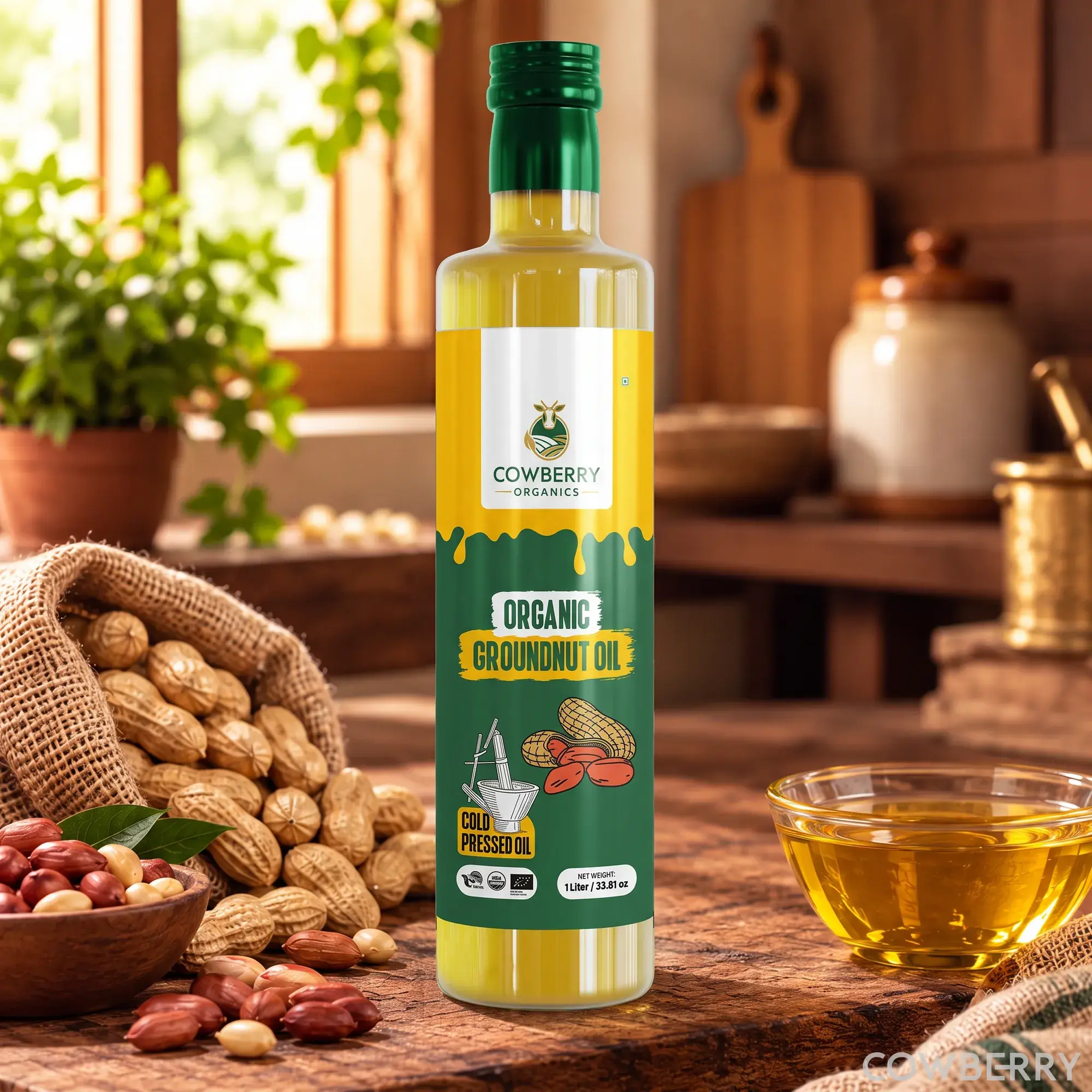
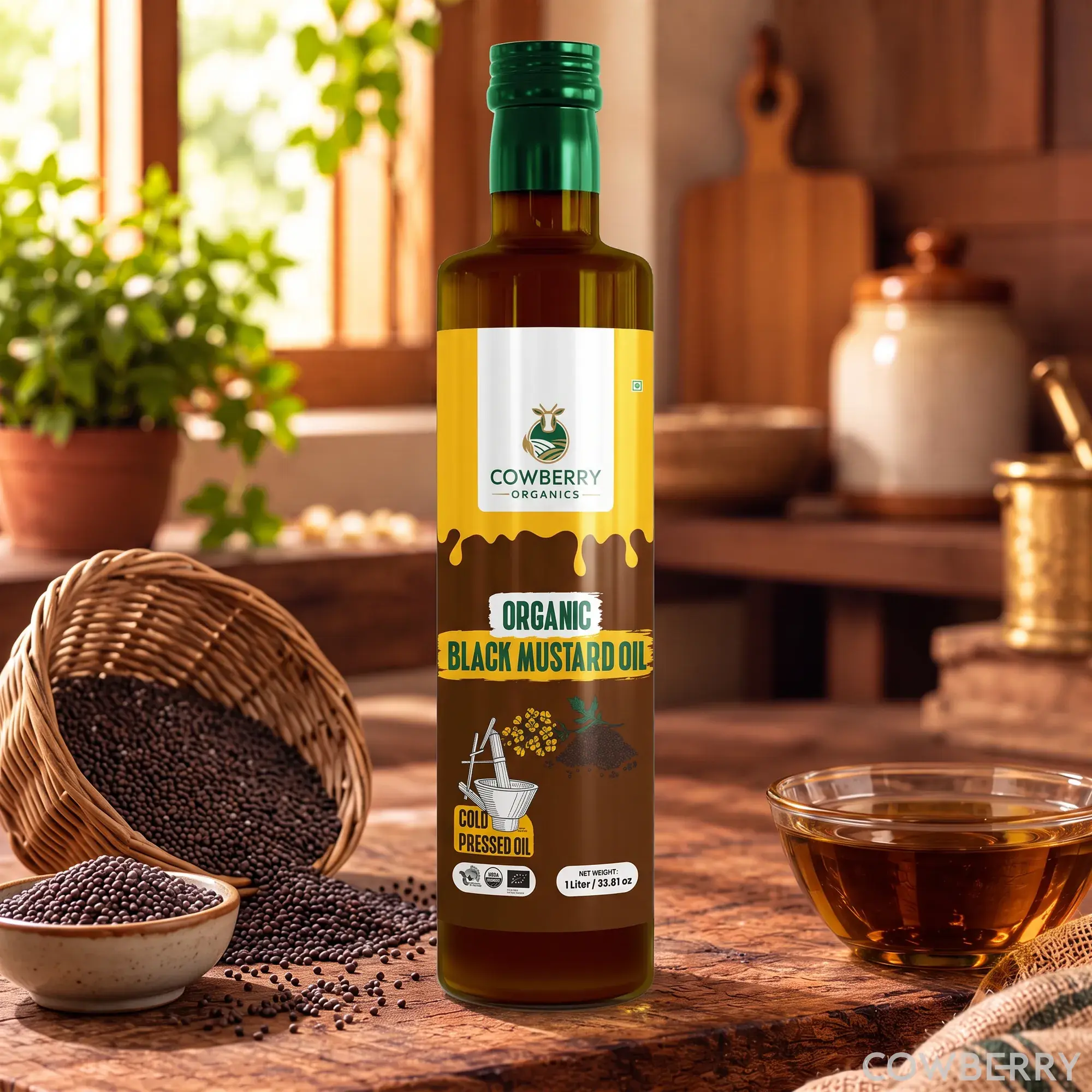
COWBERRY's oils sit on the first side of this line. Its cold-pressed groundnut oil comes from groundnuts that are sun-dried and then pressed, and its cold-pressed mustard oil is pressed slowly, both without heat or chemicals.
What changes: flavour, colour, antioxidants and heat
Flavour and aroma
The natural flavour of an oil comes largely from its minor components, such as tocopherols and sterols, ICMR-NIN explains. Cold pressing leaves them in, so the oil tastes of its seed: COWBERRY's product facts describe a strong aroma in its mustard oil and a nutty aroma in its groundnut oil. A refined oil, with its odour removed, tastes of very little.
Colour
Refining can change colour too. The guidelines give the example of crude palm oil: the pulp of the palm fruit is red because it is rich in beta carotene, and these carotenes are lost when the oil is refined. COWBERRY's product facts describe its cold-pressed mustard oil as keeping its deep colour and its groundnut oil as rich golden.
Natural antioxidants
Most of the minor components are antioxidants, and they help keep a fat from going rancid. Refining removes small amounts of antioxidants and phytosterols; in cold-pressed oil, the guidelines say, antioxidants and phytonutrients are preserved.
Fatty acids
These do not change. The split between saturated, monounsaturated and polyunsaturated fat belongs to the seed, not to the process.
What refining removes and adds
Refining clears out the undesirable compounds of crude oil, and ICMR-NIN is plain that cold-pressed oils can still contain them. It also says that the refining process adds several additives, including preservatives.
Smoke and heat
None of the sources we cite prints a smoke-point temperature, so we quote none. COWBERRY's product facts describe both of its cold-pressed oils as having a high smoke point and as suited to frying and sauteing. For every oil, the guidelines warn that repeated heating oxidises polyunsaturated fat and generates harmful compounds.
Difference between cold pressed and refined oil, side by side
| Point | Cold-pressed (kachi ghani) oil | Refined oil |
|---|---|---|
| Extraction | Mechanical pressing in a ghani or expeller, without heat | Extraction, then a series of refining steps |
| Chemicals | None | Used in refining |
| Flavour and smell | Of the seed: pungent mustard, nutty groundnut | Neutral; odour removed |
| Antioxidants and phytosterols | Preserved | Small amounts removed |
| Fatty acid composition | As in the seed | Not altered by refining |
| Undesirable compounds of crude oil | May remain | Removed |
| Additives | None in COWBERRY's oils | Several, including preservatives |
| Shelf life | Shorter | Extended |
| Calories | The same | The same |
The printed values for the two oils COWBERRY cold-presses are in the table that follows. They are identical on energy and fat, 884 kcal and 100 g fat per 100 g, because every oil is pure fat. What differs between a cold-pressed and a refined bottle is what travels with that fat.
| Nutrient | Groundnut oil | Mustard oil |
|---|---|---|
| Energy (kcal) | 884 | 884 |
| Protein (g) | 0 | 0 |
| Fat (g) | 100 | 100 |
| Carbohydrates (g) | 0 | 0 |
| Dietary fibre (g) | 0 | 0 |
| Iron (mg) | 0 | 0 |
| Calcium (mg) | 0 | 0 |
| Magnesium (mg) | 0 | 0 |
| Potassium (mg) | 0 | 0 |
| Sodium (mg) | 0 | 0 |
| Zinc (mg) | 0 | 0 |
| Folate (mcg) | 0 | 0 |
| Vitamin C (mg) | 0 | 0 |
Per 100 g raw, edible portion. Composition: USDA FoodData Central (SR Legacy), FDC ID 171410, NDB 4042; USDA FoodData Central (SR Legacy), FDC ID 172337, NDB 4583. — means not reported. These are average values for the food; the label on a pack gives the values for that product.
Is refined oil good for health? Is cold pressed oil good?
Is refined oil good for health? It is not the villain it is often made out to be, and it is not a health food either. Refining is what makes crude oil suitable for human consumption, ICMR-NIN says, and it leaves the fatty acids untouched. The same guidelines ask for moderation with every extracted seed oil, refined ones included. The fat to avoid outright is a different one: trans fat, which forms when liquid oils are hydrogenated into vanaspati.
Cold pressed oil benefits. A cold-pressed oil keeps its antioxidants, phytonutrients and flavour, and COWBERRY's oils carry no additives or preservatives. The honest caveat is that nothing has been removed either, so the quality of the seed and the care taken at the press decide the quality of the oil.
What matters more than the process. First, the amount: the guidelines limit visible fat, which means all cooking oil, ghee and butter, to 20 to 50 g per person a day depending on energy needs. Second, the type of fat: WHO's 2023 guideline recommends replacing saturated fat with polyunsaturated fat or with monounsaturated fat from plant sources. Third, the way you heat it: do not fry again in oil that has already been used for frying.
Cost and where each fits
Cold-pressed oil usually costs more than refined oil of the same seed, for reasons that follow from the process. A press leaves part of the oil behind in the seedcake, and the oil is sold without the refining that extends shelf life. Refined oil keeps longer and is the economical choice when oil is used in quantity.
- Cold-pressed mustard oil: pickles, fish, saag and tadka, where its pungency is the point.
- Cold-pressed groundnut oil: everyday sauteing, frying and snacks such as poha chivda and besan chilla, where a mild nutty note is welcome.
- Refined oil: large-batch deep frying and baking, where the oil should not be tasted.
Store cold-pressed oil closed, in a cool, dark and dry place, and buy a pack size you will use up while the oil is fresh. Ghee has its own place in the kitchen and in the same fat budget; see ghee vs oil.
Which oil for whom
- You cook for flavour: cold-pressed oil. Read mustard oil vs sunflower oil and cold pressed groundnut oil benefits before you choose.
- You deep-fry often and in large batches: refined oil is the economical option. With either kind, used frying oil should not go back into the kadhai for another round of frying.
- Someone at home has a peanut or mustard allergy: ICMR-NIN lists allergens among the compounds that unrefined oils can carry, and advises people with an allergy to avoid food products that include the ingredient. Before cooking with any oil from that seed, talk to your doctor or dietitian.
- You want fewer additives: cold-pressed oil.
- You cook with ghee as well: the guidelines keep ghee or butter to 1 to 2 teaspoons a day. Our guide to bilona ghee covers how it is made.
Many kitchens settle on two bottles: one cold-pressed oil for daily cooking and flavour, and one neutral oil for the occasional big fry.
FAQs
Is refined oil good for health?
Refined oil is suitable for cooking but is best used in moderation. ICMR-NIN notes that refining removes the undesirable compounds of crude oil without altering its fatty acids, while also removing small amounts of antioxidants and adding additives, including preservatives. The fat to avoid is trans fat from hydrogenated oils such as vanaspati.
Difference between cold pressed and refined oil?
Cold-pressed oil is pressed from the seed mechanically, without heat, and sold with its colour, smell and antioxidants intact. Refined oil is processed with chemicals to remove unwanted compounds; the refining also takes away odour and extends shelf life. The fatty acids and the calories are the same in both: 884 kcal per 100 g for mustard and groundnut oil.
Is cold pressed oil good for cooking?
Yes. Cold-pressed mustard and groundnut oil are everyday cooking oils in Indian kitchens, used for tadka, sauteing and frying, and COWBERRY's product facts describe both as having a high smoke point. Do not reuse frying oil for another round of frying, and store the bottle away from heat and light.
What is cold pressed mustard oil?
Cold pressed mustard oil is kachi ghani sarson ka tel: oil pressed mechanically from mustard seed without the application of heat. Because nothing is refined out, it holds on to its smell; ICMR-NIN notes that refining removes odour. COWBERRY's version comes from Rajasthan and Bengal seed, pressed slowly with no heat or chemicals, and is described in its product facts as deep in colour with a strong aroma.
Why is cold pressed oil better?
It is better on flavour and on what it retains: ICMR-NIN notes that antioxidants and phytonutrients are preserved when oil is pressed without heat. It is not lower in calories or fat. And because nothing is removed, it can carry the unwanted compounds of crude oil, so the seed and the seller matter.
Kachi ghani vs cold pressed: is there a difference?
No. Kachi ghani is the Indian term and cold-pressed the English one; ICMR-NIN's guidelines use them for the same oil, pressed mechanically without heat. Ghani refers to the traditional press. Oil pressed with heat is what the guidelines call virgin oil, and oil cleaned with chemicals is refined oil.
References
- Dietary Guidelines for Indians, ICMR-National Institute of Nutrition
- Kabutey A, Herak D, Mizera C et al. Assessment of quality and efficiency of cold-pressed oil from selected oilseeds. Foods, 2023
- WHO guideline: saturated fatty acid and trans-fatty acid intake for adults and children (2023)
- USDA FoodData Central
Shop this article
Keep reading
Cold pressed oil benefits: why they survive processing better
Mustard oil vs refined oil: nutrition, cooking and which to choose
Mustard oil omega 3: nutrition, calories and fat per 100g